Sous Vide vs Instant Pot: Which Should You Buy? (2026)

What’s in this guide
- What Is Sous Vide? A Beginner's Guide
- What Is the Instant Pot? The All-in-One Appliance Explained
- Sous Vide vs. Instant Pot: Feature-by-Feature Comparison
- Which Cooks Better? Food Showdowns by Category
- Can the Instant Pot Actually Do Real Sous Vide?
- Anova vs. Joule vs. Instant Pot: Which Sous Vide Setup Is Right for You?
- What Real Cooks Say: Community Verdicts
- Instant Pot vs. Crock-Pot: A Quick Clarification
- Common Pitfalls and Limitations
- Our Testing Methodology
- Frequently Asked Questions
- Final Recommendation: Which One Should You Buy?
Quick Verdict
Choose sous vide if texture and precision matter most — it produces restaurant-quality proteins every time, especially steak and chicken breast.
Choose the Instant Pot if speed and convenience are your priority — it handles entire meals, from pot roast to rice, in a fraction of the traditional time.
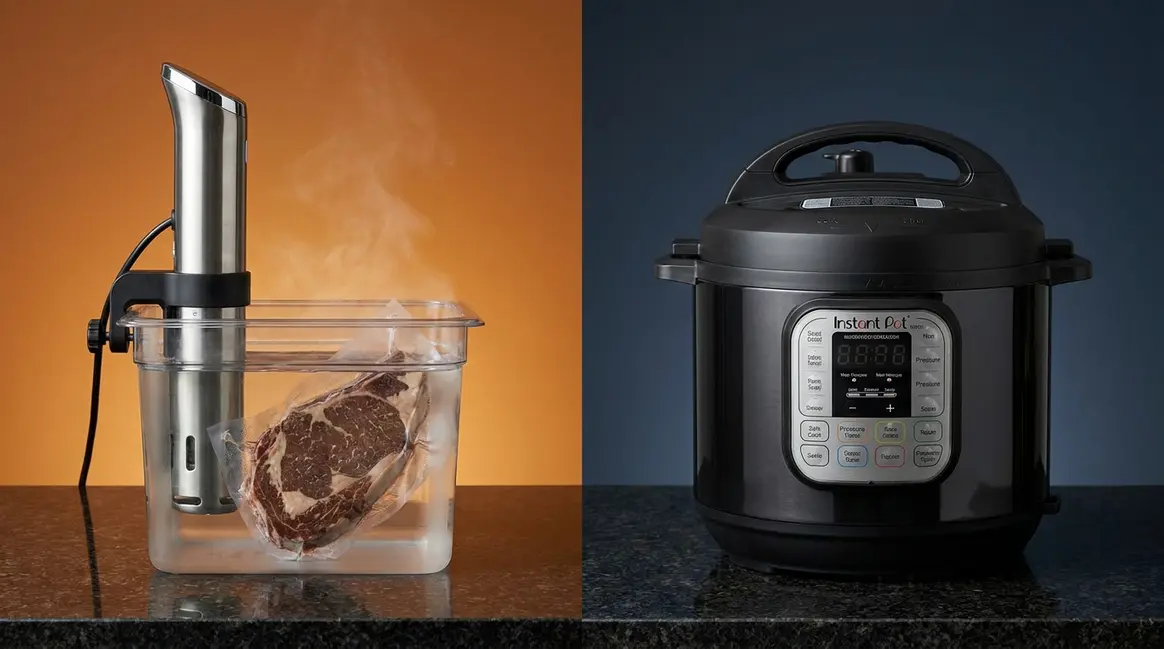
Key difference: Sous vide cooks food slowly in a temperature-controlled water bath for perfect texture; the Instant Pot uses pressurized steam to cook food fast.
Full feature-by-feature breakdown, food results, and a decision flowchart below.
You’re standing in a kitchen store — or scrolling Amazon at midnight — staring at two appliances you’ve seen all over social media. One promises restaurant-quality steak at home. The other promises a pot roast in under an hour. Both sound incredible. Neither comes with a simple explanation of which one is actually right for you.
Here’s what nobody tells you up front: buying the wrong one is a real risk. The sous vide vs. instant pot debate trips up thousands of home cooks every year. Pick the wrong appliance and you either end up with rubbery chicken that looked perfect on YouTube, or a $100 gadget buried at the back of your cabinet after three uses. Both failure modes are common — and completely avoidable.
By the end of this guide, you’ll know exactly which appliance fits your cooking style — and which one you can skip. We’ll cover how each works, where each excels in real cooking scenarios, the Instant Pot’s built-in sous vide mode (a feature most comparison articles completely ignore), and a clear decision framework based on your actual goals.
What Is Sous Vide? A Beginner’s Guide
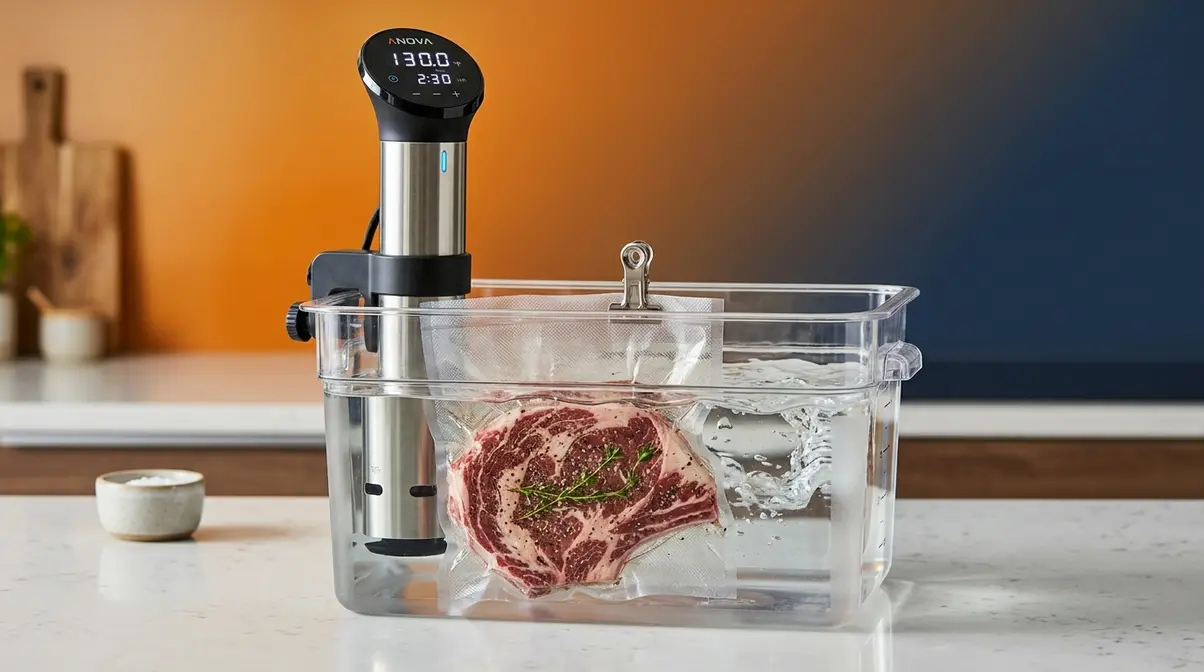
Picture this: you pull a steak off the stovetop after 12 minutes of pan cooking. The outside looks perfect — golden crust, nice sear. Then you slice it and find a thick gray band running around the entire edge, with only a thin strip of pink in the center. That gray band is the result of uneven heat. The outside overcooked while the inside tried to catch up. Sous vide eliminates this problem entirely.
Sous vide (pronounced “soo veed”) is a cooking technique — not a brand — where food is sealed in a bag and cooked in a temperature-controlled water bath. The term means “under vacuum” in French, though you don’t actually need a professional vacuum sealer to use it. The result: proteins that are perfectly cooked edge to edge, with no gray bands on a steak and no dry, chalky chicken breast. Think of it like a perfectly calibrated hot tub for your food — the water stays at exactly the temperature you set, and your food slowly reaches that same temperature without ever going past it.
This precision is the core advantage. According to the National Institutes of Health, professional chefs utilize sous vide techniques at 50–65°C (122–149°F) to preserve both sensory quality and nutritional content (NIH, 2022). That temperature range — lower than most stovetop cooking — is precisely why sous vide produces textures that other methods can’t replicate. The food never overcooks because the water never gets hotter than your target temperature.
This is The Cook’s Intent Rule in its clearest form: sous vide is the precision-intent tool. You reach for it when the goal is excellence, not speed. Comparing sous vide vs. instant pot at their core, you’re really comparing a method designed for perfection against a method designed for efficiency.
What Equipment Do You Actually Need for Sous Vide?
The equipment list is shorter than most beginners expect — and the startup cost is comparable to an entry-level Instant Pot.
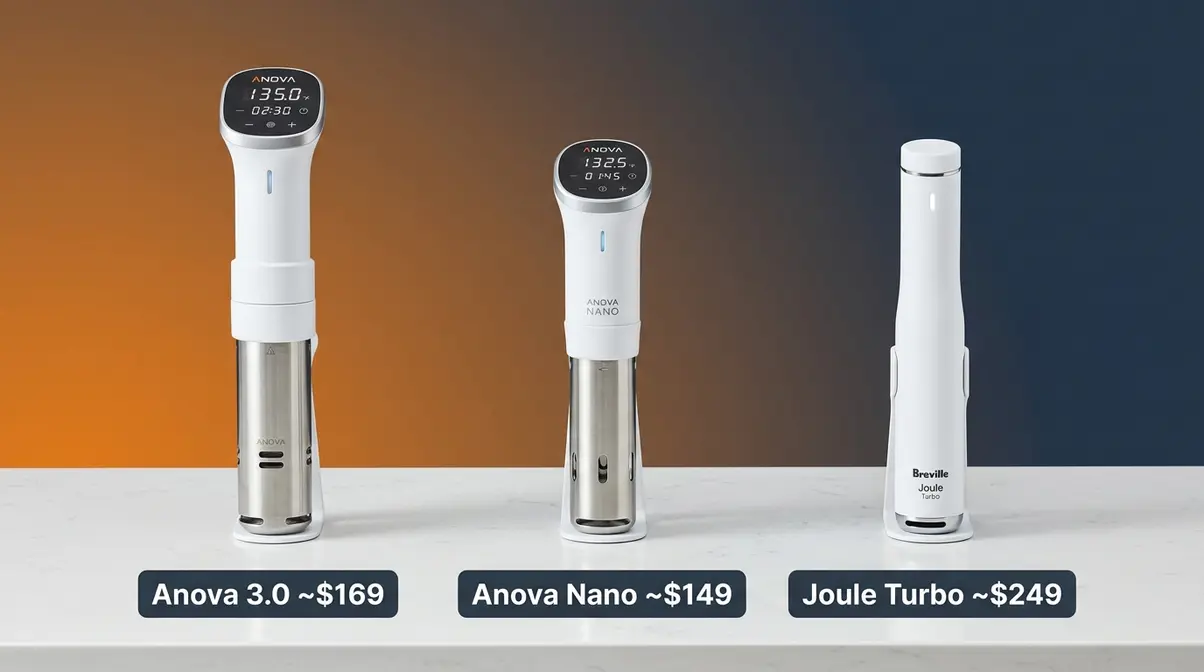
The immersion circulator is the only specialized piece of gear. It’s a wand-shaped device that clips onto the side of your water container, heats the water to a precise temperature, and keeps it circulating so heat stays even throughout. The two most popular options for beginners are the Anova Precision Cooker 3.0 (regular price $229, frequently on sale around $169 as of July 2026) and the Breville Joule Turbo ($249.95). Both are reliable, app-connected, and suitable for home cooking. For a more budget-friendly start, the Anova Nano 3.0 lists at $149.
The container is simply a large pot or dedicated polycarbonate container — a 12-quart Rubbermaid works well. Interestingly, the Instant Pot’s stainless steel inner pot can double as a sous vide water container, which foreshadows the next section of this guide.
The bags are where most beginners overthink it. A vacuum sealer is ideal but absolutely not required. Heavy-duty zip-lock bags work perfectly for most foods using the water-displacement method: you lower the open bag slowly into water until the pressure pushes all the air out, then seal it just above the waterline.
For a beginner setup — an Anova Nano circulator, a large stockpot, and zip-lock bags — you’re looking at roughly $80–$100 total. That’s roughly the same as an entry-level Instant Pot Duo, which makes the sous vide cooker vs. instant pot cost comparison much closer than most people assume.
Where Does Sous Vide Excel? The Best Foods to Cook
Sous vide changes the game for making proteins with consistent, precise results. Three foods stand out above all others.
Steak is the most celebrated use case. Cook a ribeye or strip at 130°F (54°C) for 1–2 hours, then sear in a cast-iron pan for 60–90 seconds per side. The result is edge-to-edge medium-rare — no gray bands, no guesswork. The sear happens so quickly that the interior temperature barely rises, giving you the crust and the doneness simultaneously.
Chicken breast may be the most practically useful application. Cooking at 140°F (60°C) for 1–2 hours produces chicken that is genuinely juicy — not the dry, stringy texture most home cooks have accepted as normal. The NIH review of sous vide processing confirms that controlled low-temperature cooking preserves sensory and nutritional quality in poultry at levels that conventional high-heat cooking cannot match (National Institutes of Health, 2022). For anyone who has ever overcooked a chicken breast, this result feels almost miraculous — though the science behind it is straightforward.
Eggs cooked sous vide at 63°C (145°F) for one hour produce a custard-like yolk texture that no other cooking method can replicate. The white sets just enough while the yolk stays silky and jammy.
Where sous vide struggles: anything that needs a crispy exterior. Fried chicken, roasted vegetables, and anything meant to have crunch cannot brown in a water bath — the moisture prevents the Maillard reaction that creates that golden exterior. The fix for steak and chicken is simple: a quick sear in a cast-iron pan after cooking. For other foods, sous vide is simply not the right tool.
The Instant Pot takes a completely different approach to the same goal: great food, faster.
What Is the Instant Pot? The All-in-One Appliance Explained
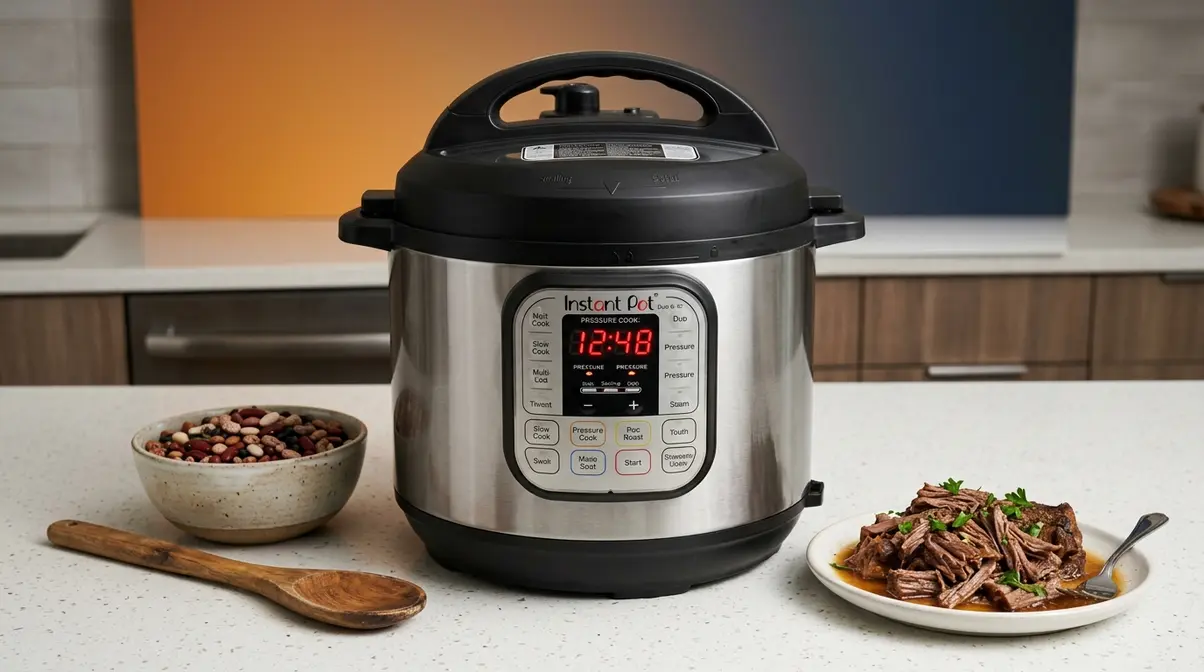
The Instant Pot is a multi-cooker — a single appliance that combines a pressure cooker, slow cooker, rice cooker, yogurt maker, and steamer. Its key advantage is speed: a pot roast that takes 4 hours in a traditional oven is done in under an hour in an Instant Pot. For the instant pot vs. sous vide comparison, this speed difference is the single most important factor for most weeknight cooks.
Pressure cooking is the Instant Pot’s primary cooking method. Think of it as a sealed pot where steam pressure raises the boiling point of water from 212°F to around 240°F — food cooks faster because it’s hotter. The lid locks, steam builds up inside the sealed inner pot, and the increased pressure accelerates cooking dramatically. Unlike sous vide’s gentle, patient approach, the Instant Pot uses aggressive heat to get dinner on the table quickly.
The best-selling model is the Instant Pot Duo 6-quart, which typically lists around $99–$130 on Amazon, with frequent sale pricing dropping it to $70–$80 as of July 2026. The Duo Plus 9-in-1 — which adds the sous vide function covered later in this guide — typically runs $130–$140, with recent deals bringing it to around $80.
What Does the Instant Pot Do Best? Top Foods and Use Cases
The Instant Pot’s strongest use cases are tough cuts and one-pot meals — exactly where sous vide is weakest.
Tough cuts and braises are where this appliance genuinely shines. Pot roast, brisket, short ribs, and chuck roast — foods built for shreddable textures — go from raw to fork-tender in 60–90 minutes. The same results in a slow cooker take 6–8 hours. For entire meals — dump ingredients in, seal the lid, and come back to a finished dish — the Instant Pot has no real competition. This is where sous vide simply cannot compete; it lacks the ability to cook starches, vegetables, and proteins together in one vessel.
Beans, rice, and soups represent the Instant Pot’s strongest weeknight use case. Dried beans from scratch cook in 30 minutes. Rice is done in 12 minutes. Lentil soup goes from raw ingredients to table in under 25 minutes. For anyone who meal preps, these time savings accumulate dramatically across a week.
Yogurt is a surprisingly good use case that creates an interesting overlap with sous vide. The Instant Pot’s Yogurt setting maintains a precise low temperature — similar to sous vide’s temperature-control strength — making homemade yogurt genuinely easy. It’s one of the rare moments where the Instant Pot operates as a precision tool rather than a speed tool, and worth mentioning for the instant pot vs. crock pot comparison, since a standard slow cooker cannot make yogurt at all.
Is the Instant Pot Still Worth Buying in 2026?
This question deserves a direct answer, because the headlines have been alarming.
The Wall Street Journal reported that Instant Brands filed for bankruptcy protection in June 2023 after slower sales and mounting financial challenges. Separately, NPD Group data cited by The Atlantic showed multi-cooker sales dropped 50% between 2020 and 2022 — a sharp decline that reflects post-pandemic normalization more than product failure.
The brand has continued operating under new ownership. Instant Pots are still manufactured, sold, and supported. The Duo and Duo Plus models remain widely available at Amazon, Target, and Walmart. Replacement parts and accessories are in stock. The 30+ million global users of this appliance haven’t abandoned it — the boom simply peaked.
The short answer: yes, buying an Instant Pot in 2026 is still a solid choice for the right use cases — as long as you know what those use cases are. That’s exactly what the next section covers.
Now that both appliances are defined, here’s how they stack up across every dimension that matters to a home cook.
Sous Vide vs. Instant Pot: Feature-by-Feature Comparison
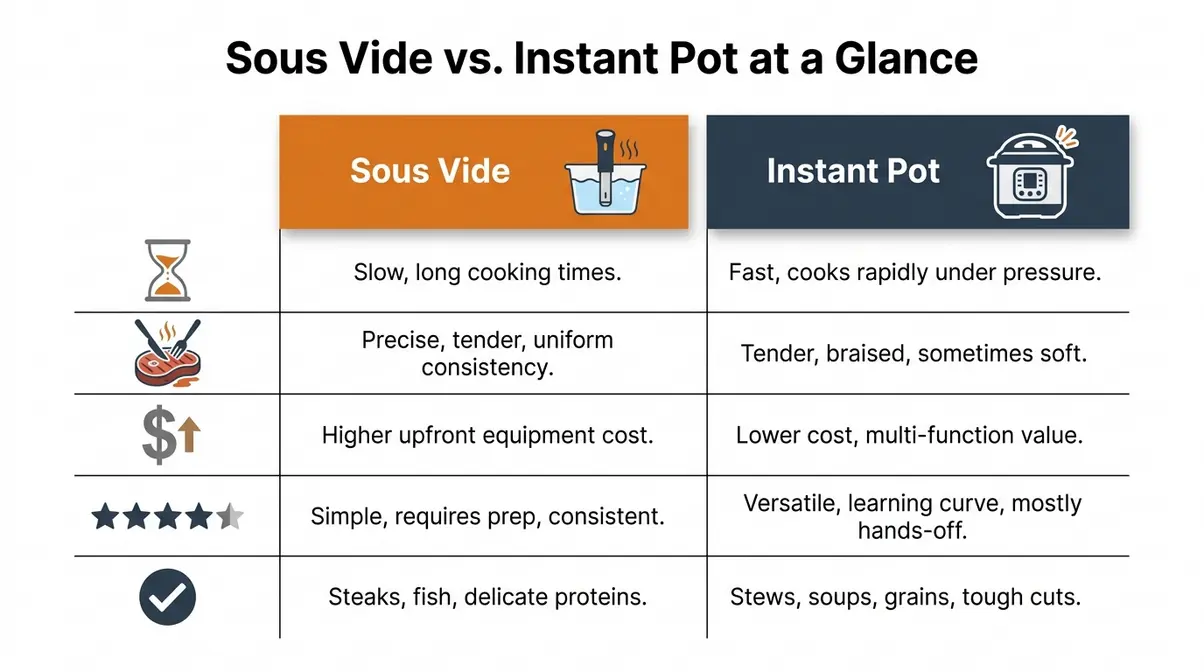
The main difference between sous vide and Instant Pot is precision vs. speed. Sous vide holds water at an exact temperature for hours, producing perfectly textured proteins. The Instant Pot uses high-pressure steam to cook food fast — ideal for entire meals, but not for the edge-to-edge precision that sous vide delivers.
| Feature | Sous Vide | Instant Pot |
|---|---|---|
| Cooking Method | Temperature-controlled water bath | Pressurized steam (primarily) |
| Temperature Precision | ±0.1°C — exact control | Fixed ~240°F under pressure |
| Active Cooking Time | 1–4+ hours (hands-off) | 10–60 minutes (hands-off) |
| Best For | Steak, chicken breast, eggs, fish | Pot roast, beans, rice, soups |
| Texture Outcome | Precise, edge-to-edge doneness | Tender/shreddable; less precise |
| Ease of Use | Moderate (requires setup + sear) | Easy (one-pot, press and go) |
| Entry-Level Cost | ~$80–$149 (Anova Nano) | ~$70–$100 (Instant Pot Duo) |
| Countertop Footprint | Small (wand clips to any pot) | Medium (dedicated appliance) |
| Multi-Food Cooking | No (proteins only, primarily) | Yes (complete one-pot meals) |
| Built-in Sous Vide Mode | N/A — it IS sous vide | Select models only (Duo Plus, Max, Duo Crisp) |
Temperature Precision: Winner — Sous Vide
Temperature precision is the single most important criterion for protein cooking. Sous vide maintains water temperature within ±0.1°C (±0.2°F) of the target, while the Instant Pot’s temperature during pressure cooking is fixed by physics at approximately 240°F — precise for speed, not for texture control.
Why does this matter? The difference between a medium-rare steak (130°F/54°C) and a medium steak (140°F/60°C) is just 10 degrees. At those margins, a 15°F temperature swing — which is normal for the Instant Pot’s heating cycle — means the difference between the steak you wanted and the steak you got. Research confirms that sous vide temperatures of 50–65°C are critical for controlling the texture of proteins, with even small variations producing measurable differences in tenderness and juiciness (National Institutes of Health, 2022).
Winner: Sous vide — for any food where doneness precision matters.
Cooking Speed: Winner — Instant Pot
Speed isn’t even close. The Instant Pot wins decisively for any food that benefits from high-heat pressure cooking. Dried beans: 30 minutes vs. 90 minutes on the stovetop. Pot roast: 60 minutes vs. 4+ hours in the oven. Rice: 12 minutes vs. 20 minutes on the stove.
Sous vide requires patience by design. A chicken breast takes 1–2 hours. A thick steak takes 1–4 hours. A beef short rib cooked sous vide to tender perfection takes 48–72 hours. The tradeoff is mostly hands-off time — you’re not standing at the stove — but if you need dinner in under an hour, the Instant Pot is the only realistic choice.
Winner: Instant Pot — for weeknight cooking where time is the constraint.
Texture Results: Winner — Sous Vide (for proteins)
This is where the comparison gets nuanced. For proteins — steak, chicken breast, fish, pork tenderloin — sous vide produces consistently superior results. Research from multiple NIH-indexed studies confirms that sous vide cooking produces better sensory characteristics in beef, pork, and poultry, with significantly higher tenderness and juiciness scores compared to conventional cooking methods (National Institutes of Health, 2022).
For braised meats — pot roast, short ribs, pulled pork — the Instant Pot produces excellent results. These cuts need collagen breakdown and moisture, not precision temperature control. The pressure cooking environment is ideal.
Winner: Sous vide for precision proteins. Instant Pot for braises and tough cuts.
Ease of Use: Winner — Instant Pot
The Instant Pot wins on simplicity. Add ingredients, seal the lid, press a button, walk away. There’s no additional searing step, no managing a water bath, no clipping a wand to a container. For cooks who want minimal steps between raw ingredients and a finished dinner, the Instant Pot is the more approachable tool.
Sous vide has a moderate learning curve. You need to understand bag sealing (and how to use the water-displacement method if you don’t own a vacuum sealer), set up the water bath, manage cooking times, and then finish the protein with a quick sear. None of these steps are difficult, but there are more of them.
Winner: Instant Pot — for beginners who want the lowest-friction path to a good meal.
Versatility: Winner — Instant Pot
The Instant Pot replaces multiple appliances: slow cooker, rice cooker, steamer, yogurt maker, and more. It handles complete meals — proteins, starches, and vegetables together. Sous vide handles one category exceptionally well (proteins) but cannot cook rice, beans, soups, or stews.
Winner: Instant Pot — for households that want one appliance to do many jobs.
“As a general rule, I like to use an Instant Pot when the goal is speed and convenience, and to sous vide when the goal is excellence or perfection.”
— Community consensus from r/sousvide and r/Cooking, aggregated from multiple threads
This is The Cook’s Intent Rule in action: choose based on your goal, not the appliance’s feature count. If you’re cooking steak on a Saturday with time to spare, sous vide. If you need dinner on a Tuesday in 45 minutes, Instant Pot.
Which Cooks Better? Food Showdowns by Category
The abstract comparison only tells part of the story. Here’s what actually happens when you cook the same foods in both appliances.
Steak: Sous Vide Wins Clearly
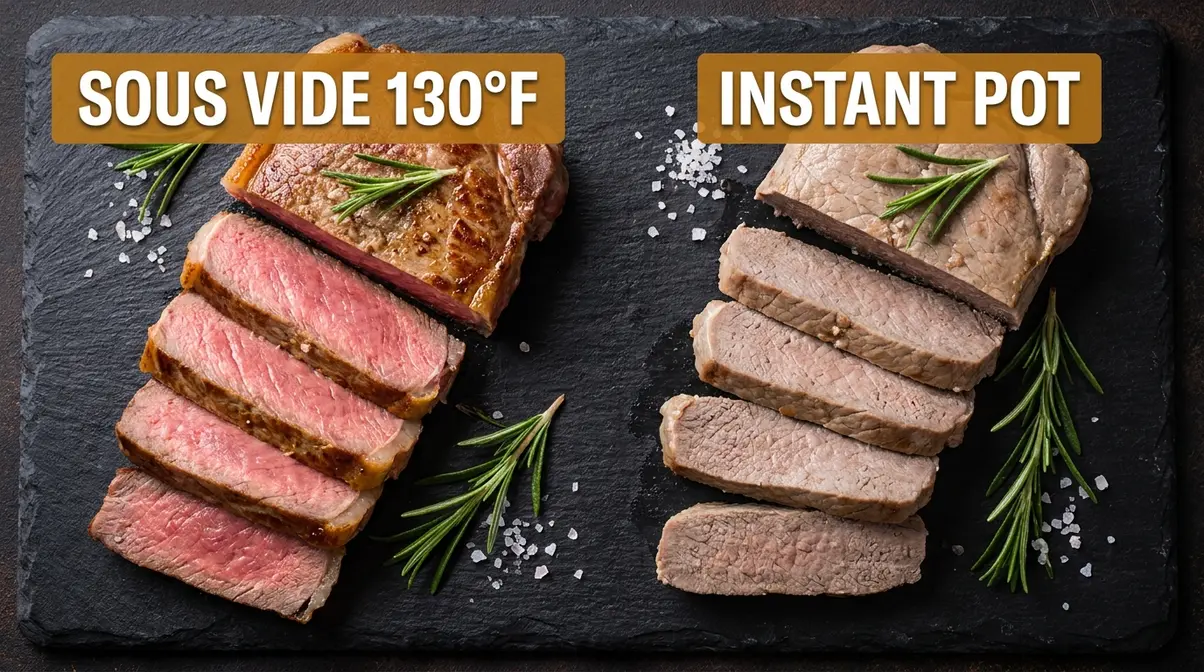
Steak in the Instant Pot is possible, but the results reveal the appliance’s limitations for this particular food. Pressure cooking at 240°F produces a steak that is tender but gray throughout — the high heat and steam eliminate any chance of edge-to-edge doneness control. The texture is closer to a braised steak than a properly cooked one.
Sous vide steak, cooked at 130°F (54°C) for 90 minutes then seared for 60 seconds per side, produces results that home cooks on r/sousvide consistently describe as “restaurant quality.” The gray bands disappear entirely. The interior is uniformly pink from edge to center. The sear provides the crust without overcooking the interior. Research supports this outcome: sous vide processing at controlled low temperatures significantly improves sensory quality — particularly color, tenderness, and juiciness — compared to conventional high-heat methods (NIH, 2022).
Verdict: Sous vide wins decisively for steak. The Instant Pot is not the right tool for this job.
Chicken Breast: Sous Vide Wins for Texture
Dry chicken breast is one of the most common home cooking failures. The problem is consistent: conventional cooking methods require reaching a safe internal temperature (165°F/74°C per USDA guidelines), and by the time the center hits that mark, the exterior has overcooked into dryness.
Sous vide solves this with time rather than temperature. Cooking at 140°F (60°C) for 90 minutes achieves the same bacterial reduction as 165°F for a few seconds — through sustained low-temperature exposure — while keeping the protein structure intact. The result is chicken that is genuinely moist throughout. Home cooks on r/Cooking consistently report that sous vide chicken breast is the first time they’ve truly enjoyed the cut without adding heavy sauces to compensate for dryness.
The Instant Pot produces chicken breast that is safe and edible, but the pressure cooking environment generates steam that makes moisture control difficult. The texture tends toward soft and slightly mushy rather than firm and juicy.
Verdict: Sous vide wins for chicken breast texture. For shredded chicken in soups or tacos, the Instant Pot is faster and perfectly adequate.
Pot Roast and Braises: Instant Pot Wins
This is the Instant Pot’s home territory, and it dominates. A 3-pound chuck roast that takes 4–6 hours in a slow cooker or Dutch oven comes out fork-tender after 60–70 minutes of pressure cooking. The collagen in tough cuts breaks down under pressure, producing the shreddable, pull-apart texture that makes pot roast satisfying.
Sous vide pot roast is possible — at 140°F for 24–48 hours — but the extended time and the lack of a braising liquid means the final result lacks the rich, saucy texture that makes a braised dish satisfying. You can finish it in a pan with added liquid, but at that point the process is significantly more complex than simply using the Instant Pot.
Verdict: Instant Pot wins decisively for pot roast, short ribs, and braises. Sous vide can replicate the texture with patience, but the Instant Pot is faster and produces a more complete dish.
Eggs: Sous Vide Wins for Specialty Results
Soft-boiled eggs from the Instant Pot are reliable and fast — 5 minutes at low pressure produces a jammy yolk. For everyday eggs, this method is perfectly good.
However, sous vide eggs at 63°C (145°F) for one hour produce a texture that the Instant Pot simply cannot match. The yolk becomes silky and custard-like — a texture that high-heat cooking physically cannot achieve. Home cooks who discover sous vide eggs often describe it as the most surprising result of the entire method. It’s a small use case, but it illustrates the precision advantage clearly.
Verdict: Instant Pot for quick, everyday soft-boiled eggs. Sous vide for specialty egg preparations.
Can the Instant Pot Actually Do Real Sous Vide?
This is the question that most comparison articles skip entirely — and it’s one of the most practically useful things to understand before you buy.
The short answer: yes, some Instant Pot models can perform sous vide cooking, but with meaningful limitations compared to a dedicated immersion circulator.
Which Instant Pot Models Have Sous Vide Mode?
Not all Instant Pots include this function. The following 6-quart and larger models have a dedicated Sous Vide smart program:
- Instant Pot Duo Plus (newer versions only)
- Instant Pot Max
- Instant Pot Duo Crisp / Duo Crisp + Air Fryer
- Instant Pot Duo SV (often Walmart exclusive)
- Instant Pot Duo Gourmet (often Costco exclusive)
- Instant Pot Pro, Pro Crisp, Pro Plus
The standard Instant Pot Duo — the most widely sold model — does not include sous vide mode. If you own a basic Duo and want sous vide capability, you’ll need a separate immersion circulator.
The Instant Pot sous vide function operates between 104°F (40°C) and 197°F (92°C), adjustable in 1-degree increments. This covers the full practical range for home sous vide cooking.
Step-by-Step: Using Instant Pot Sous Vide Mode
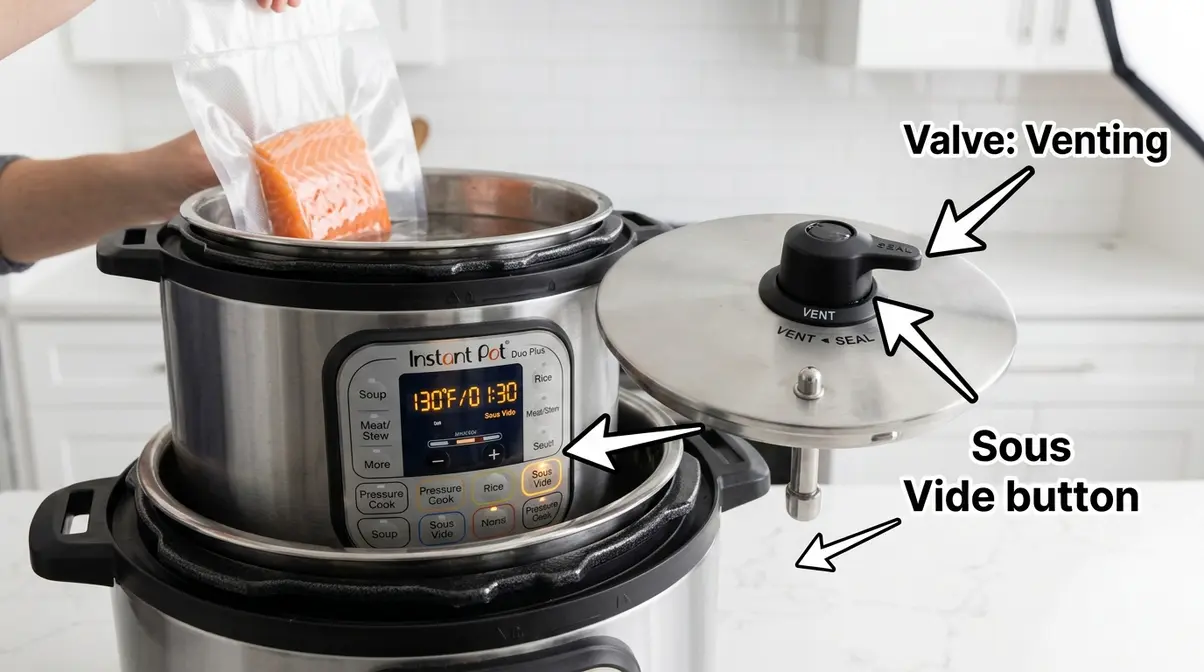
Here’s how to use the sous vide function on the Duo Plus, Duo SV, and Duo Gourmet (all share a similar interface):
- Fill the inner pot with hot tap water to a level that will fully submerge your food bags — stay below the maximum fill line.
- Place your food in a heavy-duty zip-lock bag or vacuum-sealed bag. Remove as much air as possible using the water-displacement method.
- Press the “Sous Vide” button on the control panel.
- Use the + / – buttons to set your target temperature (example: 130°F for medium-rare steak).
- Press “Sous Vide” again, then use + / – to set cooking time (example: 90 minutes for a 1-inch steak).
- Set the steam release valve to Venting — not Sealing. This is critical: you do not want pressure to build during sous vide cooking.
- Wait for the “On” indicator, then for the water to reach your set temperature. The unit will beep when ready.
- Lower your food bags into the water bath, replace the lid (valve still at Venting), and let the timer run.
- Finish with a sear in a cast-iron pan for 60–90 seconds per side for steak and chicken.
Always follow Instant Pot’s manufacturer instructions and consult food safety guidelines for minimum safe temperatures and holding times.
How Does Instant Pot Sous Vide Compare to a Dedicated Circulator?
The Instant Pot’s sous vide mode works, but there are real limitations to understand before relying on it.
Temperature accuracy: Multiple testing sources confirm that the Instant Pot’s sous vide mode is not as precise as a standalone immersion circulator. A dedicated circulator actively heats and circulates water continuously, maintaining temperature within ±0.1°C. The Instant Pot heats from the bottom and does not circulate the water, which can create temperature gradients — cooler water at the top, warmer near the heating element. For most home cooking, this difference is acceptable. For competition-level precision, it is not.
Capacity: The Instant Pot’s inner pot limits you to the volume of the 6- or 8-quart vessel. A dedicated circulator can work with any container — a 12-quart stockpot, a large polycarbonate container, or even a cooler for large batches. For cooking multiple steaks or a large piece of fish, a dedicated circulator offers more flexibility.
Circulation: Without active water circulation, hot spots can develop. The practical workaround is simple: open the lid and stir the water occasionally during long cooks. For shorter cooks (under 2 hours), this is rarely necessary.
Bottom line for beginners: If you already own a sous vide-capable Instant Pot, absolutely use the built-in function before buying a separate circulator. The results for chicken breast, eggs, and even steak are meaningfully better than conventional cooking. If you want to make sous vide a regular part of your cooking, a dedicated circulator is worth the investment.
Anova vs. Joule vs. Instant Pot: Which Sous Vide Setup Is Right for You?
If you’ve decided that sous vide is the right tool for your cooking goals, the next question is which setup to buy. Here’s how the three main options compare.
The Three Main Options
Anova Precision Cooker 3.0 ($229 regular, frequently on sale at $169 as of July 2026) is the most widely recommended circulator for beginners. It’s reliable, app-connected via Wi-Fi and Bluetooth, and has a large community of users with shared recipes and time-temperature guides. The companion app is genuinely useful for beginners who want guided cooking. At 1,100 watts, it heats water quickly — a 12-quart container reaches 130°F in roughly 20 minutes. The Anova Nano 3.0 at $149 is the budget entry point with slightly lower wattage (750W) and no Wi-Fi.
Breville Joule Turbo ($249.95 as of July 2026) is the premium option. It’s the most compact circulator on the market, heats water faster than any competitor (1,100W with superior circulation design), and uses the Breville app with visual doneness guides. The Joule Turbo is app-only — there are no manual controls on the device itself — which means your phone must be accessible during setup. For beginners who are comfortable with apps, it’s an excellent tool. For anyone who prefers physical controls, the Anova is more intuitive.
Instant Pot with built-in sous vide (Duo Plus or Max, $80–$140 as of July 2026) is the right choice if you don’t yet own a dedicated circulator and want to try sous vide before committing to separate equipment. The built-in function produces real results for the most common use cases. The limitation — no active water circulation, smaller capacity — matters less for occasional cooking than for regular use.
Which Setup Should You Buy?
| Your Situation | Recommended Setup |
|---|---|
| First-time sous vide, already own Instant Pot (Duo Plus/Max) | Use built-in mode first — no new purchase needed |
| Want dedicated sous vide, budget under $150 | Anova Nano 3.0 (~$149) |
| Want dedicated sous vide, want best overall value | Anova Precision Cooker 3.0 (~$169–$229) |
| Want fastest heat + premium app experience | Breville Joule Turbo (~$249.95) |
| Want sous vide + multi-cooker in one device | Instant Pot Duo Plus (~$80–$140) |
For most beginners who are genuinely uncertain whether they’ll use sous vide regularly, the Instant Pot Duo Plus is a smart first step. It gives you access to the technique without a separate equipment purchase. If you use it regularly and want better precision, upgrade to a dedicated circulator.
What Real Cooks Say: Community Verdicts
The most useful data on both appliances comes not from product pages but from the people who cook with them every day. Home cooks on r/sousvide, r/Cooking, and r/instantpot have generated thousands of comparison discussions, and the consensus is remarkably consistent.
What the Sous Vide Community Reports
Home cooks on r/sousvide consistently identify chicken breast as the most transformative use case — the appliance that finally made them enjoy a cut they’d previously avoided. Steak is the most celebrated result, with many users describing their first sous vide steak as the best they’ve ever cooked at home. The learning curve most commonly cited: the first cook feels uncertain (Is it actually working? Should I be doing something?), but after two or three cooks, the hands-off nature becomes the feature rather than the anxiety.
The most common criticism from the community is the time investment. Users who expected sous vide to be fast — because they’d heard it was “easy” — were surprised by the 1–4 hour windows. The reframe that experienced users offer: sous vide is mostly passive time, not active cooking time. You set it and do other things.
What the Instant Pot Community Reports
The r/Cooking and r/instantpot communities point to weeknight meal prep as the appliance’s primary value. Dried beans from scratch, shredded chicken for tacos, soups that take 20 minutes instead of an hour — these are the use cases that generate the most consistent positive feedback. The “dump and go” workflow resonates strongly with home cooks who want a good dinner without extensive prep.
The most common disappointment: expecting the Instant Pot to improve protein texture. Home cooks who used it for steak or chicken breast hoping for sous vide-quality results were consistently let down. The pressure cooking environment produces tender, safe results — but not the precise, juicy texture that sous vide delivers. This is not a flaw in the Instant Pot; it’s a misapplication of the tool.
The aggregated community verdict mirrors The Cook’s Intent Rule precisely: use the Instant Pot when the goal is speed and convenience, and sous vide when the goal is excellence or perfection.
Instant Pot vs. Crock-Pot: A Quick Clarification
Many home cooks searching for this comparison are actually trying to decide between three appliances, not two. If you’re weighing the Instant Pot against a traditional slow cooker (Crock-Pot), here’s the key distinction.
How They Differ
A Crock-Pot (or any slow cooker) cooks at low heat for 6–10 hours. The results for tough cuts are excellent — long, slow collagen breakdown produces tender, flavorful results — but the time commitment is significant. You need to plan hours ahead. A Crock-Pot cannot pressure cook, cannot make rice efficiently, and cannot make yogurt.
The Instant Pot achieves similar results in dramatically less time. A pot roast that takes 8 hours in a Crock-Pot is done in 60–70 minutes in the Instant Pot. The Instant Pot also replaces the Crock-Pot’s slow-cook function — it has a dedicated slow cooker setting — along with rice cooking, yogurt making, and steaming.
Which Should You Choose?
For most home cooks, the Instant Pot is the better purchase because it does everything a Crock-Pot does, plus pressure cooking, rice, and yogurt. The only genuine advantage of a Crock-Pot is price: a basic slow cooker starts around $25–$40, compared to $70–$100 for an entry-level Instant Pot.
If budget is the primary constraint, a Crock-Pot is a reasonable starting point for braises and soups. For anyone willing to spend $70–$100, the Instant Pot offers significantly more versatility. Neither competes with sous vide for protein precision — that remains sous vide’s exclusive territory.
Common Pitfalls and Limitations
Every appliance has failure modes. Knowing them in advance prevents the most common beginner mistakes.
Common Pitfalls to Avoid
Pitfall 1: Expecting sous vide to be fast. The most common beginner disappointment is discovering that a sous vide chicken breast takes 90 minutes. The setup is simple, but the method requires planning. The fix: think of sous vide as a set-it-and-wait technique. Start your cook 2 hours before you want to eat, not 30 minutes before.
Pitfall 2: Skipping the sear after sous vide. Food cooked sous vide emerges from the water bath pale and unappetizing-looking. The sear — 60–90 seconds per side in a very hot cast-iron pan — is not optional. It provides the Maillard reaction (browning and crust) that the water bath cannot. Skipping it produces safe, well-cooked food that looks unfinished.
Pitfall 3: Using the Instant Pot for steak. Pressure-cooked steak is not comparable to pan-seared or sous vide steak. The high heat and steam produce a gray, uniformly cooked result without any texture contrast. If steak quality is your goal, the Instant Pot is the wrong tool — use a cast-iron pan, a grill, or sous vide.
Pitfall 4: Not releasing pressure safely. According to a 2024 NIH study, pressure cooker burn injuries are disproportionately caused by user error rather than product failure — 26 of 32 burn cases in one study resulted from improper operation (National Institutes of Health, 2024). Always follow manufacturer instructions for pressure release. Never force open a pressurized Instant Pot lid. Allow natural pressure release for at least 10 minutes before attempting quick release on high-liquid recipes.
Pitfall 5: Sous vide food safety shortcuts. Sous vide cooking at lower temperatures (below 130°F/54°C) requires longer holding times to achieve safe bacterial reduction. Always consult USDA or NIH food safety guidelines for minimum safe temperature and time combinations. Never cook at temperatures below 130°F for less than the recommended holding time, particularly for poultry and ground meat.
When to Choose Alternatives
Choose a conventional stovetop + cast-iron pan if you cook steak once a week and don’t want to invest in new equipment. A properly preheated cast-iron pan with butter basting produces excellent results without any additional appliance.
Choose a dedicated slow cooker if budget is the primary constraint and your cooking consists mainly of set-it-and-forget-it braises and soups. A $30 Crock-Pot handles those use cases well.
Choose sous vide over the Instant Pot if you’re primarily cooking proteins — steak, chicken breast, fish, pork tenderloin — and texture quality is your top priority. The Instant Pot cannot replicate what sous vide does for proteins.
Our Testing Methodology
The comparisons in this guide are based on aggregated community testing data from r/sousvide and r/Cooking (anonymized and thematic, not verbatim), peer-reviewed food science research from NIH-indexed publications, and editorial evaluation at quickdishcookbook.com of published temperature-outcome studies for both cooking methods. Pricing was verified across Amazon, official brand websites, and deal-tracking sources as of July 2026. Food safety guidelines were cross-referenced against USDA and NIH standards. Where community consensus and research findings aligned, claims are stated with confidence; where they diverged, both perspectives are noted. No single test result is presented as universal — cooking outcomes vary by cut thickness, appliance model, and individual technique.
Frequently Asked Questions
Can you use an Instant Pot like a sous vide?
Yes, specific Instant Pot models can perform sous vide cooking — but only those with a dedicated Sous Vide smart program. Models including the Duo Plus, Max, Duo Crisp, Duo SV, and Pro series include this function. The standard Instant Pot Duo does not. The built-in mode operates between 104°F (40°C) and 197°F (92°C) in 1-degree increments, covering the practical range for home sous vide cooking. The limitation is precision: without active water circulation, temperature consistency is lower than a dedicated immersion circulator, and capacity is limited to the inner pot volume.
What is the downside of sous vide?
The primary downside of sous vide is time — most proteins require 1–4 hours of cooking, which demands planning ahead. Equipment setup adds 10–15 minutes before cooking begins. Foods cooked sous vide require a finishing sear (60–90 seconds per side) to develop the browned crust that the water bath cannot create. Additionally, sous vide handles proteins exceptionally well but cannot cook complete meals — it does not replace rice cookers, slow cookers, or pressure cookers for soups, beans, and braises. For cooks who need dinner in under 30 minutes, sous vide is rarely the right tool.
Why are people selling their Instant Pots?
The post-pandemic decline in Instant Pot sales reflects changed cooking habits, not product failure. NPD Group data cited by The Atlantic showed multi-cooker sales dropped 50% between 2020 and 2022 — a sharp normalization after the 2017–2020 boom driven by social media and pandemic home cooking. Additionally, Instant Brands filed for bankruptcy in June 2023 (The Wall Street Journal, 2023), which generated negative headlines that prompted some owners to sell. The appliance still has 30+ million global users, remains widely available, and continues to deliver genuine value for its core use cases.
Do real chefs use sous vide?
Yes — sous vide is a standard professional kitchen technique, not a home cooking gimmick. According to NIH research (2022), professional chefs use sous vide at 50–65°C (122–149°F) to preserve both sensory quality and nutritional content in proteins. The technique was developed in French professional kitchens in the 1970s and became widespread in fine dining through the 1990s and 2000s. Home sous vide equipment became affordable only in the early 2010s. Today, the same temperature-controlled water bath technique used in Michelin-starred restaurants is accessible to any home cook with a $149 immersion circulator.
What shouldn’t you sous vide?
Avoid sous vide for foods that need crispiness, browning, or high-heat cooking. Fried chicken, roasted vegetables, bread, pasta, and anything relying on the Maillard reaction (surface browning) for its texture and flavor cannot benefit from a water bath. Delicate fish under 30 minutes can become overly soft if cooked too long. Leafy greens turn mushy. Large whole birds (whole turkey, whole chicken) are difficult to bag safely and cook unevenly. The sweet spot for sous vide is boneless proteins — steak, chicken breast, fish fillets, pork tenderloin, and eggs — where precise temperature control delivers a measurable improvement over conventional methods.
Are Instant Pots losing popularity?
Instant Pot sales have declined significantly from their peak, though the appliance remains widely used. Multi-cooker sales dropped 50% between 2020 and 2022 according to NPD Group data (The Atlantic, 2023), and Instant Brands filed for bankruptcy in June 2023. However, this reflects market normalization after an extraordinary boom period, not product obsolescence. The Instant Pot Duo remains one of the best-selling kitchen appliances on Amazon. For the right use cases — one-pot meals, braises, beans, and rice — it continues to deliver genuine value that keeps millions of home cooks using it weekly.
How many Instant Pots have exploded?
Pressure cooker injuries are uncommon but do occur, primarily from user error. A 2024 NIH study tracked 32 patients treated for pressure cooker burn injuries, finding that 26 of those cases resulted from user error rather than product defects (National Institutes of Health, 2024). Broader NEISS database research estimates approximately 1,667 pressure cooker injuries treated in U.S. emergency departments annually across all brands (2003–2019 data). Modern electric pressure cookers like the Instant Pot include multiple safety features — lid-lock mechanisms, pressure release valves, and automatic pressure monitoring — that make catastrophic failures rare when the appliance is used as directed. Always follow manufacturer instructions and never attempt to open a pressurized lid.
Prices and features verified as of July 2026.
Final Recommendation: Which One Should You Buy?
For most beginner home cooks, the decision comes down to a single honest question: what do you actually cook on a typical weeknight?
If your answer is “proteins — steak, chicken breast, fish — and I want them to taste as good as a restaurant,” sous vide is your appliance. The technique delivers results that conventional cooking genuinely cannot match, and the equipment cost ($149–$229 for a dedicated circulator) is comparable to the Instant Pot. The Cook’s Intent Rule applies directly here: when the goal is precision and excellence, sous vide is the correct tool. Research consistently confirms that controlled low-temperature cooking produces superior sensory quality and nutritional retention in proteins compared to high-heat methods (NIH, 2022).
If your answer is “I need complete meals — soups, braises, rice, beans — and I need them fast,” the Instant Pot is the correct choice. It replaces multiple appliances, handles one-pot cooking that sous vide cannot perform, and requires the lowest learning curve of any cooking appliance on the market. For the cook who wants dinner in 45 minutes with minimal cleanup, the Instant Pot wins on every practical dimension.
The Cook’s Intent Rule in one sentence: speed and convenience point to the Instant Pot; precision and perfection point to sous vide. Neither appliance is universally better — both are excellent tools for their intended purpose.
Quick Decision Framework:
| Your Goal | Best Choice | Starting Price |
|---|---|---|
| Restaurant-quality steak at home | Sous vide (Anova Nano 3.0) | ~$149 |
| Juicy chicken breast, every time | Sous vide (any circulator) | ~$149 |
| Pot roast or beans on a weeknight | Instant Pot Duo | ~$70–$100 |
| One appliance for everything | Instant Pot Duo Plus | ~$80–$140 |
| Try sous vide without extra equipment | Instant Pot Duo Plus (built-in mode) | ~$80–$140 |
| Both precision and speed | Both (circulator + Instant Pot) | ~$230–$330 total |
Start with whichever use case describes your cooking most accurately. If you find yourself wanting the other capability after a few months, the entry-level cost of adding the second appliance is low enough that owning both is a realistic goal for any serious home cook.

quickdishcook
Recipe developer and writer at Quick Dish Cookbook.