
What’s in this guide
- Are Slow Cookers Energy Efficient? The Real Numbers
- Slow Cooker vs. Oven vs. Air Fryer vs. Microwave: The Appliance Energy Showdown
- 5 Hidden Energy Drains That Quietly Raise Your Bill
- Are Slow Cookers Safe to Leave On?
- Are Slow Cookers Worth It? An Honest Assessment
- How to Maximize Your Slow Cooker's Efficiency
- When a Slow Cooker Is Not the Right Choice
- Frequently Asked Questions
- Making the Numbers Work for Your Kitchen
“But it uses so much electricity!” Sound familiar? You’re not alone — and the honest answer is more interesting than a simple yes or no.
Think about it this way: your slow cooker sits on the counter for eight hours while your oven blasts heat for one. Which one actually costs more to run? The answer depends entirely on how you measure it — and most guides measure it wrong.
Most articles stop at wattage and call it a day. This one goes further, calculating the true cost per finished meal and exposing the five habits that quietly erase the slow cooker’s efficiency advantage. By the end of this guide, you’ll know exactly what your slow cooker costs to run, how it stacks up against your oven and air fryer, and precisely what to do — and avoid — to keep your energy bill as low as possible. We cover real numbers, a step-by-step cost formula, a four-appliance showdown, and the hidden drains that no competitor mentions.
Are Slow Cookers Energy Efficient? The Real Numbers
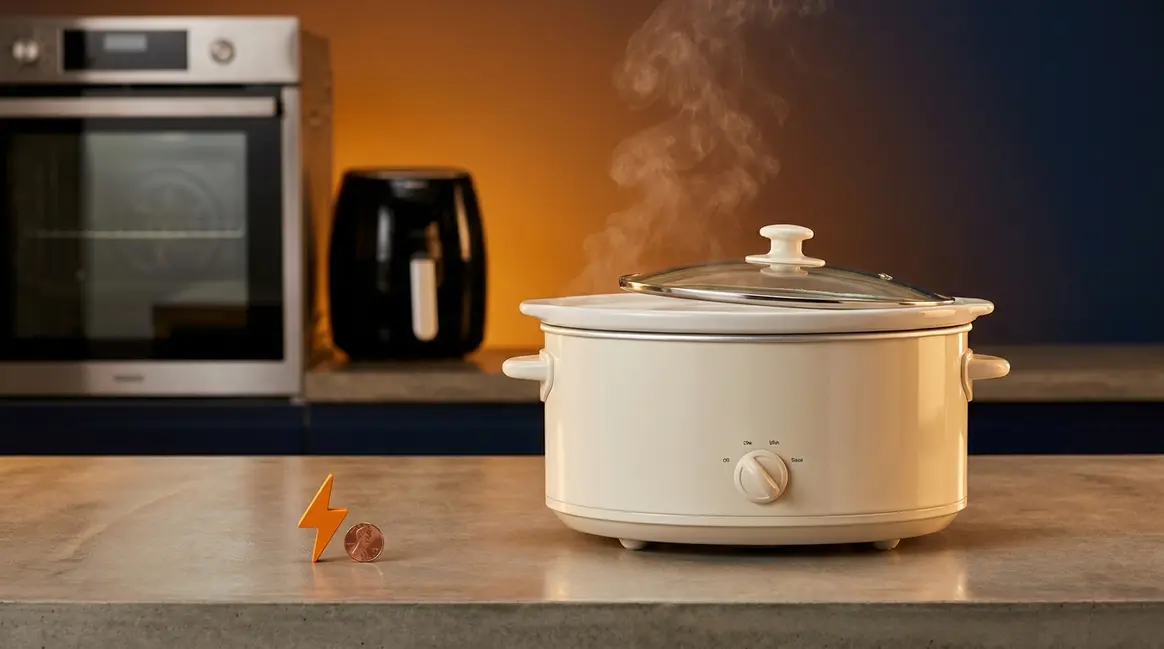
Yes — slow cookers are energy efficient. A standard model draws just 75–300 watts, compared to the 2,000–2,500 watts a conventional electric oven demands (Horsham District Council energy consumption data). That low power rating is the foundation of the slow cooker’s energy advantage — and it’s why so many cost-conscious cooks keep one on the counter.
But wattage alone is an incomplete picture. To understand whether a slow cooker is truly cheaper to run, you need to understand three things: how watts translate to electricity units, how those units add up over a full cook, and how to calculate your own cost per meal. That’s exactly what this section covers.
Tariff Data Note: Cost estimates throughout this article use a US average electricity rate of $0.17/kWh (EIA, 2026) and a UK rate of approximately 25p/kWh (Ofgem). Actual costs vary by appliance model, size, and local tariff. Always check your electricity bill for your personal rate.
How Many Watts Does a Slow Cooker Use?
A watt is simply a measure of how fast an appliance draws electrical power at any given moment. The lower the wattage, the less electricity it pulls from the grid each hour.
Most modern slow cookers use 75–150 watts on the low setting and 150–250 watts on the high setting (FoodHow, 2023; Modern Kitchen Cookware, 2026). To put that in everyday terms: a slow cooker on low draws about the same power as two standard 60-watt light bulbs. Your oven draws the equivalent of roughly 20 of those same bulbs running simultaneously.
A typical wattage breakdown by setting:
| Setting | Typical Wattage | Power Draw Analogy |
|---|---|---|
| Keep Warm | 50–75 W | One small desk lamp |
| Low | 75–150 W | Two standard light bulbs |
| High | 150–250 W | Two to three light bulbs |
| Conventional oven | 2,000–2,500 W | ~20 light bulbs |
One nuance worth knowing: learn more about slow cooker energy efficiency and you’ll find that older slow cookers (pre-2010) may draw slightly more wattage due to less efficient heating elements. If you’re wondering whether old slow cookers are energy efficient, the honest answer is “mostly yes, but a modern model will likely cost a few cents less per session.” A real-world measurement by RVelectricity (2024) found a tested unit drew 123 W on low and 189 W on high — right in the middle of the expected range. A 6-quart Crockpot typically draws around 240 watts on high, confirmed by manufacturer specifications.
“A typical slow cooker uses 75–300 watts — up to 10 times less power than a conventional electric oven, which draws 2,000–2,500 watts” (Horsham District Council).
Now that you know how much power a slow cooker draws, the next question is how that translates to electricity used over a full day of cooking.
How Much Electricity Does a Slow Cooker Use Per Day?
How energy efficient are slow cookers when you look at a full day of cooking? The answer becomes clearer once you understand the unit on your electricity bill: the kilowatt-hour (kWh). One kWh is the amount of electricity used by a 1,000-watt appliance running for exactly one hour — it’s the number that determines what you actually pay.
Here’s a side-by-side comparison that makes the efficiency gap impossible to ignore:
- A 200-watt slow cooker running for 8 hours uses 1.6 kWh.
- A 2,200-watt electric oven running for just 1 hour uses 2.2 kWh.
The slow cooker runs all day and still uses less total electricity than a single oven session. That’s a remarkable result — and it’s why the per-hour comparison alone is misleading.
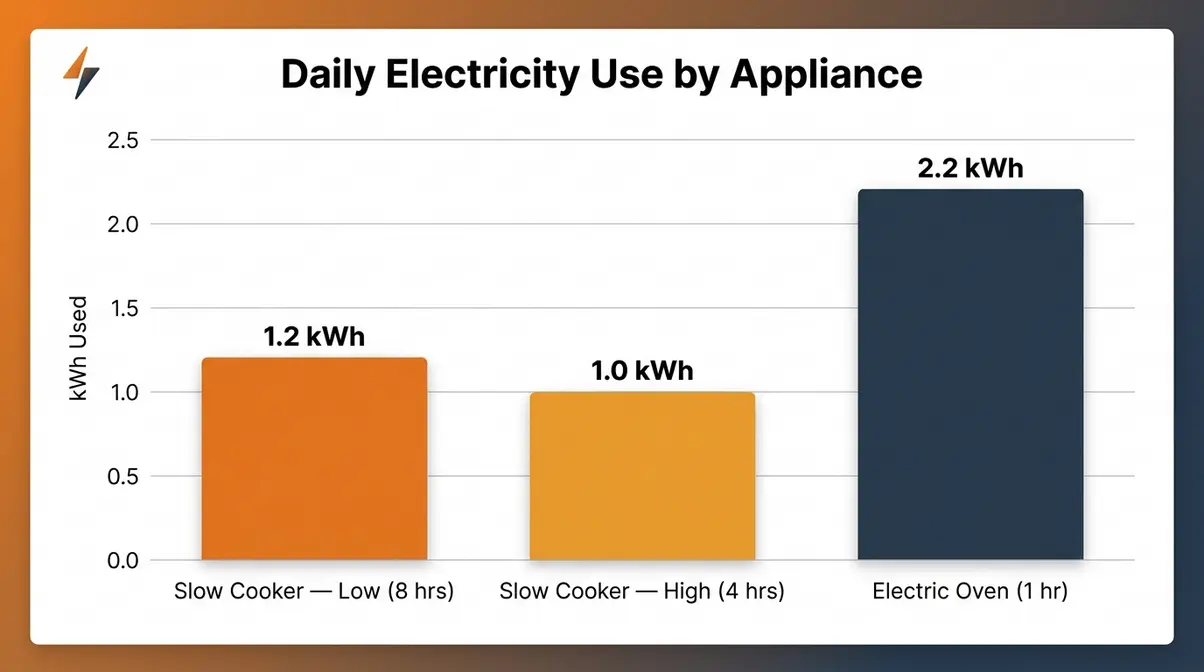
In the UK, the hourly running cost of a slow cooker works out to approximately 5p per hour for a typical 200-watt model, according to Dover District Council data. Over an 8-hour cook at current UK rates (~25p/kWh), that’s roughly 40p for the whole meal — less than a standard cup of coffee.
Those daily figures are useful — but for a true apples-to-apples comparison, you need to measure what a meal actually costs, not what an hour costs.
How Much Does It Cost to Run a Slow Cooker for 4 Hours?
Calculating your exact running cost takes three simple steps. Grab your appliance’s wattage (check the label on the bottom) and your electricity rate (check your bill), and you’re ready.
Step 1: Find your slow cooker’s wattage — it’s printed on the bottom label or in the manual.
Step 2: Multiply: Watts × Hours ÷ 1,000 = kWh used.
Step 3: Multiply: kWh × your electricity rate = your cost.
US example: A 250-watt slow cooker running for 4 hours = 1 kWh. At $0.17/kWh, that’s 17 cents for the entire meal (CNET appliance energy comparison, CNET, 2025).
UK example (slow cookers energy efficient UK): The same 4-hour cook at ~25p/kWh costs approximately 25 pence.
For comparison: a 2,000-watt oven running for 1 hour uses 2 kWh. At $0.17, that’s 34 cents — double the slow cooker’s cost, even though the oven ran for a fraction of the time.
This is what we call The Per-Meal Principle: the only honest way to compare appliances is total energy consumed per finished meal — not wattage per hour. A microwave reheating leftovers for 5 minutes is far cheaper than a 4-hour slow cooker session, even though the microwave draws more watts. The metric that matters is total kWh per dish — and that number changes the winner depending on the recipe.
Cook 3 meals per week for 52 weeks at 17 cents each, and your annual slow cooker electricity cost is around $26.52. The same 3-weekly oven sessions at 34 cents each would cost $53.04 — double, for the same number of meals.
Costs are estimates based on stated rates. Check your electricity bill for your actual rate.
The Per-Meal Principle sets up the comparison you actually need: how does the slow cooker stack up against the oven, air fryer, and microwave when you measure complete meals?
Slow Cooker vs. Oven vs. Air Fryer vs. Microwave: The Appliance Energy Showdown
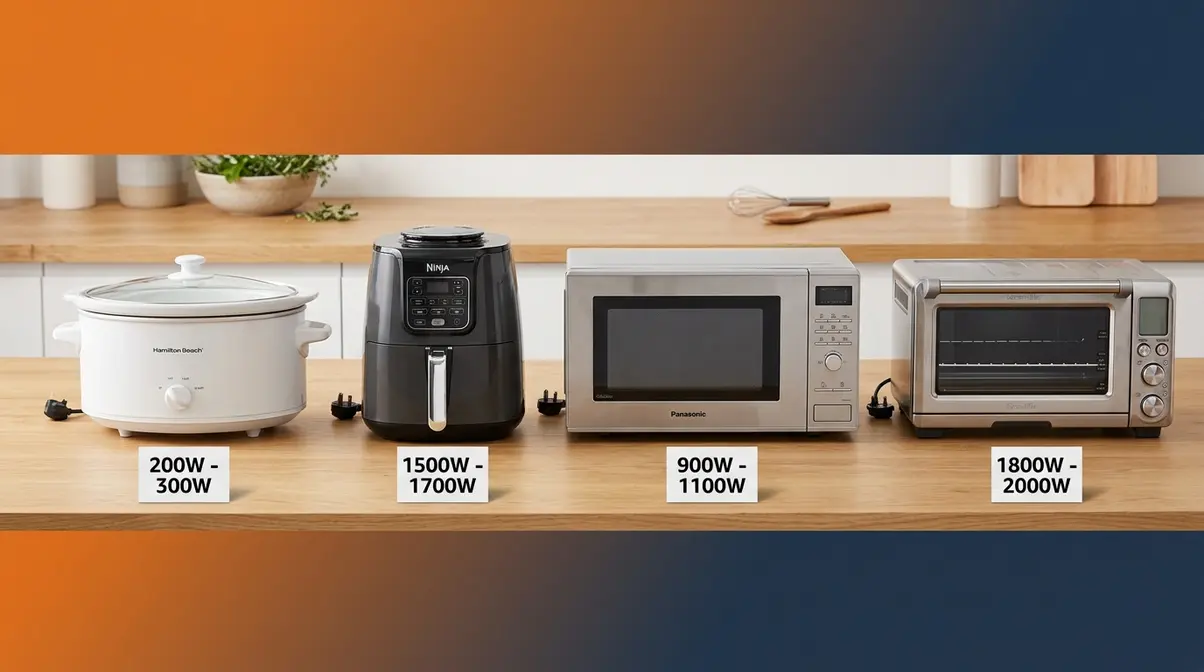
Surprising data point first: a conventional oven cooking a 1.5-hour roast uses more total electricity than a slow cooker running all day on low. That claim sounds counterintuitive — but the numbers back it up, and they reveal exactly when each appliance wins on cost.
A conventional oven uses 2,000–2,500 watts; a slow cooker uses 75–300 watts — meaning a 6-hour slow cooker braise can use up to 70% less total electricity than a 1.5-hour oven roast cooking the same cut of meat (University of Arkansas, efficiency tests of common electrical cooking appliances).
Methodology note: Figures below use manufacturer-stated wattage ranges and a US rate of $0.17/kWh as baseline assumptions. UK costs use ~25p/kWh. Sources are linked for each figure. CNET’s analysis uses New York electricity rates, which run higher than the US average — the figures here use the national average for a fairer comparison.
The Four-Appliance Comparison Table
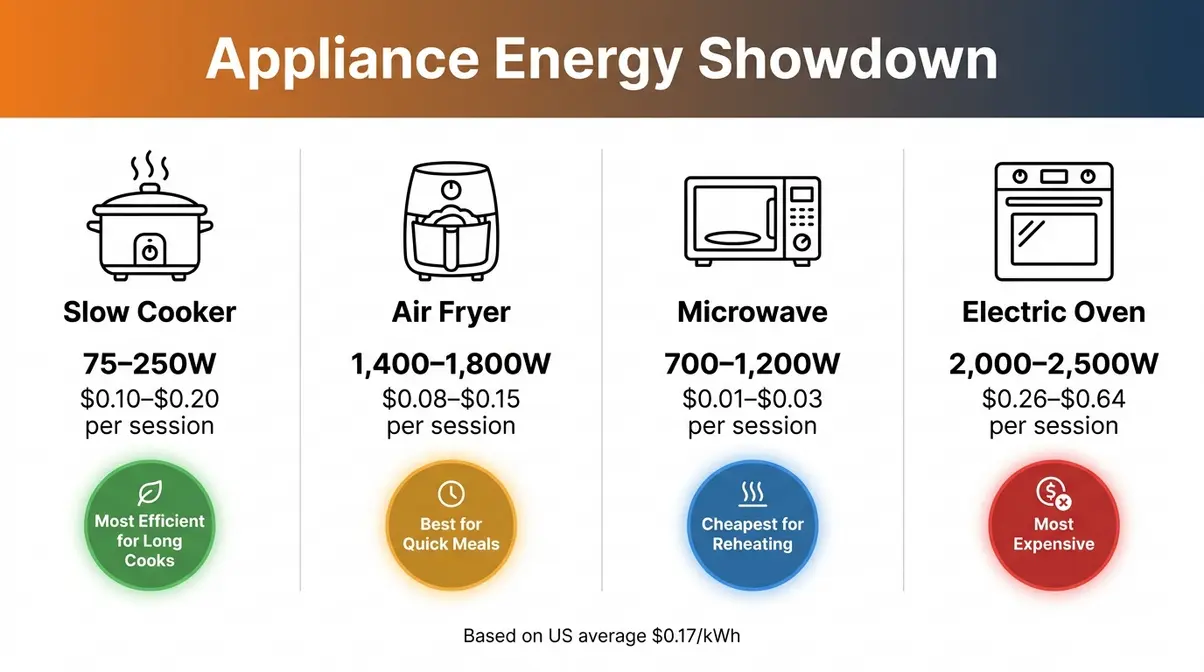
| Appliance | Typical Wattage | Typical Session | kWh per Session | Cost (US $0.17/kWh) | Cost (UK 25p/kWh) |
|---|---|---|---|---|---|
| Slow Cooker (Low) | 75–150 W | 8 hours | 0.6–1.2 kWh | $0.10–$0.20 | 15p–30p |
| Slow Cooker (High) | 150–250 W | 4 hours | 0.6–1.0 kWh | $0.10–$0.17 | 15p–25p |
| Air Fryer | 1,400–1,800 W | 20–30 min | 0.47–0.90 kWh | $0.08–$0.15 | 12p–23p |
| Microwave | 700–1,200 W | 5–10 min | 0.06–0.20 kWh | $0.01–$0.03 | 1.5p–5p |
| Electric Oven | 2,000–2,500 W | 45–90 min | 1.5–3.75 kWh | $0.26–$0.64 | 38p–94p |
Slow Cooker vs. Oven: Long Cooks
For long, low-temperature dishes — pot roasts, stews, pulled pork, bean soups — the slow cooker wins decisively. BBC testing found a roast chicken in an electric oven consumed 1.05 kWh in 35 minutes; the same recipe in a comparable countertop appliance used significantly less total energy (BBC News, 2024). Scale that up to a 6-hour braise, and the oven’s energy cost climbs steeply while the slow cooker holds steady at its low wattage draw.
The University of Arkansas efficiency tests confirm this pattern: slow cookers can use up to 70% less total electricity than a conventional oven for the same one-pot meals. For any recipe that requires more than 45 minutes in an oven, the slow cooker almost always wins on total energy cost.
Where the oven retains an edge is in versatility — browning, roasting, baking — tasks the slow cooker simply cannot replicate. For those jobs, the oven is the right tool regardless of energy cost.
Slow Cooker vs. Air Fryer: Short Cooks vs. Long Braises
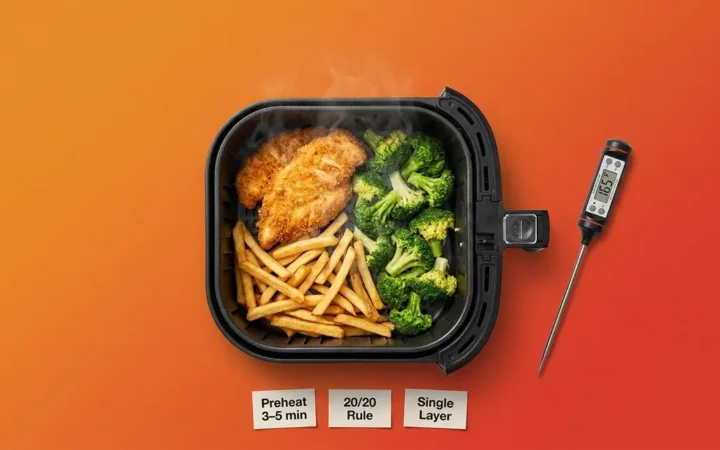
An air fryer is a compact countertop convection appliance that circulates very hot air to cook food quickly, typically in 15–30 minutes. It draws 1,400–1,800 watts — far more than a slow cooker — but because it cooks so fast, its per-meal energy cost stays low.
The comparison depends entirely on the recipe:
- Short cooks (under 30 minutes): The air fryer wins. Chicken breasts in 18 minutes at 1,500 W costs about $0.08 — less than most slow cooker sessions. BBC measurements found air-fried chips used 0.43 kWh versus 1.35 kWh in an electric oven for the same portion (Nottingham Trent University / BBC News, 2024).
- Long braises (over 3 hours): The slow cooker wins. No air fryer can replicate an 8-hour pulled pork cook, and the slow cooker’s total energy draw for that session remains under $0.20.
This is The Per-Meal Principle in action: the appliance that wins changes depending on what you’re cooking, not which one has lower wattage on paper. An air fryer cooking chips for 20 minutes costs less per session than a slow cooker running all day — even though the air fryer draws six times more watts.
For a practical decision guide: use the air fryer for quick weeknight meals and the slow cooker for anything that benefits from low, slow heat. Discover how Instant Pots and electric pressure cookers compare if you want a hybrid option that can do both.
The Per-Meal Principle Calculator in Practice
Notice how the microwave wins on cost-per-session for a 5-minute reheat (roughly 1–3 cents), but the slow cooker wins for a 6-hour braise (10–20 cents versus 26–64 cents for the oven). That’s The Per-Meal Principle at work — the only honest comparison is total kWh per finished dish, not wattage per hour.
Use this quick formula every time you’re deciding which appliance to reach for:
- Estimate the cook time for each appliance option.
- Multiply each appliance’s wattage × cook time ÷ 1,000 = kWh.
- Pick the lowest kWh result for that recipe type.
For most families cooking 3–5 nights per week, replacing oven-based stews and braises with slow cooker meals can realistically save $25–$50 per year on electricity alone — without changing what’s on the plate.
5 Hidden Energy Drains That Quietly Raise Your Bill
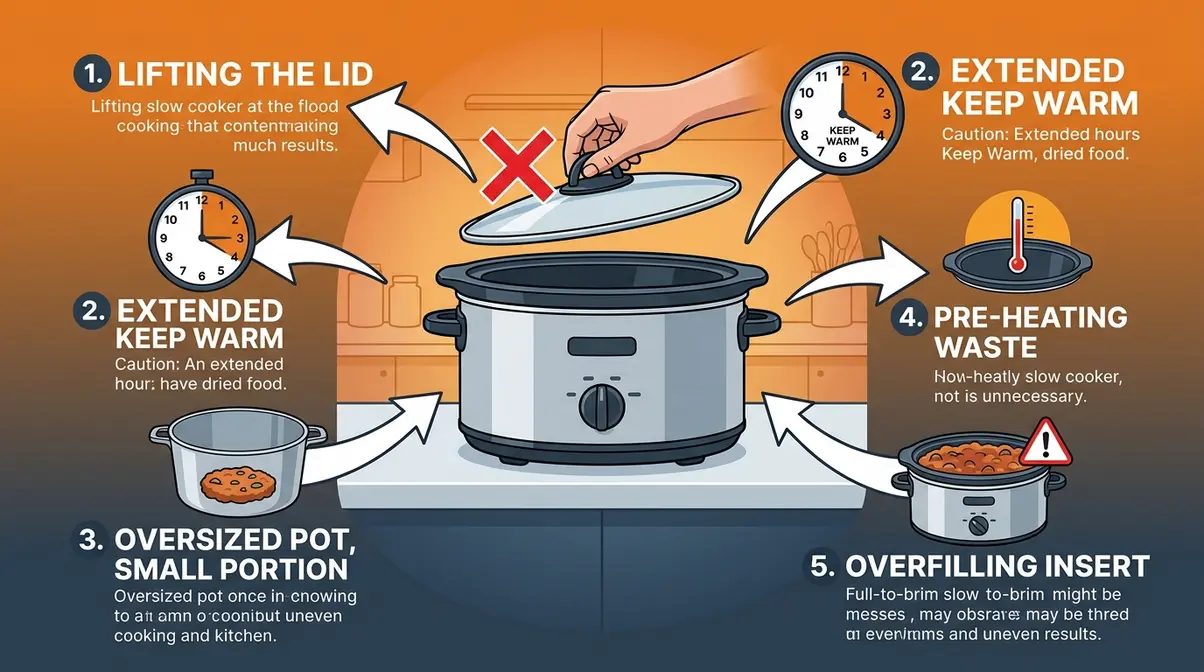
Here’s a question most guides never ask: why do some households see bigger savings from their slow cooker than others? The answer almost always comes down to five specific habits that silently erase the appliance’s efficiency advantage.
Understanding these drains is the difference between a slow cooker that genuinely trims your bill and one that costs nearly as much as the oven it replaced. Each one is fixable — once you know it exists.
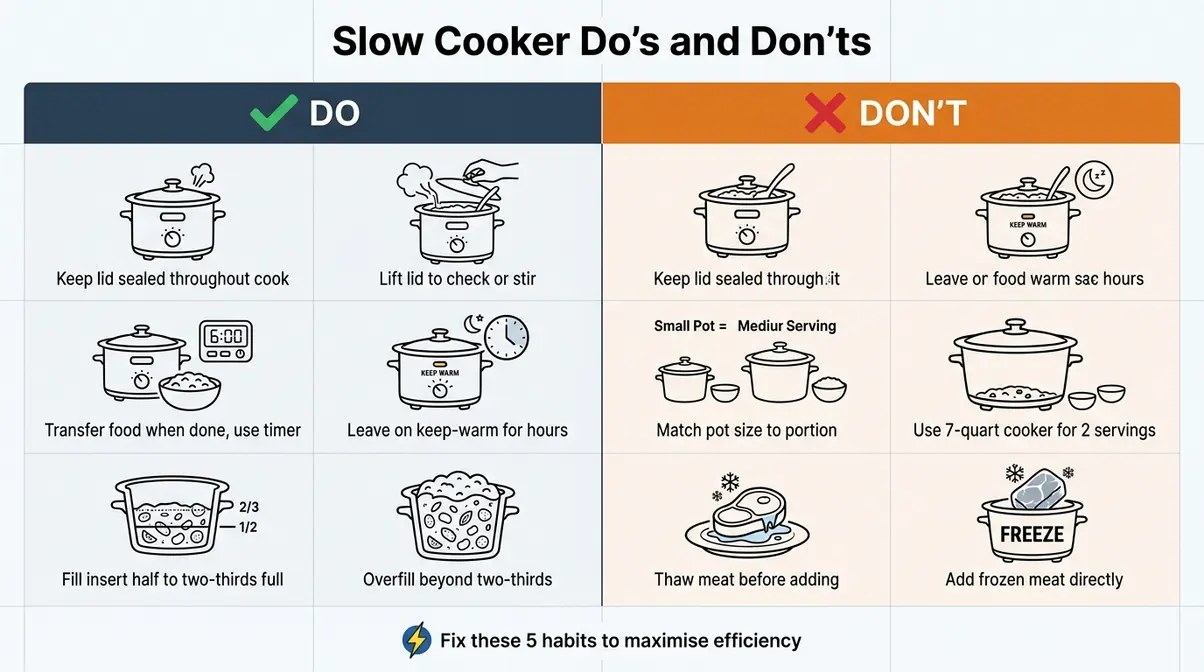
Drain 1 — Lifting the Lid
Every time you lift the lid to check on dinner, hot steam escapes and the internal temperature drops. The cooker then has to use extra energy to rebuild that heat before cooking can resume at its previous rate.
According to Utah State University Extension, each lid lift can add 15–30 minutes to your total cook time — meaning extra electricity consumed and dinner arriving later than planned. Crock-Pot’s own cooking guidelines confirm: “taking the lid off to stir food causes the slow cooker to lose a significant amount of heat, extending the cooking time required” (Crock-Pot official tips).
The practical rule: keep the lid on for the entire cook, especially during the first two hours when the appliance is building up to its operating temperature. If you need to check for doneness, wait until the minimum cook time has passed. The one exception: removing the lid in the final 30–45 minutes on high can help thicken excess liquid intentionally (Tasting Table, 2026).
Drain 2 — Extended Keep-Warm Mode
Keep-warm mode draws only 50–75 watts (WattSizing, 2026) — far less than the cooking settings — so it feels harmless. But leaving the slow cooker on keep-warm for two or three hours after the meal is ready adds up fast.
At 75 watts for 3 hours, keep-warm uses 0.225 kWh — roughly 4 cents at US rates. That’s not catastrophic on its own, but doing it every session, three times per week, adds around $6 per year in pure waste. More importantly, food safety guidelines from the USDA recommend against leaving cooked food in the “danger zone” (between 40°F and 140°F) for extended periods — so extended keep-warm isn’t just a cost issue.
The fix: set a timer and transfer food to a serving dish or storage container as soon as the meal is ready.
Drains 3, 4 & 5 — Pre-Heating, Overfilling, and Wrong-Size Pot
Three smaller drains that compound each other:
Unnecessary pre-heating: Unlike an oven, a slow cooker does not need to preheat. Turning it on 20–30 minutes before adding food wastes that entire warm-up period’s electricity — typically 0.05–0.08 kWh — for zero cooking benefit.
Overfilling: Filling a slow cooker beyond two-thirds capacity makes it work harder to reach and maintain cooking temperature, increasing both cook time and energy use. The optimal fill level is half to two-thirds of the insert’s capacity.
Wrong-size pot: Using a 7-quart cooker for a 2-person meal is like heating a six-bedroom house to warm one room. The larger heating element draws more watts to heat a proportionally larger ceramic insert — most of which isn’t doing any useful cooking work. Matching pot size to portion size is one of the easiest ways to keep the slow cooker’s running costs as low as possible.
Are Slow Cookers Safe to Leave On?
For most home cooks, the biggest concern isn’t electricity cost — it’s whether it’s actually safe to leave a slow cooker running while you’re at work or asleep. The short answer is yes, with conditions.
Modern slow cookers are specifically engineered for unattended, extended cooking. Their sealed ceramic inserts, low operating temperatures, and thermostatic controls make them fundamentally different from a stovetop burner or oven. However, “safe” depends on following a few clear guidelines.
Leaving It On While You’re at Work
Slow cookers are designed for exactly this use case — that’s the entire point of the appliance. A standard 8-hour workday aligns almost perfectly with a full low-setting cook cycle. Research from cooking communities and manufacturer guidelines consistently confirms that leaving a slow cooker unattended on a stable, heat-resistant surface is safe for the duration of a normal cook.
A few practical conditions apply. Always place the cooker on a clear, stable countertop away from flammable materials like curtains, paper towels, or wooden cabinets directly above. Ensure the cord is not in a position where it can be pulled. Check that the lid seal is intact before leaving. Most manufacturers — including Crock-Pot — explicitly state in their guidelines that their appliances are designed for unattended use when following these basic precautions.
Leaving It On Overnight
Overnight cooking is slightly more nuanced. Most slow cooker recipes run 6–10 hours on low, which maps neatly onto a night’s sleep. The primary risk is not electrical fire (modern units have built-in thermal cutoffs) but food safety: some ingredients, particularly dairy, seafood, and pasta, can degrade in texture or safety after extended heat exposure.
For overnight use, choose recipes specifically designed for it — tough cuts of meat, dried beans, or root vegetable stews that benefit from long, gentle cooking. Avoid recipes that call for adding dairy or delicate ingredients partway through. If your model has a programmable timer that automatically switches to keep-warm, use it — this prevents overcooking and limits the extended keep-warm drain identified in the previous section.
Food Safety Temperatures
Food safety is the non-negotiable element of slow cooker use. The USDA Food Safety and Inspection Service specifies that all slow-cooked food must reach an internal temperature of 165°F (74°C) for poultry or 145°F (63°C) for whole cuts of beef and pork before it is safe to eat (USDA Food Safety and Inspection Service guidelines).
The USDA also warns against placing frozen meat directly into a slow cooker, as the appliance may take too long to bring the food through the temperature danger zone (40°F–140°F / 4°C–60°C). Always thaw meat in the refrigerator before slow cooking. According to FoodSafety.gov, bacteria multiply rapidly between 40°F and 140°F — the slow cooker’s low setting must reliably exceed 140°F within two hours of starting to keep food safe.
Always follow the manufacturer’s instructions and USDA guidelines for food safety when using a slow cooker. When in doubt, use a food thermometer to verify internal temperatures before serving.
Are Slow Cookers Worth It? An Honest Assessment
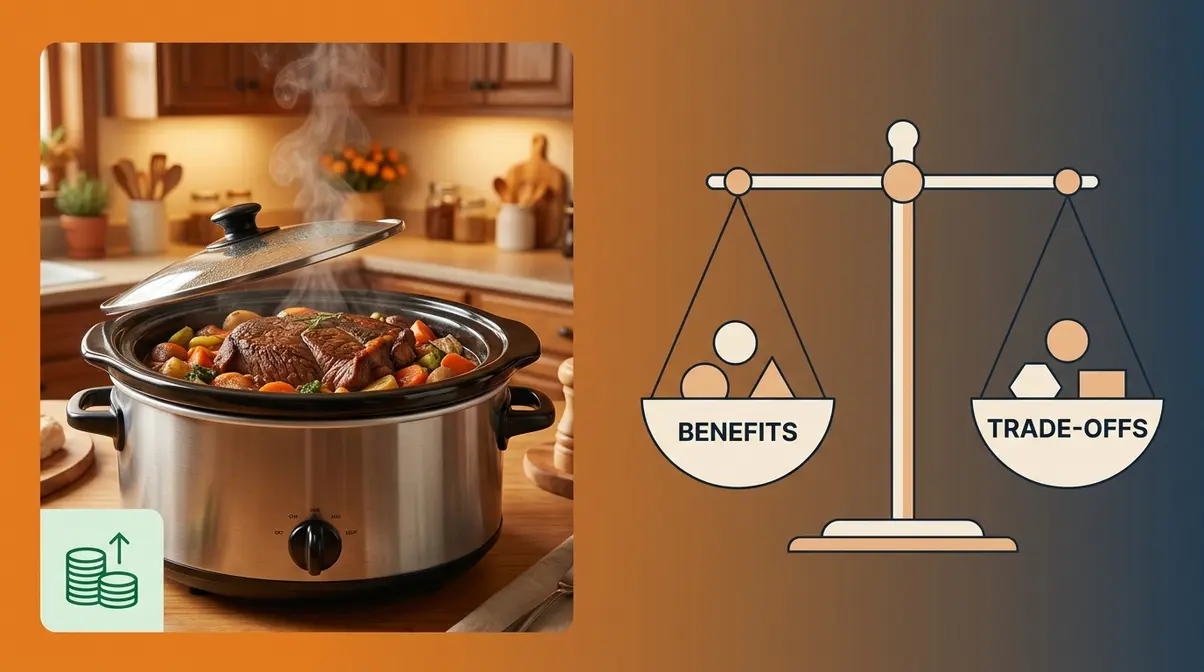
The case for slow cookers is strong — but it’s not unconditional. A fair answer requires looking at both sides, so here’s an honest breakdown of where the appliance genuinely delivers and where it falls short.
The Case For: Real Benefits That Add Up
Energy savings on the right recipes are genuine. For long-cook dishes — pot roasts, dried bean soups, pulled pork, bone broth, whole chicken — the slow cooker consistently uses 50–80% less electricity than a conventional oven for the same result. At three slow-cooker meals per week replacing oven sessions, annual savings of $25–$50 are realistic at average US rates.
Convenience is a real multiplier. The “set it and forget it” model means active cooking time is measured in minutes, not hours. This has practical value beyond electricity: it reduces gas or electricity used for stovetop monitoring, eliminates the need to stand over a pot, and allows meals to be ready at a precise time without supervision.
Cheaper cuts become better meals. Slow cookers excel at transforming tough, inexpensive cuts — chuck roast, pork shoulder, chicken thighs, lamb neck — into tender, flavourful dishes. The energy-efficient appliance and the budget-friendly ingredient reinforce each other. User consensus across cooking communities consistently rates this as the slow cooker’s single greatest practical benefit.
Annual cost to run is genuinely low. Cooking three times per week, 52 weeks per year, at an average of 17 cents per session works out to roughly $26.52 per year in electricity. That is less than most households spend on a single takeaway meal.
The Honest Downsides
It cannot replace every cooking method. Slow cookers cannot brown or sear, cannot bake, and cannot produce crispy textures. Recipes requiring high, dry heat — roasted vegetables, bread, pizza — are simply outside its capability. For those tasks, the oven or air fryer remains the right tool.
Long cook times require planning. You cannot decide at 6pm to have slow-cooker pulled pork for dinner at 7pm. The appliance rewards planners and punishes impulse cooks. This is less a flaw than a trade-off — but it’s worth naming honestly.
It is not always the cheapest option per meal. This is the core insight of The Per-Meal Principle: for quick meals (reheating, cooking pasta, making eggs), the microwave or stovetop will always be cheaper because cook time is so short. The slow cooker wins on long cooks — period.
Size and counter space matter. A 7-quart slow cooker is a substantial appliance. For small households or compact kitchens, the counter footprint may outweigh the savings.
How to Maximize Your Slow Cooker’s Efficiency
Knowing that slow cookers are energy efficient is one thing — making sure yours actually runs efficiently is another. These practical strategies ensure you’re getting the most from every session, with the smallest possible impact on your electricity bill.
What to Cook (and What to Avoid)
The slow cooker’s efficiency advantage is recipe-specific. Matching the appliance to the right dishes is the single most impactful thing you can do to keep running costs low and meal quality high.
Best dishes for energy efficiency:
- Tough meat cuts: Chuck roast, pork shoulder, lamb shank, chicken thighs — these benefit from 6–10 hours of gentle heat and would require 2+ hours in an oven.
- Dried beans and legumes: Black beans, chickpeas, lentils — a slow cooker handles these beautifully without the stovetop monitoring that wastes gas or electricity.
- Bone broth and stock: 10–12 hours on low extracts maximum nutrition from bones at a total cost of around 20–25 cents.
- Root vegetable stews: Carrots, parsnips, potatoes — long, slow heat breaks down their starches and develops flavour in a way fast cooking cannot replicate.
- Oatmeal overnight: Set it before bed, wake up to breakfast. The low-setting cook costs roughly 5–8 cents for a full pot.
Dishes to avoid (better suited to other appliances):
- Pasta and rice: These absorb too much liquid and turn mushy in a slow cooker. A stovetop pot uses less total energy for a 10-minute cook.
- Dairy-heavy sauces: Milk, cream, and soft cheeses can curdle or separate over long cook times. Add them in the final 15–30 minutes instead.
- Delicate fish and seafood: Most fish is fully cooked in 20–30 minutes — a slow cooker will overcook it into mush within the first hour.
- Quick-cooking vegetables: Peas, courgette, and spinach turn grey and mushy after hours of heat. Add these in the final 30 minutes.
Best Practices for Energy-Efficient Cooking
These habits directly reduce your slow cooker’s electricity consumption and deliver better meals at the same time:
Match pot size to portion size. For 1–2 people, use a 1.5–3 quart model. For families of 4+, a 5–6 quart is appropriate. Avoid running a large cooker half-empty — the heating element draws the same wattage regardless of how much food is inside.
Fill the insert correctly. Aim for half to two-thirds full. Too little food means the cooker heats proportionally more air; too much food impedes even heat distribution and can push cook times beyond the recipe’s stated range.
Use the low setting whenever possible. Low setting (75–150 W) uses roughly half the electricity of high setting (150–250 W) for the same finished result on most recipes — it just takes longer. For an 8-hour workday cook, low is almost always the right choice.
Keep the lid on. As established in the hidden drains section, each unnecessary lid lift adds 15–30 minutes of cook time (Utah State University Extension). Keeping the lid sealed from start to finish is the simplest efficiency habit available.
Defrost before cooking. Placing frozen ingredients in a slow cooker forces the appliance to work harder and longer to bring food through the temperature danger zone. Always thaw meat in the refrigerator overnight before adding it to the insert.
Use a timer. If your model doesn’t have a built-in timer, a basic plug-in outlet timer costs under $10 and eliminates extended keep-warm waste automatically.
When a Slow Cooker Is Not the Right Choice
The Per-Meal Principle cuts both ways. Just as it reveals when the slow cooker wins, it also shows clearly when it doesn’t — and choosing the wrong appliance is a hidden cost that never appears on an electricity bill.
When Another Appliance Wins on Energy
For meals under 30 minutes: The microwave and air fryer both win decisively on per-meal energy cost for quick tasks. Reheating a bowl of soup in the microwave costs 1–3 cents. Cooking chicken breasts in an air fryer for 18 minutes costs around 8 cents. Neither of these tasks benefits from a slow cooker — and forcing them into one results in worse food and higher energy use.
For single servings: Running a 6-quart slow cooker for 8 hours to produce one portion of stew costs the same as feeding a family of six. The energy-per-serving ratio collapses for small portions. An Instant Pot or electric pressure cooker (typically 700–1,000 W for 20–40 minutes) is often the more efficient choice for single-serve or two-person meals that don’t require all-day cooking.
For browning-required recipes: Any recipe that starts with searing meat, toasting spices, or caramelizing onions will require a separate stovetop step anyway. If the majority of the recipe’s active cooking happens on the hob, the slow cooker adds a step rather than replacing one.
When to Reconsider Your Current Model
If your slow cooker was manufactured before 2010, it may draw closer to the upper end of its wattage range due to older heating element technology. Testing data from multiple sources suggests pre-2010 models can draw 10–20% more electricity than current equivalents for the same cook. If your appliance is showing signs of age — uneven heating, a cracked ceramic insert, or a lid that no longer seals tightly — replacing it with a modern model will likely recover its cost in energy savings within 1–2 years of regular use.
Consider consulting an electrician or appliance specialist if you notice the slow cooker tripping circuit breakers, running noticeably hotter than it used to, or drawing significantly more power than the rated wattage suggests. These are signs of component degradation, not normal operation.
Frequently Asked Questions
What are the disadvantages of a slow cooker?
Slow cookers have four main disadvantages worth knowing before you rely on one. First, they cannot brown, sear, or crisp food — you’ll need a separate pan for those steps. Second, cook times are long (4–10 hours), requiring advance planning. Third, they’re not efficient for small, quick meals — a microwave or air fryer costs less per session for tasks under 30 minutes. Fourth, delicate ingredients like dairy, pasta, and seafood perform poorly in extended low-heat environments.
How much does it cost to run a slow cooker for 4 hours?
A slow cooker running for 4 hours costs approximately 10–17 cents at US electricity rates ($0.17/kWh). The exact figure depends on wattage: a 150-watt model uses 0.6 kWh (about 10 cents); a 250-watt model uses 1.0 kWh (about 17 cents). In the UK at ~25p/kWh, the same 4-hour session costs roughly 15–25 pence. Always check your electricity bill for your actual rate, as costs vary by region and tariff (EIA, 2026).
Which is cheaper to run — a slow cooker or an air fryer?
It depends entirely on the recipe. For short cooks under 30 minutes, an air fryer (1,400–1,800 W for 15–20 minutes = 0.35–0.60 kWh) can cost less per session than a slow cooker running 6–8 hours. For long braises and stews, the slow cooker wins — its 8-hour low-setting session uses 0.6–1.2 kWh versus the air fryer’s inability to replicate those recipes at all. This is The Per-Meal Principle: the cheapest appliance changes with the dish (BBC News, 2024).
Does a slow cooker use up a lot of electricity?
No — slow cookers use surprisingly little electricity. Most models draw 75–250 watts, compared to 2,000–2,500 watts for a conventional oven. An 8-hour session on low uses roughly 0.6–1.2 kWh — less than a single hour of oven use. At the US average rate of $0.17/kWh, a full day of slow cooking costs under 20 cents. Running it three times a week for a full year costs approximately $26–$31 in total electricity (Modern Kitchen Cookware, 2026).
What should not be cooked in a slow cooker?
Several foods perform poorly or become unsafe in a slow cooker. Frozen meat should never go in directly — it takes too long to pass through the bacterial danger zone (40°F–140°F), raising food safety risks (USDA Food Safety and Inspection Service). Pasta and rice turn mushy after hours of moisture exposure. Delicate fish overcooks within the first hour. Dairy products like milk and soft cheese can curdle or separate. Add these ingredients in the final 15–30 minutes of cooking instead.
What’s the most expensive thing to run in a house?
Home heating and cooling systems are typically the most expensive appliances to run, accounting for roughly 40–50% of the average household electricity bill (US Energy Information Administration). Among kitchen appliances, the electric oven is one of the costliest at 2,000–2,500 watts. In comparison, a slow cooker at 75–250 watts is one of the cheapest cooking appliances to operate. Switching long-cook oven recipes to a slow cooker is one of the easiest kitchen-level ways to reduce your electricity bill.
What are some mistakes people make using a slow cooker?
The five most common slow cooker mistakes that increase energy costs and reduce meal quality are: (1) lifting the lid during cooking, which adds 15–30 minutes of cook time per lift (Utah State University Extension); (2) leaving keep-warm mode running for hours after the meal is ready, wasting electricity and risking food quality; (3) using a pot that’s too large for the portion size; (4) placing frozen meat directly in the insert; and (5) overfilling beyond two-thirds capacity, which impedes even heat distribution and extends cook time.
What are the disadvantages of using a slow cooker vs. other methods?
Compared to faster appliances, a slow cooker’s main disadvantages are time and versatility. It cannot replace an oven for roasting, baking, or browning. It cannot compete with a microwave or air fryer on speed — or on per-session cost for quick meals. It rewards planners: a 6-hour recipe cannot be started at 5pm for a 6pm dinner. For households that cook spontaneously or mainly prepare quick meals, an air fryer or Instant Pot may deliver better value, since the slow cooker’s efficiency advantage only materializes on long-cook recipes.
Making the Numbers Work for Your Kitchen
For cost-conscious home cooks, slow cookers are genuinely energy efficient — but only when used for the right recipes. A typical 200-watt model running on low costs roughly 10–17 cents per 4-hour session at the US average rate of $0.17/kWh (EIA, 2026), and a full 8-hour braise uses less total electricity than a single hour of oven operation. That is a real, measurable advantage worth keeping on your counter.
The Per-Meal Principle is the framework that makes these numbers actionable: stop comparing appliances by wattage and start comparing them by total kWh per finished dish. The slow cooker wins on long braises and stews. The air fryer wins on quick weeknight meals. The microwave wins on reheating. Matching the appliance to the recipe is how you trim your bill without sacrificing a single meal.
The next step is straightforward: identify two or three recipes you currently cook in the oven for longer than 45 minutes — a pot roast, a bean soup, a whole chicken — and try them in the slow cooker instead. Check the label on your appliance for its wattage, apply the three-step formula from this guide, and calculate your actual savings. Give it four weeks of regular use, then compare that section of your electricity bill to the month before. The numbers will do the rest.

Dave King
Recipe developer and writer at Quick Dish Cookbook.
![How Long to Cook Pork Shoulder at 250°F [Chart]](https://quickdishcookbook.com/wp-content/uploads/2026/07/pork-shoulder-cook-time-250f-720x450.webp "How Long To Cook Pork Shoulder At 250°F [Chart] 8")