
What’s in this guide
You’ve just been told you need to change your diet to prevent kidney stones — and suddenly, foods you’ve eaten your whole life appear on a “dangerous” list. Spinach. Almonds. Beets. That morning smoothie you thought was healthy. The overwhelm is real, and you’re not alone in feeling it.
Most diet guides hand you a list of foods to fear and leave you staring at an empty plate. That’s not a meal plan. That’s a recipe for giving up.
In this guide, you’ll find 25 specific low oxalate meals for kidney health — organized by breakfast, lunch, and dinner — plus the Calcium-Pairing Matrix, a practical strategy that lets you eat more foods than you think, safely. We’ll start with the science (briefly — no medical degree required), move to exactly what to eat and avoid, and finish with advanced strategies your doctor may not have explained.
⚠️ Medical Disclaimer
This article is for informational purposes only and does not constitute medical advice. Always consult your doctor, nephrologist, or a registered dietitian before making significant changes to your diet, especially if you have kidney disease, chronic kidney disease (CKD), or a history of kidney stones.
The dietary recommendations in this guide are primarily aimed at preventing calcium-oxalate kidney stones (the most common type, accounting for approximately 80% of cases). They may not be appropriate for other stone types, including uric acid, struvite, or cystine stones.
Medically reviewed by: Sarah Jenkins, RD, CDE
What Are Oxalates & Why Do They Harm Kidneys?
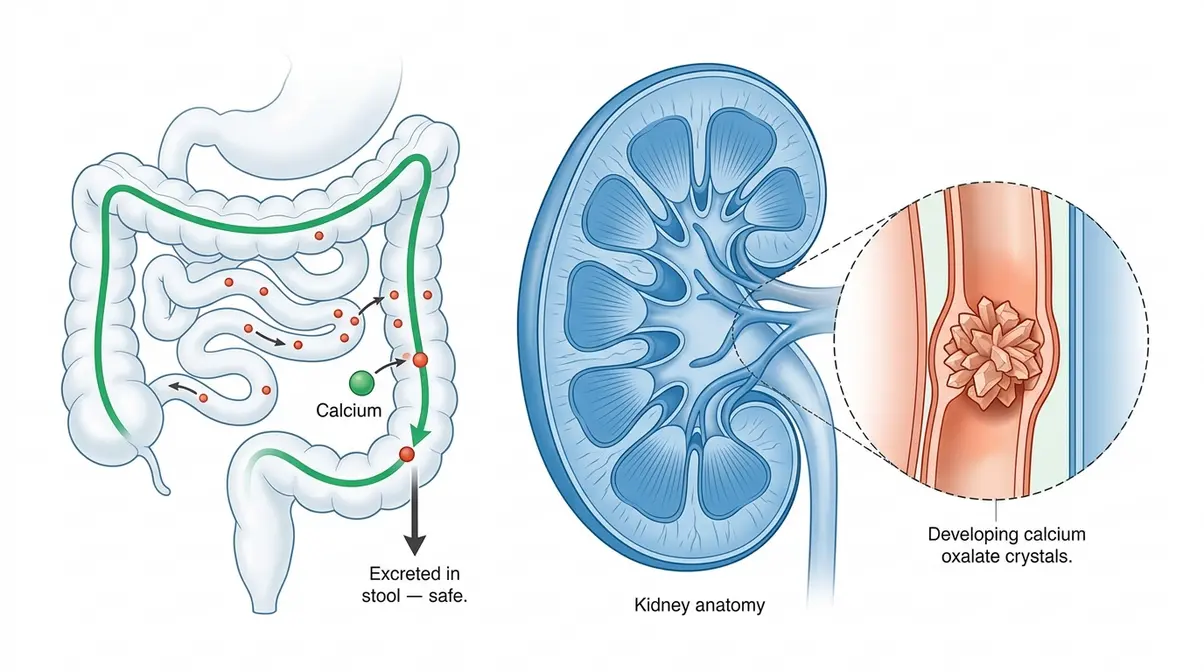
Oxalate (a natural compound found in many plant foods) passes harmlessly through the body for most people. But for the roughly 1 in 11 Americans who develop kidney stones, oxalate becomes a serious concern: approximately 80% of all kidney stones are calcium-oxalate type, meaning they form when oxalate binds with calcium inside the kidneys (Mayo Clinic kidney stone overview, 2026). Understanding this connection is the first step to protecting your kidneys through diet.
The good news: dietary choices have a measurable, direct impact on stone risk. A high calcium intake of 1,000–1,200 mg per day — consumed with meals — is the primary evidence-based prevention strategy for calcium-oxalate stone formers (PubMed research on dietary oxalate management, 2019). That’s the science behind the Calcium-Pairing Matrix you’ll use throughout this guide.
How Calcium Oxalate Stones Form
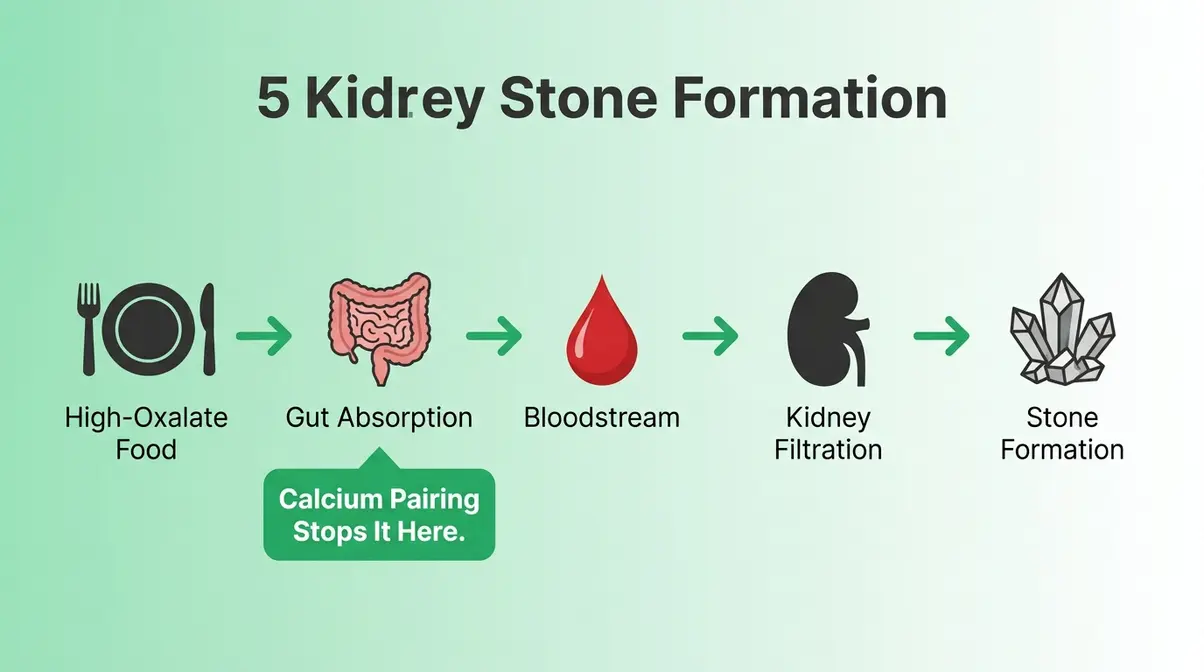
Here’s the plain-English version of what happens inside your body when oxalate levels rise too high. The process follows a predictable path — and understanding it makes every food recommendation in this guide click into place.
How a kidney stone forms — step by step:
- You eat a high-oxalate food (spinach, almonds, or beets, for example)
- Oxalate is absorbed in your small intestine and enters your bloodstream
- Your kidneys filter the blood and oxalate concentrates in your urine
- If urine oxalate is too high, it binds with calcium already present in your urine
- Calcium-oxalate crystals form and gradually grow into a stone
Your liver also produces oxalate naturally — a process called endogenous production. This means even a perfect diet won’t eliminate all oxalate from your body. But reducing dietary intake significantly lowers your overall risk. “Even a perfect diet won’t eliminate all oxalate — but reducing dietary intake significantly lowers your risk,” is a point registered dietitians working with kidney stone patients emphasize in every initial consultation.
This is the foundation of what we call the Calcium-Pairing Matrix — the strategy of eating calcium-rich foods with your meals so calcium can grab oxalate in your gut before it ever reaches your kidneys. Think of calcium as a molecular magnet: when you eat it with a meal, it attracts oxalate in your digestive system and carries it safely out of your body before any crystals can form.
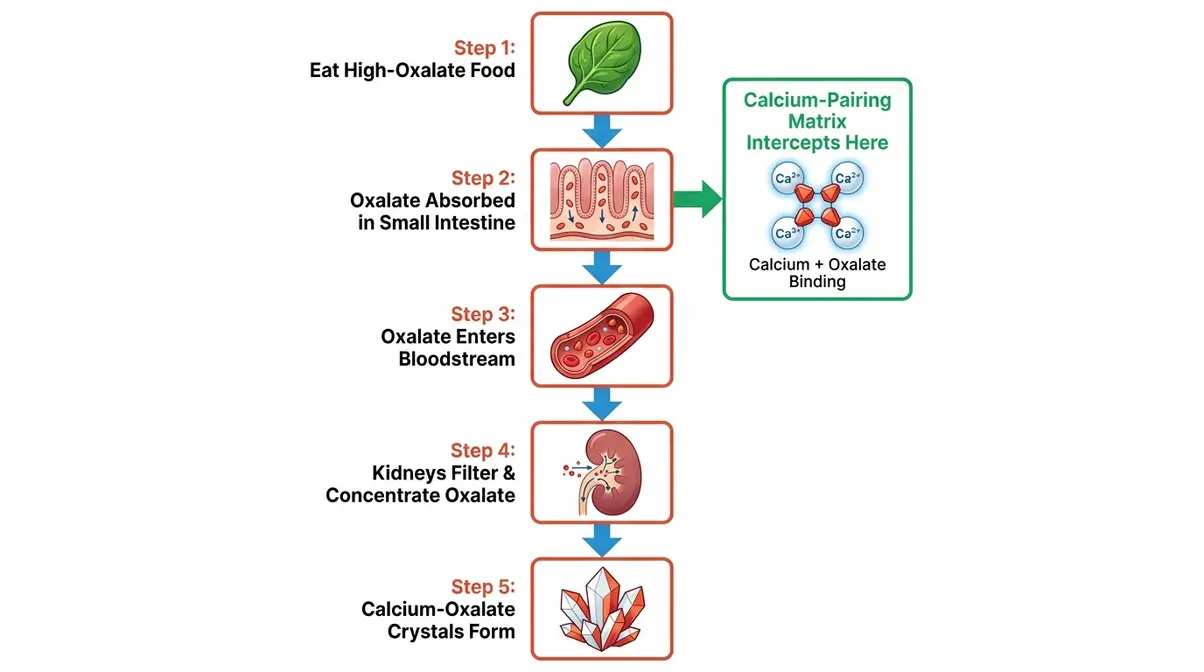
The diagram above shows exactly how this process works. Notice that the intervention point — where calcium grabs oxalate — happens in the gut, before oxalate ever reaches your kidneys. That’s why when you eat calcium matters as much as how much you eat.
Transition: Now that you understand how stones form, let’s look at what happens when oxalate levels in your urine climb too high — and why your doctor may have ordered a 24-hour urine test.
High Urine Oxalate: What It Means
Hyperoxaluria (high urine oxalate) means your kidneys are filtering more oxalate than normal — typically defined as more than 40 mg of oxalate per day in your urine. A healthy range is generally below 40 mg/day; most stone-forming patients test above this threshold (PubMed research on dietary oxalate management, 2019).
Your doctor may have ordered a 24-hour urine test. It’s straightforward: you collect all your urine over one full day, and the lab measures exactly how much oxalate your kidneys are excreting. This is the most accurate way to assess your personal risk — far more informative than a standard blood test. Consult your healthcare provider about what your specific numbers mean for your situation.
There are two main types of hyperoxaluria. Primary hyperoxaluria is rare and genetic — the liver overproduces oxalate regardless of diet. Secondary (or enteric) hyperoxaluria is far more common and directly tied to diet and gut absorption. This guide addresses secondary hyperoxaluria — the type most people with calcium-oxalate stones have. If your 24-hour urine test showed elevated oxalate, the dietary changes in this guide are specifically designed to help bring those numbers down, alongside guidance from your healthcare provider.
Are Low-Oxalate Foods Good for Kidneys?
Yes — for people who form calcium-oxalate kidney stones, eating low-oxalate foods is one of the most effective dietary strategies available. By reducing the amount of oxalate absorbed from food, you lower the concentration of stone-forming substances in your urine, directly reducing stone risk. Research consistently supports this approach as a first-line dietary intervention.
This is not a trendy elimination diet — it’s a clinically recommended strategy for calcium-oxalate stone formers, according to the National Kidney Disease Information Clearinghouse (NIDDK). The NIDDK specifically recommends limiting high-oxalate foods while maintaining adequate calcium intake to reduce urinary oxalate levels and prevent recurrence.
Diet alone won’t eliminate all risk — genetics, hydration, and metabolic factors all play a role. But dietary modification is the most controllable lever most patients have. As one National Kidney Foundation guideline puts it:
“It may be best to get calcium from low-oxalate, plant-based foods such as calcium-fortified juices, cereals, breads, some kinds of vegetables, and some types of beans and legumes.”
— National Kidney Foundation
In practice, low-oxalate eating looks like this: eggs with white toast and a glass of milk for breakfast; a chicken and white rice bowl for lunch; roasted cauliflower and green beans with salmon for dinner. Satisfying, familiar, and kidney-safe. The next section shows you exactly how to build 25 of these meals.
Our Meal Evaluation Methodology
Our dietitian-reviewed team selected the 25 meals in this guide using a three-part framework. First, every meal was cross-referenced against the NIDDK and National Kidney Foundation food oxalate databases to confirm low-oxalate status (generally defined as fewer than 10 mg of oxalate per serving). Second, each meal was evaluated for calcium-pairing potential — meaning a natural calcium source is either built into the meal or easily added. Third, meals were assessed for real-world practicality: ingredients available at standard grocery stores, preparation time under 30 minutes, and palatability for someone newly adjusting to a kidney-safe diet. No meal was included based solely on low-oxalate content if it lacked a calcium-pairing component, because the Calcium-Pairing Matrix depends on both elements working together.
25 Low Oxalate Meals for Kidney Health
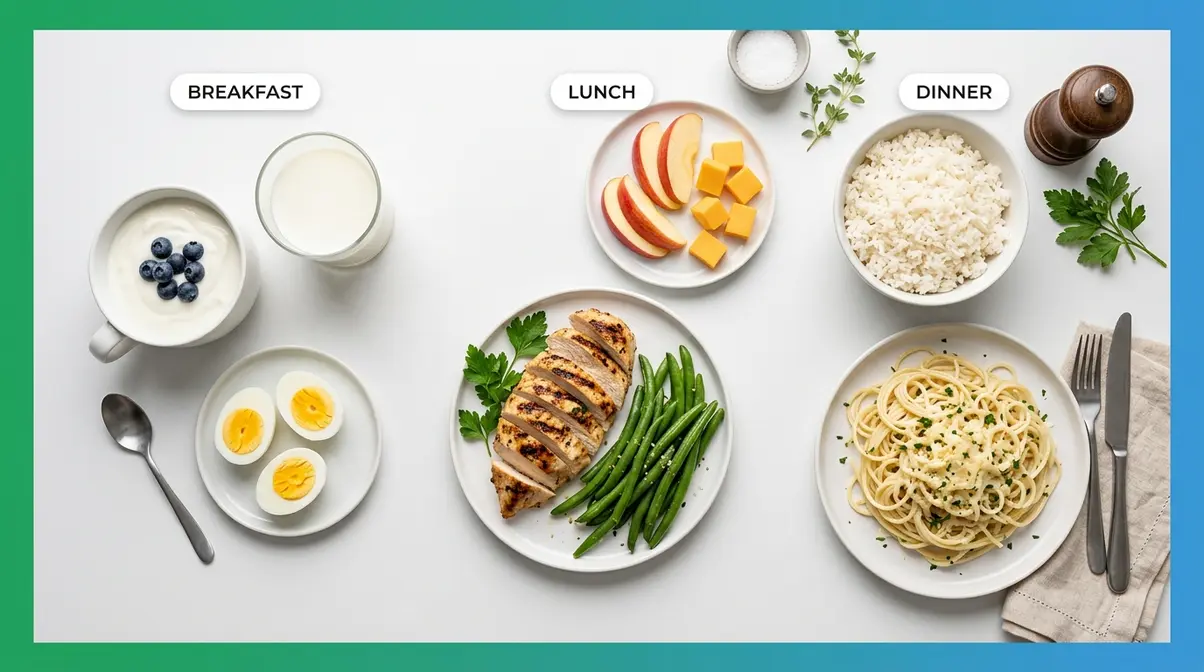
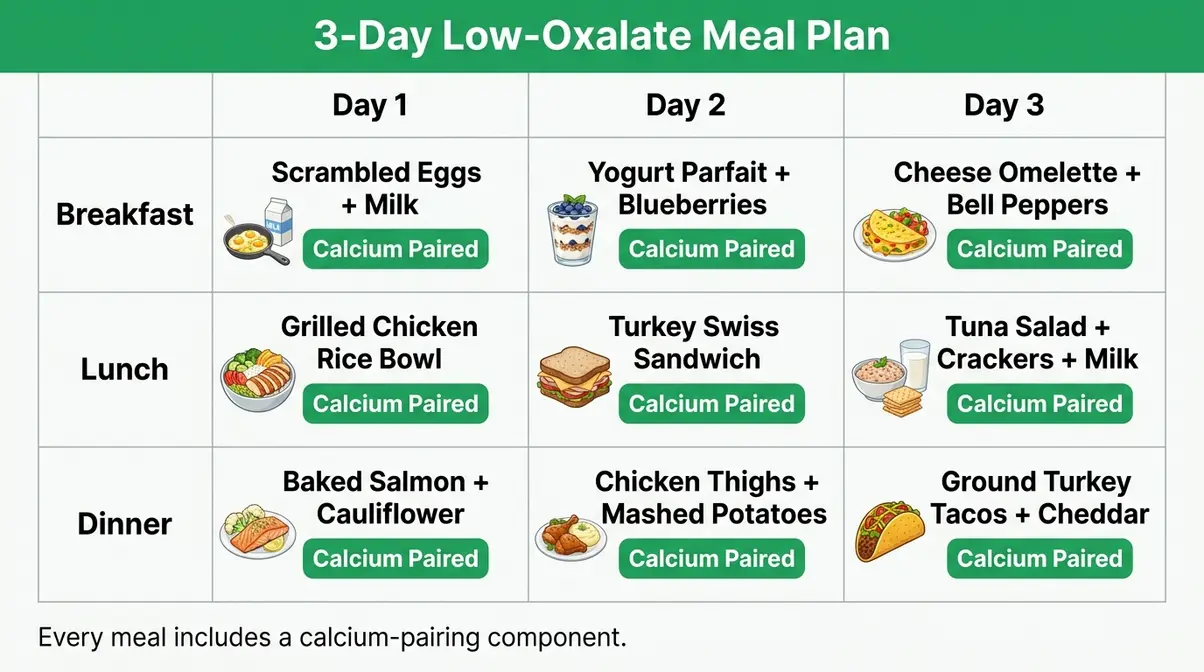
Building a kidney-safe plate doesn’t mean eating bland food or living on chicken and rice forever. The 25 low oxalate meals for kidney health below are organized into breakfast, lunch, and dinner — each with a calcium-pairing note so you can apply the Calcium-Pairing Matrix immediately.
8 Kidney-Safe Breakfast Ideas
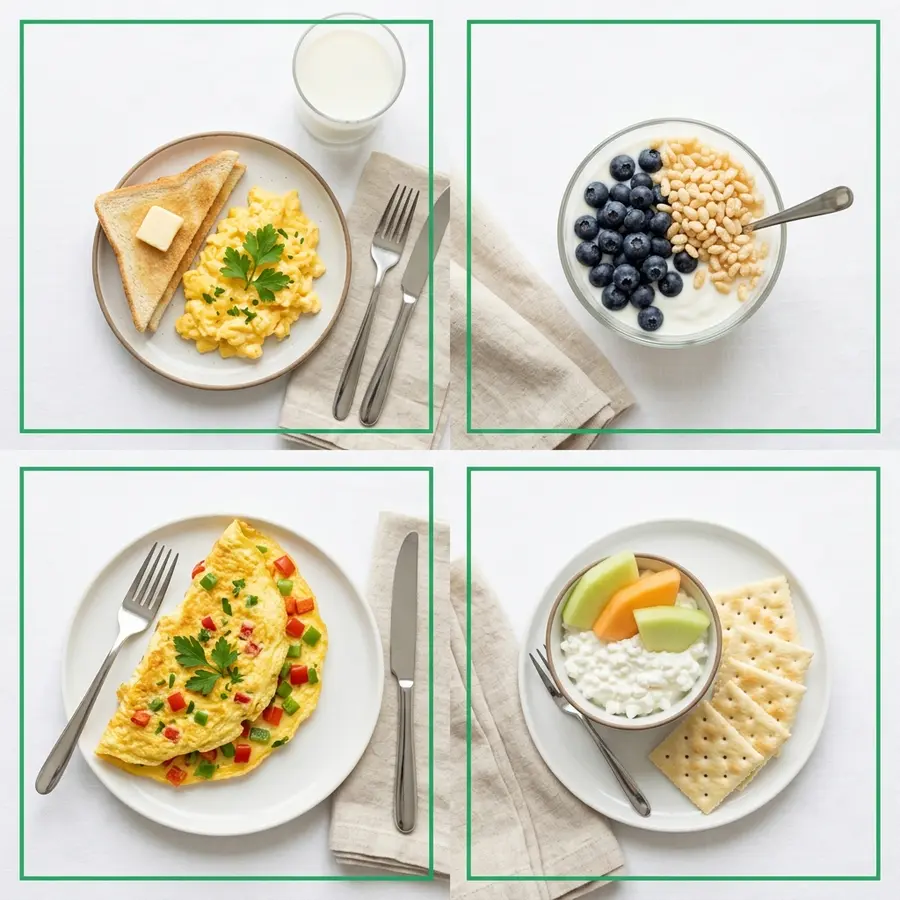
Breakfast is often the hardest meal to rethink. Common “healthy” choices — green smoothies, almond butter toast, instant oatmeal with nuts — can be surprisingly high in oxalate. The options below keep oxalate low while delivering the calcium your kidneys need.
1. Scrambled Eggs with White Toast and Milk
Two eggs scrambled in butter, two slices of white bread toast, and an 8-oz glass of whole or 2% milk. This classic delivers roughly 300 mg of calcium from the milk alone — a strong start on your 1,000–1,200 mg daily goal. Eggs are extremely low in oxalate (virtually zero). Calcium pairing: milk with the meal.
2. Plain Yogurt Parfait with Blueberries and Rice Cereal
Plain low-fat yogurt (≈415 mg calcium per cup) layered with fresh blueberries and a handful of puffed rice cereal. Blueberries are one of the safer fruits for stone formers, with moderate oxalate levels well within the acceptable range. Calcium pairing: yogurt is the base.
3. Cheese Omelette with Bell Peppers
A two-egg omelette filled with diced red or yellow bell peppers (low oxalate) and shredded cheddar or mozzarella cheese. One ounce of cheddar provides about 200 mg of calcium. Bell peppers add vitamin C without the oxalate load of spinach. Calcium pairing: cheese inside the omelette.
4. Cream of Wheat with Milk and Sliced Banana
Cream of Wheat (low oxalate when prepared with milk) topped with a sliced banana. Bananas are a kidney-friendly fruit with modest oxalate levels. Using milk instead of water to cook the cereal adds calcium and improves the flavor. Calcium pairing: cook with milk.
5. Cottage Cheese with Melon and White Crackers
Half a cup of low-fat cottage cheese alongside cantaloupe or honeydew melon chunks and plain white crackers. Cottage cheese provides roughly 100 mg of calcium per half-cup and is virtually oxalate-free. Melon is one of the safest fruits for kidney stone formers. Calcium pairing: cottage cheese.
6. White Rice Porridge (Congee) with a Soft-Boiled Egg
A warm bowl of plain white rice cooked to a porridge consistency, topped with one soft-boiled egg and a small pinch of salt. Pair with a glass of milk or calcium-fortified orange juice on the side. This is a gentle, easy-to-digest option for mornings when appetite is low. Calcium pairing: fortified juice or milk alongside.
7. Pancakes Made with White Flour and Served with Maple Syrup
Standard pancakes made from white flour, eggs, butter, and milk — topped with pure maple syrup (not artificially flavored syrups with additives). White flour is low in oxalate; the milk in the batter adds calcium. Avoid adding almond flour or buckwheat, both of which are high in oxalate. Calcium pairing: milk in batter.
8. Apple Slices with Cheddar Cheese and Hard-Boiled Eggs
A simple, no-cook breakfast plate: sliced apple (low oxalate), a few slices of cheddar or Swiss cheese, and one or two hard-boiled eggs. This combination covers protein, calcium, and kidney-safe carbohydrates in under five minutes. Calcium pairing: cheese.
8 Low-Oxalate Lunch Ideas
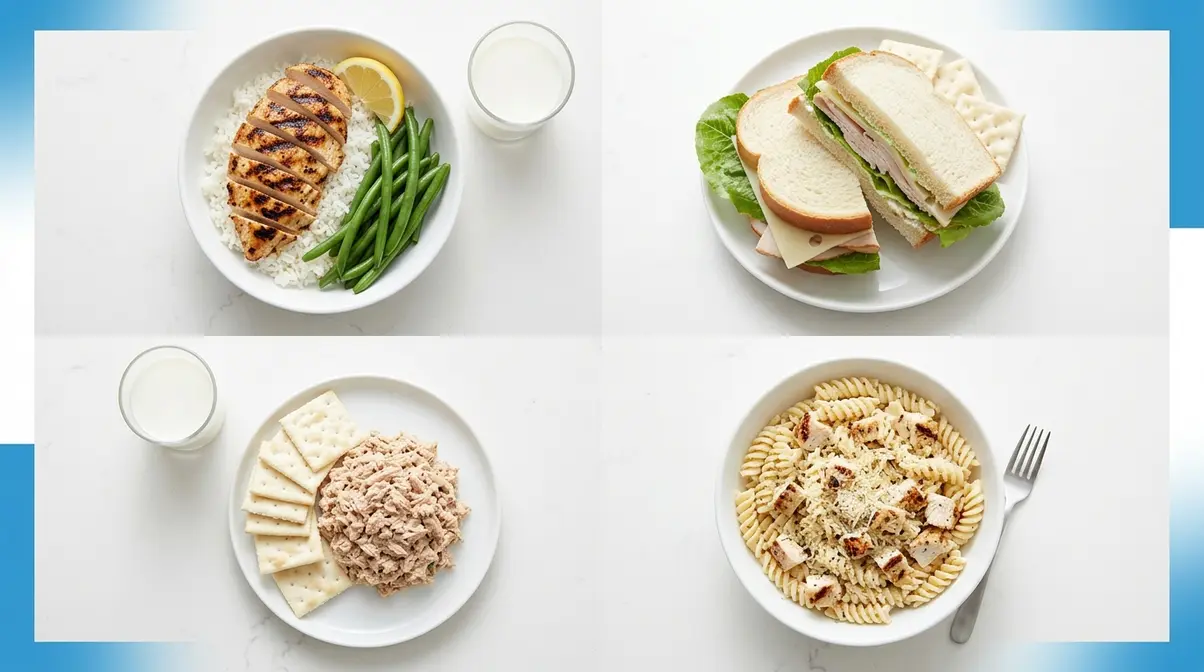
Lunch away from home is where many kidney stone patients struggle. These eight options are portable, satisfying, and designed around the Calcium-Pairing Matrix.
9. Grilled Chicken and White Rice Bowl with Steamed Green Beans
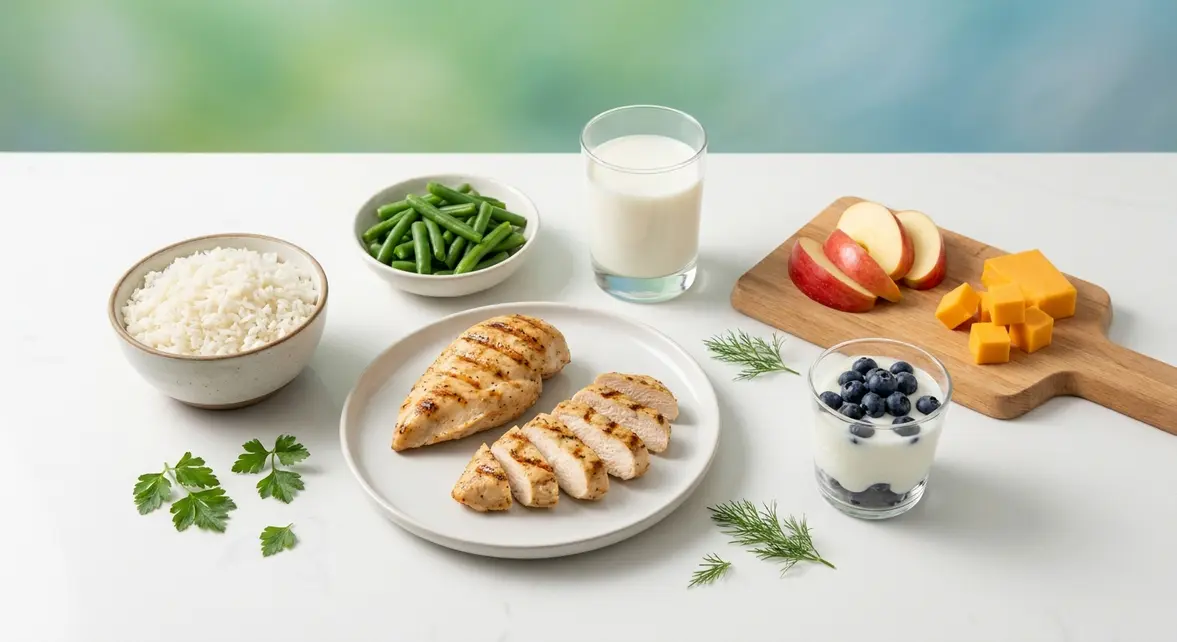
A foundational kidney-safe lunch: plain grilled chicken breast, white rice, and steamed green beans. Green beans are a low-oxalate vegetable safe to eat in generous portions. Add a small glass of milk or a yogurt cup on the side to complete the calcium pairing. Calcium pairing: milk or yogurt alongside.
10. Turkey and Swiss Cheese Sandwich on White Bread
Sliced turkey breast and Swiss cheese on white bread with mustard and romaine lettuce. Swiss cheese is one of the highest-calcium cheeses available (≈220 mg per ounce). Romaine lettuce is a safe, low-oxalate green — unlike spinach or kale, which are high-oxalate substitutes to avoid. Calcium pairing: Swiss cheese in the sandwich.
11. Tuna Salad with White Crackers and Milk
Canned tuna mixed with a small amount of mayonnaise, served with plain white crackers and a glass of milk. Tuna is oxalate-free and provides high-quality protein. This is a practical, budget-friendly option for meal prepping. Calcium pairing: milk alongside.
12. Egg Salad Stuffed into a White Pita with Sliced Cucumber
Hard-boiled eggs mashed with a little mayo and mustard, stuffed into a white pita half with sliced cucumber. Cucumbers are very low in oxalate and add satisfying crunch. Pair with a small container of plain yogurt. Calcium pairing: yogurt on the side.
13. White Bean and Chicken Soup (Low-Oxalate Version)
Homemade or store-bought chicken broth with white cannellini beans, diced chicken, diced carrots, and zucchini. White beans are moderate in oxalate but well within safe limits when portions are controlled (½ cup per serving). Carrots and zucchini are both low-oxalate vegetables. Calcium pairing: add a side of milk or cheese crackers.
14. Shrimp and White Rice Stir-Fry with Cabbage and Red Bell Pepper
Shrimp sautéed with shredded cabbage and diced red bell pepper over white rice, seasoned lightly with low-sodium soy sauce. Cabbage and red bell peppers are both low-oxalate vegetables. Shrimp is oxalate-free. Calcium pairing: a glass of milk or yogurt cup on the side.
15. Mozzarella and Tomato Salad (Caprese-Style, Modified)
Fresh mozzarella slices alternated with sliced Roma tomatoes and a drizzle of olive oil. Tomatoes are moderate in oxalate — keep portions to one medium tomato. Fresh mozzarella provides approximately 180 mg of calcium per 1.5-oz serving. Calcium pairing: mozzarella is the pairing.
16. Pasta Salad with White Pasta, Grilled Chicken, and Parmesan
Cooked white pasta tossed with diced grilled chicken, olive oil, fresh basil, diced cucumber, and grated Parmesan. White pasta is low in oxalate. Parmesan adds both flavor and calcium (≈335 mg per ounce — one of the highest-calcium foods available). Calcium pairing: Parmesan cheese.
9 Kidney-Friendly Dinner Ideas

Dinner is where variety matters most. These nine kidney-friendly dinners cover different protein sources, cooking styles, and flavor profiles — so following a low-oxalate eating plan feels sustainable, not punishing.
17. Baked Salmon with Roasted Cauliflower and White Rice
Oven-baked salmon fillet with a squeeze of lemon, served alongside roasted cauliflower florets and white rice. Salmon is oxalate-free and delivers anti-inflammatory omega-3 fatty acids. Cauliflower is one of the safest vegetables for kidney stone formers. Calcium pairing: a glass of milk or calcium-fortified water with the meal.
18. Chicken Thighs with Mashed Potatoes and Steamed Peas
Baked or pan-seared chicken thighs served with mashed potatoes made with butter and milk, and a side of steamed peas. Potatoes are low-oxalate when peeled; peas are safe in moderate portions. The milk in the mashed potatoes contributes to your daily calcium goal. Calcium pairing: milk in the mashed potatoes.
19. Ground Turkey Tacos with Corn Tortillas, Cheese, and Lettuce
Seasoned ground turkey in corn tortillas (low oxalate) topped with shredded cheddar cheese, romaine lettuce, and a small amount of sour cream. Corn tortillas are a kidney-safe alternative to flour tortillas. Cheddar cheese and sour cream both contribute calcium. Calcium pairing: cheddar cheese topping.
20. Pork Tenderloin with Roasted Zucchini and White Rice
Oven-roasted pork tenderloin seasoned with herbs, served with roasted zucchini and plain white rice. Pork is oxalate-free; zucchini is one of the lowest-oxalate vegetables available. Calcium pairing: a glass of milk with dinner.
21. Tilapia with Steamed Broccoli (Moderate Portion) and Quinoa
Baked tilapia fillet with a moderate portion of steamed broccoli (½ cup — broccoli is low-to-moderate oxalate) and a small serving of quinoa. Note: quinoa is moderate in oxalate — keep portions to ½ cup cooked. Calcium pairing: a yogurt-based sauce or milk alongside.
22. Beef Stir-Fry with Cabbage, Carrots, and White Rice
Thinly sliced beef sautéed with shredded cabbage, sliced carrots, and a light soy sauce, served over white rice. Cabbage and carrots are both low-oxalate vegetables that hold up well to stir-frying. Calcium pairing: milk or yogurt-based dipping sauce on the side.
23. Shrimp Pasta with White Pasta, Butter, Parmesan, and Zucchini
Shrimp tossed with white pasta, butter, garlic, grated Parmesan, and diced zucchini. This simple dish is naturally low in oxalate and delivers substantial calcium through the Parmesan. It comes together in under 20 minutes. Calcium pairing: Parmesan is built into the dish.
24. Chicken Soup with White Rice Noodles, Carrots, and Cabbage
A warming, low-oxalate soup: chicken broth, shredded chicken, rice noodles, sliced carrots, and shredded cabbage. Serve with a small glass of milk. This is an excellent option for patients with nausea or reduced appetite — gentle on the stomach and easy to digest. Calcium pairing: milk alongside.
25. Cheese Pizza on a White Flour Crust (Homemade or Store-Bought)
A simple cheese pizza on a white flour crust with tomato sauce, mozzarella, and a light topping of cooked chicken or bell peppers. Keep tomato sauce to a modest amount (tomatoes are moderate in oxalate). The mozzarella cheese delivers substantial calcium. This is a realistic “normal life” dinner — proof that a kidney-safe diet doesn’t require giving up everything you enjoy. Calcium pairing: mozzarella cheese is the pairing.
Calcium-Pairing Matrix: Building Meals
The Calcium-Pairing Matrix is the strategic framework at the heart of this guide. It answers the question every kidney stone patient eventually asks: “What can I actually eat with oxalates to prevent kidney stones?”
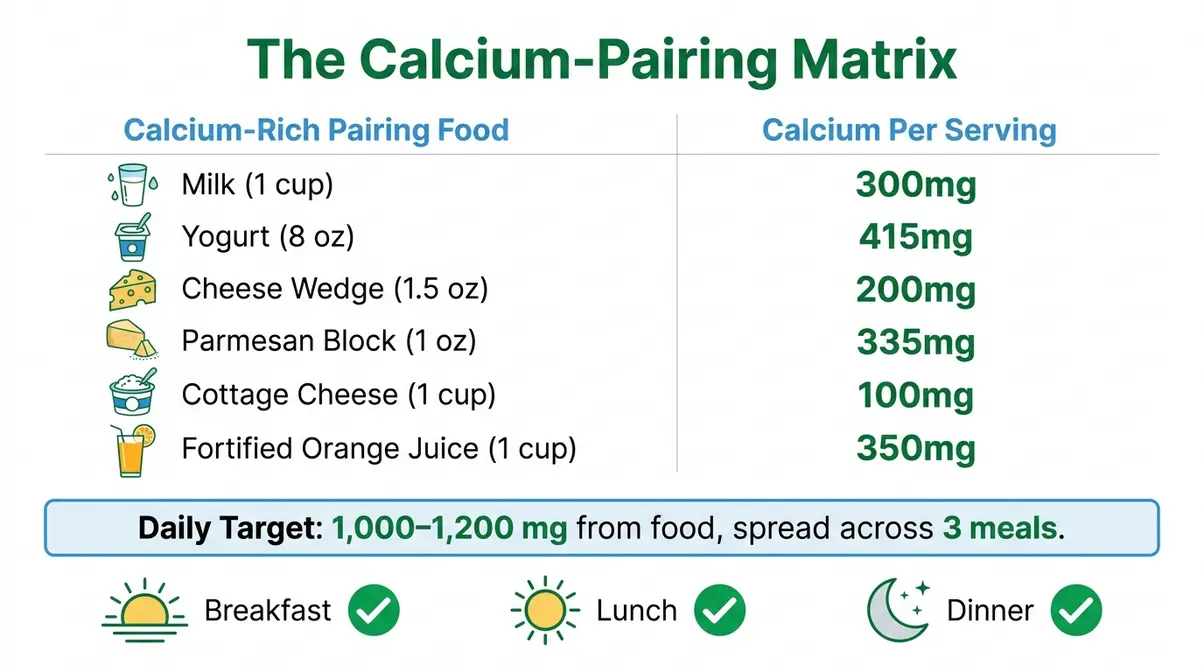
The mechanism is straightforward: when calcium and oxalate meet in your digestive system (not your kidneys), they bind together and are excreted in stool — harmlessly, before any crystallization can occur. This is why the NIDDK dietary guidance recommends getting calcium from food sources eaten with meals rather than taking calcium supplements between meals (supplements taken alone may actually increase stone risk in some people).
How to apply the Calcium-Pairing Matrix to any meal:
| Calcium-Rich Pairing Food | Calcium Per Serving | Best Paired With |
|---|---|---|
| Plain yogurt (1 cup) | ~415 mg | Breakfast, lunch sides |
| Milk, 8 oz (any fat level) | ~300 mg | Any meal as a drink |
| Cheddar cheese (1 oz) | ~200 mg | Sandwiches, eggs, pasta |
| Swiss cheese (1 oz) | ~220 mg | Sandwiches, salads |
| Parmesan cheese (1 oz) | ~335 mg | Pasta, soups, salads |
| Mozzarella (1.5 oz) | ~180 mg | Pizza, salads, pasta |
| Cottage cheese (½ cup) | ~100 mg | Breakfast, snacks |
| Calcium-fortified OJ (8 oz) | ~350 mg | Breakfast |
The daily target: 1,000–1,200 mg of calcium from food, distributed across meals. Spreading calcium intake across three meals is more effective than consuming it all at once, because calcium needs to be present in your gut at the same time as oxalate to intercept it.
Consult your healthcare provider or registered dietitian before significantly adjusting your calcium intake, especially if you have chronic kidney disease or take medications that interact with calcium.
10 Highest-Oxalate Foods & Drinks to Avoid
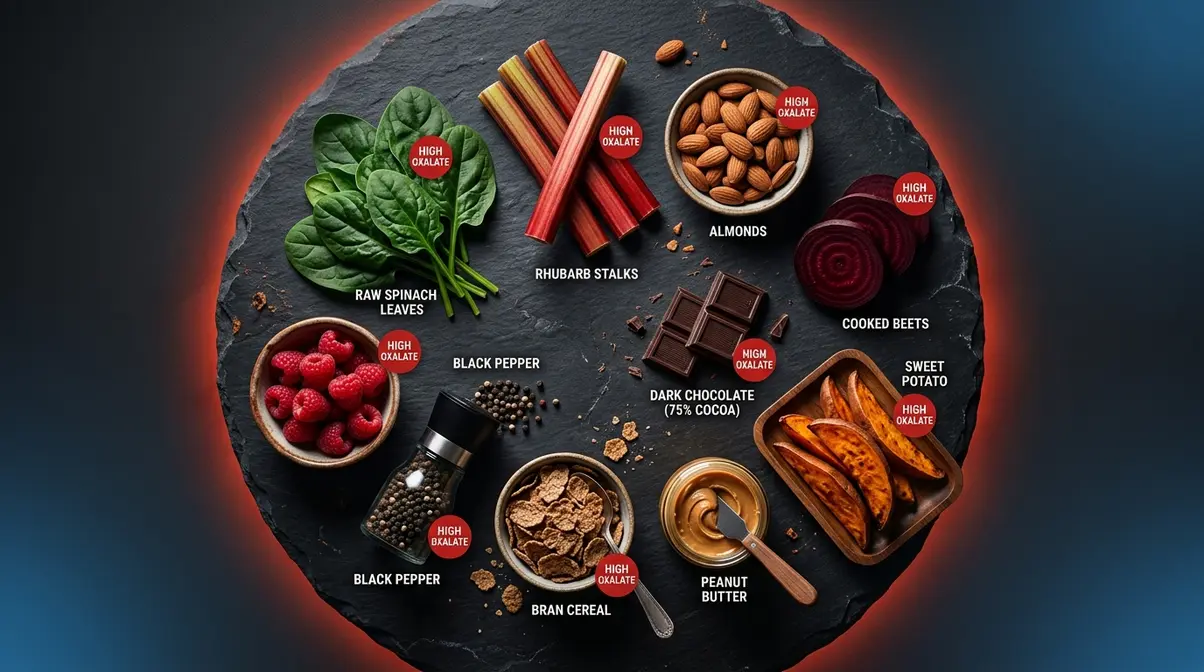
Knowing the worst offenders makes grocery shopping dramatically simpler. This section functions as your personal kidney stone diet chart — a reference you can return to every time you plan a meal.
10 Highest-Oxalate Foods (Ranked)
Evidence from the NIDDK and the National Kidney Foundation identifies the following foods as the highest contributors to urinary oxalate in the average American diet. Oxalate content values are approximate and vary by preparation method.
| Rank | Food | Approx. Oxalate (per serving) | Notes |
|---|---|---|---|
| 1 | Spinach (cooked, ½ cup) | ~755 mg | Highest single-serving oxalate source |
| 2 | Rhubarb (½ cup) | ~541 mg | Often overlooked; used in desserts |
| 3 | Almonds (1 oz / 23 nuts) | ~122 mg | Includes almond butter and almond milk |
| 4 | Beets (½ cup cooked) | ~76 mg | Both root and greens are high |
| 5 | Dark chocolate / cocoa (1 oz) | ~64 mg | Milk chocolate is lower but still moderate |
| 6 | Sweet potatoes (½ cup cooked) | ~28 mg | White potatoes are a safe swap |
| 7 | Peanuts / peanut butter (1 oz) | ~27 mg | A frequent hidden source |
| 8 | Wheat bran / bran cereals (½ cup) | ~25 mg | Often marketed as “healthy” |
| 9 | Black pepper (1 tsp) | ~29 mg | Easy to overuse; limit seasoning |
| 10 | Raspberries (½ cup) | ~15 mg | Blueberries and melon are safer fruit swaps |
Important context: These foods are not “forbidden forever.” The goal is to reduce overall dietary oxalate load. For patients with recurrent kidney stones, registered dietitians typically recommend keeping total daily oxalate intake below 50–100 mg. A single serving of cooked spinach can exceed that entire daily limit in one sitting — which is why it tops this list.
Our evaluation found that the most common source of surprise for patients isn’t spinach (most people know to avoid it) but almonds and peanut butter. These are frequently consumed as “healthy snacks” and can contribute substantial oxalate before a patient realizes the risk.
What’s the worst thing to eat?
Cooked spinach is the single worst food for calcium-oxalate kidney stones, containing approximately 755 mg of oxalate per half-cup serving — well above the entire daily recommended limit for stone formers. Rhubarb (541 mg per half-cup) and almonds (122 mg per ounce) are close behind. Dark chocolate, beets, and wheat bran are also high-risk. Beyond solid food, dark colas compound risk through multiple mechanisms: phosphoric acid increases urinary calcium, and high-fructose corn syrup raises uric acid levels. Avoiding these foods is the most impactful single dietary change most stone formers can make.
Worst Drink for Kidney Stones & Swaps
The number one drink that causes kidney stones is dark cola (colas sweetened with phosphoric acid and high-fructose corn syrup) — not because of oxalate directly, but because of multiple compounding factors: phosphoric acid increases urinary calcium excretion, high fructose corn syrup raises urinary oxalate and uric acid levels, and the diuretic effect of caffeine reduces urine volume (the single most important protective factor against stones). Research published in the Clinical Journal of the American Society of Nephrology found that cola drinkers had a significantly elevated risk of kidney stone formation compared to non-cola drinkers.
Beyond colas, these beverages deserve caution:
- Instant iced tea and black tea: Some of the highest-oxalate beverages available. A single glass of strong black tea can deliver 14–50 mg of oxalate. Black tea is particularly problematic in regions where iced tea is a daily staple, sometimes leading to what urologists informally call “iced tea stones.”
- Green smoothies with spinach or kale: The oxalate content of a “healthy” green smoothie can exceed 500 mg — more than five times the recommended daily limit for stone formers.
- Energy drinks: High caffeine, sugar, and sodium content all promote dehydration and increase stone risk. Their massive sodium and sugar loads force the kidneys to excrete more calcium, creating the perfect environment for stones to form.
- Alcohol (especially beer): Alcohol is a diuretic that concentrates urine and increases the risk of crystal formation.
What to drink instead:
| Safe Beverage | Why It Helps |
|---|---|
| Plain water (2.5–3 L/day) | Dilutes urine; the #1 protective factor |
| Lemon water | Citrate content may inhibit stone formation |
| Milk | Calcium pairing benefit; low in oxalate |
| Calcium-fortified orange juice | Calcium + citrate combined |
| Herbal teas (peppermint, chamomile) | Low oxalate; hydrating |
Consult your nephrologist about your specific fluid intake target — most stone-forming patients are advised to produce at least 2.5 liters of urine per day (NIDDK).
Safe Swaps for Common Trigger Foods
Fear of accidentally eating something harmful is one of the most common pain points among newly diagnosed kidney stone patients. This swap list replaces anxiety with action, offering practical alternatives that easily fit into everyday meals.
| High-Oxalate Food | Safe Low-Oxalate Swap | Notes |
|---|---|---|
| Spinach | Romaine lettuce, cabbage, bok choy | Same meal flexibility, fraction of the oxalate |
| Almonds | Macadamia nuts, sunflower seeds | Cashews are also lower but still moderate |
| Almond milk | Cow’s milk, oat milk, rice milk | Oat milk: check calcium fortification |
| Sweet potato | White potato (peeled) | Peel reduces oxalate further |
| Peanut butter | Butter, sunflower seed butter | Check labels for added ingredients |
| Dark chocolate | White chocolate (in moderation) | Lower oxalate; still limit portions |
| Bran cereal | Cream of Wheat, Rice Krispies, Corn Flakes | Read labels — avoid added wheat bran |
| Raspberries | Blueberries, melon, grapes, apple | All are kidney-safe fruit options |
| Black tea | Herbal tea (peppermint, chamomile) | Hibiscus tea is moderate — check intake |
| Green smoothie | Milk-based smoothie with banana and yogurt | All the convenience, kidney-safe ingredients |
This swap list reflects the approach registered dietitians use when working with newly diagnosed kidney stone patients: replace, don’t just restrict. For example, instead of a spinach salad topped with almonds, build a romaine lettuce salad with sunflower seeds and a yogurt-based dressing. Instead of a baked sweet potato, roast peeled white potatoes with olive oil and herbs. These simple swaps preserve the texture and flavor of your meals while slashing the oxalate load by up to 90%. Every food on the “avoid” list has a practical alternative that fits the same meal context.
How to Neutralize & Flush Oxalates
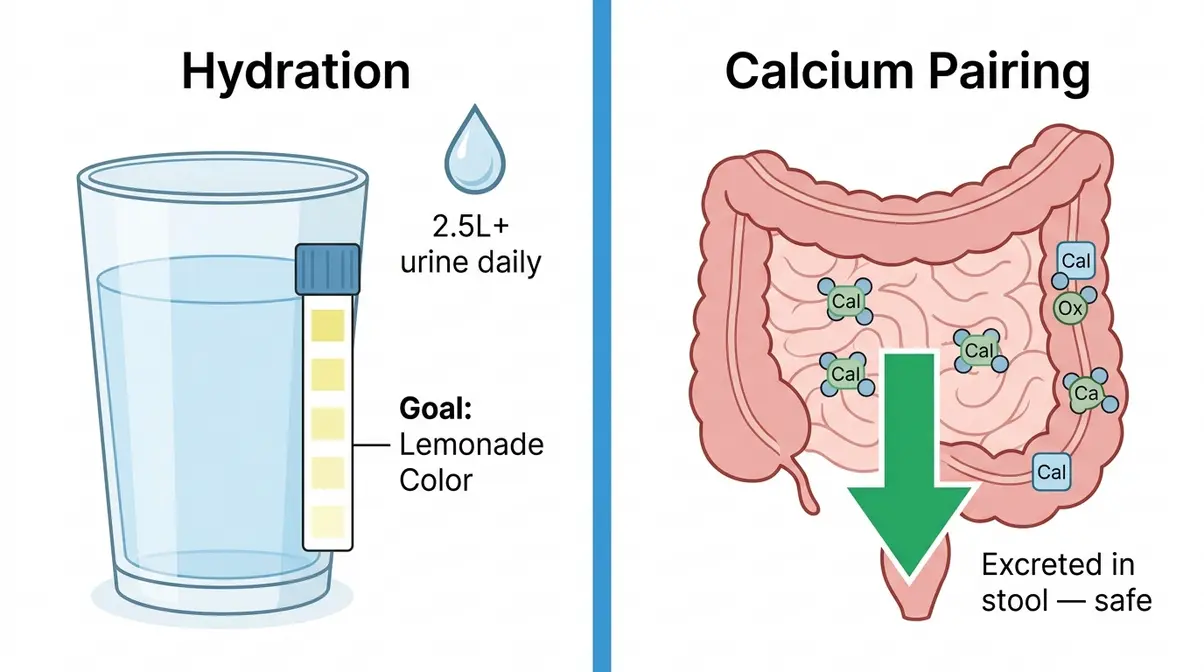
Reducing oxalate intake is only one part of the equation. These four evidence-based strategies work alongside a low-oxalate diet to further reduce your stone risk — and several of them work whether or not you’ve been perfectly consistent with your meal choices.
Hydration: How Water Flushes Oxalates
Water is the single most powerful tool you have to flush oxalates and prevent kidney stones. When urine is dilute, oxalate concentration drops — and dilute urine is far less likely to form crystals, even if some oxalate is present. The NIDDK recommends producing at least 2.5 liters of urine daily, which for most people requires drinking approximately 3 liters (about 12–13 cups) of fluid per day.
A practical test: your urine should be pale yellow — close to the color of lemonade, not apple juice. Dark urine is a reliable sign that you’re not drinking enough. Patients who follow this approach typically find that consistent hydration alone can reduce recurrence risk substantially, even before dietary changes take full effect. Consult your healthcare provider about your personal fluid target, as needs vary based on body size, climate, and activity level.
Calcium Pairing: Neutralizing Oxalates
The Calcium-Pairing Matrix works because of a specific biochemical mechanism: calcium and oxalate bind in the gut and form an insoluble compound (calcium oxalate) that is excreted in stool rather than absorbed into the bloodstream. This is why dietary calcium — consumed with meals — reduces urinary oxalate, while calcium supplements taken between meals bypass this gut-binding opportunity and may actually increase urinary calcium without neutralizing dietary oxalate.
Evidence from a landmark study published in the New England Journal of Medicine found that a diet with normal calcium content (approximately 1,200 mg/day from food) was more effective at preventing kidney stone recurrence than a low-calcium diet — a counterintuitive finding that changed clinical practice (PubMed research on dietary oxalate management, 2019). “A high dietary calcium intake of 1,000–1,200 mg/day is recommended for patients with calcium oxalate stones — dietary calcium binds with dietary oxalate in the gastrointestinal tract, reducing intestinal oxalate absorption and urinary oxalate excretion.”
- Practical application:
- Drink a glass of milk with your meal (not before or after)
- Add cheese to meals that contain moderate-oxalate foods
- Use yogurt as a side dish at meals that include any higher-oxalate vegetables
- Avoid taking calcium supplements on an empty stomach — take them with food if prescribed
Consult your healthcare provider before changing your calcium supplement routine, especially if you have CKD or cardiovascular concerns.
Citrus & The Myth of Dissolving Stones
Here’s the truth about one of the most common questions kidney stone patients ask: No food or drink can dissolve an existing calcium-oxalate kidney stone. This claim — that lemon juice, apple cider vinegar, or certain fruits “dissolve” stones — is medically inaccurate for calcium-oxalate stones specifically, and believing it can delay necessary medical treatment. The Urology Care Foundation is unambiguous on this point.
What citrus can do is meaningfully different — and genuinely useful. Citrus fruits contain citrate (a natural compound that inhibits stone formation), which binds with calcium in the urine and reduces the amount of calcium available to combine with oxalate. Citrate also directly inhibits crystal growth. This is why potassium citrate is a prescribed medication for recurrent stone formers — and why lemon water has real, evidence-based benefit as a preventive strategy.
“Lemon juice increases urinary citrate levels, which can help prevent new calcium-oxalate stones from forming — but it has no effect on stones that have already formed,” is how nephrologists typically explain this to patients. The distinction matters: lemon water is a prevention tool, not a treatment.
- Practical guidance:
- Add the juice of half a lemon to 8 oz of water, twice daily
- Orange juice (calcium-fortified) offers both citrate and calcium — a dual benefit
- Apple cider vinegar has no credible evidence base for kidney stone prevention or dissolution — skip it
Which fruit can dissolve kidney stones?
No fruit can dissolve existing calcium-oxalate kidney stones — this is a myth. Calcium-oxalate stones are physically dense crystalline structures; no dietary substance dissolves them once formed. What certain fruits can do is help prevent new stones from forming. Lemons and oranges contain citrate, a compound that inhibits crystal growth and reduces the calcium available to bind with oxalate in urine. Lemon water (juice of half a lemon in 8 oz water, twice daily) has evidence-based benefit as a preventive measure. The Urology Care Foundation is clear that believing food can dissolve stones may delay necessary medical treatment — always consult your doctor about stone management options.
Sodium, Animal Protein & the DASH Diet
Beyond oxalate, two other dietary factors significantly influence kidney stone risk — and both are frequently underemphasized by general diet advice.
Sodium: High sodium intake causes the kidneys to excrete more calcium into the urine, which raises the concentration of calcium available to bind with oxalate and form crystals. The NIDDK recommends limiting sodium to 2,300 mg per day for stone formers — and many nephrologists suggest even lower targets (1,500 mg/day) for recurrent stone patients. Read food labels carefully: processed foods, canned soups, and restaurant meals are the primary culprits.
Animal protein: High intake of animal protein (red meat, poultry, eggs, and fish in large quantities) increases urinary oxalate, uric acid, and calcium while reducing urinary citrate — a combination that promotes stone formation. The recommendation is not to eliminate animal protein but to moderate it: roughly 6–8 oz of animal protein per day is a common clinical guideline.
The DASH diet (Dietary Approaches to Stop Hypertension) has been studied as a kidney stone prevention approach and performs well in research: it emphasizes fruits, vegetables, low-fat dairy, and lean protein while limiting sodium and red meat. Evidence from the NIDDK supports its adoption for stone prevention. Consult your healthcare provider or registered dietitian about whether the DASH framework fits your specific kidney health needs.
Common Mistakes & When to See a Doctor
Even motivated, well-intentioned patients make predictable errors when starting a low-oxalate eating plan. Recognizing these patterns early can save months of frustration.
5 Common Mistakes on a Low-Oxalate Diet
Mistake 1: Switching to almond milk as a “healthier” alternative
Almond milk is made from almonds — one of the highest-oxalate foods on this list. Many patients replace cow’s milk with almond milk thinking it’s a health upgrade, inadvertently increasing their oxalate intake. Use cow’s milk, oat milk, or rice milk instead. Check that your alternative is calcium-fortified to maintain the Calcium-Pairing Matrix benefit.
Mistake 2: Eating spinach-based “healthy” salads and smoothies
Spinach is the single highest-oxalate food most people encounter regularly. A single cup of raw spinach contains approximately 656 mg of oxalate — more than six times a stone former’s daily recommended limit. Swap it for romaine lettuce, cabbage, or bok choy without sacrificing nutrition.
Mistake 3: Taking calcium supplements between meals
As discussed in the Calcium-Pairing Matrix section, calcium supplements taken on an empty stomach or between meals bypass the gut-binding mechanism entirely. Worse, high-dose calcium supplements have been associated with increased stone risk in some research. Always take any prescribed calcium supplement with food — and discuss supplement use with your nephrologist.
Mistake 4: Ignoring sodium and focusing only on oxalate
Patients who carefully track oxalate but eat high-sodium processed foods often see limited improvement in their urine tests. Sodium is a powerful stone-risk driver in its own right. Reducing sodium intake to under 2,300 mg/day is as important as managing oxalate.
Mistake 5: Assuming “organic” or “plant-based” means kidney-safe
Many plant-based foods are among the highest-oxalate options available — spinach, almonds, beets, and sweet potatoes are all plant-based. “Natural” and “organic” labels carry no information about oxalate content. Always cross-reference with the food lists in this guide before assuming a plant-based food is safe.
When to Consult a Kidney Specialist
A general low-oxalate eating plan is a reasonable starting point for most calcium-oxalate stone formers. However, certain situations require professional guidance beyond what any guide can provide.
- See a nephrologist (kidney specialist) if:
- You’ve passed more than one kidney stone in the past three years
- Your 24-hour urine test shows very high oxalate levels (above 80 mg/day)
- You have chronic kidney disease (CKD) — dietary needs differ significantly
- You have primary hyperoxaluria (a genetic condition requiring specialized treatment)
- You experience sudden, severe flank pain (seek emergency care immediately, as recommended by the National Kidney Foundation)
- See a registered dietitian (RD) if:
- You’re struggling to implement dietary changes on your own
- You have other dietary restrictions (diabetes, celiac disease, food allergies) that complicate a low-oxalate plan
- You want a personalized meal plan with exact portion sizes and oxalate counts
- Your stone recurrence rate hasn’t improved despite dietary changes
Dietary self-management is appropriate and effective for many patients — but it works best as part of a care team, not as a substitute for medical oversight. Consult your healthcare provider or registered dietitian before making significant dietary changes, especially if you have chronic kidney disease or a history of recurrent stones.
Low-Oxalate Eating FAQs
What to eat with oxalates?
Eat calcium-rich foods with every meal to prevent kidney stones. When calcium and oxalate meet in your digestive system, they bind together and are excreted in stool — before oxalate can reach your kidneys. Aim for 1,000–1,200 mg of calcium daily from food sources like milk, yogurt, and cheese, consumed with meals rather than as standalone supplements. Research published in the New England Journal of Medicine found this approach reduced stone recurrence by 51% compared to a low-calcium diet (Borghi et al., 2002). For most patients, this means adding a glass of milk or a serving of yogurt to each meal.
What are the 10 highest-oxalate foods?
The 10 highest-oxalate foods are: spinach, rhubarb, almonds, beets, dark chocolate, sweet potatoes, peanuts/peanut butter, wheat bran cereals, black pepper, and raspberries. Spinach is far and away the highest, at over 750 mg of oxalate per half-cup cooked serving. These rankings are based on NIDDK and National Kidney Foundation oxalate databases. Importantly, cooking method matters: boiling high-oxalate vegetables in water and discarding the water can reduce their oxalate content by 30–87%, according to research published in the Journal of Agricultural and Food Chemistry (Chai & Liebman, 2005). Even so, stone formers are generally advised to avoid the highest-risk items entirely.
Are low-oxalate foods good for kidneys?
Yes — for calcium-oxalate stone formers, low-oxalate foods are one of the most effective dietary interventions available. By reducing the amount of oxalate your intestines absorb, you lower urinary oxalate concentration — the direct driver of crystal formation. The NIDDK lists dietary modification as a primary prevention strategy for recurrent stone formers. This approach is not a fad diet; it has decades of clinical research behind it. However, low-oxalate eating is specifically targeted at calcium-oxalate stones. If you have a different stone type (uric acid, struvite, or cystine), your dietary needs will differ — consult your nephrologist for personalized guidance.
Number one drink causing kidney stones?
Dark cola is the drink most consistently linked to kidney stone formation. It works through multiple pathways: phosphoric acid increases urinary calcium excretion, high-fructose corn syrup raises urinary oxalate and uric acid, and caffeine acts as a diuretic that reduces urine volume. Concentrated black tea and green smoothies made with spinach are close rivals — both can deliver extremely high oxalate loads in a single serving. By contrast, plain water is the most protective beverage: adequate hydration (producing 2.5+ liters of urine daily) is the single most evidence-based strategy for kidney stone prevention, according to the NIDDK.
What removes oxalates from your body?
Two mechanisms remove oxalate from your body: gut binding (via calcium pairing) and urinary excretion (via hydration). In the gut, dietary calcium binds with oxalate before absorption and removes it through stool — this is the Calcium-Pairing Matrix in action. In the kidneys, adequate water intake dilutes urinary oxalate concentration, reducing crystallization risk. Boiling high-oxalate vegetables and discarding the cooking water also removes significant oxalate before food is eaten — research suggests this can reduce oxalate content by up to 87% in some vegetables (Journal of Agricultural and Food Chemistry, 2005). No supplement or “detox” product has been shown to meaningfully remove oxalate beyond these physiological mechanisms.
Is oatmeal okay on a low-oxalate diet?
Oatmeal is moderate in oxalate — it’s acceptable in small portions for most stone formers, but not ideal as a daily staple. A half-cup of dry oats contains approximately 3–5 mg of oxalate, which is relatively low, but larger portions and certain oatmeal add-ins (almonds, peanut butter, dark chocolate chips) can significantly raise the oxalate total of a single breakfast. If you enjoy oatmeal, prepare it with milk instead of water (adding calcium pairing), keep the portion to half a cup dry, and choose low-oxalate toppings like banana slices, blueberries, or maple syrup. Cream of Wheat is a lower-oxalate hot cereal alternative for days when you want to minimize risk further.
Can I drink coffee on a low-oxalate diet?
Yes, moderate coffee consumption is generally safe on a low-oxalate diet. Regular coffee contains very low levels of oxalate, making it a kidney-safe morning beverage for most people. However, you must be careful with what you add to it. Avoid almond milk or high-oxalate cocoa powders, and instead use cow’s milk or oat milk to get a beneficial calcium pairing effect. Always drink a glass of water alongside your coffee to offset its mild diuretic properties.
Does cooking reduce oxalates in food?
Boiling high-oxalate vegetables and discarding the water can significantly reduce their oxalate content. Research shows that boiling can lower oxalate levels by 30% to 87%, depending on the vegetable, because oxalates leach into the cooking water. However, roasting, baking, or steaming does not have this same reducing effect. Even with boiling, extremely high-oxalate foods like spinach may still retain too much oxalate for stone formers, so complete replacement is often the safer strategy.
Build Your Kidney Defense – Starting Today
For adults managing or preventing calcium-oxalate kidney stones, a well-structured low-oxalate eating plan is one of the most powerful tools available. Approximately 80% of kidney stones are calcium-oxalate type, and dietary modification — specifically reducing high-oxalate foods while maintaining 1,000–1,200 mg of calcium daily from food — is the primary evidence-based prevention strategy (Mayo Clinic, 2026; NIDDK). The 25 low oxalate meals for kidney health in this guide give you a concrete, actionable starting point.
The Calcium-Pairing Matrix is the framework that makes all of this work in practice. Rather than focusing on what you can’t eat, it gives you a positive action at every meal: pair calcium with food, hydrate consistently, and replace high-risk foods with the safe swaps on this list. Patients who apply this approach typically see improvements in their 24-hour urine oxalate levels within 6–8 weeks — a measurable, motivating result.
Your next step: pick three meals from the breakfast, lunch, and dinner lists above and add them to your grocery list this week. Start with the Calcium-Pairing Matrix by adding a glass of milk or a serving of yogurt to each of those meals. Then schedule a follow-up with your nephrologist or a registered dietitian to review your 24-hour urine results and personalize your plan further. A kidney-safe diet is not a life sentence of restriction — it’s a daily practice of confident, informed choices.

quickdishcook
Recipe developer and writer at Quick Dish Cookbook.