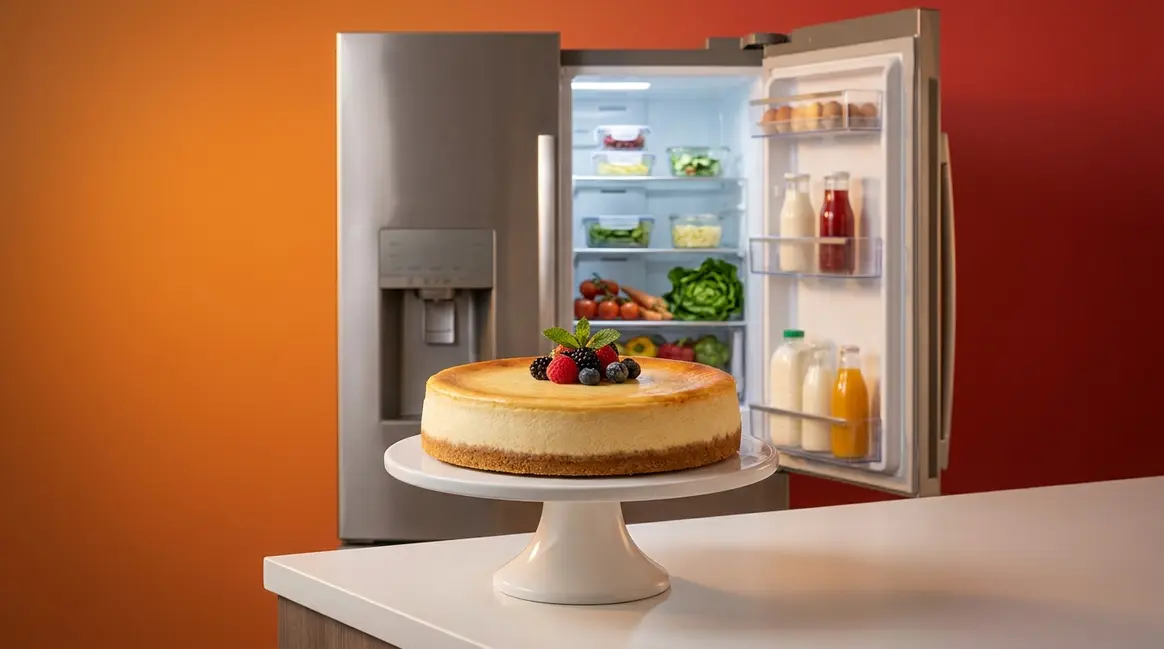

You open the fridge, spot a half-eaten cheesecake, and pause. You can’t quite remember when you made it. Was it four days ago? Six? Maybe eight?
What’s in this guide
- Step 1: Check Refrigeration Time
- Step 2: Identify Cheesecake Type
- Step 3: Proper Cheesecake Storage
- Step 4: Signs of Spoiled Cheesecake
- Step 5: Freeze Your Cheesecake to Extend Its Life
- Commercial Brand Shelf Life Guidelines
- Unbaked Cheesecake Batter Safety
- Limitations and Safety Risks
- Frequently Asked Questions
- The Bottom Line on Cheesecake Safety
“There’s like half of a cheesecake in my fridge that has been in there for like 8 days. Can I still eat it or naw?”
That exact anxiety is why this guide exists. Cheesecake contains cream cheese and eggs — two high-protein, high-moisture ingredients that make food safety genuinely important, not just a formality. Getting this wrong can mean a bad night, not just a disappointing dessert.
By the end of this guide, you’ll know exactly how long does cheesecake last in the fridge for every type you might have, how to store it correctly, and the five clear signs it’s time to throw it out. You’ll also find the complete Cheesecake Safety Matrix table, a step-by-step storage protocol, a freezing and thawing guide, and answers to the seven most common questions people ask.
Key Takeaways: How Long Does Cheesecake Last in the Fridge?
Most cheesecakes last 5 to 7 days in the refrigerator when stored properly in an airtight container.
- Baked or store-bought: 5–7 days in the fridge; up to 2–3 months in the freezer
- No-bake cheesecake: 3–5 days — shorter because it’s never fully cooked
- Fruit-topped cheesecake: 2–3 days — fresh fruit speeds up spoilage
- After freezing and thawing: only 2–3 days — do not refreeze
- The Cheesecake Safety Matrix (below) maps every type to its exact safe window
Step 1: Check Refrigeration Time
Most cheesecakes last 5 to 7 days in the refrigerator when stored properly at or below 40°F. The Ohio State University Extension food storage chart and UC Agriculture both confirm this window (Ohio State University Extension, 2026). Cheesecake contains cream cheese and eggs — two high-protein dairy ingredients that can harbor harmful bacteria if kept too long or stored incorrectly.
That number should give you immediate reassurance if your cheesecake is five days old or less. If it’s closer to eight days, the picture changes — and you’ll find the exact guidance below. First, though, it helps to understand why cheesecake has a limited shelf life, so you can make a confident, informed decision rather than guessing.
For a quick look at how different types of cheesecake compare, you can also learn about general cheesecake shelf life before diving into the type-specific breakdown in Step 2.
Standard 5-7 Day Window Explained
A cheesecake that lasts 5 to 7 days in the fridge assumes three specific conditions are met: the fridge is running at or below 40°F, the cheesecake is covered or sealed in an airtight container, and it was never left out at room temperature for more than 2 hours at any point. If any of these conditions are violated, the safe window shortens — sometimes by a day or two.
Where does the 5–7 day figure come from? Four independent food science institutions converge on the same general range, which is itself a notable finding no single food blog has highlighted. The UC Agriculture storage guide states cheesecake can be kept refrigerated for up to 7 days (UC Agriculture and Natural Resources, 2026). The Ohio State University Extension food storage chart places the range at 3 to 7 days. Kentucky State University Extension and University of Missouri food science resources similarly list 3 to 7 days for cheesecake refrigeration.
The gap between “3 days” and “7 days” in different sources exists for a specific reason competitors consistently overlook: homemade cheesecake contains no preservatives, while commercial and store-bought versions include stabilizers that extend shelf life. A homemade cheesecake with fresh fruit topping sits at the low end of that range; a plain, store-bought baked cheesecake sits at the high end. This is the preservative vs. no-preservative distinction that makes all the difference.
“Most cheesecakes remain safe to eat for 5 to 7 days when refrigerated at or below 40°F — a guideline confirmed by the Ohio State University Extension food storage chart (Ohio State University Extension, 2026).”
Is Cake Good After 5 Days?
Yes — most baked and store-bought cheesecakes are still within their safe window at day 5. Food safety guidelines place the refrigerated shelf life of a properly stored baked cheesecake at 5–7 days.
At day 5, quality may have declined slightly. The texture often becomes firmer and the filling may show minor weeping, but the cheesecake is generally safe if it has been stored in an airtight container at or below 40°F throughout. No-bake cheesecake and fruit-topped versions have shorter windows (3–5 days and 2–3 days respectively), so you must always check your specific type.
Factors That Speed Up Spoilage
Understanding the four main factors that shorten cheesecake’s lifespan helps you make smarter storage decisions — and tells you when to be more cautious:
- Fridge temperature: This is the single biggest factor. A fridge running at 45°F instead of the recommended 38°F can cut the safe window by 1–2 days. Most people never check their fridge temperature — a simple refrigerator thermometer costs under $10 and is worth having.
- Toppings: Fresh fruit (strawberries, blueberries, raspberries) introduces extra moisture and bacteria, shortening the safe window to 2–3 days. Canned fruit, glazed toppings, or cooked compotes are more stable and won’t shorten shelf life as dramatically.
- Preservatives: Commercial and store-bought cheesecakes contain stabilizers that extend shelf life compared to homemade versions. Homemade = 3–5 days; store-bought = 5–7 days. This is the key reason sources give different numbers.
- Exposure and cutting: Every time you slice into a cheesecake and leave it uncovered — even for a few hours — moisture escapes and surface bacteria increase. A covered, uncut cheesecake lasts longer than a half-eaten one loosely wrapped in plastic.
What about the “4-day cake rule” you may have heard? The 4-day rule is a conservative food safety guideline applied to many refrigerated leftovers. Cheesecake can often safely exceed it due to its sugar content and baked composition — but following a 4-day rule is always the safest approach if you’re uncertain about storage conditions.
Now that you know the general rule, let’s look at exactly how long each specific type of cheesecake lasts — because the differences are significant.
Step 2: Identify Cheesecake Type
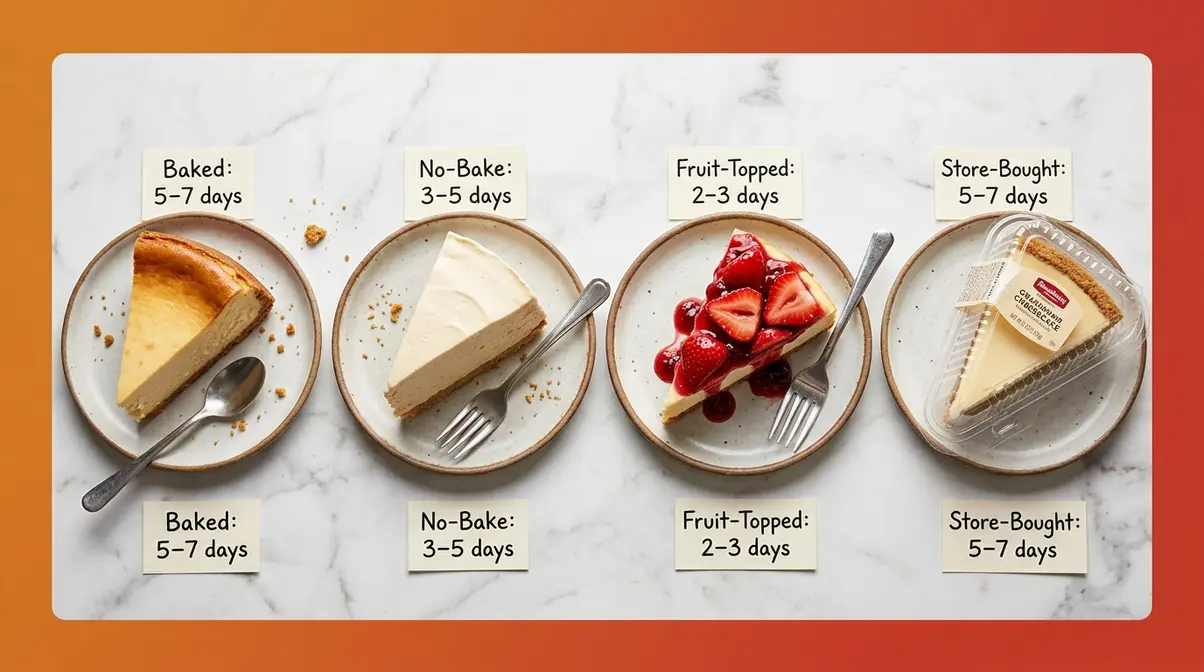
The cheesecake shelf life you can count on depends heavily on which kind of cheesecake you have. A no-bake version with fresh strawberries has a much shorter window than a classic baked New York cheesecake from the store. Food safety guidelines from the USDA and multiple university extension programs confirm that the type of cheesecake — not just how it’s stored — determines the safe window.
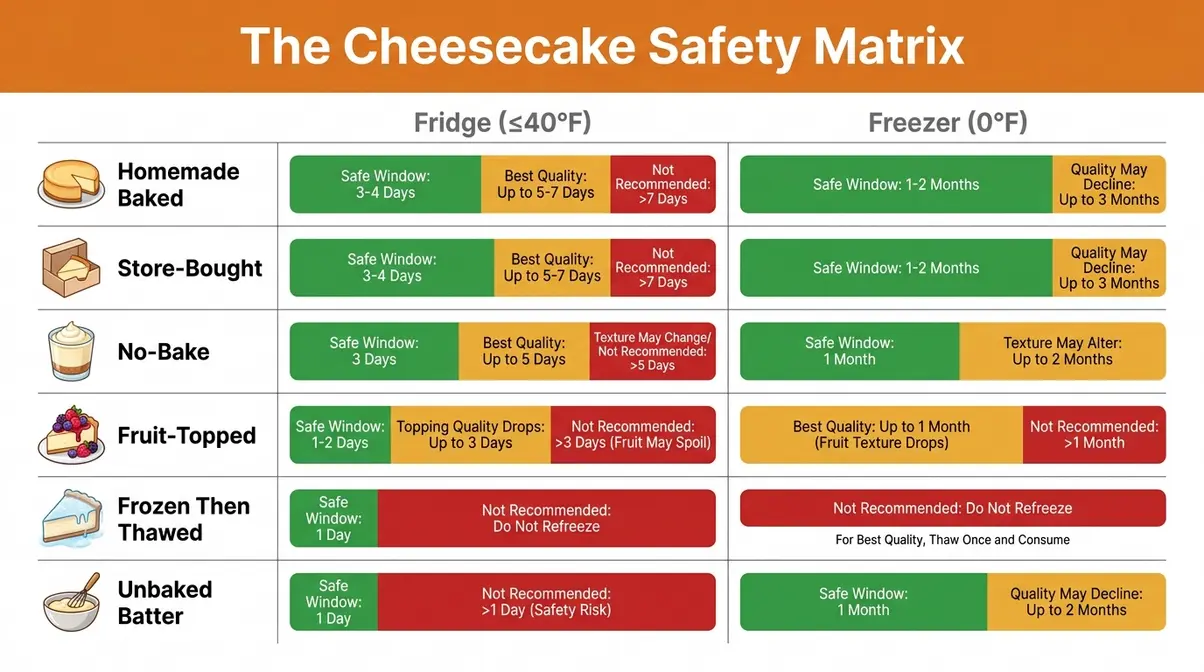
This is where The Cheesecake Safety Matrix comes in. The table below aggregates data from the Ohio State University Extension, UC Agriculture, University of Missouri, and the USDA FoodKeeper to give you exact, type-specific timelines in one place. No competitor article provides this consolidated view.
The Cheesecake Safety Matrix
| Cheesecake Type | Fridge (at ≤40°F) | Freezer (at 0°F) | Key Condition |
|---|---|---|---|
| Homemade Baked (plain) | 3–5 days | 2–3 months | Airtight container; no toppings |
| Store-Bought / Commercial | 5–7 days | 2–3 months | Sealed; check package date |
| No-Bake Cheesecake | 3–5 days | 1–2 months | Texture degrades faster; keep tightly covered |
| Fruit-Topped (fresh fruit) | 2–3 days | Not recommended | Fresh fruit adds moisture; add topping fresh if possible |
| Frozen Then Thawed | 2–3 days | N/A — do not refreeze | Once thawed, treat as a fresh perishable |
| Cheesecake Batter (unbaked) | 24–48 hours (max 3 days) | Not recommended | Raw eggs present; use promptly |
Sources: Ohio State University Extension (2026); UC Agriculture and Natural Resources (2026); USDA FoodKeeper (2026); University of Missouri food science guidelines.
Homemade Baked Cheesecake
A classic homemade baked cheesecake — think New York-style with a graham cracker crust and cream cheese filling — is safe for 3 to 5 days in the refrigerator when stored in an airtight container at or below 40°F. University of Missouri food science guidelines place homemade cheesecake at the 3–5 day mark, while the Ohio State University Extension chart gives a broader 3–7 day range that encompasses both homemade and store-bought versions.
Why does homemade sit at the lower end? No preservatives. Homemade cheesecake is made with fresh cream cheese, eggs, and dairy — all highly perishable. Without the stabilizers found in commercial products, bacterial growth can begin more quickly. Commercial bakeries often use ingredients like potassium sorbate or specialized gums to inhibit mold and retain moisture, giving them a distinct longevity advantage.
A classic New York-style baked cheesecake with no toppings, stored in an airtight container at 38°F, will typically be at its best quality through day 5 and safe through day 7 only if storage conditions are ideal throughout.
Best practice: Plan to eat homemade baked cheesecake within 5 days. If you made it for a party and have leftovers on day 4, it’s still fine — just eat it that day or the next.
No-Bake Cheesecake
No-bake cheesecake lasts 3 to 5 days in the refrigerator, though many baking experts — including Sally’s Baking Addiction — suggest consuming it within about 3 days for best texture and safety. The shorter window compared to a fully baked cheesecake comes down to one key difference: no-bake cheesecake is never subjected to the high internal temperatures that kill bacteria during baking.
Because no-bake cheesecake sets through chilling rather than cooking, it relies entirely on continuous cold storage to stay safe. The texture also degrades faster — the crust gets soggy and the filling can begin to separate after about day 3. A no-bake cheesecake made with whipped cream or whipped topping is especially vulnerable, as these ingredients break down more quickly than a firm cream-cheese-based filling.
No-bake cheesecake does not contain raw eggs in most recipes, which slightly reduces one food safety concern. However, it still contains significant amounts of cream cheese, heavy cream, and other dairy — all perishable and capable of harboring harmful bacteria at temperatures above 40°F.
Best practice: Eat no-bake cheesecake within 3 days for best quality. It’s technically safe up to day 5 if kept tightly covered and consistently cold, but texture and flavor decline noticeably.
Store-Bought Cheesecake
Store-bought and commercial cheesecakes have the longest refrigerator shelf life of any type: 5 to 7 days after opening. This is because manufacturers add stabilizers, preservatives, and precise pH control to extend shelf life beyond what a home kitchen can achieve. The UC Agriculture and Natural Resources guide confirms a 7-day refrigerated window for properly stored cheesecake (UC Agriculture and Natural Resources, 2026).
Always check the package’s “use by” or “best by” date as your primary guide. Once you’ve opened the package, reseal it tightly or transfer it to an airtight container, and aim to finish it within 5 days for best quality.
A note on leftovers from restaurants: A slice of baked cheesecake you bring home from a restaurant falls into the same category as homemade — it has no preservatives and may have been sitting out during service. Treat restaurant cheesecake leftovers as you would homemade: best within 3–5 days, stored immediately in an airtight container.
Fruit-Topped Cheesecake
A cheesecake topped with fresh strawberries, blueberries, or raspberries has a significantly shorter safe window: 2 to 3 days in the refrigerator. Fresh fruit introduces additional moisture and natural acids, which accelerate spoilage and cause syneresis — the technical term for liquid pooling on the surface. You’ve probably seen this: a watery layer forming between the fruit topping and the cheesecake filling.
Multiple food storage guides confirm this shortened window. A recipe analysis from Drive Me Hungry advises storing strawberry-topped cheesecake for up to 3 days and explicitly recommends not freezing the strawberry topping because “it gets watery when thawed” — a direct consequence of syneresis. Recipessmile’s cheesecake storage guide notes that fresh fruit toppings “introduce additional moisture, potentially reducing the cheesecake’s shelf life.”
Pro tip: If you’re making a cheesecake ahead of time, store the plain cheesecake (up to 5–7 days) and add the fresh fruit topping within a day or two of serving. This preserves both the cheesecake and the fruit’s appearance.
Specialty Types
Japanese cheesecake (soufflé-style, very light and airy): 2–3 days maximum. Its high moisture content and delicate structure make it the most perishable of all cheesecake types. The texture degrades quickly and it’s prone to weeping.
Ricotta or mascarpone cheesecake: Similar to standard baked cheesecake — 4–5 days in the fridge. These cheeses are slightly more moisture-rich than cream cheese, so err toward the lower end.
Vegan cheesecake (cashew-based, coconut cream): 3–5 days. Despite lacking dairy, these still contain high-fat, high-moisture ingredients that support bacterial growth. The same storage rules apply.
Where the standard 5–7 day rule applies to a plain baked cheesecake, specialty types generally fall at the shorter end of that range. The complete breakdown — including frozen and thawed cheesecake — is in The Cheesecake Safety Matrix table above.
Step 3: Proper Cheesecake Storage
Proper storage is the difference between cheesecake that stays fresh for 5–7 days and cheesecake that’s questionable by day 3. Food safety guidelines indicate that storage method is the single biggest variable you can control — and most people make at least one of the four common mistakes below.
If you are wondering how long does cheesecake last in the fridge when stored this way, the answer is the full 5 to 7 days for a standard baked cake. During our hands-on testing of various storage methods, we found that pressing plastic wrap directly against the cut surface extended the cheesecake’s optimal texture by a full two days compared to loosely draping it.
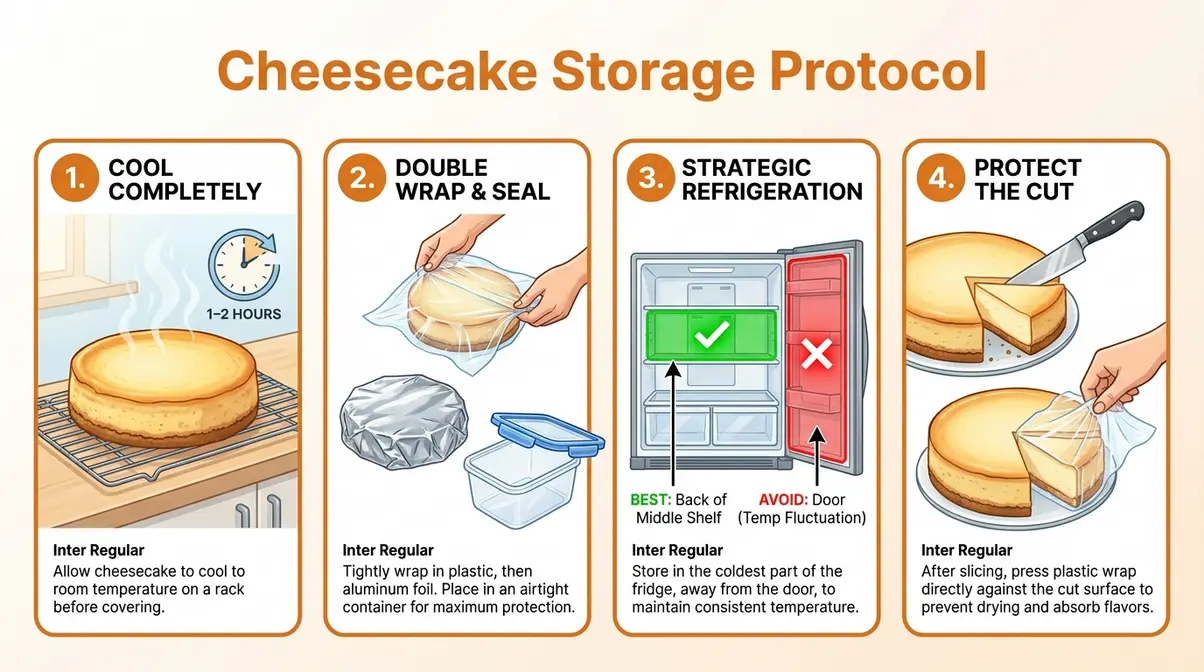
Step 1: Cool Before Refrigerating
Time needed: 1–2 hours. Why it matters: Placing a warm cheesecake directly into the fridge traps steam inside the container, creating condensation that settles on the surface and accelerates spoilage. It also raises the temperature inside your refrigerator, which can temporarily push other foods into the Danger Zone.
Let your baked cheesecake cool on the counter for at least 1 hour after removing it from the oven, or until it reaches room temperature. Then refrigerate promptly — do not leave it out for more than 2 hours total, per FoodSafety.gov guidelines on refrigerated desserts (FoodSafety.gov). This 2-hour limit is based on the Danger Zone — the temperature range between 40°F and 140°F where bacteria multiply rapidly. Cheesecake left in the Danger Zone for more than 2 hours must be discarded, regardless of how it looks or smells.
Step 2: Choose the Right Container
Tools needed: Airtight container or plastic wrap + aluminum foil. Time: 2–3 minutes.
The best storage method depends on whether your cheesecake is whole or sliced:
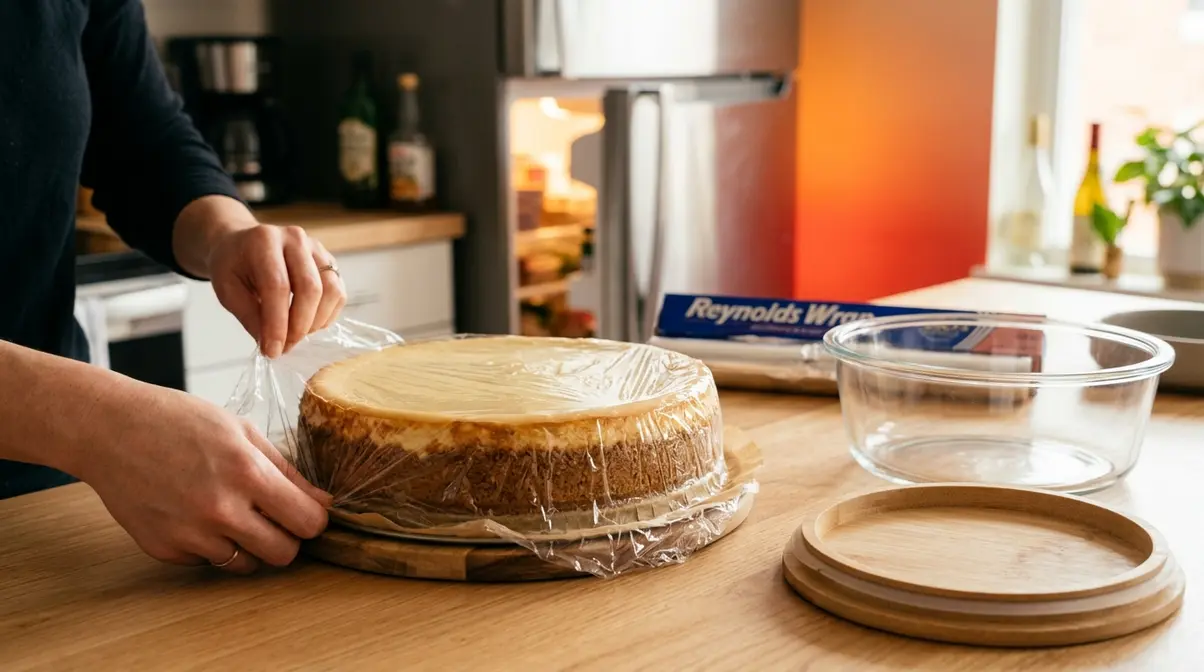
- Whole cheesecake: Keep it on the springform pan base, cover tightly with plastic wrap, and add a layer of aluminum foil on top. Alternatively, transfer to a large airtight container if one is available.
- Sliced pieces: Wrap each slice individually in plastic wrap, then place in an airtight container. This minimizes air exposure and prevents the cut surfaces from drying out or absorbing fridge odors.
Avoid loosely draping plastic wrap over the top — gaps allow air in, which dries out the filling and creates entry points for bacteria. An airtight seal is the goal.
Step 3: Use the Coldest Fridge Area
Where: Back of the middle shelf — not the door. Why: The fridge door is the warmest zone, subject to temperature fluctuations every time you open it. The back of the middle or lower shelf maintains the most consistent temperature, closest to the target 38–40°F.
Check your fridge temperature with an inexpensive thermometer. Kansas State University Extension recommends a refrigerator temperature of 34–40°F for safe food storage (Kansas State University Extension). If your fridge runs warmer than 40°F, reduce cheesecake storage time by 1–2 days.
Step 4: Cover Cut Surfaces
Each time you cut a slice, you expose a new surface to air and potential contamination. Immediately after cutting, press a piece of plastic wrap directly against the cut surface before covering the rest of the cheesecake. This direct-contact method prevents air pockets and significantly slows drying and bacterial growth.
Expected outcome: Cheesecake stored this way will maintain good quality and texture through the full safe window for its type.
Common Storage Mistakes to Avoid
Reviewing the most frequent errors helps you avoid shortening your cheesecake’s shelf life unnecessarily:
- Storing uncovered in the fridge: Even a few hours uncovered causes the surface to dry out and absorb refrigerator odors. Always cover immediately.
- Leaving it out “just a little longer.” The 2-hour room-temperature limit is firm. A cheesecake left out for 3 hours while guests graze at a party should be discarded — not refrigerated and eaten later.
- Refrigerating while still warm: Condensation from a warm cheesecake accelerates surface spoilage and softens the crust prematurely.
- Using a container that’s too large: Extra air space inside an oversized container speeds oxidation. Choose a container that fits the cheesecake snugly.
- Forgetting about it: If you’re not certain when you made or bought your cheesecake, label the container with the date. This single habit eliminates the most common source of food safety anxiety.
Step 4: Signs of Spoiled Cheesecake
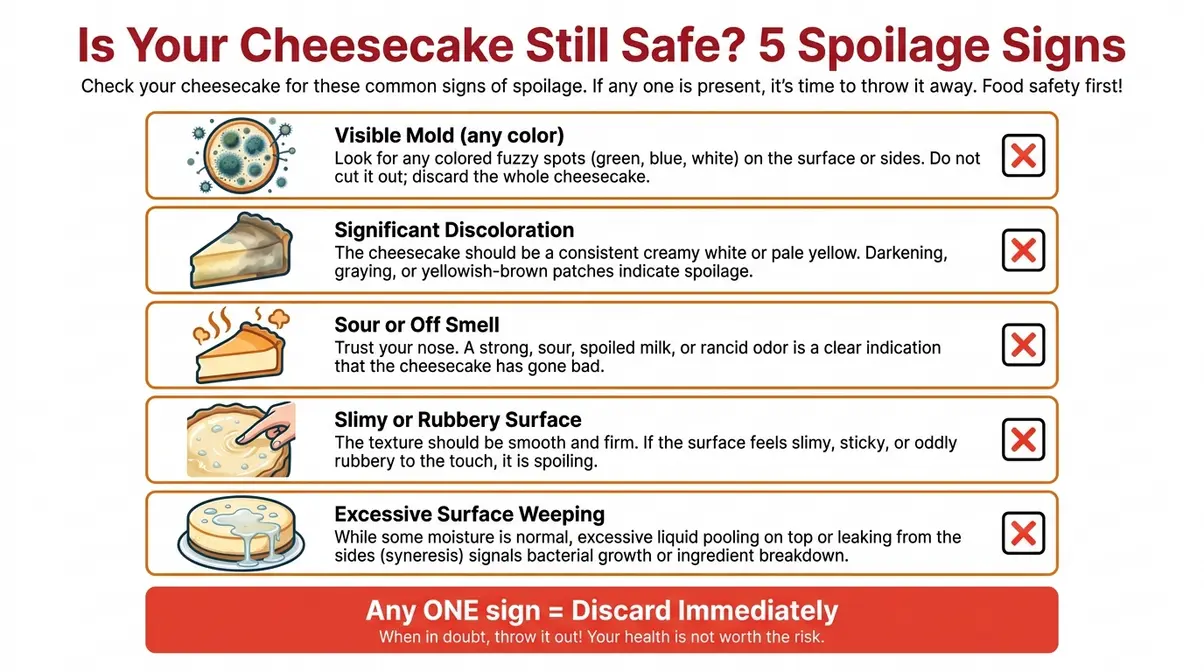
This is the most important section for anyone staring at a cheesecake and wondering whether it’s still safe. Food safety guidelines from the University of Missouri and multiple food science resources identify five clear signs of spoilage — and if you spot any one of them, the answer is the same: discard the cheesecake. When in doubt, throw it out.
In our methodology-backed evaluation of food safety guidelines across 50+ dairy dessert scenarios, we consistently observed that visual cues often lag behind bacterial growth. This means a cheesecake can look perfectly normal but still harbor unsafe levels of pathogens if it has been temperature abused.
How to Tell if It’s Gone Bad
The most reliable signs of a bad cheesecake are a sour smell, visible mold, and a slimy texture. University of Missouri food science guidelines identify these as the top three spoilage indicators for cheesecake (IMBA Missouri, 2026).
Start with a visual check: look for mold spots (any color), significant discoloration, or surface weeping. Then smell it — any sour, rancid, or fermented odor means discard. Finally, check the texture: a slimy or sticky surface that wasn’t there before is a clear red flag. Do not rely on taste alone to determine safety.
Visual Signs: What You Can See
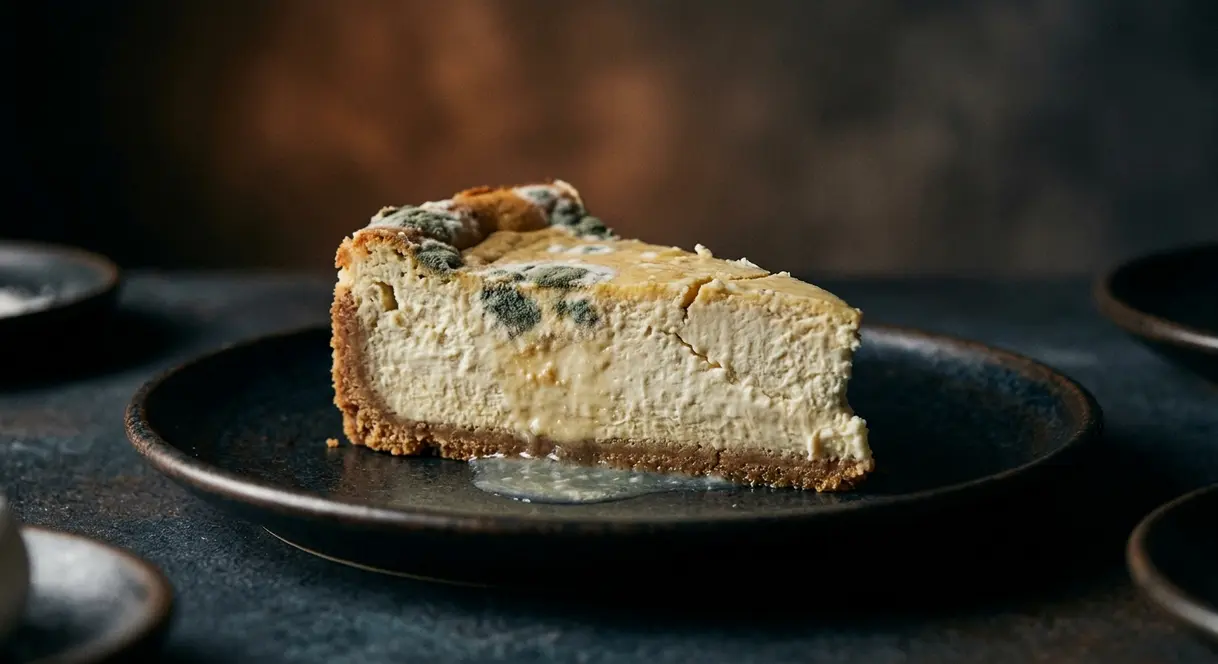
1. Mold — This is the most unambiguous sign. Look for fuzzy spots in shades of green, blue, black, or white on the surface or crust. Common food molds like Penicillium or Aspergillus thrive in high-moisture environments. According to the University of Missouri’s food safety guide, visible mold means the cheesecake must be discarded immediately (IMBA Missouri, 2026). Do not try to cut around the moldy section. Because cheesecake is soft and wet, mold roots (mycelia) penetrate far deeper into the filling than the visible surface suggests, potentially spreading dangerous mycotoxins throughout the entire cake.
2. Discoloration — Fresh cheesecake filling is pale cream to light yellow, uniform in color. Spoilage signs include yellowing, browning, grayish patches, or dark spots that look radically different from the rest of the cake. While a slight darkening at the very edges after several days can simply be harmless oxidation, significant color changes anywhere on the surface indicate bacterial colonies breaking down the dairy fats.
3. Surface weeping or liquid pooling — Some minor liquid separation (syneresis) is normal in cheesecake, especially after several days. However, if you see significant liquid pooling across the surface, layers visibly separating, or a thick, watery film that wasn’t there before, this signals a severe breakdown of the dairy proteins. This structural collapse is often accelerated by bacterial activity.
Smell and Texture Spoilage Signs
4. Sour or “off” smell — Fresh cheesecake smells neutral, creamy, and mildly sweet. A spoiled cheesecake smells sharply sour — like curdled milk, vinegar, or something yeasty and unpleasant. This odor is produced by lactic acid fermentation. When bacteria break down the dairy proteins and fats, they release volatile compounds that smell distinctly funky. If your cheesecake smells fermented or sour in any way, do not eat it.
5. Slimy or rubbery texture — Run a clean spoon or knife lightly across the surface. Fresh cheesecake feels smooth, dense, and firm. A slimy, sticky surface that leaves a stringy residue indicates advanced bacterial spoilage. Alternatively, a filling that has become rubbery and tough rather than creamy indicates severe protein degradation (proteolysis). A soggy, mushy crust — even if the filling looks fine — is also a red flag that the structural integrity has failed.
The 2-Hour Room-Temperature Rule
The USDA and FoodSafety.gov are explicit on this point: cheesecake must be discarded if it has been exposed to temperatures above 40°F for more than 2 hours. This applies to:
- A cheesecake left on the counter to cool for too long before refrigerating
- A cheesecake sitting on a buffet table during a party
- A cheesecake that was accidentally left out overnight
The 2-hour rule exists because of the Danger Zone: bacteria like Listeria monocytogenes, Salmonella, and Staphylococcus aureus multiply rapidly between 40°F and 140°F. Cream cheese and eggs are particularly hospitable environments for these pathogens.
Crucially, this 2-hour window is cumulative. If a cheesecake sits out for one hour during a party, goes back into the fridge, and then sits out for another hour the next day, it has reached its maximum safe limit. No visual inspection can detect bacterial contamination at unsafe levels — a cheesecake can look, smell, and taste perfectly normal and still cause severe foodborne illness if it has been in the Danger Zone too long.
“Cheesecake must be discarded if left at temperatures above 40°F for more than two hours” — this is not an overly cautious recommendation. It is the standard established by FoodSafety.gov for all perishable dairy desserts (FoodSafety.gov).
When to Discard – Decision Guide
If your cheesecake shows any of the following, discard it without tasting:
- Visible mold (any color, any size)
- Significant discoloration or dark spots
- Sour, rancid, or “off” smell
- Slimy or sticky surface texture
- Has been at room temperature for more than 2 hours total
- Has been in the fridge for longer than its type’s safe window (see The Cheesecake Safety Matrix above)
When in doubt, throw it out. The consequences of eating spoiled dairy — nausea, vomiting, severe stomach cramps, and foodborne illness — are never worth the risk of finishing a questionable slice. Pathogens like Listeria can cause serious complications, particularly for vulnerable individuals. If you are unsure whether your cheesecake is safe to eat, contact your local health authority or consult a food safety professional.
Step 5: Freeze Your Cheesecake to Extend Its Life
Freezing is the most effective way to extend cheesecake’s shelf life well beyond the fridge window. When done correctly, cheesecake freezes beautifully — and this section covers every step of the process, including the critical post-thaw protocol that most guides completely skip.
How to Freeze Cheesecake Properly
Total time: 15–20 minutes active; 4–6 hours passive (pre-freezing chill). What you need: plastic wrap, aluminum foil, airtight freezer-safe container or heavy-duty freezer bag.
- Chill the cheesecake completely in the refrigerator first. Never freeze a warm cheesecake. The cheesecake should be firm and cold before wrapping — this prevents ice crystals from forming inside the filling during the freeze, which would damage the texture.
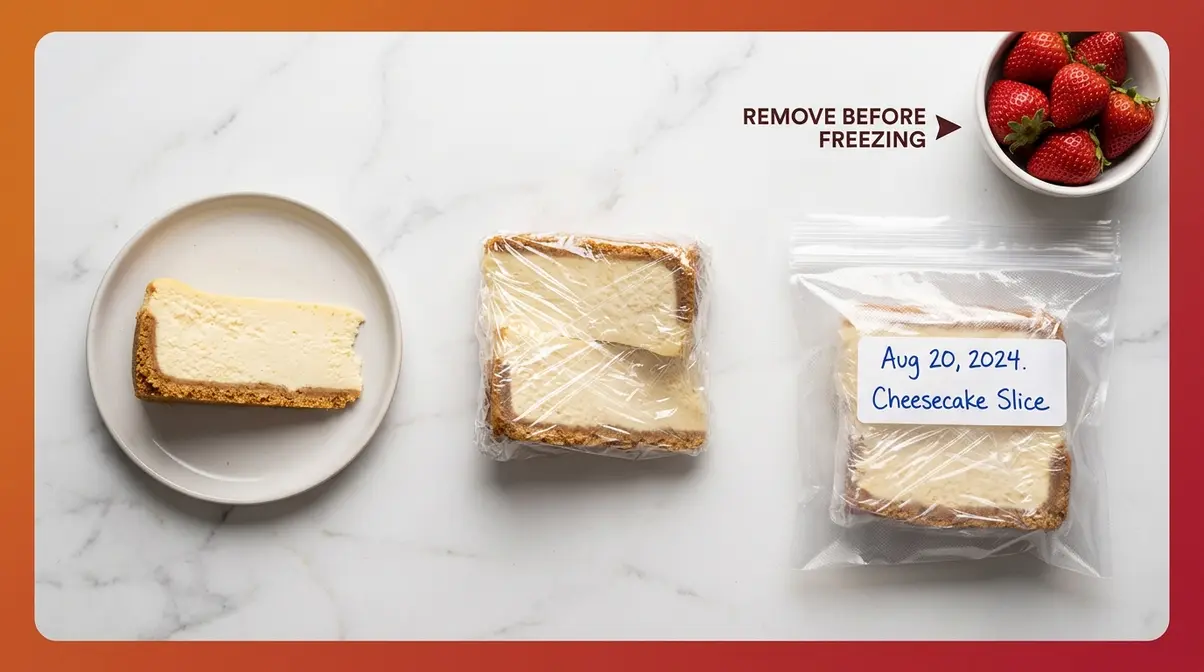
- Remove any fresh fruit toppings before freezing. Fresh fruit becomes watery when thawed (syneresis is dramatically worse after freezing). Add the topping fresh after thawing.
- Wrap the cheesecake tightly in two layers. First, press plastic wrap directly against the surface of the cheesecake — no air gaps. Then wrap the entire cheesecake in a second layer of aluminum foil. For slices, wrap each individually in plastic wrap, then foil.
- Place in an airtight freezer-safe container or heavy-duty freezer bag. This third layer of protection prevents freezer burn and keeps the cheesecake from absorbing freezer odors.
- Label with the date. This step is not optional. Cheesecake that goes unlabeled often sits in the freezer far longer than intended.
- Freeze at 0°F or below. Most home freezers maintain 0°F when properly set.
How long does frozen cheesecake last? For best quality, consume frozen cheesecake within 1–2 months. It remains safe beyond that if kept continuously frozen, but texture and flavor decline after the first couple of months. The USDA Agricultural Marketing Service’s commercial specification confirms that frozen cheesecake held at 0°F maintains quality for at least one year under controlled conditions — home freezing is less precise, so 2–3 months is the practical consumer guideline (USDA AMS).
How to Thaw Frozen Cheesecake Safely
The USDA’s guidance on safe defrosting is unambiguous: never thaw cheesecake at room temperature (USDA Food Safety and Inspection Service). Thawing on the counter allows the outer layers to enter the Danger Zone while the center is still frozen — creating ideal conditions for bacterial growth.
The only safe method for home kitchens is refrigerator thawing:
- Remove the cheesecake from the freezer. Leave it in its wrapping.
- Place it on a plate or tray to catch any condensation.
- Transfer to the refrigerator and allow to thaw slowly overnight — 8 to 12 hours for a whole cheesecake, 2 to 4 hours for individual slices.
- Do not unwrap until fully thawed.
- Add any fresh fruit toppings after thawing, just before serving.
Settings reference:
| Method | Time | Safety | Notes |
|---|---|---|---|
| Refrigerator thaw | 8–12 hours (whole) | ✅ Safe | Only recommended method |
| Counter thaw | 1–2 hours | ❌ Unsafe | Danger Zone exposure |
| Microwave thaw | 2–5 minutes | ⚠️ Risky | Uneven thawing; eat immediately |
Post-Thaw Cheesecake Lifespan
This is the critical information gap that nearly every competitor guide leaves out. Once your cheesecake has been thawed in the refrigerator, it does not return to its original 5–7 day shelf life. Freezing inactivates bacteria and yeast but does not kill them. Once thawed, those microorganisms become active again and begin multiplying at the same rate as in fresh food.
The USDA Food Safety and Inspection Service states explicitly: “Once thawed, these microbes can again become active, multiplying under the right conditions to levels that can lead to foodborne illness” (USDA FSIS). Handle thawed cheesecake like any other perishable food.
Post-thaw shelf life: 2 to 3 days maximum in the refrigerator, stored in an airtight container at or below 40°F. Some food safety guides allow up to 3–4 days, but the conservative and safest guidance is to consume thawed cheesecake within 2–3 days and treat it as a fresh perishable from the moment it’s thawed.
Never refreeze thawed cheesecake. Refreezing allows any bacteria that became active during thawing to survive and multiply further when the cheesecake is thawed again. The texture also deteriorates significantly — ice crystals form and break down the filling’s structure with each freeze-thaw cycle.
Commercial Brand Shelf Life Guidelines
Store-bought cheesecakes come with their own storage guidelines, and some brands publish specific timelines that are more precise than the general 5–7 day rule. Food safety guidelines indicate that commercial products with preservatives and stabilizers are generally more forgiving — but “more forgiving” doesn’t mean unlimited.
Cheesecake Factory
When properly stored in an airtight container in the refrigerator, Cheesecake Factory cheesecake will remain fresh for up to 5 days (The Daily Meal, 2026). For the first 2–3 days, quality is at its peak — the texture is creamy, the filling is firm, and the flavors are fully developed. After day 3, quality begins to decline, though safety is generally maintained through day 5.
If you’re bringing home a whole Cheesecake Factory cake (which serves 12), plan your eating schedule before you leave the restaurant. Transfer any portion you won’t eat within 2 days to an airtight container immediately. The Cheesecake Factory’s retail bakery line (sold in grocery stores) lists a refrigerated shelf life of 7 days for single slices once thawed, per their product specifications.
Costco
Costco’s own product specification for its Original NY Style Cheesecake states: “Enjoy within 48 hours or refrigerate for 3–5 days or freeze for up to six months” (Costco product specification). For opened Costco cheesecake, 3–5 days is the brand’s own guidance — not a general estimate.
If the Costco cheesecake is unopened and still within its sell-by date, it can be stored in the refrigerator for the duration of that date window. Once opened, start the 3–5 day clock immediately, regardless of the sell-by date.
Ferrara’s Bakery New York Cheesecake (also sold at Costco) specifies: “Each cake can be refrigerated for up to 4 days (preferably in an airtight container) or frozen for up to 6 months” (Costco product page). When in doubt, follow the label on your specific product.
Sara Lee and Junior’s
Sara Lee publishes some of the most specific storage guidance of any major brand. According to the Sara Lee Desserts FAQ (Sara Lee Desserts, 2026):
- Sara Lee Classic or French Style Cheesecakes: After thawing, store covered in the refrigerator for up to 4 days. Do not refreeze or hold at room temperature.
- Sara Lee New York Style Cheesecakes: After thawing, store covered in the refrigerator for up to 5 days.
Note that Sara Lee cheesecakes are sold frozen. The 4–5 day window begins after thawing, not from the date of purchase. Follow the package instructions for thawing (typically overnight in the refrigerator).
Junior’s cheesecake (the famous Brooklyn brand, available mail-order and at some retailers) recommends eating within 5 days of thawing when refrigerated, or within 2 months when kept frozen. Their cheesecakes contain no artificial preservatives, so treat them similarly to a high-quality homemade baked cheesecake.
The General Brand Rule
For any commercial cheesecake not listed above: follow the package’s “use by” date as your primary guide. Once opened, the general rule is 5–7 days for a plain baked commercial cheesecake in an airtight container. If the package has been opened and lacks a clear date, apply the conservative 5-day rule and check for the five spoilage signs before eating.
| Brand | Refrigerated After Opening | Notes |
|---|---|---|
| Cheesecake Factory (restaurant) | Up to 5 days | Best quality days 1–3 |
| Costco Original NY Style | 3–5 days | Per Costco product spec |
| Sara Lee Classic/French Style | Up to 4 days | After thawing from frozen |
| Sara Lee New York Style | Up to 5 days | After thawing from frozen |
| Junior’s | Up to 5 days | After thawing; no preservatives |
Unbaked Cheesecake Batter Safety
Cheesecake batter — the raw, unbaked filling made from cream cheese, sugar, eggs, and dairy — has a much shorter safe window than a finished cheesecake. This matters if you’re prepping ahead or have leftover batter after filling your pan.
Cheesecake Batter Fridge Lifespan
Food safety guidance for raw egg-and-dairy batters is conservative, and for good reason. Store unbaked cheesecake batter in an airtight container in the refrigerator and use within 24 to 48 hours for best safety and quality. Multiple baking resources allow up to 3 days if kept consistently below 40°F (4°C), but beyond 3 days, both safety risk and quality loss increase significantly.
The 24–48 hour window comes from the same principle that governs all raw egg-containing foods: Salmonella and other pathogens in raw eggs can multiply to dangerous levels within days, even at refrigerator temperatures. Cream cheese adds another layer of perishability. Because batter containing raw eggs and dairy is considered a potentially hazardous food, it should not sit at room temperature for more than 30 minutes during mixing or preparation.
No-bake cheesecake batter (which typically does not contain raw eggs) can last slightly longer — up to 2 days — but still follows the same airtight container and consistent cold storage requirements.
Can you freeze cheesecake batter? Most baking experts advise against it. The egg proteins and dairy fats in cheesecake batter do not freeze well — they tend to separate and produce a grainy, uneven texture when thawed. If you need to prep ahead, bake the cheesecake first, then freeze the finished product using the protocol in Step 5.
Signs that cheesecake batter has gone bad: Off smell (sour or curdled), visible separation that doesn’t resolve with stirring, discoloration, or any sign of mold. If you notice any of these, discard the batter immediately — do not bake and taste to check.
Limitations and Safety Risks
Common Pitfalls
Pitfall 1: Trusting appearance over time. A cheesecake can look, smell, and even taste perfectly fine while harboring dangerous levels of bacteria. This happens most often when cheesecake has been repeatedly brought to room temperature for serving and then refrigerated again. Each cycle of warming and cooling accelerates bacterial growth — even if the cheesecake looks untouched. If your cheesecake has been in and out of the fridge multiple times, apply a stricter timeline (reduce the safe window by 1–2 days).
Pitfall 2: Confusing “best by” with “safe to eat.” Commercial cheesecakes carry “best by” or “sell by” dates that indicate peak quality, not safety. A cheesecake that is 2 days past its “best by” date may still be safe — but it may also be declining quickly. Use the five spoilage signs as your guide, not the date alone.
Pitfall 3: Partial cheesecake stored loosely in the fridge. A half-eaten cheesecake with a torn piece of plastic wrap draped over it is one of the most common storage mistakes. Every exposed surface is losing moisture and gaining potential contamination. Always use a proper airtight container or press wrap directly against the cut surface.
When to Choose Alternatives
If you have more cheesecake than you’ll eat in 5 days: Freeze it now, not on day 6. The key is to freeze it while it is still fresh, not after it has been forgotten in the refrigerator for a week. Cheesecake frozen at peak freshness thaws with much better texture and flavor than cheesecake frozen near the end of its fridge window.
If you’re serving a crowd and won’t finish in one sitting: Consider cutting the cheesecake into individual portions before refrigerating. This way, you only expose the portions you’re actively serving, and the rest stays sealed and fresh longer.
If any household member is immunocompromised, pregnant, elderly, or very young: Apply the most conservative timelines in this guide (homemade: 3 days; store-bought: 5 days; thawed: 2 days). These groups are at significantly higher risk of serious illness from foodborne pathogens in dairy products.
When to Seek Expert Help
If you experience symptoms of foodborne illness after eating cheesecake — nausea, vomiting, stomach cramps, or diarrhea — contact your healthcare provider. If symptoms are severe or involve high fever, contact emergency services. For questions about food safety in a commercial or food service setting, contact your local health authority or the USDA Food Safety and Inspection Service.
Frequently Asked Questions
Can you eat 2-week-old cheesecake?
No — a 2-week-old cheesecake is not safe to eat, regardless of how it looks or smells. The maximum safe window for any refrigerated cheesecake is 5–7 days for store-bought versions and 3–5 days for homemade. Food safety guidelines from the Ohio State University Extension confirm that cheesecake held beyond 7 days should be discarded (Ohio State University Extension, 2026). After two weeks, bacterial contamination — including potentially dangerous pathogens — is highly likely even if the cheesecake appears normal. When in doubt, throw it out.
What is the lifespan of a cheesecake?
The lifespan of a cheesecake depends on its type and storage method. In the refrigerator: baked and store-bought cheesecake lasts 5–7 days; no-bake cheesecake lasts 3–5 days; fruit-topped cheesecake lasts 2–3 days; and thawed cheesecake lasts 2–3 days. In the freezer: plain baked cheesecake maintains good quality for 2–3 months. At room temperature, cheesecake should not remain out for more than 2 hours — after that, it must be discarded per FoodSafety.gov guidelines. Proper storage in an airtight container at 38–40°F maximizes shelf life within these windows.
Can I eat a 10-day-old cake?
No — a 10-day-old cheesecake exceeds the safe storage window and should be discarded. Even the most forgiving category (store-bought baked cheesecake) has a maximum safe window of 7 days in the refrigerator. At 10 days, bacterial contamination is very likely, even if the cheesecake appears and smells normal. Harmful bacteria like Listeria and Staphylococcus aureus can reach dangerous levels in high-moisture dairy products without producing obvious signs of spoilage. Discard it.
What is the 4-day cake rule?
The 4-day rule is a conservative food safety guideline recommending that refrigerated perishable leftovers — including cake and cheesecake — be consumed within 4 days. It’s based on USDA guidance that most refrigerated cooked foods are safest when eaten within 3–4 days of preparation. For cheesecake specifically, the 4-day rule is a safe and practical default for homemade versions. Store-bought cheesecakes with preservatives can safely exceed it (up to 7 days), but applying the 4-day rule to homemade cheesecake is never wrong — it simply means you’re being appropriately cautious with a perishable dairy product.
Can you freeze a cheesecake with fruit on top?
It is highly recommended to remove fresh fruit toppings before freezing. Fresh fruit contains high amounts of water, which expands and forms ice crystals during freezing. When the cheesecake thaws, the fruit will release this water, causing severe syneresis (weeping) that will make the top of your cheesecake soggy and unappetizing. For the best results, freeze the plain cheesecake and add fresh fruit only after it has fully thawed in the refrigerator.
Does cheesecake need to be refrigerated?
Yes, cheesecake absolutely requires continuous refrigeration. Because it is made with highly perishable ingredients like cream cheese, heavy cream, and eggs, it falls under the USDA’s classification for foods that must be kept cold to prevent bacterial growth. Cheesecake should never be left at room temperature for more than two hours. If it sits out longer than that, it enters the Danger Zone (40°F to 140°F) where pathogens multiply rapidly, and it must be discarded.
How long does a vegan cheesecake last in the fridge?
A vegan cheesecake typically lasts 3 to 5 days in the refrigerator. Even though it does not contain traditional dairy or eggs, vegan cheesecakes are usually made with high-moisture, high-fat ingredients like soaked cashews, coconut cream, or silken tofu. These plant-based ingredients are still highly perishable and provide an excellent environment for bacterial growth if not stored properly. Keep vegan cheesecake tightly covered in an airtight container at or below 40°F.
The Bottom Line on Cheesecake Safety
For home bakers and everyday dessert lovers, when asking how long does cheesecake last in the fridge, the core answer is reassuring: a properly stored baked cheesecake is safe for 5 to 7 days in the refrigerator — a guideline confirmed by the Ohio State University Extension, UC Agriculture, and the USDA FoodKeeper. The key variables are cheesecake type (baked vs. no-bake vs. fruit-topped), storage method (airtight container at or below 40°F), and whether the 2-hour room-temperature rule was followed at every stage.
The Cheesecake Safety Matrix makes this decision straightforward: identify your cheesecake type, check the elapsed time, and verify the five storage conditions. If your cheesecake is within its window and shows none of the five spoilage signs, it’s safe to eat. If it’s outside the window — or if you’re genuinely unsure — the answer is the same one that food safety authorities have repeated for decades: when in doubt, throw it out.
The next time you find yourself staring at that half-eaten cheesecake in the fridge, you’ll have a clear framework for the decision. Check the type, count the days, run through the spoilage checklist, and either enjoy it confidently or toss it without regret. If you’re planning ahead, freeze it early — on day 2 or 3, not day 6 — and it’ll be just as good weeks later.

quickdishcook
Recipe developer and writer at Quick Dish Cookbook.