
What’s in this guide
- What You'll Need Before You Start
- Step 1: Check How Long Your Brownies Will Last
- Step 2: Bake Brownies for the Right Amount of Time
- Step 3: Cool Brownies Completely Before Storing
- Step 4: Store at Room Temperature
- Step 5: Refrigerate for Up to 1 Week
- Step 6: Freeze for Long-Term Storage
- Step 7: Check for Spoilage Before Eating
- Advanced Tips: Storage by Brownie Type
- Troubleshooting: 5 Common Brownie Storage Problems
- Frequently Asked Questions
- What to Do Next
Homemade brownies last 3–4 days at room temperature in an airtight container, up to 1 week in the refrigerator, and up to 3 months in the freezer when wrapped correctly. This 7-step guide covers baking, cooling, storing, and spoilage checks — the full process takes about 10 minutes to read and will save your next batch from drying out.
You just pulled a pan of perfect brownies out of the oven — now you’re wondering if they’ll survive until Sunday. It’s a completely reasonable worry. Leave them uncovered on the counter and they’ll taste dry and crumbly by day two. Store them wrong in the fridge and they’ll come out like chocolate-flavored cardboard. And nobody wants to bring flat, stale brownies to their coworkers.
Most guides hand you a single number — “four days” — and leave you guessing about the rest. This guide is different. It explains the science behind brownie staling, gives you specific instructions for each storage method, and shows you exactly how to tell the difference between a brownie that’s just a little past its best and one that needs to go in the bin.
“I just finished baking homemade brownies and want to know how long they’ll last since I want to bring some for my coworkers on Sunday (3 days from now).”
— Home baker, r/AskBaking
By the end of this guide, you’ll know exactly how to store your brownies, how long they’ll stay moist and squidgy, and how to spot the signs that it’s time to throw them out.
Key Takeaways: How Long Do Brownies Last
Homemade brownies last 3–4 days at room temperature, up to 1 week in the fridge, and up to 3 months in the freezer when stored correctly.
- Room temp: 3–4 days in an airtight container, away from heat and sunlight
- Refrigerator: Up to 1 week — wrap tightly to prevent drying out
- Freezer: Up to 3 months — double-wrap each brownie to prevent freezer burn
- The Brownie Freshness Window: Quality peaks in the first 2 days; safety and acceptability extend beyond that with proper storage
- Spoilage rule: If you see mold, smell something sour, or the texture is hard and crumbly, discard them
What You’ll Need Before You Start
Each storage zone in The Brownie Freshness Window requires a different container. Grab these before you begin — not having the right tools is the most common reason brownies dry out within 24 hours.
- Airtight container — a storage box or zip-lock bag with a seal that blocks air and moisture; this is your single most important tool
- Plastic wrap (cling film) — wraps individual brownies or the whole pan to lock in moisture before boxing
- Aluminum foil — adds a second moisture barrier on top of plastic wrap, especially useful for freezing
- Zip-lock freezer bags — thicker than standard bags and designed to resist freezer burn
- Parchment paper — lines the container so brownies don’t stick and layers don’t fuse together
- Wire cooling rack — allows air to circulate under the pan so brownies cool evenly and don’t sweat on the bottom
The key distinction to understand before any step: stale means quality loss (dry texture, flat flavor, loses its chewiness) — the brownie is unpleasant but not dangerous. Spoiled means a safety risk — mold, sour smell, or bacterial growth that makes the brownie unsafe to eat. You’ll learn to tell these apart in Step 7.
The full storage process — wrapping, labeling, and putting brownies away — takes about 5 minutes per batch. Once you have everything ready, start with Step 1 to understand exactly how long your specific brownies will last.
Step 1: Check How Long Your Brownies Will Last
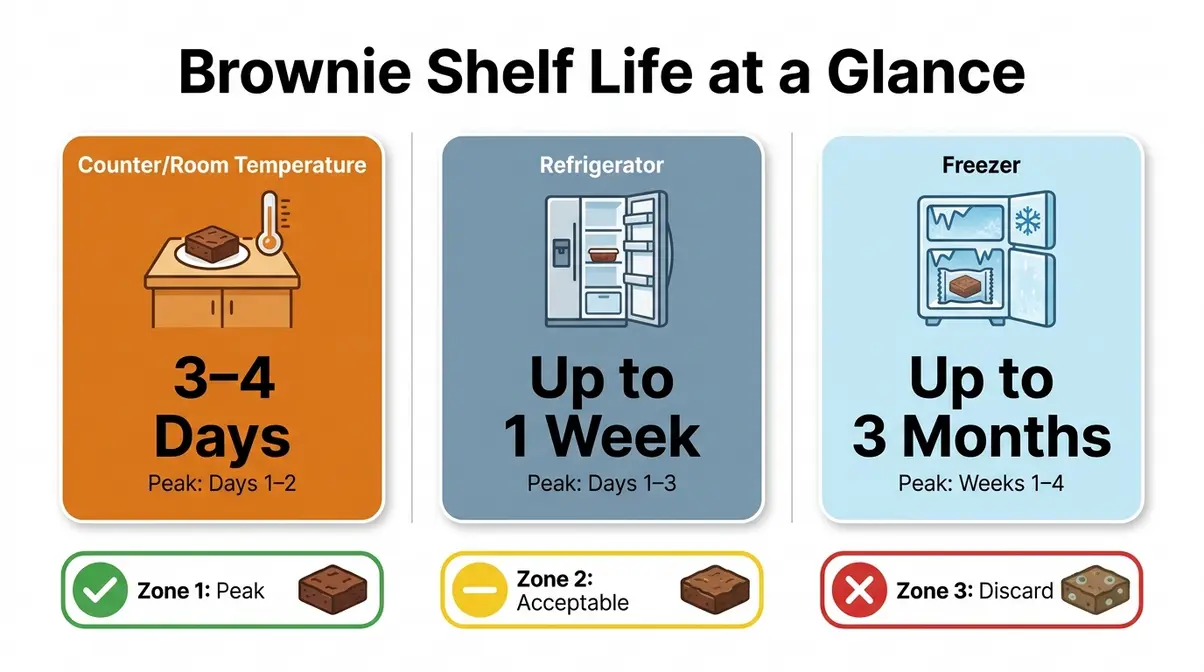
Homemade brownies stored in an airtight container last 3–4 days at room temperature, up to 1 week refrigerated, and up to 3 months in the freezer (NC State Extension Safe Plates, 2020). Quality drops before safety does — a brownie can still be technically safe on day 5 but taste flat and dry by day 3. That gap is exactly what The Brownie Freshness Window helps you navigate.
| Storage Method | How Long Brownies Last | Quality Window | Best For |
|---|---|---|---|
| Room Temperature | 3–4 days | Peak: Days 1–2 | Eating within the week |
| Refrigerator | Up to 1 week | Peak: Days 1–3 | Planning ahead 5–7 days |
| Freezer | Up to 3 months | Peak: Weeks 1–4 | Long-term batch storage |
For a deeper dive into spoilage timelines, see our guide to brownie shelf life and storage tips.
Brownies go stale because of a process called starch retrogradation — where starch molecules re-crystallize after baking, making the crumb progressively firmer over time. Think of it like a sponge slowly drying out from the inside. Research on baked goods from Texas A&M University’s Cereal Quality Lab shows that Texas A&M starch retrogradation research — specifically how baking thermal profiles affect starch hydration and subsequent firmness development during storage (2006). The faster moisture escapes, the faster retrogradation accelerates. Proper sealing slows both.
Quality vs. Safety Explained
How long do brownies stay fresh? That depends on which definition of “fresh” you’re using. There are two different timelines at work, and most people confuse them.
Stale means quality loss: the brownie is dry, crumbly, loses its chewiness, and may taste a bit flat. It’s still safe to eat. Spoiled means a safety risk: visible mold, a sour or musty smell, or a slimy texture that signals bacterial or fungal growth.
The Brownie Freshness Window has three zones:
- Zone 1 — Peak Freshness (Days 1–2): Moist and squidgy, rich flavor, ideal texture. This is when your brownies are at their absolute best.
- Zone 2 — Acceptable (Days 3–7 depending on storage): Still safe, but quality is declining. A brownie on day 3 at room temperature is in Zone 2 — still safe but starting to lose its chewiness. Refrigeration or freezing extends this zone significantly.
- Zone 3 — Discard: Beyond the safe storage window, or showing any sign of spoilage. When in doubt, throw it out.
Understanding these zones prevents two common mistakes: throwing out safe brownies because they seem “off,” and eating genuinely spoiled ones because they look fine.
Why Cut vs. Uncut Matters
Uncut brownies in the pan retain more moisture because the intact crust seals the interior. Cut brownies expose more surface area to air, which speeds up drying and accelerates how long brownies last after baking. A practical rule: if storing for more than 2 days, keep your brownies uncut in the pan, covered tightly with plastic wrap, until you’re ready to serve. A full uncut pan will stay moist a full day longer than a pan of pre-cut squares.
Transition: Now that you know your storage window, Step 2 covers how long to bake brownies correctly — because underbaked or overbaked brownies don’t store as well.
Step 2: Bake Brownies for the Right Amount of Time
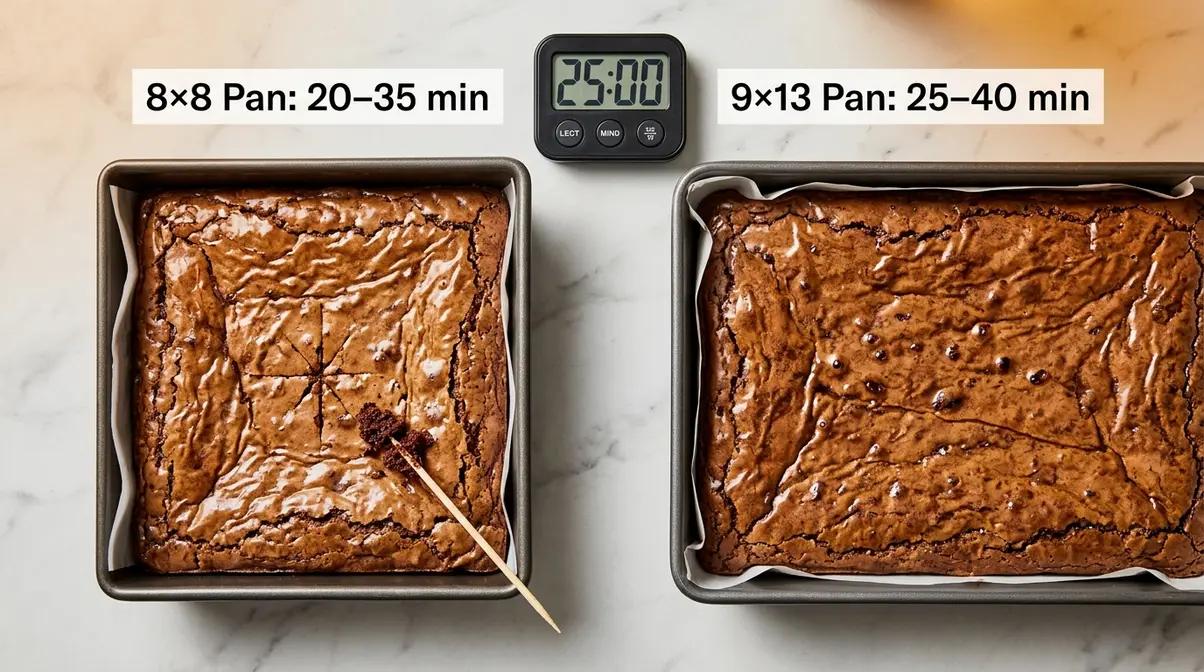
Getting the bake right is the first step in how long your brownies will last. Underbaked brownies carry too much moisture, which speeds up mold growth. Overbaked brownies are already dry, and they’ll turn rock-hard within a day or two of storage. The target is a toothpick that comes out with moist crumbs — not wet batter, not bone dry.
8×8 and 9×13 Pan Baking Times
| Pan Size | Temperature | Fudgy | Medium | Cakey |
|---|---|---|---|---|
| 8×8 inch | 350°F (177°C) | 20–25 min | 25–30 min | 28–35 min |
| 9×13 inch | 350°F (177°C) | 25–28 min | 28–30 min | up to 35–40 min |
Bakers consistently find that switching from a 9×13 to an 8×8 pan requires adding 5–7 minutes of bake time, because the batter sits thicker and taller (HowLongFor.com, 2026). For ceramic or thick pans, start checking at 25 minutes and test every 5 minutes — some ceramic 9×13 pans can take up to 40 minutes total.
The single most important doneness cue: insert a toothpick into the center. For fudgy brownies, it should come out with moist crumbs clinging to it, not wet batter. For cakey brownies, it should be mostly clean. Brownies continue to set as they cool — so pulling them out a minute early is always better than a minute late (Sally’s Baking Addiction, 2026).
Muffin Tin and Mini Brownie Baking Times
Mini brownie bites bake much faster because the smaller portion size cooks through quickly. Here are the verified ranges at 350°F:
| Pan Type | Fudgy | Medium | Cakey |
|---|---|---|---|
| Mini muffin tin | 10–12 min | 12–14 min | 14–15 min |
| Regular muffin tin | 15–18 min | 18–22 min | 22–25 min |
For mini bites, look for tops that are shiny, set, and slightly cracked — that’s your visual cue that they’re ready. Start checking at the lower end of each range, especially if your oven runs hot. A toothpick with moist crumbs (not wet batter) confirms doneness (Kimecopak, 2026).
Transition: With the right bake done, Step 3 covers cooling — because cutting too early is one of the most common reasons brownies dry out faster.
Step 3: Cool Brownies Completely Before Storing
Storing warm brownies is one of the most reliable ways to ruin them. Trapped steam creates condensation inside the container, which leads to a soggy top, accelerated mold growth, and a texture that turns gummy rather than fudgy. The rule is simple: brownies must be completely cool before they go into any container or wrapping.
How Long to Cool Before Cutting
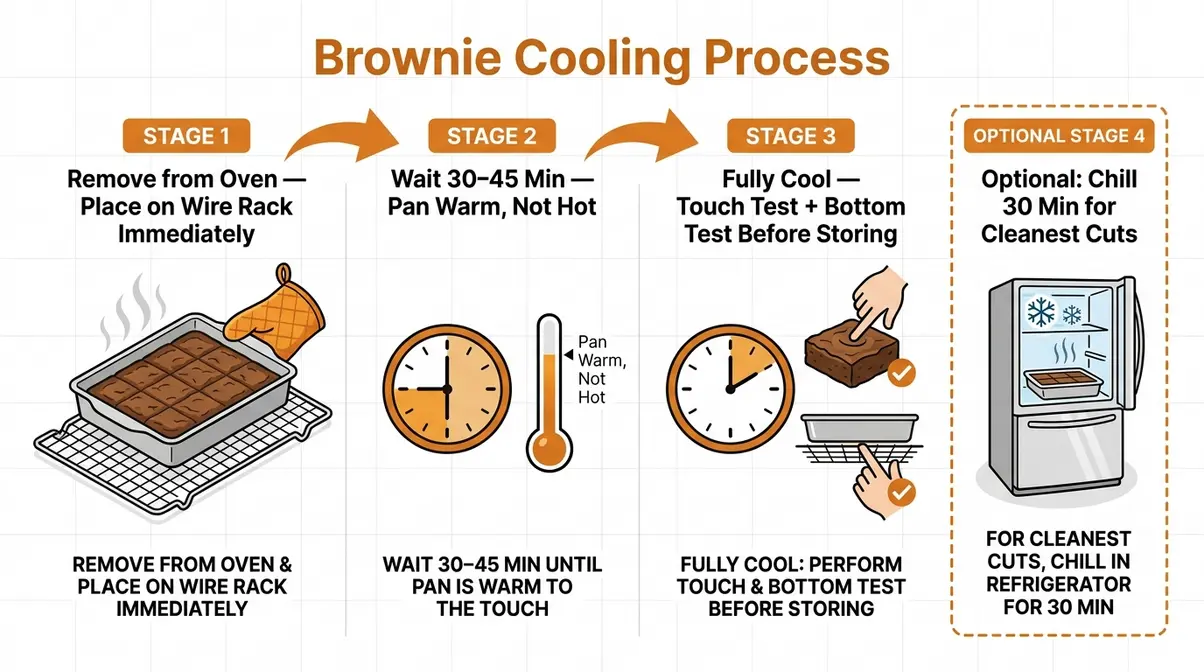
Place your pan on a wire cooling rack immediately after removing it from the oven. The rack allows air to circulate underneath, which prevents the bottom from sweating. Here’s the cooling timeline home bakers consistently follow:
- Remove from oven → Place pan on wire rack immediately
- Wait 30–45 minutes → The pan will feel warm but not hot to the touch
- Wait a full 1–2 hours → Brownies are fully set and cool enough to cut cleanly
- For cleanest cuts → Refrigerate the pan for 30 minutes before slicing
Cutting too early not only makes a mess — it also exposes more warm, moist interior to air, which speeds up how quickly the brownie surface dries out. Patience here directly extends Zone 1 of The Brownie Freshness Window.
How to Tell When Brownies Are Fully Cool
You need two tests before storing:
- Touch test: Press the center of the pan gently. It should feel firm and room temperature — not springy or warm.
- Bottom test: Lift the pan and feel the underside. If it still radiates heat, wait another 15–20 minutes.
A common mistake is checking only the top surface. The center of a thick brownie pan retains heat longer than the edges, so check the middle specifically. Once both tests pass, your brownies are ready to wrap and store.
Transition: Cooling is done. Step 4 covers room-temperature storage — the right method for the next 3–4 days.
Step 4: Store at Room Temperature
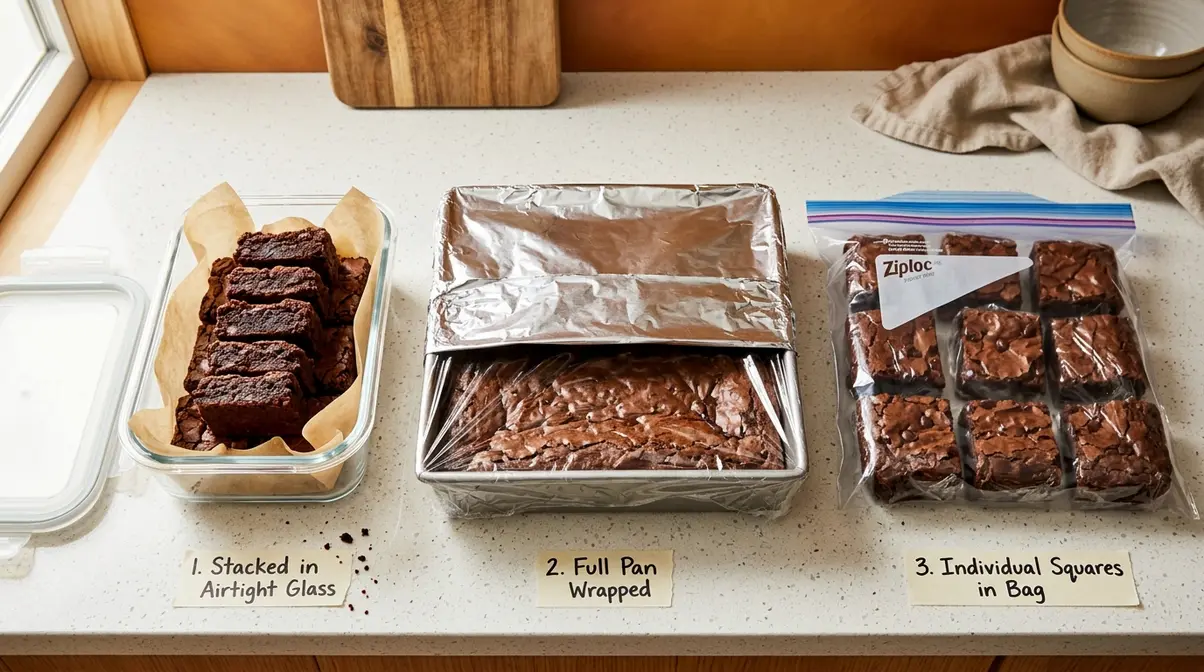
Room-temperature storage is the best option for brownies you plan to eat within 3–4 days. It preserves their soft, fudgy texture better than the refrigerator does — cold air accelerates starch retrogradation, which is why fridge-stored brownies often feel firmer. The key is sealing out air completely.
Best Containers for Counter Storage
Not all containers work equally well. Home baking communities consistently find that the method of sealing matters more than the container type itself:
- Option 1 — Airtight container with parchment: Line the base with parchment paper, add a single layer of brownies, add another sheet of parchment, then add a second layer. This prevents layers from sticking together.
- Option 2 — Original pan with tight wrap: Keep brownies uncut in the pan and cover tightly with two layers of plastic wrap, then a layer of foil. This is the best option if you’re storing for the full 3–4 days.
- Option 3 — Individual wrapping: Wrap each cut brownie individually in plastic wrap before placing in a zip-lock bag. This is ideal when you want to grab one at a time without exposing the rest to air.
Store your container away from direct sunlight, heat sources (ovens, stovetops), and humid areas. A cool, dry cupboard or pantry shelf works well.
Room Temperature Shelf Life
NC State Extension Safe Plates (2020) advises that low-moisture, high-sugar baked goods like brownies are safely stored at room temperature when kept covered — and recommends refrigerating or freezing homemade baked goods not consumed within 1–2 days to extend shelf life. For quality purposes, home bakers consistently find 3–4 days is the practical limit before texture noticeably deteriorates.
“Homemade brownies sealed in an airtight container typically last 3–4 days at room temperature before quality drops noticeably — with the first two days representing peak fudginess.”
After day 4 at room temperature, move any remaining brownies to the refrigerator or freezer. Don’t leave them out hoping they’ll last longer — they won’t, and the risk of mold increases in warmer or more humid kitchens.
Transition: Room temperature covers your short-term needs. Step 5 covers the refrigerator — the right choice when Sunday is further away than you thought.
Step 5: Refrigerate for Up to 1 Week
Refrigerating brownies extends their safe storage window to up to 1 week — but only if you wrap them correctly first. The fridge is a dry environment, and exposed brownies will lose moisture rapidly and come out tasting like chocolate-flavored cardboard. Proper wrapping is not optional here.
How to Refrigerate Correctly
Follow these steps exactly:
- Wrap each brownie individually in plastic wrap — press the wrap snugly against all sides, including the bottom
- Place wrapped brownies in an airtight container or zip-lock bag
- Squeeze out excess air from the bag before sealing
- Label with the date using a piece of masking tape or a marker on the bag
- Store away from strong-smelling foods (brownies absorb odors from the fridge)
- Remove from fridge 15–20 minutes before eating to restore texture — cold brownies taste significantly less rich
Why do refrigerated brownies sometimes come out hard? This is starch retrogradation happening faster in the cold. Research published in Food Science journals confirms that around 4°C (fridge temperature) is near the optimal rate for amylopectin recrystallization in baked goods — meaning the fridge actually accelerates the staling process in the starch (PubMed, 2015). The fat in brownies partially counteracts this, which is why fudgy, high-fat recipes hold up better than cakey ones. The solution is always to rewarm briefly before eating.
Fridge Storage Shelf Life
Properly wrapped homemade brownies last up to 1 week in the refrigerator (NC State Extension Safe Plates, 2020). Quality is best in the first 3 days; by days 5–7, texture will be noticeably firmer even after rewarming.
⚠️ Food Safety Disclaimer — Perishable Add-Ins: Brownies containing cream cheese swirls, fresh fruit, custard layers, or dairy-based frostings must always be refrigerated — they cannot be stored at room temperature. These add-ins are time/temperature control for safety foods. Follow the 2-hour rule: if brownies with perishable mix-ins have been left at room temperature for more than 2 hours (or 1 hour above 90°F/32°C), discard them. NC Cooperative Extension food safety guidance (2022) reinforces that high-moisture, dairy-containing baked goods must be kept at 41°F (5°C) or below. Even in the refrigerator, consume brownies with cream cheese or fresh fruit within 3–4 days rather than the full 7.
For more details on keeping your food safe, check out our general refrigeration guidelines for leftovers.
Transition: The fridge handles your medium-term needs. For anything beyond a week, Step 6 covers freezing — which keeps brownies genuinely fresh for months.
Step 6: Freeze for Long-Term Storage
Freezing is the single best method for preserving brownie quality long-term. NC State Extension Safe Plates (2020) confirms that baked goods are safe to freeze indefinitely, with quality beginning to decline after approximately 2–3 months. For brownies specifically, the quality sweet spot is within the first 4 weeks — after that, texture gradually softens and flavor subtly dulls, though the brownies remain safe.
Wrapping for the Freezer
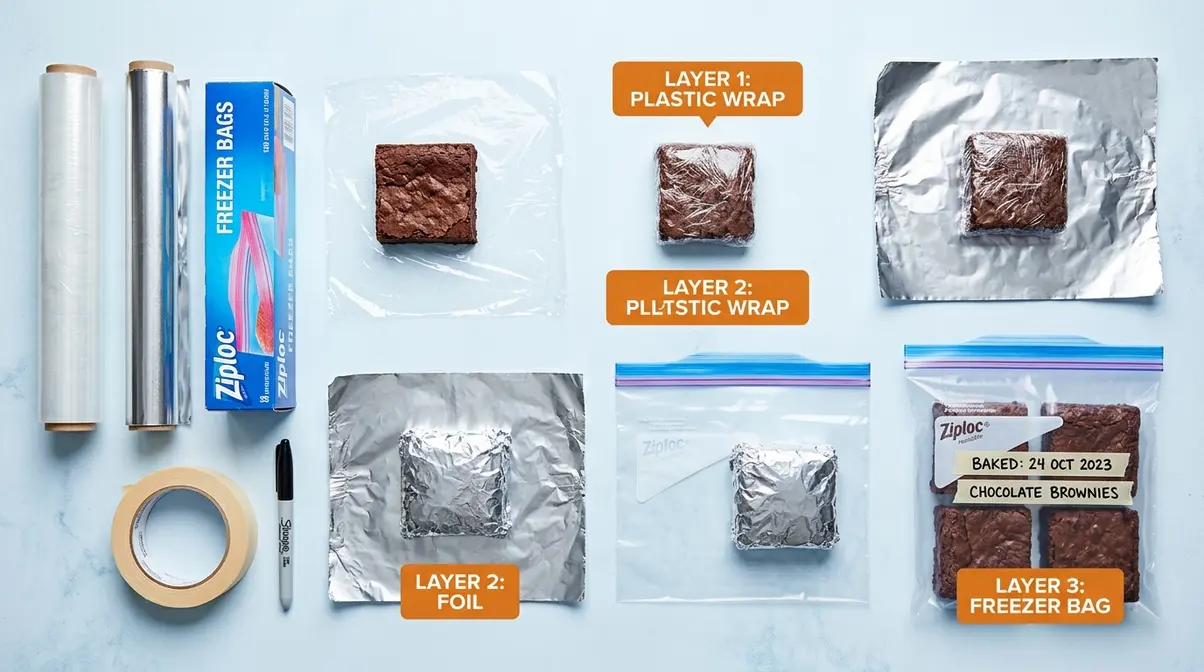
The enemy in the freezer is freezer burn — dehydration caused by direct contact between food and the cold, dry freezer air. Double-wrapping prevents it completely.
Follow these steps:
- Cool brownies completely — never freeze warm brownies (condensation causes ice crystals inside the wrap)
- Cut into individual squares — individual portions thaw faster and let you take only what you need
- Wrap each square tightly in plastic wrap — press out any air pockets and fold the ends under
- Wrap again in aluminum foil — the second layer blocks freezer air that plastic wrap alone can miss
- Place wrapped brownies in a zip-lock freezer bag — squeeze out all air before sealing
- Label the bag with the date and contents — frozen brownies look identical to other baked goods after a few weeks
- Freeze flat — don’t stack heavy items on top until the brownies are fully frozen solid
“Brownies wrapped in plastic then foil and stored in a sealed freezer bag remain peak quality for up to 4 weeks and acceptable quality for up to 3 months at 0°F (−18°C).”
How to Thaw Frozen Brownies
Thawing method affects final texture. Here are three options ranked by result quality:
| Method | Time | Result |
|---|---|---|
| Countertop (still wrapped) | 1–2 hours | Best texture — gradual thaw preserves moisture |
| Refrigerator overnight | 8–12 hours | Good texture — ideal for next-day planning |
| Microwave (unwrapped, 10 sec bursts) | 20–30 seconds | Acceptable — slight risk of uneven heating |
The critical rule for all three methods: thaw brownies while still wrapped. Unwrapping while frozen exposes warm, moist brownie surface to cold air, which creates condensation and a sticky, slightly soggy top. Keep the wrap on until the brownie reaches room temperature, then unwrap and serve.
Transition: You now have the full storage toolkit. Step 7 covers the most important check: how to tell if brownies have actually gone bad before you eat them.
Step 7: Check for Spoilage Before Eating
Knowing how to tell if brownies are bad is the final — and most important — step. Even well-stored brownies can spoil if the seal was broken, the kitchen was unusually warm, or a perishable ingredient was overlooked. Always check before eating, especially brownies that have been stored for more than 3 days.
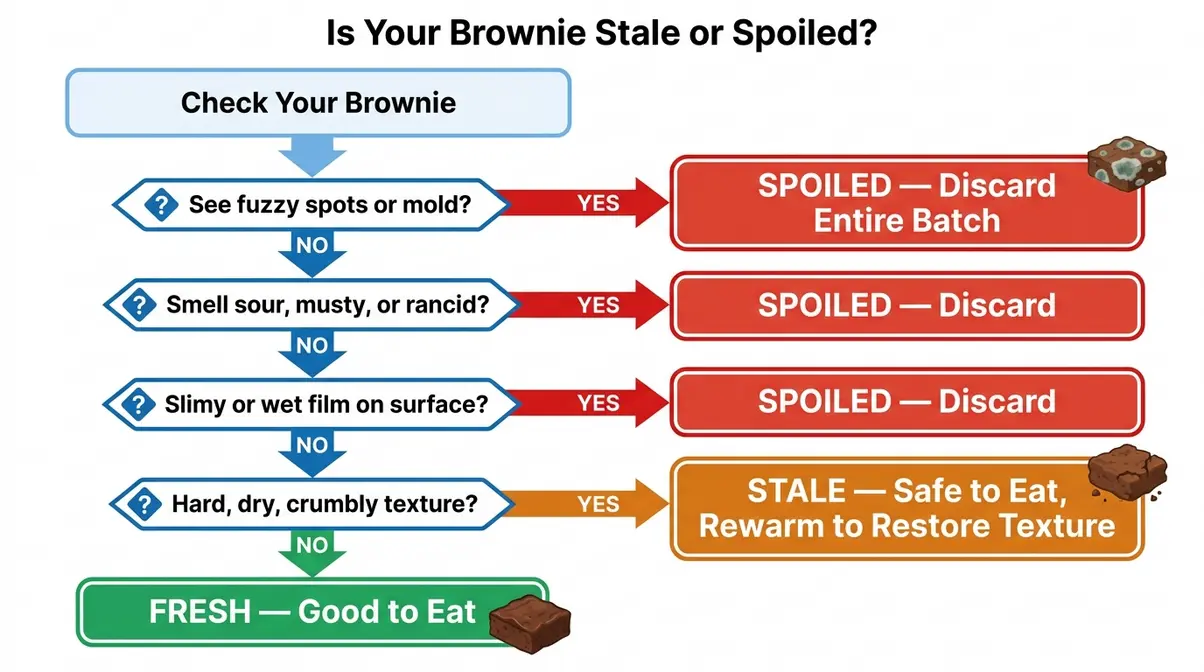
How to tell if brownies are bad?
Look carefully at the surface, edges, and underside of your brownies. Spoilage often starts in less visible spots:
- Fuzzy spots in white, green, blue-green, gray, or black — this is mold, and it means the entire batch should be discarded. Mold roots penetrate deeper than visible surface patches, so cutting off the affected piece is not safe (ARJ Chocolate, 2026).
- Unusual discoloration — patches that look pale, grayish, or unevenly dark in ways that weren’t there when fresh
- Slimy or shiny film on the surface — a wet, glossy patch that wasn’t there before indicates bacterial breakdown of sugars and fats; this is different from the natural sheen of a fresh fudgy brownie
Smell and Texture Tests
Fresh brownies smell like chocolate, butter, and vanilla. Any departure from that profile is a warning sign:
- Sour, musty, or rancid smell — a yeasty, fermented, or “wet cardboard” odor means the brownie has spoiled and should be discarded immediately
- Slimy or sticky texture — different from the natural stickiness of a fudgy brownie; this is a wet, slick film in patches
- Very hard and crumbly texture with no smell or discoloration — this is likely staleness (Zone 2 or Zone 3 quality), not spoilage; the brownie is unpleasant but probably safe
The key distinction: hard and dry = stale (quality issue). Slimy, smelly, or moldy = spoiled (safety issue). When in doubt, throw it out.
Can You Eat 2-Week-Old Brownies?
This is the question no other guide answers directly. Here is a clear, conditional answer:
Plain brownies (no perishable add-ins) stored in the freezer from day one: Yes, 2-week-old frozen brownies are very likely safe, and quality should still be good if double-wrapped.
Plain brownies stored in the refrigerator for 2 weeks: This exceeds the recommended 1-week window. While the high sugar and low moisture content of brownies mean they may not be immediately dangerous, the risk of mold and quality loss is significant. Inspect carefully for all spoilage signs above. If anything looks, smells, or feels off — discard.
Plain brownies stored at room temperature for 2 weeks: Do not eat them. Two weeks at room temperature is well beyond the 3–4 day safe quality window. Even if no visible mold is present, bacterial and fungal activity may have occurred inside the brownie where you can’t see it. Discard the batch.
Brownies with cream cheese, fresh fruit, or custard stored anywhere for 2 weeks: Discard without tasting. These contain perishable ingredients that can harbor dangerous bacterial growth.
Advanced Tips: Storage by Brownie Type
Not all brownies store the same way. The recipe type affects how quickly a brownie moves through The Brownie Freshness Window.
Homemade vs. Boxed vs. Store-Bought
| Type | Room Temp | Refrigerator | Freezer | Key Difference |
|---|---|---|---|---|
| Homemade | 3–4 days | Up to 1 week | Up to 3 months | No preservatives — freshest but shortest window |
| Boxed mix | 3–5 days | Up to 1 week | Up to 3 months | Added stabilizers may extend counter shelf life slightly |
| Store-bought (packaged) | Check use-by date | 1–2 weeks past use-by | Up to 3 months | Commercial preservatives significantly extend shelf life |
Homemade brownies made with high-fat recipes (extra butter, more egg yolks, or added oil) tend to stay moist longer than cakey versions because fat slows moisture loss and partially offsets starch retrogradation. Bakers consistently find that fudgy brownies are still pleasant on day 4 at room temperature, while cakey brownies may feel noticeably dry by day 3.
Cream Cheese, Fruit & Vegan Types
Cream cheese brownies: Must be refrigerated immediately after cooling. The cream cheese layer is a perishable dairy product — it cannot sit at room temperature for more than 2 hours. Refrigerated shelf life is 3–4 days (not the standard 7), and they freeze well for up to 2 months.
Fresh fruit brownies (raspberry, strawberry swirl): Same rules as cream cheese — refrigerate immediately, consume within 3–4 days. Fresh fruit adds moisture that accelerates both staling and mold growth.
Vegan brownies: Often made with flax eggs, coconut oil, or nut butters. These typically have a similar shelf life to standard homemade brownies — 3–4 days at room temperature, up to 1 week refrigerated. However, nut butter–based recipes can go rancid faster than butter-based ones, so check the smell carefully after day 3.
Troubleshooting: 5 Common Brownie Storage Problems
Problem 1: Dried Out After One Day
Cause: Container wasn’t fully airtight, or brownies were cut before storing.
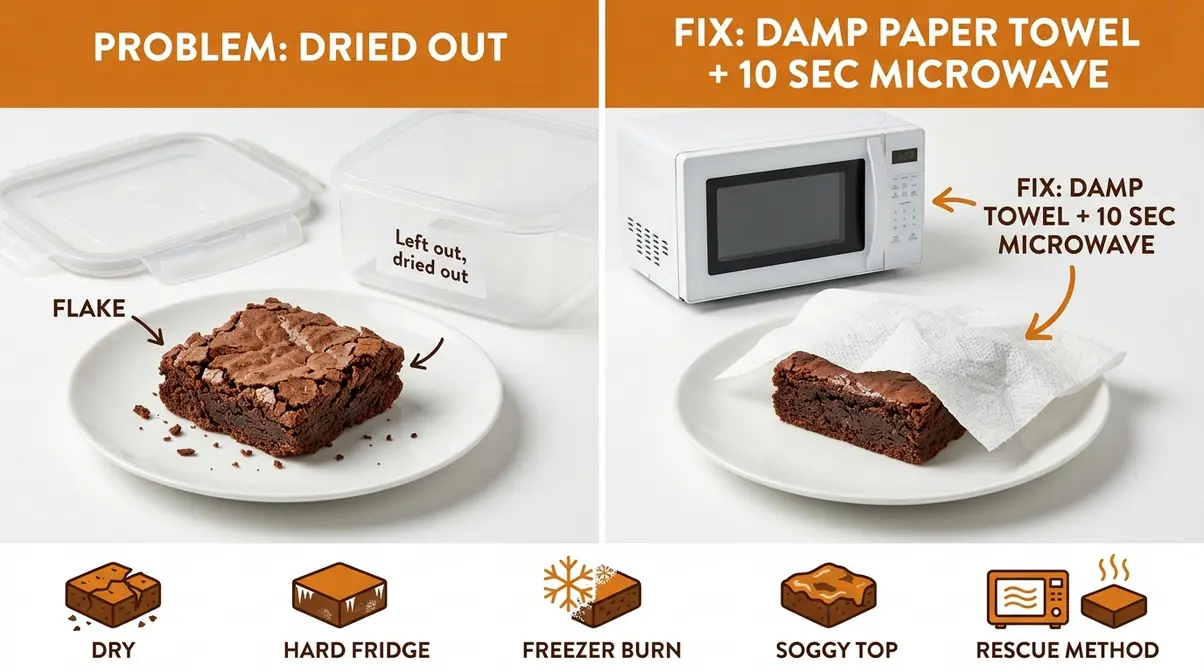
Fix: Transfer to a tightly sealed container and add a slice of plain white bread. The bread releases moisture that the brownies reabsorb overnight. Replace the bread daily. This works for up to 2 days.
Problem 2: Fridge Brownies Are Hard
Cause: Starch retrogradation accelerates in the cold — this is expected and doesn’t mean the brownies are spoiled.
Fix: Remove from the fridge 20–30 minutes before eating to let them return to room temperature. Alternatively, microwave individual brownies for 10–15 seconds to melt the retrograded starch back into a softer texture. The warmth reverses the crystallization temporarily.
Problem 3: Freezer Burn White Patches
Cause: Air reached the brownie surface inside the freezer, causing dehydration.
Fix: The brownie is safe to eat — cut away the affected area, which will be dry and tasteless. Prevent this in future batches by double-wrapping more tightly and pressing all air out of the freezer bag before sealing.
Problem 4: Soggy Tops After Fridge
Cause: Brownies were stored while still warm, creating condensation inside the container.
Fix: There’s no fix once this happens — the texture is compromised. Prevent it by always cooling brownies completely (touch test + bottom test from Step 3) before any storage. Pat the surface gently with a paper towel to remove surface moisture, then consume within 24 hours.
Problem 5: Rescuing Dry Brownies
When brownies are dry but not spoiled (Zone 2 or early Zone 3), this revival technique works reliably:
- Place the brownie on a microwave-safe plate
- Dampen a paper towel with water and wring it out so it’s moist, not soaking
- Lay the damp paper towel loosely over the brownie
- Microwave on 50% power for 10–15 seconds
- Check texture — if still firm, repeat once more for 10 seconds
The steam from the paper towel rehydrates the surface and softens the starch temporarily. Bakers across home baking communities consistently report this method restores acceptable texture to day-3 or day-4 brownies that have dried slightly. Eat immediately after rewarming — the effect doesn’t last.
Frequently Asked Questions
How long do brownies last unrefrigerated?
Homemade brownies last 3–4 days at room temperature when stored in an airtight container in a cool, dry spot. The first two days are peak quality — moist, fudgy, and rich. By day 3 or 4, texture starts to firm and flavor becomes slightly flat. NC State Extension Safe Plates (2020) recommends refrigerating or freezing homemade baked goods not consumed within 1–2 days to extend freshness. If your kitchen is warm or humid, move brownies to the fridge by day 2 to prevent premature mold growth.
How long do brownies last in the fridge?
Properly wrapped brownies last up to 1 week in the refrigerator. Wrap each brownie individually in plastic wrap, then place in a sealed airtight container to prevent moisture loss and odor absorption. Quality is best in the first 3 days — after that, the cold environment accelerates starch retrogradation, making brownies progressively firmer. Always remove refrigerated brownies 15–20 minutes before eating, or microwave for 10–15 seconds to restore softness. Brownies with cream cheese or fresh fruit should be eaten within 3–4 days refrigerated, not 7.
How do I know if brownies have gone bad?
Brownies have gone bad if you see mold, smell something sour or rancid, or notice a slimy texture. Mold appears as fuzzy white, green, or black spots — discard the entire batch, not just the moldy piece, because mold roots spread deeper than visible patches (ARJ Chocolate, 2026). A sour, musty, or fermented smell (instead of chocolate and butter) is a clear spoilage sign. Hard and dry texture alone is usually staleness, not spoilage — but if hardness comes with any off-smell or discoloration, discard immediately.
Can I eat brownies after 5 days?
It depends on how they were stored. Brownies stored in the refrigerator for 5 days are typically still safe — they’re within the 7-day refrigerator window, though texture will be firmer. Check for mold, off-smell, and sliminess before eating, and rewarm to restore texture. Brownies left at room temperature for 5 days have exceeded the safe 3–4 day quality window — inspect very carefully, and if there’s any doubt about appearance or smell, discard them. When in doubt, throw it out.
Can you eat 2-week-old brownies?
It depends entirely on storage method. Two-week-old brownies stored in the freezer from day one are very likely safe and should still have acceptable quality if double-wrapped. Two-week-old refrigerated brownies have exceeded the recommended 1-week window — inspect carefully for all spoilage signs, and discard if anything seems off. Two-week-old brownies stored at room temperature should be discarded without tasting — this is well beyond the safe 3–4 day counter window. Brownies with cream cheese or fresh fruit at 2 weeks should always be discarded, regardless of storage method.
What to Do Next
For home bakers planning ahead, the storage method that matches your timeline makes all the difference. If you are still wondering how long do brownies last, remember that proper storage is the ultimate deciding factor. Homemade brownies deliver peak quality in the first two days — that’s Zone 1 of The Brownie Freshness Window, where they’re moist and squidgy and worth every minute you spent making them. Beyond that, proper sealing, correct refrigeration, and double-wrapped freezing extend your options significantly.
The Brownie Freshness Window isn’t just about safety dates. It’s about knowing which zone your brownies are in so you can make a confident decision: serve them now, rewarm them later, or move them to the freezer before quality drops. NC State Extension Safe Plates (2020) confirms that baked goods frozen at 0°F are safe indefinitely — quality, not safety, is the limiting factor.
Make your next batch, wrap it right, label it with today’s date, and check it before you serve. If you’re bringing brownies to coworkers on Sunday and you baked on Thursday, refrigerate them tonight — wrapped tightly — and pull them out 20 minutes before you leave. They’ll taste nearly as good as day one.

Dave King
Recipe developer and writer at Quick Dish Cookbook.
![How Long to Cook Pork Shoulder at 250°F [Chart]](https://quickdishcookbook.com/wp-content/uploads/2026/07/pork-shoulder-cook-time-250f-720x450.webp "How Long To Cook Pork Shoulder At 250°F [Chart] 9")