


You made a big batch of mashed potatoes last night — or maybe it was Thanksgiving dinner — and now there’s a container sitting in your fridge. You’re wondering whether it’s still safe to eat, or whether you’ve already crossed the line.
What’s in this guide
- What You'll Need Before You Start
- Step 1: Fridge Storage Duration
- Step 2: Cool Within 2 Hours
- Step 3: Use Airtight Containers
- Step 4: Check for Spoilage Before Eating
- Step 5: Use the Dairy & Ingredient Storage Matrix
- Step 6: Freeze for Long Storage
- Step 7: Reheat Mashed Potatoes Safely
- Troubleshooting Common Storage Mistakes
- Frequently Asked Questions
- Limitations and When to Seek Help
- Conclusion
That quiet uncertainty is completely understandable. No one wants to waste food, but no one wants to spend the next day sick either. Most articles online just tell you “3 to 5 days” and leave it there — without explaining what that range actually means, or whether your potatoes made with sour cream and cream cheese follow the same rules as plain ones.
This guide answers exactly how long do mashed potatoes last in the fridge, how to store them correctly from the moment they come off the stove, and how to tell when they’ve gone bad — so you never have to guess. You’ll work through 7 clear steps covering cooling, storage, spoilage signs, dairy-specific timelines, freezing, and reheating.
Key Takeaways: Mashed Potato Storage at a Glance
When determining how long do mashed potatoes last in the fridge, they typically last 3 to 5 days in the fridge when stored in an airtight container at or below 40°F — though USDA guidelines for cooked leftovers set the safest limit at 3 to 4 days (FoodSafety.gov).
- Fridge limit: 3-4 days (USDA safe limit); 5 days is the outer edge
- Dairy matters: Mashed potatoes made with milk, sour cream, or cream cheese should be eaten within 3-4 days — see the Dairy & Ingredient Storage Matrix in Step 5
- Freeze for longer: Properly frozen mashed potatoes last up to 10-12 months
- When in doubt, throw it out — if they smell sour, look gray, or feel slimy, discard immediately
What You’ll Need Before You Start
Estimated Time: 5 minutes to prep for storage
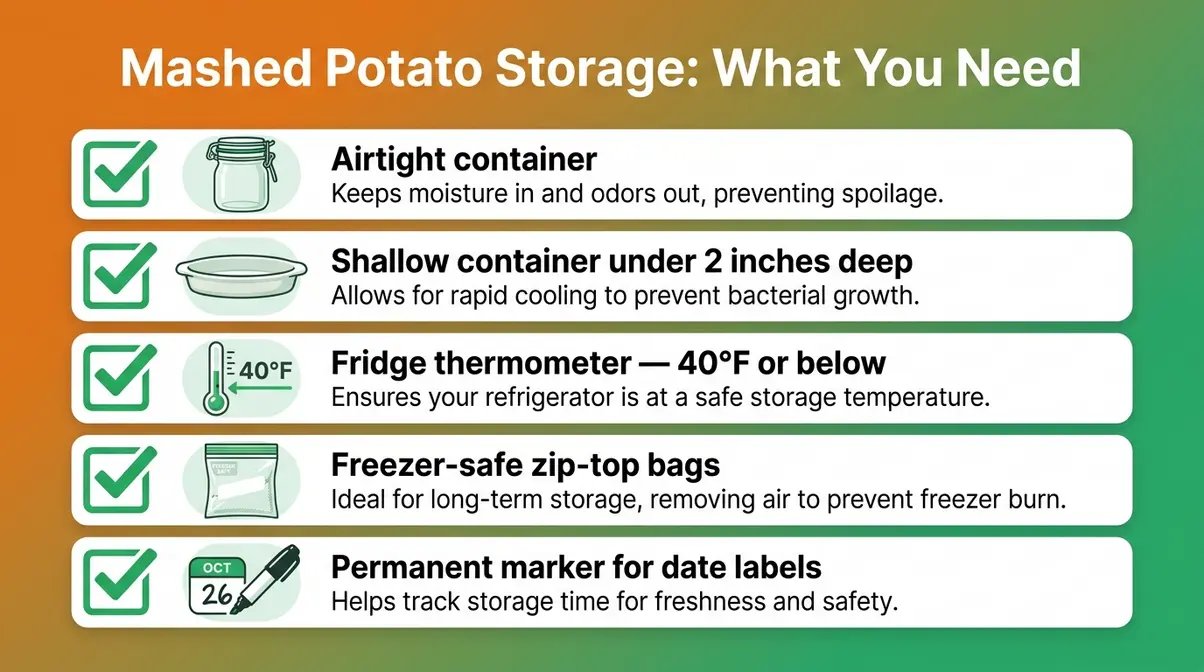
Before working through the steps below, gather these items. Each one plays a specific role in keeping your mashed potatoes safe.
- Airtight container (glass with a locking lid, or BPA-free plastic with a rubber-seal lid) — prevents air exposure, which causes graying and dries out the surface
- Shallow container or baking dish (no more than 2 inches deep) — shallow layers release heat much faster than a deep bowl, which is critical in the first two hours after cooking
- Refrigerator set to 40°F (4°C) or below — if you’re unsure of your fridge’s temperature, a simple fridge thermometer costs under $10 and takes the guesswork out
- Freezer-safe zip-top bags or containers — for storage beyond 4 days; regular storage bags are not thick enough to prevent freezer burn
- A permanent marker — for writing the date and “eat by” date directly on the container
Step 1: Fridge Storage Duration
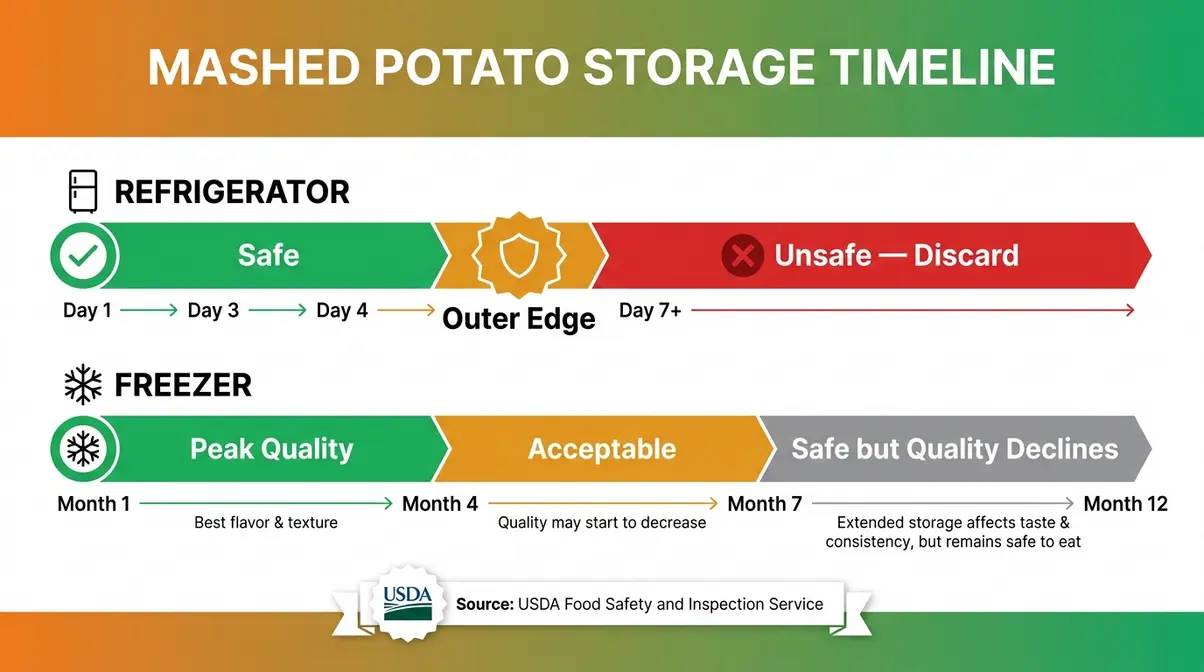
If you are wondering how long do mashed potatoes last in the fridge, the USDA provides clear guidance. Mashed potatoes last 3 to 5 days in the fridge, but the USDA’s food safety guidelines recommend treating 3 to 4 days as the safest limit for cooked leftovers. That’s because mashed potatoes are a TCS food — a “Time/Temperature Control for Safety” food, meaning they’re the type of food bacteria love: cooked, moist, and starchy. Eating them beyond day 5 significantly raises your risk of foodborne illness, even if they look and smell fine.
According to federal food safety guidelines for leftovers, cooked leftovers — including mashed potatoes — are safe in the refrigerator for 3 to 4 days when stored at or below 40°F (4°C) (FoodSafety.gov, Cold Food Storage Chart). That’s the official, government-backed number. The 5-day figure that appears on many food blogs represents the outer boundary of safe consumption — not the recommended window.
The exact number also depends on what’s in your mashed potatoes. We cover that in Step 5 with the Dairy & Ingredient Storage Matrix, which shows how milk, sour cream, and cream cheese affect your safe window. For a deeper dive into mashed potato storage duration and safety, it is crucial to understand these ingredient variables.
The 3-5 Day Rule Explained
How long are mashed potatoes good for in the fridge? The USDA Cold Food Storage Chart gives a clear answer: 3 to 4 days when stored at or below 40°F. That is the official guideline. The “up to 5 days” figure you’ll see on many food sites represents the outer boundary of what’s considered tolerable — not what food safety experts actually recommend.
Storage conditions push you toward the safer or riskier end of that range. If your fridge runs warmer than 40°F, if the container wasn’t airtight, or if the potatoes sat out for close to two hours before refrigerating, you’re closer to the 3-day end. If everything was done perfectly — rapid cooling, airtight seal, fridge at 38°F — day 4 is still reasonable. Day 5 is a judgment call, not a guarantee.
A practical rule: if you made mashed potatoes on Monday, aim to finish them by Thursday (day 4). Friday is the absolute outer limit — and only if they were stored perfectly and show zero signs of spoilage.
Transition: But knowing the number is only half the story — the other half is what you do in the first two hours after cooking.
Can They Last a Week?
No — 7 days exceeds the USDA’s 3-4 day guideline by nearly double. Bacterial growth does not pause after day 5, and it does not announce itself with a smell or a color change.
Even if your mashed potatoes look and smell fine on day 7, harmful bacteria like Staphylococcus aureus and Bacillus cereus can be present in dangerous numbers without any visible signs. These bacteria produce toxins that survive even reheating. The user perspective that “depending on how cold the fridge is, 7 days is the far end of tolerance” reflects real-world practice — but it is not food safety guidance. The USDA’s Cold Food Storage Chart is unambiguous: cooked leftovers belong in the trash after 3-4 days, not on your plate after 7.
How long can you keep mashed potatoes in the fridge? The answer is up to 4 days — and only under proper storage conditions.
Transition: Now that you know the deadline, let’s make sure your mashed potatoes actually make it to day 4 safely — starting with the most overlooked step.
Step 2: Cool Within 2 Hours
Before your mashed potatoes go into the fridge, one rule matters more than the container you choose: get them cold within 2 hours. Bacterial growth risks in mishandled prepared potatoes are significant — mishandling prepared potato dishes by leaving them at room temperature can result in rapid bacterial growth and cause severe foodborne illness (Colorado State University Food Source Information).
Following the Rapid Cooling Protocol before refrigerating is just as important as the 3-4 day storage limit itself. Many home cooks focus entirely on the container and the fridge, but the window between cooking and refrigerating is where most food safety mistakes happen.
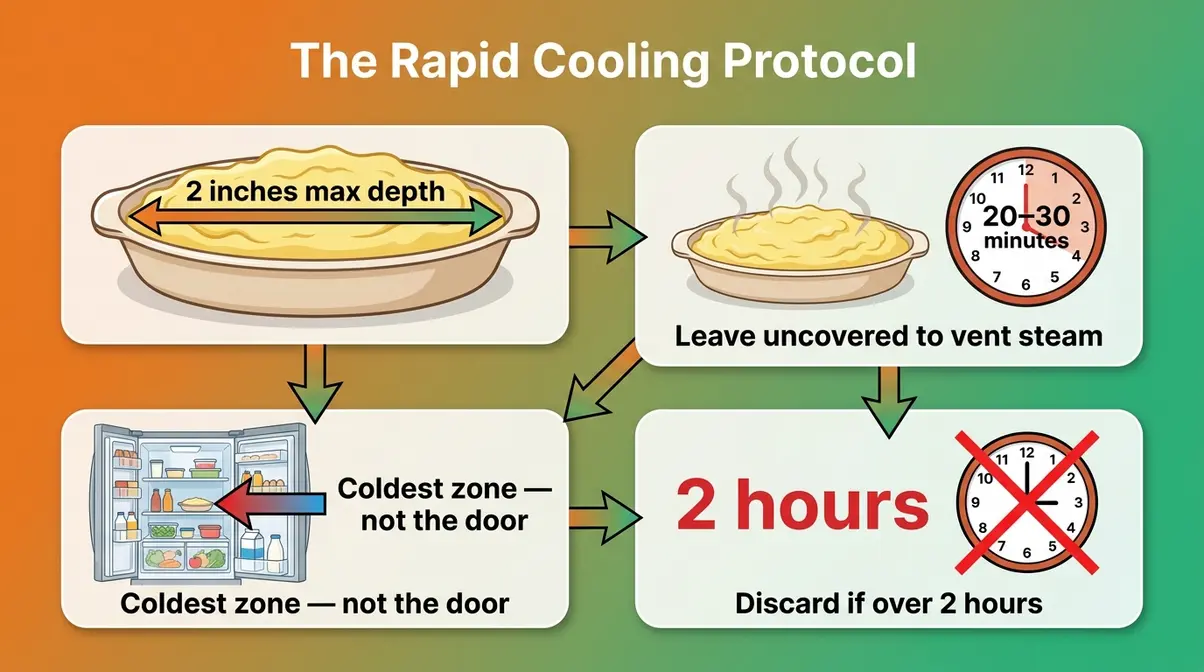
The Rapid Cooling Protocol:
- Divide into shallow portions. Transfer mashed potatoes into a container no more than 2 inches deep. Shallow layers release heat faster than a deep bowl — a critical difference when you’re racing against the 2-hour clock.
- Do not cover while hot. Leave uncovered for 20-30 minutes to allow steam to escape. Then loosely cover before refrigerating. Trapping steam creates condensation, which adds moisture and accelerates spoilage.
- Place in the coldest part of the fridge. The back of the middle shelf stays closest to 40°F. The door fluctuates in temperature every time it opens — avoid it for leftovers.
- Check the 2-hour clock. If more than 2 hours have passed since cooking — including time spent on the table during dinner — discard. Do not refrigerate.
Checkpoint: Your mashed potatoes should be in the fridge within 2 hours of cooking, in a shallow container, with the fridge set to 40°F (4°C) or below. If you hit this checkpoint, the 3-4 day clock starts now.
The 2-Hour Rule: Why Timing Matters
The USDA defines the “Danger Zone” as the temperature range between 40°F and 140°F (4°C–60°C) — think of it as the range where bacteria throw a party in your food. In this zone, harmful bacteria can double in number every 20 minutes (USDA FSIS, “Keeping Food Safe”). A pot of hot mashed potatoes sitting on your counter is squarely in that zone.
Clostridium perfringens — one of the most common causes of foodborne illness from cooked starchy foods — is especially dangerous here. It forms heat-resistant spores that survive cooking. When food cools too slowly in the Danger Zone, those spores germinate and multiply to harmful levels. Reheating later will not necessarily destroy the toxins they produce.
There is also a 1-hour rule for hot days: if the ambient temperature in your kitchen is above 90°F (32°C) — common in summer or near a hot oven — the safe window is cut in half. Refrigerate within 1 hour.
Transition: Once cooled, the container you choose makes a bigger difference than most people realize.
Step 3: Use Airtight Containers
According to FDA guidelines on safe food storage, food stored continuously at or below 40°F (4°C) remains safe within USDA-recommended timeframes (FDA, “Are You Storing Food Safely?”). But “properly stored” means more than simply putting a bowl in the fridge. The container type, placement, and surface protection all determine how long do mashed potatoes last in the fridge safely.
“Storing mashed potatoes in an airtight container at 40°F or below, within 2 hours of cooking, extends their safe refrigerator life to 3-4 days per USDA guidelines.”
Storage Steps:
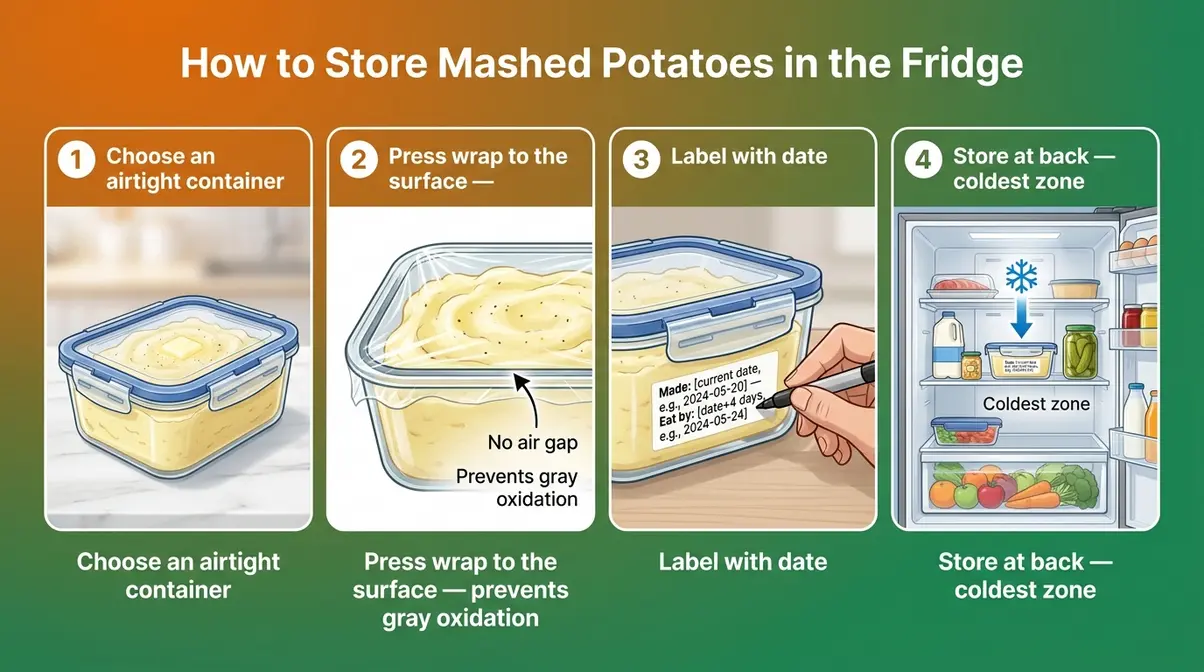
- Choose an airtight container. Glass containers with locking lids or BPA-free plastic with a rubber-seal lid work best. Avoid loosely covered bowls — air exposure accelerates oxidation (graying) and drying. A bowl covered with aluminum foil is not airtight.
- Press plastic wrap directly onto the surface. Before sealing the lid, press a sheet of plastic wrap directly against the surface of the mashed potatoes. This eliminates air pockets between the food and the lid. It also prevents the surface from turning gray — a cosmetic change caused by oxidation that makes people throw away still-safe potatoes.
- Label with the date. Write today’s date and a simple “Eat by: [date + 4 days]” on the container with a permanent marker. This removes all guesswork and protects you from the “when did I make these?” problem.
- Store in the coldest part of the fridge. The back of the middle shelf stays closest to a consistent 40°F. The fridge door fluctuates every time it opens — never store leftovers there.
Checkpoint: Container sealed, plastic wrap touching the surface, date label applied, stored in the back of the fridge. If all four are done, your mashed potatoes are set for a safe 3-4 day window.
Step 4: Check for Spoilage Before Eating
This is the most important safety step in the entire guide. Even if your mashed potatoes are within the 3-4 day window, always check them before reheating. According to CDC guidelines on food safety, bacteria are invisible — but spoilage often leaves behind sensory clues you can detect.
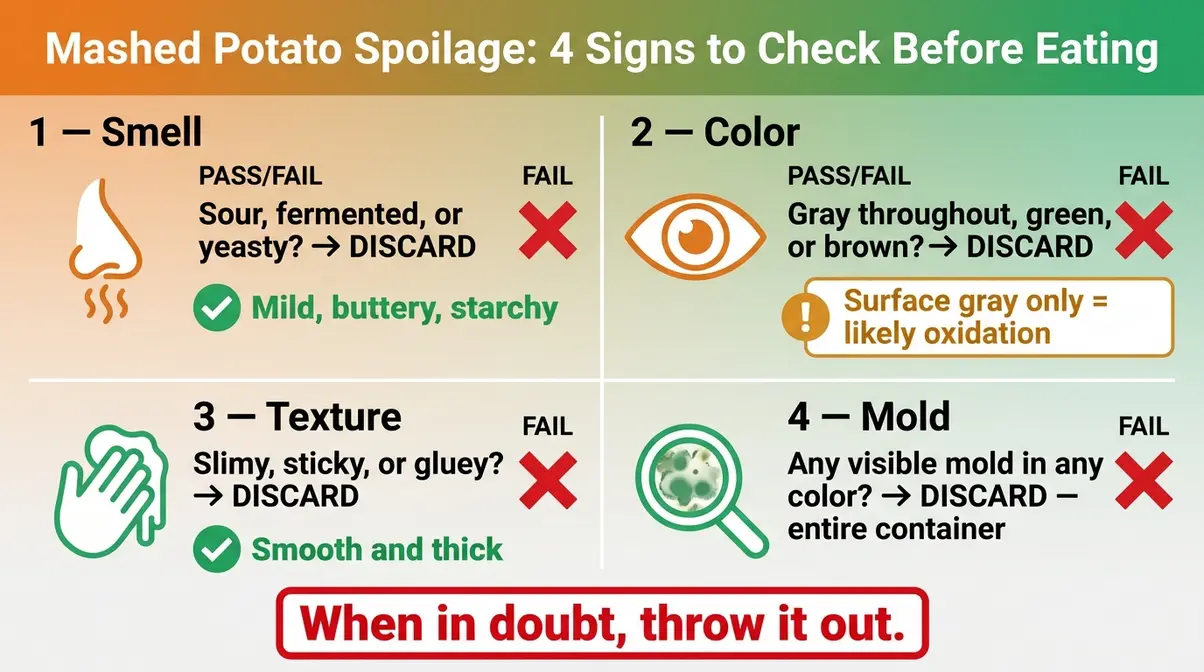
⚠️ When in doubt, throw it out. If you are unsure whether your mashed potatoes are safe, discard them. No leftover is worth a foodborne illness.
The 4 Sensory Spoilage Checks
1. Smell — The First and Most Reliable Test
Open the container and take a cautious sniff. Fresh mashed potatoes smell mildly buttery and starchy. If a sour, cheesy, sharp, or fermented smell hits you immediately, the potatoes have gone bad. Sour dairy notes, yeasty odors, or a hint of alcohol all point toward bacterial fermentation. Trust your nose — if anything smells off, discard.
2. Color — Watch for Gray or Green
A slight gray tinge on the surface is usually oxidation, not spoilage — it can happen even to well-stored potatoes when air reaches the surface. However, gray that appears throughout the batch (not just the surface layer), or any green or brown discoloration, indicates bacterial or mold activity. Unusual discoloration that doesn’t look like normal oxidation is a discard signal.
3. Texture — Slimy or Gummy Means Go
Fresh mashed potatoes feel smooth and thick. If they feel slimy, sticky, or gluey in an unusual way — not just the normal dense texture — bacterial growth has likely occurred. Excessive liquid separation that doesn’t reincorporate when stirred is another warning sign. A watery consistency you didn’t notice before is a red flag.
4. Mold — Zero Tolerance
Any visible mold — fuzzy spots, powdery patches, or discolored growth in any color (green, white, black, gray) — means the entire container must be discarded. Do not scoop out the moldy part and eat the rest. Mold spreads invisible threads throughout food, and the toxins it produces can be present even in areas that look clean.
Food Safety Reminder: The absence of these signs does not guarantee safety. Harmful bacteria like Staphylococcus aureus and Bacillus cereus can reach dangerous levels without causing any visible change in smell, color, or texture. The 3-4 day guideline exists precisely because of this — time is the most reliable limit, not appearance alone.
Step 5: Use the Dairy & Ingredient Storage Matrix
Not all mashed potatoes are equal when it comes to shelf life. The ingredients you add — butter, milk, sour cream, cream cheese, garlic — affect how quickly your leftovers approach their safe limit. This is the gap every competitor misses, and it is where the Dairy & Ingredient Storage Matrix makes a real difference.
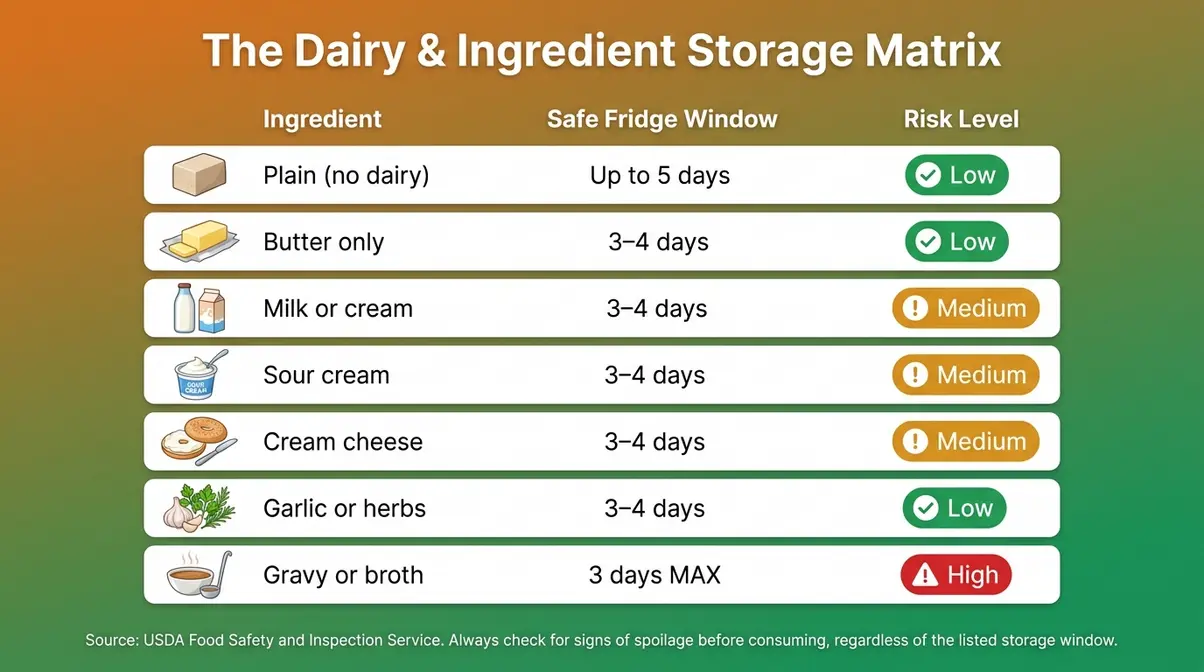
The Dairy & Ingredient Storage Matrix — a named framework for understanding how common mashed potato add-ins shift your safe storage window — is designed to help you make a confident decision based on exactly what’s in your bowl, not a generic “3-5 days” rule.
The core principle: dairy fats and proteins create an additional layer of perishability on top of the potato itself. According to Penn State Extension, adding butter, cream, sour cream, or cream cheese provides fat that helps frozen mashed potatoes maintain texture — but those same dairy ingredients are independently perishable at refrigerator temperatures (Penn State Extension, “Freezing Potatoes,” 2026). Food safety guidance treats mashed potatoes as a cooked leftover containing perishable dairy ingredients — subject to the same 3-4 day USDA limit as all TCS foods (USDA FSIS).
The Dairy & Ingredient Storage Matrix
| Ingredient Added | Safe Fridge Window | Notes |
|---|---|---|
| Plain (no dairy) | Up to 5 days | Lowest perishability; still follow 3-4 day USDA baseline |
| Butter only | 3-4 days | Butter adds minimal additional risk; follow USDA baseline |
| Milk or cream | 3-4 days | Milk is a TCS food; refrigerate within 2 hours, use within 3-4 days |
| Sour cream | 3-4 days | Opened sour cream lasts 7-21 days alone; once cooked in, follow leftover rule |
| Cream cheese | 3-4 days | Cream cheese has a 2-week standalone fridge life; once mixed in, use within 3-4 days |
| Garlic or herbs | 3-4 days | No change to safety window; may affect flavor faster |
| Gravy or broth added | 3 days maximum | Meat-based additions accelerate bacterial risk; use within 3 days |
The key takeaway from this matrix: once dairy is mixed into mashed potatoes and the dish is cooked, the entire batch takes on the shortest shelf life of its ingredients. Mashed potatoes with milk last in the fridge for 3-4 days — the same as plain potatoes — because the cooked potato itself is the limiting factor as a TCS food. Adding sour cream or cream cheese does not shorten this window further, but it does confirm you should never push toward day 5.
The one exception is gravy or meat-based additions. If you stirred leftover gravy or meat drippings into your mashed potatoes, treat the entire batch as a 3-day maximum item. Meat-based ingredients carry their own bacterial risk and shorten the safe window.
Step 6: Freeze for Long Storage
If you will not finish your mashed potatoes within 3-4 days, freezing is the right move — and it should happen within that window, not after it. Do not wait until day 5 to freeze potatoes that are already at their limit.
Frozen mashed potatoes remain safe indefinitely at 0°F (-18°C) or below, but quality declines over time. For the best texture and flavor, most food storage guides recommend using them within 2-4 months. Some sources, including the Wyoming Department of Health, note they can last up to 10-12 months in a well-maintained freezer, though the texture may suffer after the 6-month mark (Tasting Table, citing Healthline).
How to Freeze Mashed Potatoes
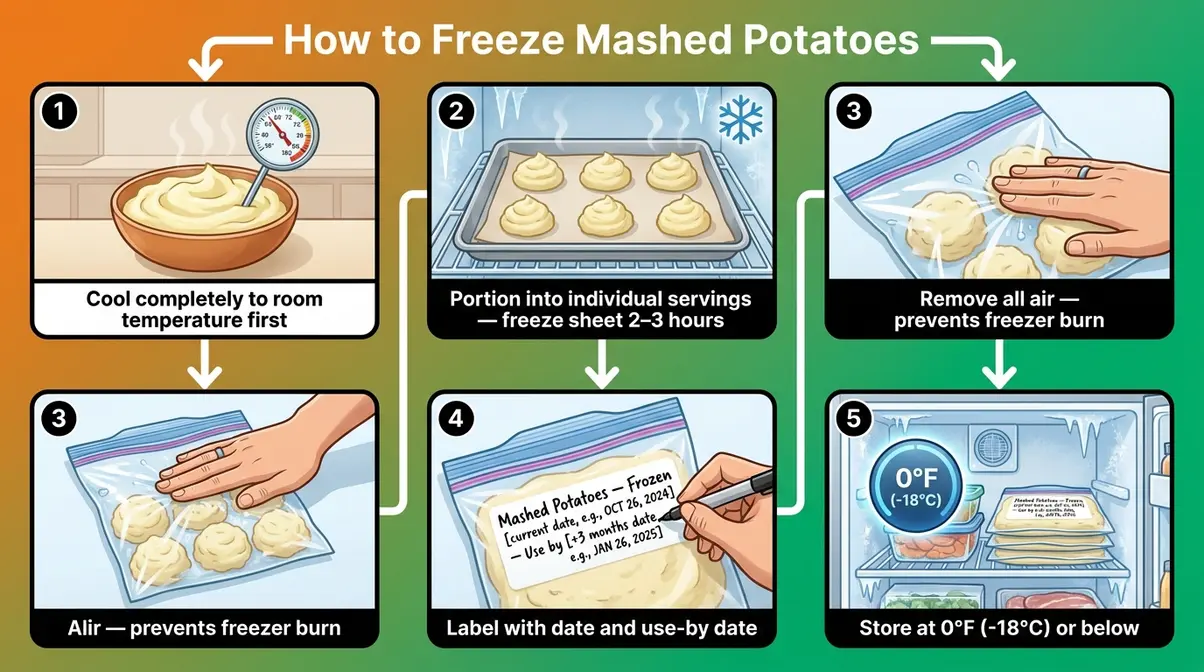
- Cool completely first. Mashed potatoes must be at room temperature (or cooler) before going into the freezer. Placing warm food in the freezer raises the temperature of surrounding items and can create ice crystals that destroy texture.
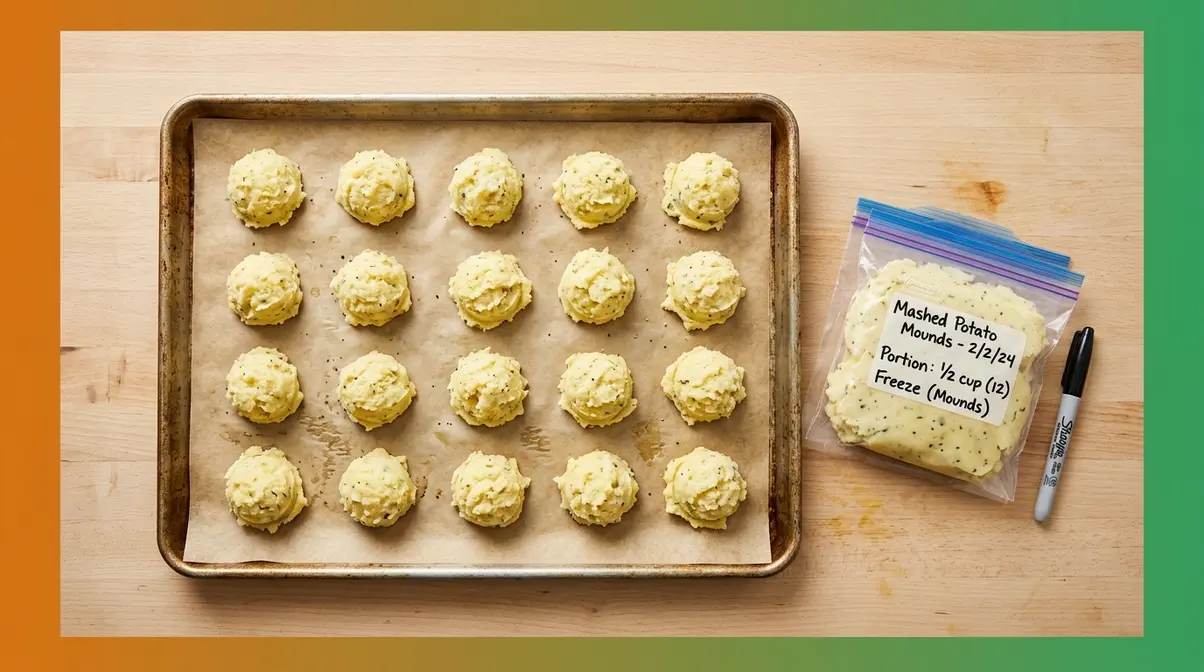
- Portion into individual or family-sized servings. Scoop cooled mashed potatoes onto a parchment-lined baking sheet in individual mounds, or divide into portion-sized freezer bags. Freeze the sheet for 2-3 hours until solid, then transfer to labeled freezer bags. This prevents one large frozen block that is difficult to thaw partially.
- Remove as much air as possible. Press out excess air before sealing freezer bags. Air causes freezer burn — the dry, discolored patches that ruin texture. For rigid containers, fill close to the top to minimize headspace.
- Label with date and contents. Write “Mashed Potatoes — Frozen — Use by [date + 3 months]” on the bag. Three months is the quality sweet spot; they remain safe longer but may need extra butter or cream when reheating to restore texture.
- Store at 0°F (-18°C) or below. A freezer that fluctuates above 0°F shortens quality life significantly. If your freezer is set to “medium,” check the actual temperature with a thermometer.
Checkpoint: Cooled, portioned, airtight, labeled, and stored at 0°F. Your mashed potatoes are now set for up to 3 months of quality storage.
To thaw: Move frozen mashed potatoes to the refrigerator the night before you need them. Thaw in the fridge, not on the counter — thawing at room temperature puts them back in the Danger Zone. Once thawed, use within 1-2 days and do not refreeze.
Step 7: Reheat Mashed Potatoes Safely
Reheating is the final safety gate before eating. Getting the temperature right is not just about texture — it is about killing any bacteria that may have grown during refrigerator storage.
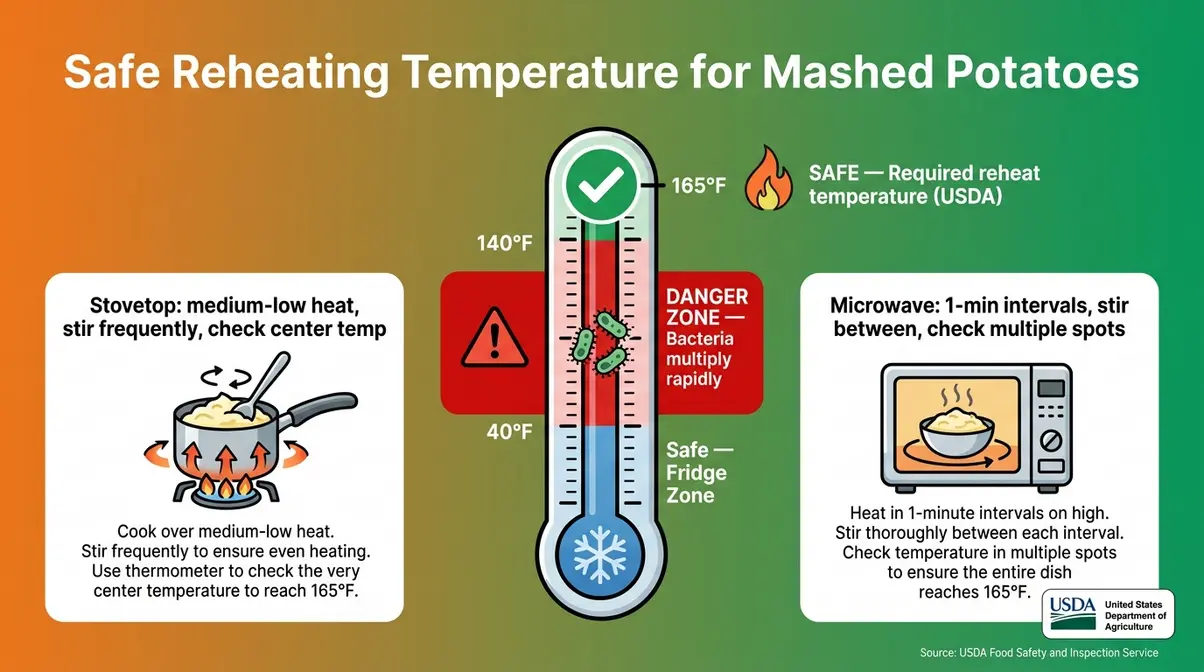
According to the USDA Safe Minimum Internal Temperature Chart, leftovers must be reheated to an internal temperature of 165°F (74°C) to be considered safe (USDA FSIS, 2026). This applies to mashed potatoes reheated by any method — stovetop, microwave, or oven.
Stovetop Method (Best for Texture)
The stovetop gives you the most control over temperature and consistency.
- Place mashed potatoes in a saucepan over medium-low heat.
- Add 1-2 tablespoons of butter, milk, or cream per cup of potatoes. Cold mashed potatoes are denser and drier than fresh — the added fat restores creaminess and prevents scorching.
- Stir frequently. Mashed potatoes can stick and burn at the bottom if left unattended.
- Heat until steaming throughout — check the internal temperature with a food thermometer. You are aiming for 165°F (74°C) throughout, not just at the surface.
- Serve immediately. Do not let reheated mashed potatoes sit at room temperature for more than 2 hours.
Microwave Method (Fastest)
Microwaves heat unevenly — a critical issue for food safety in dense foods like mashed potatoes.
- Transfer to a microwave-safe bowl and spread into an even layer, not a mound.
- Cover loosely with a microwave-safe lid or damp paper towel. This traps steam and promotes even heating.
- Microwave in 1-minute intervals on medium power, stirring between each interval. Stirring redistributes heat and eliminates cold spots where bacteria survive.
- Check the temperature in multiple spots with a food thermometer. The center and edges can differ by 20°F or more.
- Continue heating until all areas reach 165°F (74°C).
Reheating Rule: Do not reheat mashed potatoes more than once. Each reheat-and-cool cycle creates additional bacterial risk. Reheat only the portion you plan to eat.
Troubleshooting Common Storage Mistakes
Even careful cooks run into problems. Here are the four most common mashed potato storage mistakes — and how to handle them.
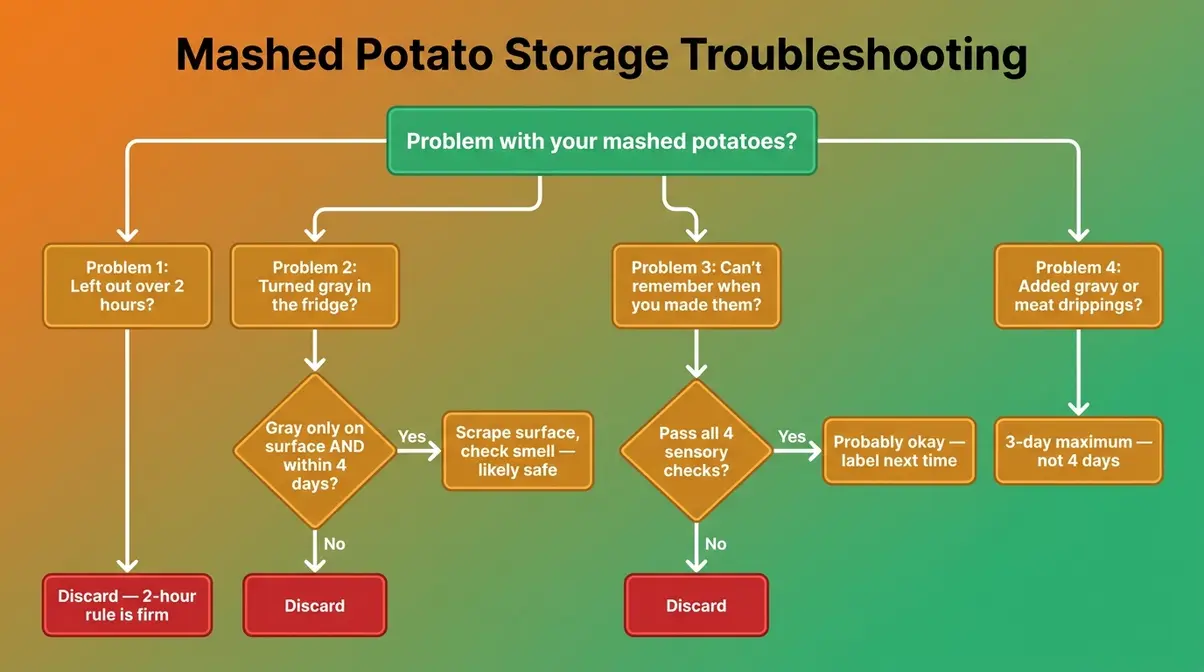
Problem 1: “I forgot to refrigerate them and they sat out for 3 hours.”
Discard them. The 2-hour rule is firm. Once mashed potatoes have been in the Danger Zone (40°F–140°F) for more than 2 hours, bacterial growth may have reached levels that reheating cannot reverse. This is especially true for Clostridium perfringens, whose heat-resistant spores survive cooking. No amount of refrigerating or reheating makes them safe again.
Problem 2: “My mashed potatoes turned gray in the fridge — are they bad?”
Not necessarily. Gray discoloration on the surface is usually oxidation — a chemical reaction when air contacts the cut surface of potatoes. It is the same reason sliced apples turn brown. If the gray is only on the surface, the smell is normal, and you are within 4 days, the potatoes are generally still safe. Scrape off the gray layer before reheating. Next time, press plastic wrap directly onto the surface before sealing (Step 3) to prevent this.
Problem 3: “I’m not sure when I made them — I forgot to label the container.”
Apply the sensory checks from Step 4 first. If anything smells sour, looks unusual, or feels slimy, discard immediately. If they pass the sensory check but you genuinely cannot remember when you made them, the safe choice is to discard. The risk of a foodborne illness is not worth saving a container of potatoes. This is exactly why the labeling step in Step 3 matters.
Problem 4: “I added leftover gravy to the mashed potatoes — does that change anything?”
Yes. As the Dairy & Ingredient Storage Matrix shows, meat-based additions shorten the safe window to 3 days maximum. Gravy made from meat drippings is a TCS food with its own bacterial risk profile. When mixed into mashed potatoes, the entire batch should be treated as a 3-day item, not a 4-day item.
Frequently Asked Questions
Can you eat 7-day-old mashed potatoes?
“Depending on how cold the fridge is, you should be fine — though 7 days is the far end of tolerance.” — common home-cooking community advice
No — 7-day-old mashed potatoes are not safe to eat. The USDA Cold Food Storage Chart specifies that cooked leftovers are safe for 3 to 4 days at or below 40°F. By day 7, bacterial growth has had nearly double the recommended time to accumulate. Harmful bacteria like Staphylococcus aureus and Bacillus cereus can reach dangerous levels without causing any visible change in smell, color, or texture. The advice above reflects real-world practice — but it is not food safety guidance. If you experience symptoms of foodborne illness after eating leftovers, contact a healthcare provider immediately.
How to tell if they have gone bad?
Mashed potatoes have gone bad if they smell sour, look gray throughout, feel slimy, or show any visible mold. A sour, fermented, or cheesy odor is the most reliable sign — fresh mashed potatoes smell mildly buttery, not sharp or tangy. Surface graying can be oxidation (usually safe if within 4 days), but gray throughout the batch signals spoilage. Any visible mold — in any color — means the entire container must be discarded. Importantly, the absence of these signs does not guarantee safety: some dangerous bacteria leave no sensory trace. Always apply the 3-4 day rule alongside the sensory checks.
How long with milk added?
Mashed potatoes made with milk last 3 to 4 days in the fridge, the same as any cooked leftover containing dairy. Milk is a TCS food — bacteria love it — but once it is cooked into mashed potatoes, the limiting factor becomes the cooked potato itself, not the milk alone. The USDA’s 3-4 day guideline for cooked leftovers applies to the entire dish. Adding sour cream or cream cheese does not shorten this window further, but it does confirm you should never push toward day 5. Store in an airtight container at 40°F or below and refrigerate within 2 hours of cooking.
Are they okay for 5 days?
Day 5 is the outer edge of tolerance — not a safety guarantee. The USDA recommends 3 to 4 days as the safe limit for cooked leftovers. If you are wondering how long do mashed potatoes last in the fridge, day 5 is sometimes cited by food bloggers as acceptable, but it assumes perfect storage conditions: rapid cooling, an airtight container, a fridge at exactly 40°F, and no dairy additions that might have been near their own expiration date. In practice, most home fridges run slightly warmer than ideal, and storage is rarely perfect. If you are on day 5, apply all four sensory checks from Step 4 — and when in doubt, throw it out.
How long do they last refrigerated?
Refrigerated mashed potatoes last 3 to 4 days when stored at or below 40°F (4°C), according to the USDA Cold Food Storage Chart. The 3-4 day window assumes they were refrigerated within 2 hours of cooking, stored in an airtight container, and kept in the coldest part of the fridge (back of the middle shelf, not the door). Plain mashed potatoes without dairy additions can potentially last up to 5 days under ideal conditions, but the USDA baseline of 3-4 days applies to all cooked leftovers. Label your container with the date when you make them — it removes all guesswork.
How quickly do they go bad?
Mashed potatoes can begin to deteriorate within 24 hours if stored incorrectly — but under proper conditions, they remain safe for 3 to 4 days. The fastest route to spoilage is leaving them in the Danger Zone too long before refrigerating. If mashed potatoes sit at room temperature for more than 2 hours, bacterial growth may have already begun, and refrigerating them does not reverse the damage. A fridge warmer than 40°F also accelerates spoilage — bacteria grow more slowly at 40°F but do not stop entirely. The combination of rapid cooling, an airtight container, and a properly calibrated fridge is what buys you the full 3-4 day window.
Limitations and When to Seek Help
Common Pitfalls
Pitfall 1: Assuming “looks fine” means “is safe.” Mashed potatoes can harbor dangerous bacterial levels with no visible signs of spoilage. Staphylococcus aureus and Bacillus cereus are odorless and colorless at harmful concentrations. The 3-4 day rule exists because of this — time is the most reliable safety indicator, not appearance. Never override the timeline based on a visual check alone.
Pitfall 2: Refrigerating in the cooking pot. A deep pot of mashed potatoes takes hours to cool to a safe temperature at its center — the outside reaches 40°F while the inside stays warm and bacterial. Always transfer to shallow containers (under 2 inches) before refrigerating.
Pitfall 3: Storing near the fridge door. The door is the warmest part of any refrigerator, fluctuating several degrees every time it opens. Leftovers stored there may not stay consistently below 40°F. Always use the back of the middle shelf.
Pitfall 4: Refreezing thawed mashed potatoes. Once frozen mashed potatoes have thawed in the refrigerator, they should not be refrozen. Each freeze-thaw cycle degrades texture and creates additional bacterial risk windows. Thaw only what you plan to use within 1-2 days.
When to Choose Alternatives
If you need to store mashed potatoes beyond 4 days: Freeze them, do not extend the fridge window. Freezing within the 3-4 day safe period is always preferable to pushing the refrigerator limit.
If your fridge temperature is unreliable: An older refrigerator that runs warm or fluctuates frequently is not suitable for storing TCS foods like mashed potatoes for the full 4-day window. Reduce your window to 2-3 days, or freeze sooner.
If the mashed potatoes contain meat-based additions: Treat the entire batch as a 3-day maximum item, not a 4-day item. Meat-based gravies and drippings carry higher bacterial risk than dairy alone.
When to Seek Expert Help
If you experience symptoms of foodborne illness — nausea, vomiting, diarrhea, stomach cramps, or fever within 6-48 hours of eating leftovers — contact a healthcare provider immediately. Do not wait to see if symptoms resolve on their own. Foodborne illness from cooked starchy foods can be serious, particularly for children, elderly individuals, pregnant women, and people with compromised immune systems. The CDC’s FoodSafety.gov hotline (1-888-SAFEFOOD) is also available for food safety questions.
Conclusion
For home cooks managing leftover mashed potatoes, the USDA-backed answer is straightforward: 3 to 4 days in the fridge at or below 40°F is the safe limit for how long do mashed potatoes last in the fridge. Day 5 is the outer edge, not a recommendation. Day 7 is not safe, regardless of how the potatoes look or smell. According to FoodSafety.gov’s Cold Food Storage Chart, cooked leftovers reach this limit consistently across all preparation styles — including dairy-rich versions made with milk, sour cream, or cream cheese.
The Dairy & Ingredient Storage Matrix in Step 5 shows that common add-ins do not dramatically extend or shorten the 3-4 day window — but they do confirm you should never push toward day 5. The real variables are the ones you control: how quickly you cooled the potatoes, how airtight the container is, and how consistently your fridge holds 40°F. Get those three things right, and you reliably reach day 4. Get them wrong, and day 2 may already be a risk.
Start with the two-step habit that protects you every time: refrigerate within 2 hours, and label the container with today’s date and an “eat by” date four days out. If you will not finish them in time, freeze them within that window — frozen mashed potatoes keep for up to 3 months at peak quality. When in doubt, throw it out. No leftover is worth a foodborne illness.

quickdishcook
Recipe developer and writer at Quick Dish Cookbook.