
What’s in this guide
- What You'll Need Before You Start
- Step 1: Refrigerate Your Pizza Within 2 Hours
- Step 2: Transfer Pizza to an Airtight Container
- Step 3: Check How Long Your Pizza Type Lasts in the Fridge
- Step 4: Spot the Signs That Your Pizza Has Gone Bad
- Step 5: Reheat Your Pizza to 165°F Before Eating
- How Long Does Pizza Last in the Freezer?
- How Long Does Pizza Dough Last in the Fridge?
- How Long Does Pizza Sauce Last in the Fridge?
- Troubleshooting Common Pizza Storage Mistakes
- Frequently Asked Questions
- Conclusion
“There is 6-day-old pizza in my fridge. I opened the bag and smelled/felt it, and it smelled normal, albeit felt slightly hard. Is it safe for consumption?”
The honest answer is no — and the reason might surprise you. Pizza that smells perfectly fine can still harbor dangerous bacteria, because your nose is not a reliable food safety test. According to the USDA FSIS guidelines on leftovers, cooked pizza is only safe for 3 to 4 days in the refrigerator — not a week, no matter how it smells or looks. Knowing exactly how long does pizza last in the fridge, and what the warning signs are, could save you from a very unpleasant experience.
In this guide, you’ll learn exactly how long pizza is safe in the fridge, how to store it correctly, and how to tell when it’s time to toss it — using USDA food safety guidelines. We’ll walk through 5 simple steps, plus a topping-specific shelf-life table and a clear spoilage checklist.
What You’ll Need Before You Start
Before following these 5 steps, gather a few simple items. Being prepared means you won’t have to make decisions mid-process when you’re tired and hungry.
- A working refrigerator set at 40°F (4°C) or below. Here’s the thing: a fridge above 40°F is technically in the bacterial “danger zone.” Most people’s fridges run warmer than they realize. A $10 fridge thermometer (available at any grocery store) eliminates the guesswork completely.
- An airtight container or zip-lock bag. An airtight container is one with a lid that seals completely — think a Tupperware with a snapping lid, or a zip-lock bag pressed flat to remove all the air. The original pizza box does not count. It’s cardboard, it’s porous, and it was designed for delivery, not preservation.
- Aluminum foil or plastic wrap as a backup option if you don’t have a container handy. Two tight layers create a near-airtight seal around individual slices.
- A food thermometer for Step 5 — this is how you verify the pizza has reached the safe reheating temperature of 165°F.
- Time: Following all 5 steps takes approximately 5 minutes.
With those on hand, let’s start with the most important step — the one most people skip.
Step 1: Refrigerate Your Pizza Within 2 Hours
It’s 11 PM. You’ve just finished dinner, and three slices are sitting in the open box on the counter. You’re tired. Here’s what you need to know before you go to bed: that pizza has a ticking clock — and it may already be close to the limit.
According to USDA FSIS guidelines on leftovers, all perishable foods — including pizza — must be refrigerated within 2 hours of cooking or serving, or within 1 hour if the ambient temperature exceeds 90°F (USDA FSIS, 2025).
Why the 2-Hour Window Exists
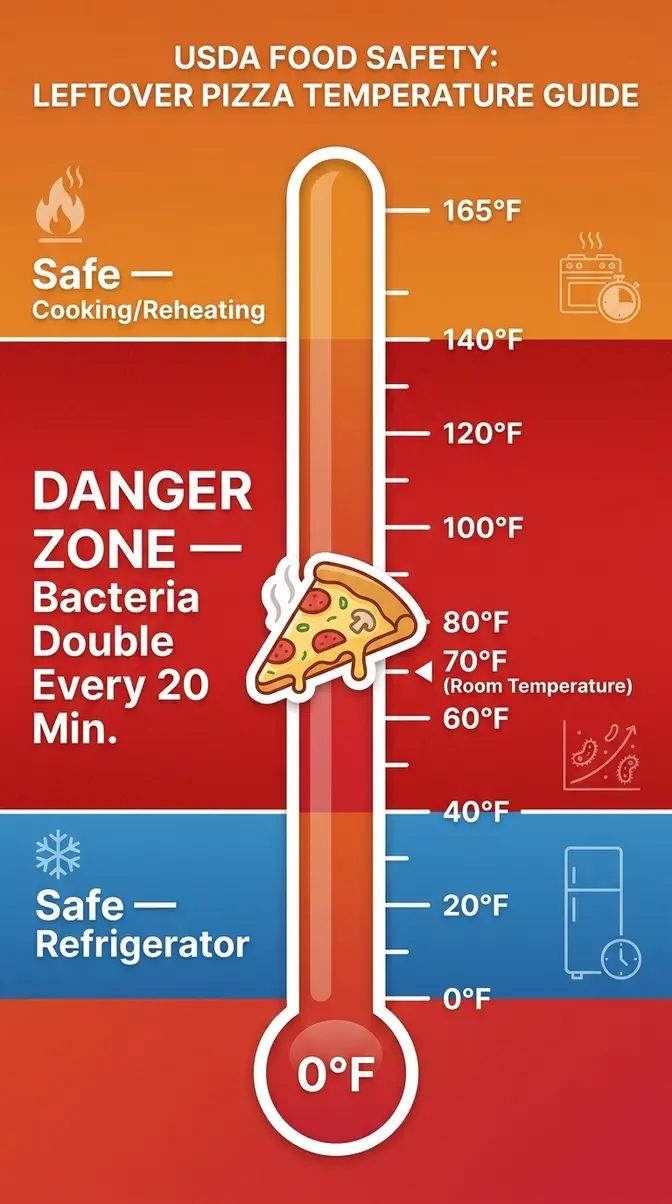
Bacteria thrive in what food scientists call the temperature danger zone — the range between 40°F and 140°F (4°C and 60°C). This is the range where harmful bacteria grow fastest. At a typical room temperature of around 70°F, Staphylococcus aureus (a type of bacteria that commonly causes food poisoning) can double in number every 20 minutes. That means a small, harmless amount of bacteria on a fresh slice can multiply to dangerous levels faster than you’d expect.
Key finding: The USDA Food Safety and Inspection Service states that perishable foods, including cooked pizza, must be refrigerated within 2 hours of cooking — or within 1 hour if the ambient temperature is above 90°F (32°C). Bacteria in the “danger zone” (40°F–140°F) can double every 20 minutes. Source: USDA FSIS, 2025.
As Cleveland Clinic’s warning on pizza left out overnight confirms, pizza left out overnight is unsafe regardless of how it smells — bacteria multiply rapidly at room temperature, and no amount of sniffing can detect it (Cleveland Clinic, 2024).
The Cumulative Clock: The Detail Most Guides Miss
Here is the critical insight that competitors universally overlook. The 2-hour rule is not per sitting — it is cumulative across all room-temperature exposures.
The Cumulative Clock is the running total of all the time your pizza has spent outside the fridge. Every minute it sits at room temperature counts, whether that’s consecutive or spread across multiple occasions.
Here’s a concrete example: Your pizza sat out for 90 minutes during the party. Then it sat out another 45 minutes while you cleaned up. That’s 135 minutes total — leaving only 25 minutes before it must be discarded. If you then took it out of the fridge the next day to grab a slice and left it on the counter for 30 minutes, The Cumulative Clock for that session has already started from zero — but the pizza itself is now in its second day of fridge storage.
On a hot summer day or in a warm car where temperatures exceed 90°F, the entire window shrinks to just 1 hour.
Checkpoint: Your pizza is now in the fridge within the safe 2-hour window. You’ve avoided the most common pizza storage mistake.
Once the clock is stopped and the pizza is cold, the next step determines how long it actually stays fresh and safe.
Step 2: Transfer Pizza to an Airtight Container
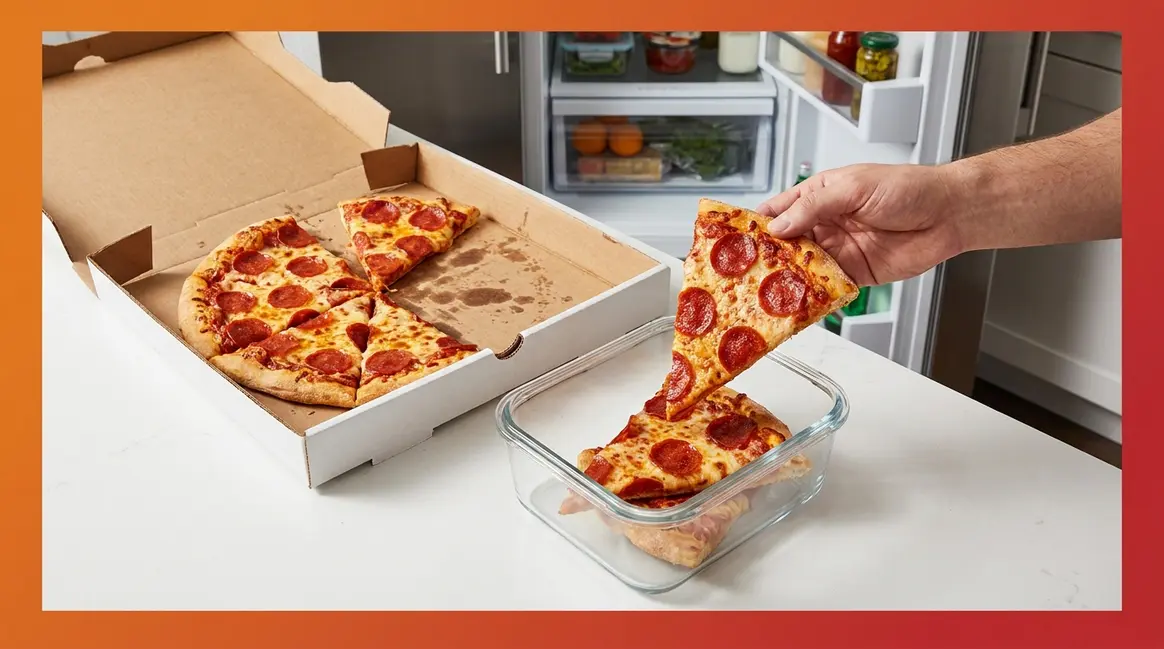
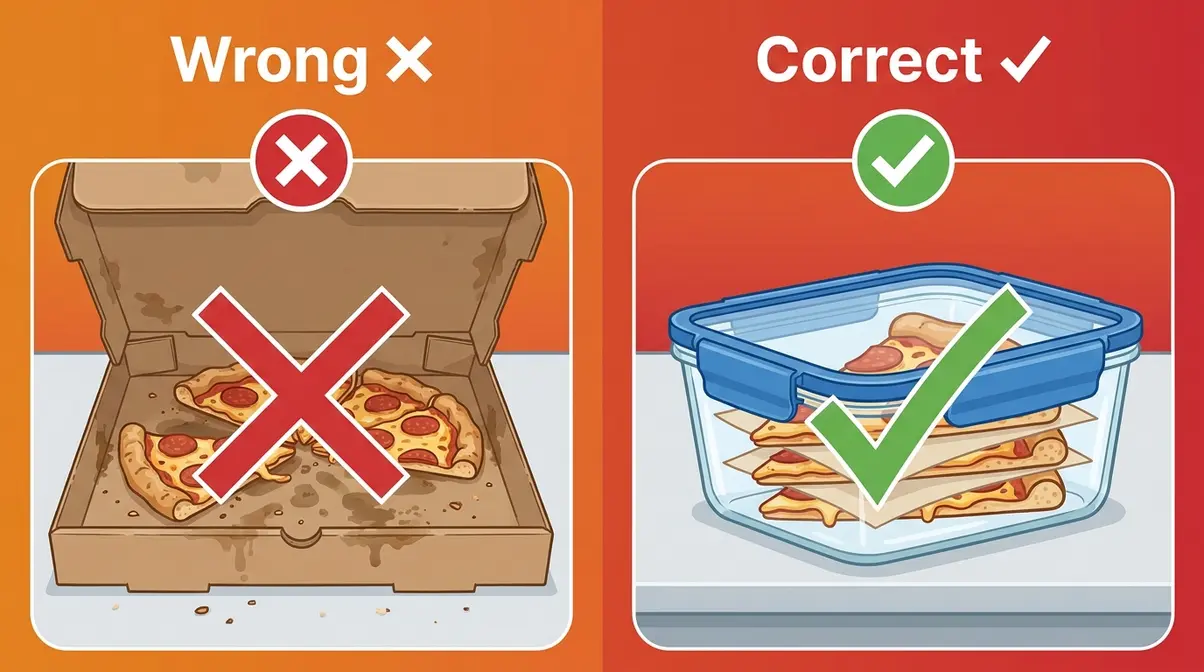
The original pizza box is not a storage container. It’s cardboard — porous, non-airtight, and designed for delivery, not preservation. Every hour pizza spends in the box accelerates drying and bacterial exposure.
Storing pizza in an airtight container at 40°F or below is the single most effective way to reach the full 3–4 day safe storage window recommended by the federal food storage safety chart (USDA, 2024). Beyond freshness, the airtight seal slows oxidation and limits the moisture transfer that accelerates bacterial growth — especially on high-moisture toppings like vegetables and seafood.
Here are your options, ranked best to acceptable:
- Best option: An airtight glass or plastic container with a snapping, sealing lid. Stack slices with a small piece of parchment paper between them to prevent sticking and preserve the crust texture.
- Good option: A zip-lock bag, pressed completely flat before sealing to remove excess air.
- Acceptable option: Wrap each slice tightly in aluminum foil first, then in a layer of plastic wrap. Two layers creates a near-airtight seal around each individual slice.
Temperature check: Confirm your fridge is at or below 40°F (4°C). This is worth verifying — the USDA notes that many household refrigerators run warmer than their settings indicate. A fridge thermometer costs under $10 and removes all doubt.
Checkpoint: Your pizza is in a sealed container in a fridge at 40°F or below. You’ve set it up for the full 3–4 day safe window.
Now that it’s stored correctly, here’s how long your specific pizza will actually last — because not all toppings age the same way.
Step 3: Check How Long Your Pizza Type Lasts in the Fridge
According to the federal food storage safety chart published by the USDA, cooked pizza is safe for 3 to 4 days in the refrigerator — regardless of the toppings. That rule applies to Domino’s, Pizza Hut, homemade, and Costco pizza equally (USDA, 2024).
This is one of the most common points of confusion about how long does pizza last in the fridge. People assume meat pizza goes bad faster, or that veggie pizza lasts longer. The USDA does not make that distinction for the safety window. What does differ is quality and baseline bacterial risk — and that’s worth understanding.
Pizza Shelf Life by Topping Type
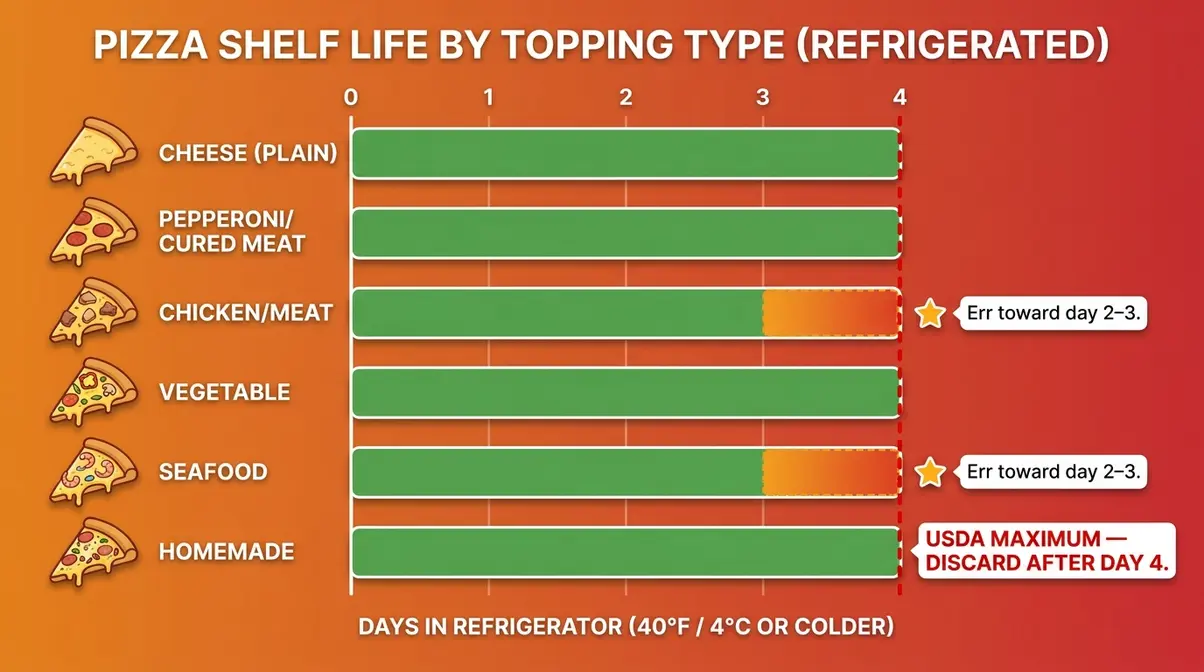
The table below reflects the universal USDA 3–4 day safety rule while noting where quality and risk vary by topping. Use it as your quick reference guide.
| Pizza Type | Safe Fridge Window | Quality Note | Special Caution |
|---|---|---|---|
| Cheese (plain) | 3–4 days | Best quality at day 1–2; cheese firms up | None |
| Pepperoni / Cured meat | 3–4 days | Cured meats slow spoilage slightly | Watch for grease separation |
| Chicken / Meat toppings | 3–4 days (eat by day 3 for best safety) | Chicken degrades faster in quality | Higher baseline bacterial risk |
| Vegetable toppings | 3–4 days (best by day 2–3) | High-moisture veggies get soggy and watery | Mushrooms and peppers accelerate crust sogginess |
| Seafood toppings | 3–4 days (eat by day 2–3) | Seafood quality drops fastest | Highest bacterial risk — err on the earlier side |
| Homemade pizza | 3–4 days | Same rule as takeout | Ensure fully cooked before refrigerating |
| Takeout (any brand) | 3–4 days | Brand does not change the safety rule | Follow the same 2-hour and 4-day rules |
A Note on Chicken and Seafood Pizza
The 3–4 day rule is universal, but chicken and seafood toppings deserve extra attention. Chicken can harbor Salmonella (a bacteria common in undercooked poultry) at higher baseline levels than cured meats. Seafood protein degrades quickly in quality and can carry bacteria that multiply fast. Neither of these creates a different safety deadline — but if your chicken or seafood pizza is on day 3 and you have any doubt, eating it that day or discarding it is the safer call.
Mayo Clinic’s 3 to 4 day refrigerator storage limit confirms that leftovers kept in the refrigerator are safe for 3 to 4 days before the risk of food poisoning increases — regardless of the specific food type (Mayo Clinic, 2024).
Checkpoint: You know exactly how many days your specific pizza has left. If it’s day 4 or beyond, toss it — even if it smells fine.
Step 4: Spot the Signs That Your Pizza Has Gone Bad
Knowing when to throw pizza out is just as important as knowing how to store it. This step could be the most important one for your health.
⚠️ Food Safety Reminder: “When in doubt, throw it out.” This is the official USDA guidance, and it applies here. If something seems off — even if you can’t name exactly what — trust your instincts and discard the pizza.
Visual, Smell, and Texture Signs
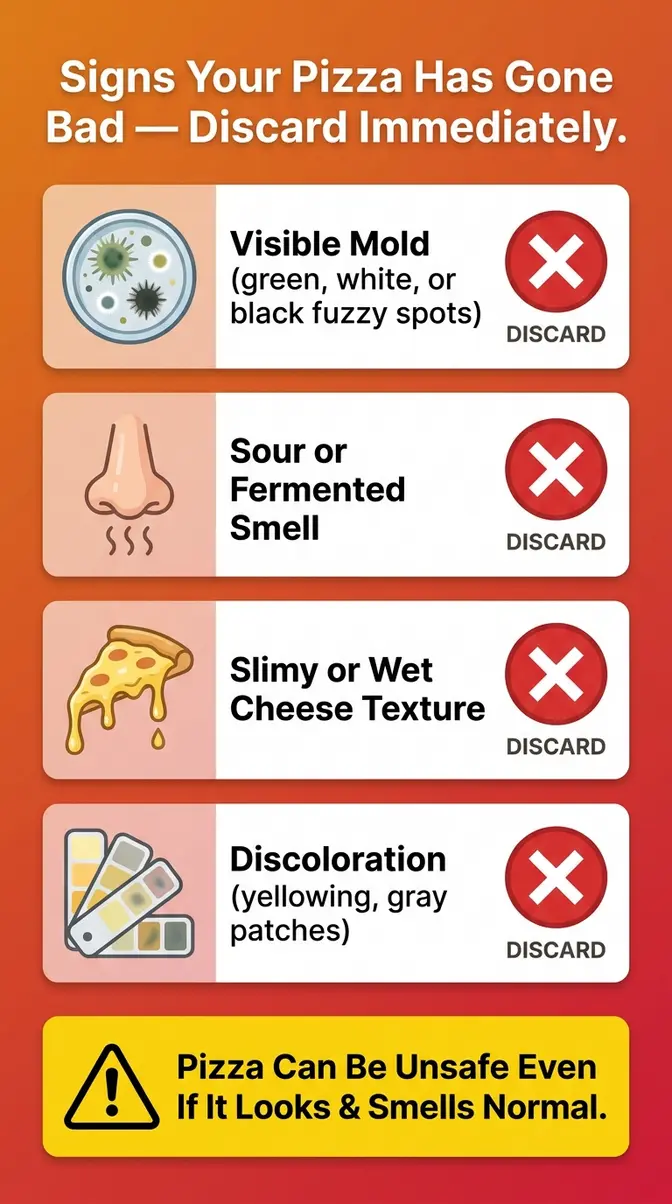
Food safety research identifies three reliable categories of spoilage indicators for refrigerated pizza:
- Visual signs:
- Mold is the clearest signal. It can appear as green, white, or black fuzzy spots — most often starting on the crust edges or under toppings where moisture collects. If you see mold on any part of the pizza, discard the entire pizza — not just the affected slice. Mold spreads invisibly beyond what you can see.
- Discoloration on the cheese (yellowing, gray patches) or toppings that look slimy or darkened.
- Smell signs:
- A sour, fermented, or “off” odor that differs from the normal cheese and tomato smell. This is a clear sign of bacterial activity.
- Here is the critical point: a pizza that smells normal can still be unsafe. According to the FDA’s food safety guidance, many dangerous bacteria — including Staphylococcus aureus and Salmonella — do not produce noticeable odors as they multiply. The smell test alone is not a reliable safety check. The FDA’s food storage guidance explicitly warns that you cannot rely on sight or smell alone to determine safety (FDA, 2026).
- Texture signs:
- Slimy or wet cheese that feels different from the normal slight greasiness of refrigerated pizza.
- An unusually hard or completely dried-out crust that suggests the pizza was not stored airtight — though dryness alone doesn’t indicate spoilage, it’s a sign that conditions weren’t ideal.
The Cumulative Clock in Spoilage Context
The Cumulative Clock becomes especially relevant here because bacteria that cause foodborne illness — like Staphylococcus aureus — don’t just grow during storage. They grow during every minute the pizza spends in the danger zone, across its entire history. A pizza that sat out for 90 minutes before refrigeration has already given bacteria a head start. By day 3 or 4, that head start matters.
This is why the 3–4 day rule is not a suggestion — it’s the outer limit accounting for normal handling. If The Cumulative Clock ran close to the 2-hour limit before refrigeration, consider treating day 3 as your personal cutoff rather than day 4.
⚠️ If you suspect foodborne illness after eating pizza — symptoms include nausea, vomiting, stomach cramps, or diarrhea — contact a healthcare provider. Foodborne illness can be serious, particularly for young children, older adults, pregnant women, and people with weakened immune systems.
Checkpoint: You’ve checked your pizza visually, by smell, and by texture. If any sign of spoilage is present — or if it’s been more than 4 days — discard it.
Step 5: Reheat Your Pizza to 165°F Before Eating
Reheating pizza isn’t just about taste — it’s about safety. The USDA FSIS Safe Minimum Internal Temperature Chart lists 165°F (73.9°C) as the required internal temperature for all leftovers, including pizza (USDA FSIS, 2025). This temperature is the threshold at which harmful bacteria are reliably killed. Surface heat or steam at the edges does not guarantee the center has reached 165°F — only a food thermometer can confirm this.
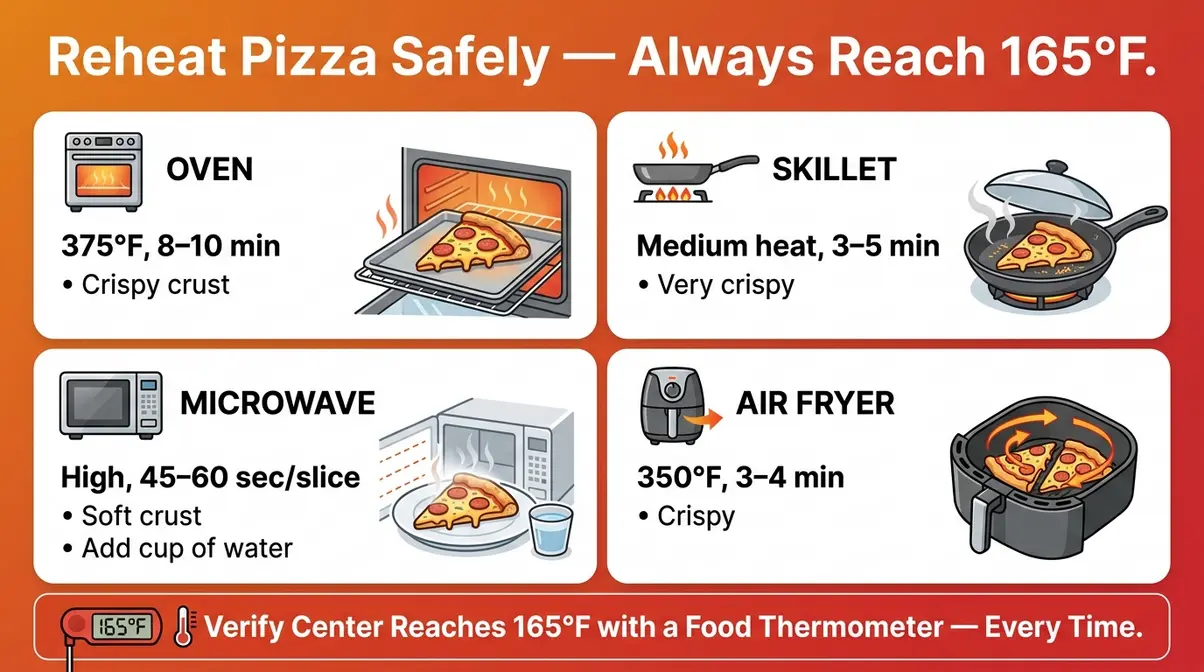
Oven and Skillet Methods
- Oven (best for crispy results):
- Preheat your oven to 375°F (190°C). This temperature reheats the pizza thoroughly without burning the cheese.
- Place slices on a baking sheet or directly on the oven rack for a crispier crust.
- Heat for 8–10 minutes, or until the cheese is visibly melted and bubbling.
- Use a food thermometer to check the center of the thickest slice — it must read at least 165°F. Estimated time: 10–12 minutes total.
- Skillet (best for crispy crust, stovetop):
- Place a non-stick skillet over medium heat. No oil needed.
- Add the pizza slice and cover the skillet with a lid — this traps steam to melt the cheese while the crust crisps.
- Heat for 3–5 minutes until the bottom is crispy and the cheese is fully melted.
- Check the center with a food thermometer — target 165°F. Estimated time: 5–6 minutes total.
Microwave and Air Fryer Methods
- Microwave (fastest, softer crust):
- Place the pizza slice on a microwave-safe plate.
- Place a small cup of water in the microwave alongside the pizza — this prevents the crust from becoming rubbery by adding steam.
- Microwave on high for 45–60 seconds per slice.
- Check the center temperature with a food thermometer — it must reach 165°F. If not, microwave in 15-second intervals until it does. Estimated time: 1–2 minutes total.
- Note: Microwaves heat unevenly. Rotate the plate halfway through and always verify temperature at the center.
- Air fryer (best for quick, crispy results):
- Preheat your air fryer to 350°F (175°C) for 2 minutes.
- Place 1–2 slices in the basket without overlapping.
- Cook for 3–4 minutes until cheese is melted and crust is crispy.
- Verify center temperature hits 165°F before eating. Estimated time: 5–6 minutes total.
| Reheating Method | Temp Setting | Time | Crust Result | Thermometer Check |
|---|---|---|---|---|
| Oven | 375°F | 8–10 min | Crispy | Required — 165°F |
| Skillet | Medium heat | 3–5 min | Very crispy | Required — 165°F |
| Microwave | High | 45–60 sec/slice | Soft | Required — 165°F |
| Air Fryer | 350°F | 3–4 min | Crispy | Required — 165°F |
Checkpoint: Your pizza has been reheated to 165°F using a food thermometer to confirm. It’s safe to eat.
How Long Does Pizza Last in the Freezer?
If you can’t eat your leftover pizza within the 3–4 day fridge window, freezing is a smart and safe option. According to the USDA’s federal food storage safety chart, cooked pizza can be frozen for 1 to 2 months while maintaining good quality (USDA, 2024). After 2 months, the pizza is technically still safe if kept at a consistent 0°F, but quality — particularly crust texture and cheese flavor — declines noticeably.
- How to freeze pizza correctly:
- Allow the pizza to cool to room temperature, but do not leave it out longer than 2 hours total.
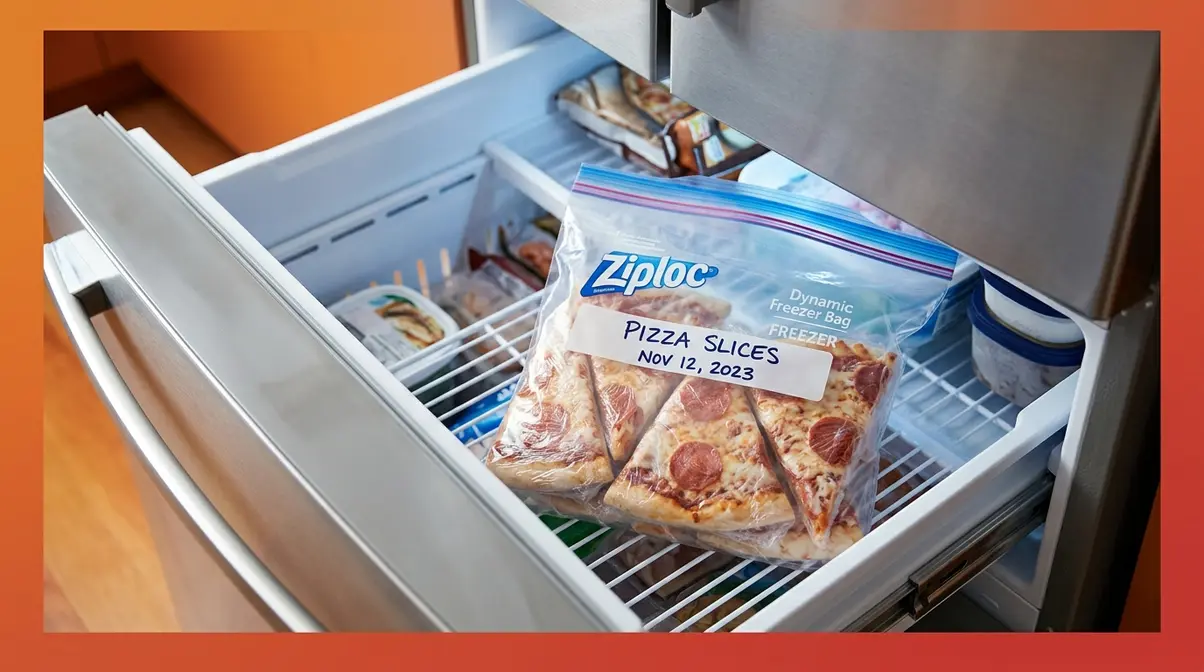
- Wrap individual slices tightly in plastic wrap, then in a layer of aluminum foil. This double-wrap prevents freezer burn.
- Place wrapped slices in a zip-lock freezer bag, press out excess air, and label with the date.
- Store at 0°F (-18°C) or below.
To reheat frozen pizza: Do not thaw at room temperature. Move slices from the freezer to the fridge the night before, or reheat directly from frozen in the oven at 375°F for 12–15 minutes. Always verify the center reaches 165°F before eating.
Key tip: Freeze pizza within 4 days of refrigerating it — do not freeze pizza that has already been in the fridge for 4 days, as bacteria may have already reached concerning levels.
How Long Does Pizza Dough Last in the Fridge?
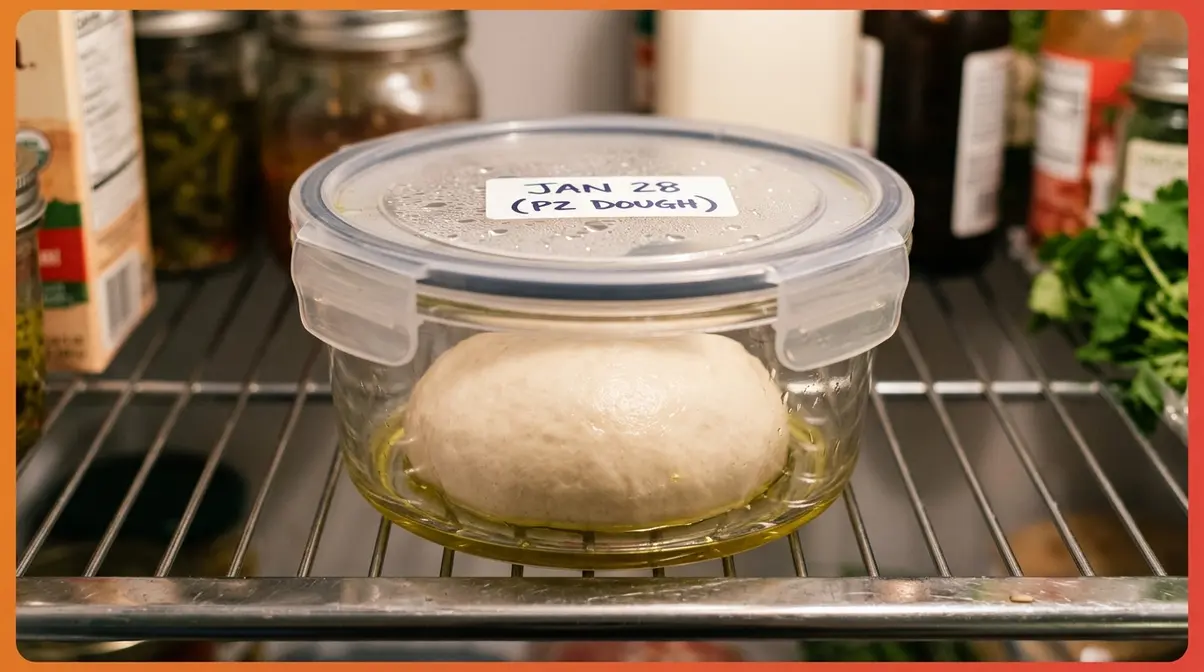
Pizza dough has a different shelf life than cooked pizza, and it’s worth knowing before your next pizza night. When stored properly in an airtight container at or below 40°F (4°C), pizza dough keeps well for about 3–5 days in the refrigerator. The sweet spot for flavor and texture is around 48–72 hours, when cold fermentation has developed the dough’s flavor without over-proofing it.
Beyond 5 days, most baking experts recommend discarding the dough. Over-fermentation causes the gluten structure to break down, making the dough difficult to stretch and producing an overly sour, yeasty flavor.
- Signs that pizza dough has gone bad:
- A strong alcohol or vinegar-like odor (beyond normal yeast smell)
- Gray or orange discoloration on the surface
- Excessive surface bubbling or a collapsed, flat appearance
- Any visible mold — discard immediately if present
To store pizza dough correctly: Place the dough ball in a lightly oiled airtight container or zip-lock bag. Press out excess air before sealing. Label with the date so you know exactly when the 3–5 day window expires.
Freezing dough: Pizza dough freezes well for up to 3 months. Wrap tightly in plastic wrap, then place in a freezer bag. Thaw overnight in the fridge before use.
How Long Does Pizza Sauce Last in the Fridge?
Leftover pizza sauce has a longer fridge life than cooked pizza, but it still has limits. Based on food safety guidelines aligned with USDA FSIS guidance for cooked tomato products:
- Homemade pizza sauce: Lasts approximately 5–7 days in the fridge when stored in a sealed airtight container at or below 40°F. For stricter food safety adherence, aim to use it within 3–4 days.
- Store-bought sauce (opened): Lasts approximately 7–10 days refrigerated after opening, though this varies by brand. Check the label for manufacturer guidance.
- Store-bought sauce (unopened): Follow the printed expiration or best-by date on the jar or can.
Storage tip: Transfer sauce to a glass jar or airtight container immediately after opening — the original can or jar may not seal airtight once opened. Always refrigerate within 2 hours of cooking or opening.
Signs pizza sauce has gone bad: Mold on the surface, a sour or fermented odor that differs from normal tomato smell, or any bubbling or fizzing in a non-carbonated product. If in doubt, throw it out.
Troubleshooting Common Pizza Storage Mistakes
To compile this section, we cross-referenced USDA FSIS, FDA, and Cleveland Clinic guidance on the most frequently reported leftover pizza handling errors. These three mistakes account for the majority of unsafe pizza situations.
Common Pitfalls
Mistake 1: Leaving pizza out too long — and not counting all the time.
This is the most common error, and The Cumulative Clock is why it catches people off guard. Many people assume the 2-hour rule resets each time they handle the pizza. It doesn’t. If your pizza sat out 1 hour at the party, 30 minutes during cleanup, and then 45 minutes while you watched TV, it has exceeded the 2-hour limit — even though no single exposure was longer than an hour. Fix: Start a timer the moment the pizza comes out of the oven or the delivery box is opened. Count every minute.
Mistake 2: Storing pizza in the original cardboard box.
Cardboard is porous. It allows air to circulate freely around the slices, drying out the crust and exposing the toppings to ambient air (and any bacteria it carries). Many people store pizza in the box for days, assuming it’s fine because it’s in the fridge. Fix: Transfer to an airtight container or wrap tightly within 2 hours of serving.
Mistake 3: Reheating pizza without checking the internal temperature.
Reheating pizza until it “looks hot” or until the cheese is melted does not guarantee the center has reached 165°F. Microwaves in particular heat unevenly, leaving cold spots in the center of a slice even when the edges are steaming. According to the USDA, reheating leftovers to at least 165°F is the only reliable way to kill bacteria that may have grown during storage (USDA, 2025). Fix: Use a food thermometer every time. It takes 5 seconds.
When to Choose Alternatives
- If your pizza has been in the fridge for 5+ days: Do not eat it. No reheating temperature makes day-5 pizza safe. The bacterial load at that point exceeds what heat alone can reliably address. Discard it.
- If you’re cooking for young children, pregnant women, older adults, or immunocompromised individuals: Apply the 3-day rule instead of the 4-day rule. Higher-risk individuals face more serious consequences from foodborne illness, so a conservative cutoff is the right call.
- If your fridge runs above 40°F: Your pizza storage window may be shorter than 3–4 days. Verify your fridge temperature with a thermometer and consider eating pizza within 2 days if you can’t confirm it’s staying at or below 40°F.
When to Seek Expert Help
If you or someone in your household experiences symptoms of foodborne illness — including nausea, vomiting, stomach cramps, diarrhea, or fever — after eating leftover pizza, contact a healthcare provider. The CDC notes that foodborne illness affects an estimated 48 million Americans each year and can be serious for vulnerable populations. Do not wait to see if symptoms resolve on their own if the affected person is elderly, pregnant, very young, or immunocompromised.
Frequently Asked Questions
Can you eat leftover pizza after 5 days in the fridge?
No — leftover pizza is not safe to eat after 5 days in the fridge. The USDA’s food storage guidelines set the limit at 3 to 4 days for cooked pizza refrigerated at 40°F or below. After 4 days, bacterial growth can reach levels that cause foodborne illness, even if the pizza smells and looks normal. Reheating does not make day-5 pizza safe — heat kills active bacteria but does not neutralize toxins that some bacteria have already produced. Discard pizza that has been in the fridge for 5 or more days (USDA, 2025).
How do you tell if fridge pizza is bad?
Look for mold, a sour smell, or slimy cheese — any of these means discard the pizza immediately. Mold appears as fuzzy green, white, or black spots, often starting at crust edges. A sour or fermented odor that differs from normal pizza smell is a clear spoilage sign. Slimy or wet cheese texture also indicates bacterial activity. However, the most important fact is this: pizza can be unsafe even when it looks and smells normal. Dangerous bacteria like Staphylococcus aureus don’t produce detectable odors. The 3–4 day rule exists precisely because smell alone is not a reliable test (FDA, 2026).
How long does it take for pizza to go bad unrefrigerated?
Pizza left at room temperature becomes unsafe after just 2 hours, per USDA FSIS guidelines. At temperatures above 90°F — like on a hot day or in a warm car — the window shrinks to 1 hour. Bacteria in the danger zone (40°F–140°F) can double every 20 minutes, meaning a pizza left out overnight has given harmful bacteria 8+ hours of unchecked growth. No reheating makes overnight pizza safe. Discard any pizza that has been left out longer than 2 hours (USDA FSIS, 2025).
Is it okay to eat pizza that is a week old?
No — week-old pizza is not safe to eat, regardless of how it smells. The USDA recommends discarding cooked pizza after 3 to 4 days in the refrigerator. At 7 days, bacterial contamination is almost certain to be at dangerous levels. Additionally, toxins produced by bacteria like Staphylococcus aureus are heat-stable — meaning reheating the pizza will not make it safe. Mayo Clinic’s 3 to 4 day refrigerator storage limit applies to all leftovers, including pizza (Mayo Clinic, 2024). When in doubt, throw it out.
Can I eat pizza 3 days after getting it?
Yes — pizza that is exactly 3 days old is within the USDA’s safe 3 to 4 day window, provided it was refrigerated within 2 hours of delivery or cooking and stored at 40°F or below in an airtight container. Day 3 is still safe for all topping types. For chicken or seafood pizza specifically, day 3 is the recommended cutoff due to higher baseline bacterial risk on those proteins. Always reheat to 165°F before eating, confirmed with a food thermometer (USDA FSIS, 2025).
Conclusion
For home cooks and pizza lovers, keeping leftover pizza safe comes down to three numbers: 2 hours (the room-temperature limit), 4 days (the fridge limit), and 165°F (the reheating target). Following the USDA FSIS and FDA guidelines covered in these 5 steps reliably keeps pizza safe and reduces the risk of foodborne illness. Research confirms that properly stored pizza — refrigerated within 2 hours in an airtight container at 40°F or below — reaches the full 3–4 day safe window every time (USDA, 2025).
The Cumulative Clock is the concept that ties it all together. Every minute pizza spends at room temperature counts against the 2-hour limit — whether that’s one long stretch or several short ones across an evening. Understanding this single principle is what separates safe leftover handling from the kind of guesswork that leads to food poisoning. Apply it every time you handle leftover pizza, and you’ll never have to wonder whether those slices are safe.
The next time you finish a pizza night, set a timer the moment the box opens. Transfer the leftovers to an airtight container before it goes off. Check your fridge temperature once this week. And if it’s been more than 4 days — or if anything seems off — remember the USDA’s most practical food safety advice: “When in doubt, throw it out.”

Dave King
Recipe developer and writer at Quick Dish Cookbook.
![How Long to Cook Pork Shoulder at 250°F [Chart]](https://quickdishcookbook.com/wp-content/uploads/2026/07/pork-shoulder-cook-time-250f-720x450.webp "How Long To Cook Pork Shoulder At 250°F [Chart] 9")