
What’s in this guide
- What You'll Need Before You Start
- Step 1: Choose A5 vs. American Wagyu
- Step 2: Prepare Your Steak Before Cooking
- Step 3: Season Your Wagyu Simply
- Step 4: Heat Your Pan to the Right Temperature
- Step 5: Sear Your Wagyu Steak
- Step 6: Rest, Slice, and Serve Your Wagyu
- Verify Your Results: Wagyu Doneness Guide
- The Wagyu Wellness Framework
- Alternative Cooking Methods for Wagyu
- Troubleshooting Common Mistakes
- Frequently Asked Questions
- Limitations and When to Seek Alternatives
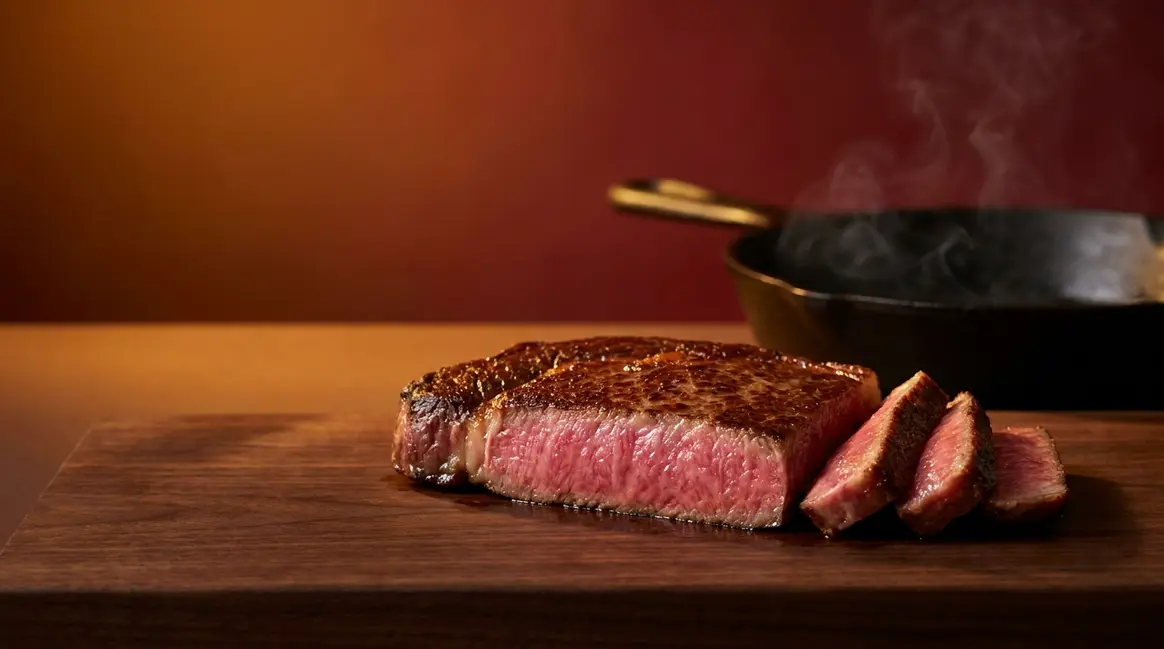
To cook Wagyu steak at home, sear it in a dry, screaming-hot cast-iron pan with no added oil or butter. This 6-step process takes about 20 minutes. Season with salt only, sear 60–90 seconds per side for A5 Japanese Wagyu (cook from cold) or 2–3 minutes per side for American Wagyu (room temperature), and rest for 5 minutes before slicing. Pull the steak at an internal temperature of 110–125°F for perfect medium-rare.
You’re holding a steak that cost more than your last dinner out. You’ve already read three different recipes, and they all contradict each other. Should you add oil? Let it rest on the counter first? Sear it fast or slow?
“I’ve seen conflicting information online on whether you should let it rest…” — a sentiment echoed by home cooks everywhere when they first encounter Wagyu.
Here’s the truth: getting it wrong means a greasy, overcooked result that wastes both money and a once-in-a-while experience. But getting it right is simpler than you think — once you know which grade you have and why it changes everything. By the end of this guide, you’ll know how to cook wagyu steak at home with a beautiful crust, wall-to-wall doneness, and zero guesswork. This guide walks you through 6 clear steps: choose your grade, prepare, season, heat your pan, sear, and rest.
Key Takeaways: How to Cook Wagyu Steak at Home
The best way to cook Wagyu steak at home is a 6-step dry pan-sear — no oil, no butter — in a cast-iron skillet heated to at least 425°F.
- Grade matters: A5 Japanese Wagyu cooks from cold (straight from the fridge); American Wagyu cooks from room temperature (30–45 min out).
- Zero added fat: Wagyu’s marbling — up to 33.9% intramuscular fat (Sains Malaysiana, 2026) — self-bastes the steak in its own rendering fat.
- Pull temperature: Remove at 110–125°F internal for perfect medium-rare; rest 5 minutes before slicing.
- Wagyu Wellness Framework: Limit A5 portions to 3–4 oz and pair with acidic sides (ponzu, daikon, arugula, citrus) to support comfortable digestion.
- Rest time: Always rest 5 minutes before slicing to preserve juices and allow carryover cooking to finish.
What You’ll Need Before You Start
Before you cook Wagyu steak at home, gather these tools and ingredients. Discovering mid-cook that you lack a proper pan is the most common beginner disaster — so check this list now.
Equipment:
- Cast-iron skillet (a thick, heavy-bottomed pan that holds intense heat evenly — the best choice for Wagyu; stainless steel works as a backup)
- Infrared (IR) thermometer — to measure the pan surface temperature before the steak touches it. This is a separate tool from your meat thermometer, and competitors rarely mention it. Without it, you’re guessing whether your pan is ready.
- Instant-read meat thermometer (such as a ThermoWorks Thermapen) — to check internal doneness in real time. These two thermometers serve completely different jobs.
- Metal tongs — never a fork. Piercing the steak releases the juices you’ve worked to keep inside.
- Wire rest rack or clean cutting board — for resting the steak after cooking.
Ingredients:
- 1 Wagyu steak — A5 Japanese or American Wagyu (your method will differ; see Step 1)
- Kosher salt or flaky sea salt
- Freshly cracked black pepper (optional — add after searing, not before)
According to Carney Wagyu, expert Wagyu producers confirm the steak requires no added oil or butter in the pan — the fat content handles everything (2026).
Once you have everything ready, the first — and most important — decision is understanding which type of Wagyu you’re working with.
Step 1: Choose A5 vs. American Wagyu
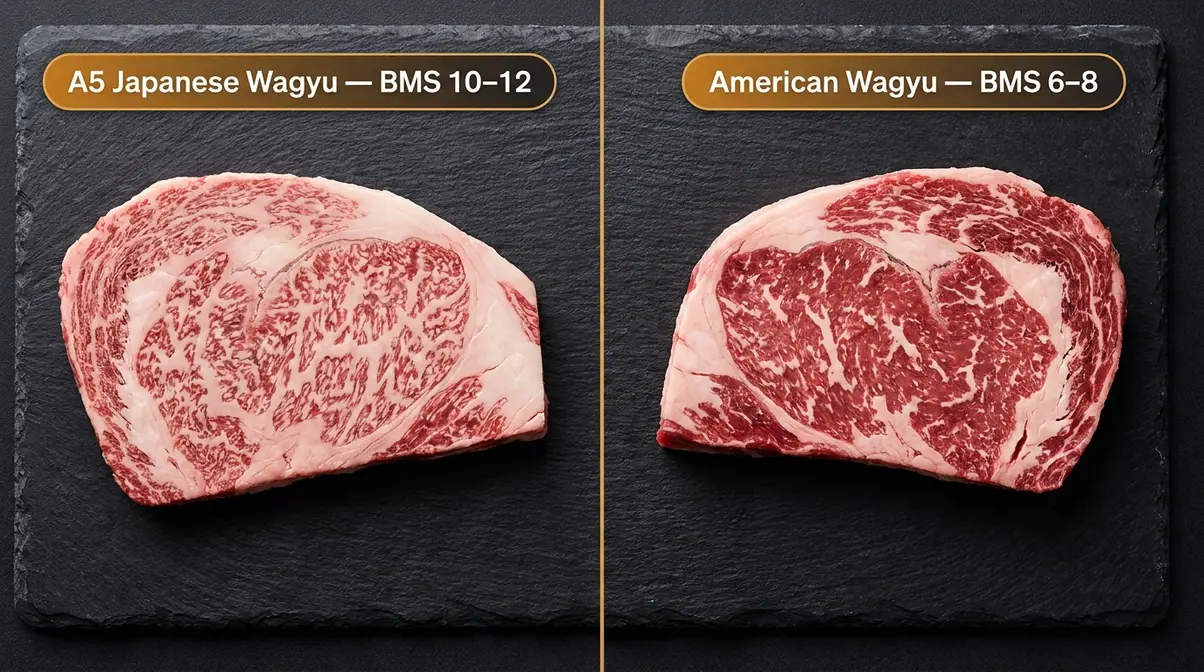
Knowing your Wagyu grade is the single most important decision in this entire guide. A5 Japanese Wagyu and American Wagyu have fundamentally different fat structures — and that difference dictates your cooking time, temperature approach, and portion size. Using the wrong method for your grade is the most expensive mistake a beginner can make.
Key differences at a glance:
- A5 Japanese Wagyu has up to 33.9% intramuscular fat — nearly double USDA Prime beef
- American Wagyu has typically 15–25% intramuscular fat (BMS 6–8 range)
- A5 cooks from cold; American Wagyu cooks from room temperature
- A5 sears in 60–90 seconds per side; American Wagyu needs 2–3 minutes per side
- A5 serving size: 3–4 oz; American Wagyu: 6–8 oz is appropriate
A5 Japanese Wagyu — The Ultra-Rich Grade
A5 Japanese Wagyu is the highest classification on Japan’s Beef Marbling Standard (BMS), a grading scale from 1 to 12 that measures intramuscular fat — the fat that runs through the muscle, creating the marbled effect. A5 corresponds to BMS 8–12. A 2026 study published in Sains Malaysiana found that Wagyu samples had 33.9% intramuscular fat and 86.32% fat retention during cooking — significantly higher than Angus (20.87%) or Brahman (12.17%). Separate research on Wagyu oleic acid concentrations from NIH indicates the oleic acid concentration in Wagyu subcutaneous fat reaches 52.9%, contributing to its extreme richness (Smith et al., via NIH review 2026).
Because A5 fat renders so rapidly under heat, you cook it straight from the refrigerator — not from room temperature. Bringing it to room temp causes the fat to begin softening before it hits the pan, reducing crust quality and losing precious flavor. If your steak has dense, creamy-white fat webbed throughout the muscle like a mosaic, you almost certainly have A5.
A5 Wagyu contains up to 33.9% intramuscular fat and 86.32% fat retention during cooking (Sains Malaysiana, 2026) — nearly double the marbling of USDA Prime beef, which is why its cooking method differs so dramatically.
A note on portion size: A5 is so rich that 3–4 oz is the standard serving. The full reasoning is explained in the Wagyu Wellness Framework section below.
American Wagyu is also exceptional beef — but its lower fat content means a different approach.
American Wagyu — The Accessible Grade
American Wagyu is a crossbreed of Japanese Wagyu genetics and Angus cattle. It produces rich, beautiful marbling — typically BMS 6–8 — but at a noticeably lower fat intensity than A5. The result is a steak that’s far richer than USDA Prime, but more forgiving to cook and more accessible in price. Snake River Farms’ American Wagyu is a widely available example.
Because American Wagyu doesn’t render as aggressively, you can bring it to room temperature — remove it from the refrigerator 30–45 minutes before cooking, just as you would a premium conventional steak. This allows more even cooking from edge to center through the thicker, leaner cut. American Wagyu also responds well to the reverse sear method (bringing the steak up to temperature in the oven before finishing in a hot pan), which is covered in the Alternative Cooking Methods section.
Now that you know your grade, let’s prepare the steak correctly — starting with the one debate that confuses almost every beginner.
Checkpoint: You should now know which grade of Wagyu you have and the one key rule it demands: A5 cooks from cold; American Wagyu cooks from room temperature.
Step 2: Prepare Your Steak Before Cooking
If you’ve read three different Wagyu recipes and gotten three different answers about whether to add oil, you’re not alone. This step gives you the definitive answer — and the food science to back it up. Proper preparation is the difference between a steak that sears with a crackling, dark crust and one that steams in its own fat.
How to Temper Your Wagyu
Tempering means bringing a steak toward room temperature before cooking. For most steaks, it’s standard advice. For A5 Wagyu, it’s the wrong move entirely.
A5 Japanese Wagyu — cook straight from cold. Leave it in the refrigerator until the moment you’re ready to sear. The cold center slows fat rendering, which gives the exterior time to form a proper crust before the interior overcooks. This approach is endorsed by ThermoWorks’ culinary testing on Japanese Wagyu and runs counter to general steak advice — but the science of A5’s fat content makes it correct.
American Wagyu — remove from the refrigerator 30–45 minutes before cooking. Expert advice on tempering and dry-pan cooking Wagyu from Carney Wagyu confirms this window; it allows more even cooking through the leaner cut without the aggressive fat-render risk of A5 (2026).
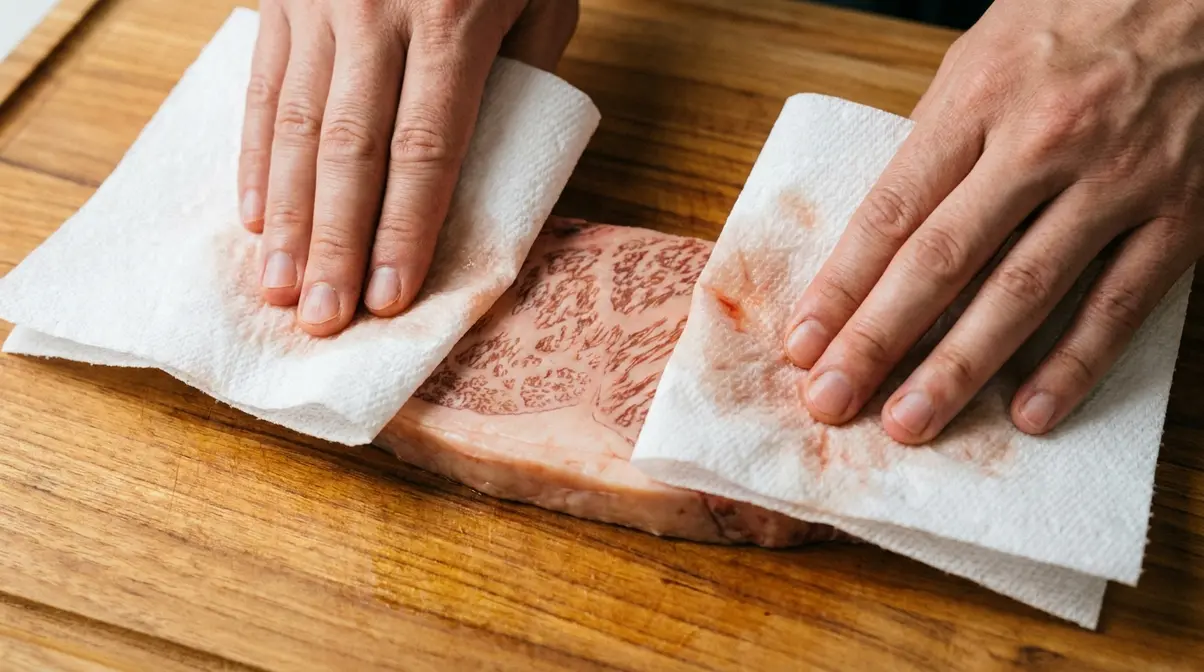
Both grades: Pat the steak completely dry with paper towels before seasoning. Surface moisture creates steam when the steak hits the pan, which prevents the Maillard reaction (the browning chemical reaction that creates the crust) from occurring. A wet steak surface gives you a grey, steamed exterior — not the dark, crackling crust that makes Wagyu worth every penny.
A5 Wagyu: Cook from cold. American Wagyu: Room temp 30–45 min.
Do You Need Oil or Butter to Cook Wagyu?
No — you do not need oil or butter to cook A5 Wagyu steak. This is the self-basting technique: Wagyu’s intramuscular fat renders into the pan within seconds of contact with a hot surface, creating its own cooking medium. Adding butter or oil is not only unnecessary but risks making the steak greasy and diluting its natural flavor (Carney Wagyu, 2026).
For American Wagyu, or if your cast-iron pan has dry spots, trim a small piece of fat from the steak’s edge and melt it in the pan first. This is preferable to butter — which has a smoke point of approximately 300°F and will burn before your pan reaches the temperature needed for a proper Wagyu sear. Vegetable oil works in a pinch but dilutes Wagyu’s clean, buttery flavor. A small amount of beef tallow (rendered beef fat) is the best alternative if you need any added fat at all. Explore the benefits of cooking with beef tallow as a natural, high smoke-point cooking fat.
Think of A5 Wagyu as self-sufficient — it brings its own cooking fat to the party.
With your steak dry and your fat question answered, it’s time to season — and the rule here is refreshingly simple.
Checkpoint: You should now have a completely dry steak at the correct temperature (A5: cold from fridge; American: room temp 30–45 min) and a clear answer on added fat (none needed for A5).
Step 3: Season Your Wagyu Simply
The best seasoning for Wagyu steak is also the simplest: quality salt, applied before cooking, and nothing else until after the sear. Wagyu’s fatty acid composition produces its own seasoning in the form of aroma compounds — adding complex rubs actively buries that flavor. Salt defines the edges; it doesn’t compete with the canvas.
Best seasoning for Wagyu steak?
Texas A&M research on Wagyu aroma confirms that Wagyu’s distinctive sweet smell during cooking is driven by lactones (sweet, coconut-like aroma compounds) derived from its unique fatty acid composition — specifically its high oleic acid content. Research published in MDPI Foods (2026) further shows that the sweet and fatty “Wagyu beef aroma” is mainly related to lactones produced from oleic and linoleic acid. Complex rubs mask these compounds entirely (Texas A&M University Department of Animal Science).
Apply kosher salt (a coarse, additive-free salt preferred by chefs for its clean flavor) or flaky sea salt generously to all surfaces — including the edges — according to your grade:
- American Wagyu: Salt 30–60 minutes before cooking. Salt initially draws out surface moisture, but given enough time, it re-absorbs into the meat, seasoning it from within.
- A5 Japanese Wagyu: Salt just before cooking, since it goes straight from fridge to pan with no waiting period.
Black pepper: add after searing, not before. Pepper contains compounds that burn above 300°F, creating a bitter flavor. Since a proper Wagyu sear requires a pan at least 425°F, pre-sear pepper will char noticeably.
Optional finishing touch: A small pinch of flaky sea salt — such as Maldon, a finishing salt (a delicate, large-crystal salt applied after cooking for crunch and visual appeal) — added right before serving adds texture without competing with the steak’s natural flavor.
- What to avoid entirely:
- Heavy marinades
- Garlic powder or onion powder
- Pre-mixed steak rubs
- Fresh herbs (thyme, rosemary) added before cooking
- Soy sauce or Worcestershire
Think of salt as a frame for a painting — it defines the edges without obscuring the art.
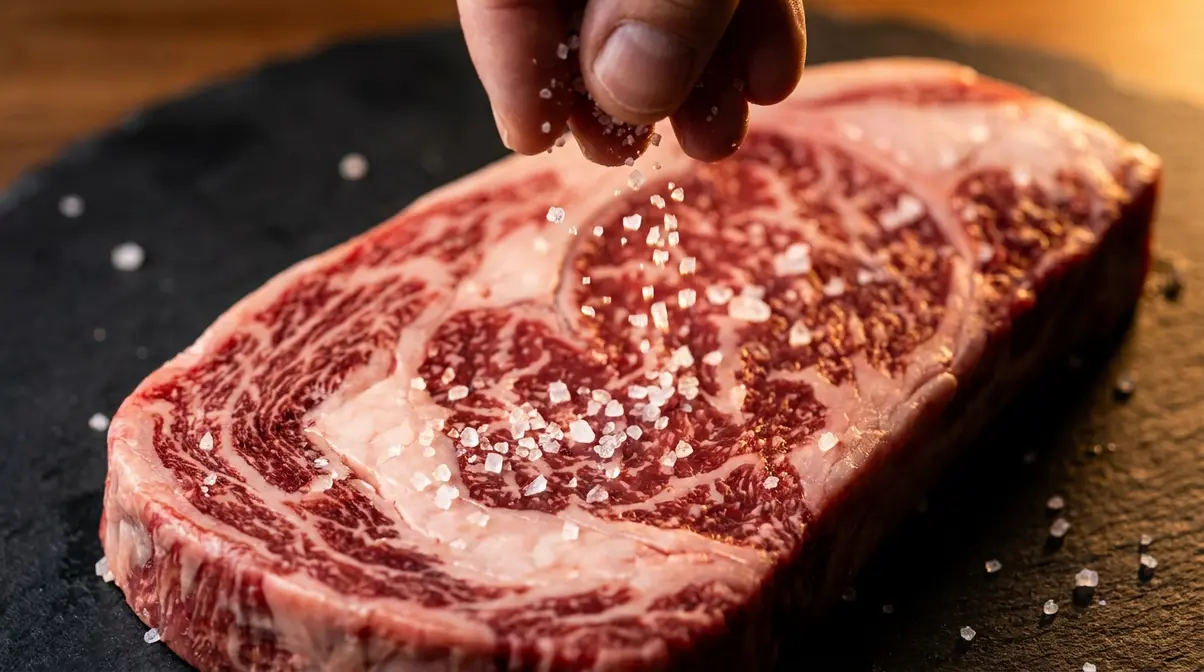
Properly season your Wagyu steak before moving to the next step, because once the pan is screaming hot, there’s no time to adjust.
Checkpoint: You should now have a dry, salted Wagyu steak. If using pepper, hold it until after the sear.
Step 4: Heat Your Pan to the Right Temperature
The single most common beginner mistake is placing the steak into an insufficiently hot pan. A warm or moderately hot pan produces a grey, steamed exterior instead of the dark, crackling crust that makes Wagyu worth the investment. Exact temperature data is your best friend here.
Choose the Right Pan
A cast-iron skillet is the best choice for cooking Wagyu at home. Cast iron retains heat exceptionally well, distributes it evenly across the cooking surface, and can withstand the sustained high temperatures needed for a proper Wagyu sear without warping. Stainless steel is an acceptable alternative. Avoid non-stick pans — they cannot safely handle the temperatures required and will degrade.
Preheat to the Right Temperature
According to ThermoWorks’ dedicated Wagyu cooking guide, your pan surface needs to reach at least 425°F (218°C) before the steak touches it — this is the minimum for the Maillard browning you need with high-marbling Wagyu (ThermoWorks, updated 2026). Their general searing guide confirms that a minimum of 375°F is needed for any steak to brown properly; for Wagyu, go hotter.
How to preheat:
- Place your cast-iron skillet over medium-high to high heat on the stovetop.
- Heat for 3–5 minutes, then check the surface temperature with your infrared (IR) thermometer.
- The pan is ready when the surface reads 425°F or above.
- You’ll notice the pan beginning to smoke slightly — this is the visual cue that the surface is hot enough.
Temperature Reference Table:
| Pan Surface Temperature | Result |
|---|---|
| Below 375°F | Grey, steamed exterior — no crust |
| 375–424°F | Partial browning, inconsistent crust |
| 425°F+ (target) | Strong Maillard browning, dark crust, fast sear |
| 500°F+ | Aggressive crust — ideal for very thin A5 slices |
Do not add any fat to the pan at this stage for A5 Wagyu. For American Wagyu, add your rendered fat trim (or tallow) only once the pan reaches temperature — never to a cold pan.
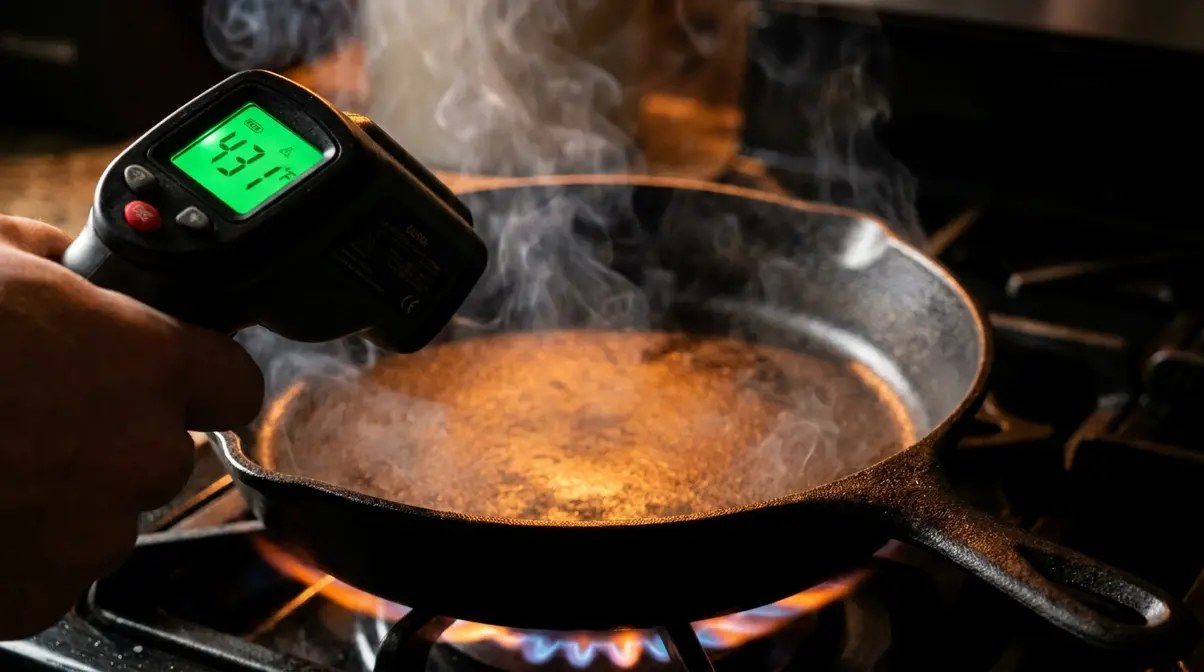
Checkpoint: Your cast-iron pan is smoking slightly and reading 425°F or above on your IR thermometer. You are ready to sear.
Step 5: Sear Your Wagyu Steak
When you are learning how to cook wagyu steak at home, this is the step most beginners overthink — but with the right pan temperature and a clear understanding of timing by grade, the sear is fast, decisive, and satisfying. The goal is wall-to-wall doneness with a deeply browned crust.
The Sear
Place the steak gently into the dry, screaming-hot pan. You should hear an immediate, loud sizzle. If you don’t hear it, your pan isn’t hot enough — remove the steak and continue heating.
Sear times by grade:
| Grade | Sear Time Per Side | Notes |
|---|---|---|
| A5 Japanese Wagyu | 60–90 seconds per side | Cook from cold; fat renders extremely fast |
| American Wagyu | 2–3 minutes per side | From room temp; lower fat, needs longer browning |
Do not move the steak around the pan. Let it sit undisturbed. A properly heated cast-iron pan will release the steak naturally when the crust has formed — if it sticks, it’s not ready to flip. This is the “steak tells you when” rule that professional cooks rely on.
Sear the edges too. After the two main sides, use your tongs to hold the steak upright on each edge for 15–20 seconds. The fat cap on the edge renders beautifully and adds flavor to the pan.
Basting and Flipping
For A5 Wagyu, the self-basting technique handles everything. As the steak sears, fat renders out of the marbling and pools in the pan. You can tilt the pan slightly and use a spoon to baste the top surface of the steak with its own rendered fat — this adds flavor and helps the top surface cook evenly without flipping prematurely.
For American Wagyu, if you’ve added a small amount of tallow, the same basting approach applies. Some cooks add a sprig of thyme at this stage for American Wagyu (not A5, where it masks aroma compounds).
Pull temperature by doneness:
| Doneness | Pull Temperature | Final Rested Temp |
|---|---|---|
| Rare | 110–115°F | 120–125°F |
| Medium-Rare (recommended) | 120–125°F | 130–135°F |
| Medium | 125–130°F | 135–140°F |
User consensus among home cooks and culinary testing consistently identifies medium-rare as the optimal doneness for Wagyu — it renders enough fat for silky texture without losing the steak’s natural moisture. Well-done is strongly discouraged; it eliminates the marbling advantage entirely.
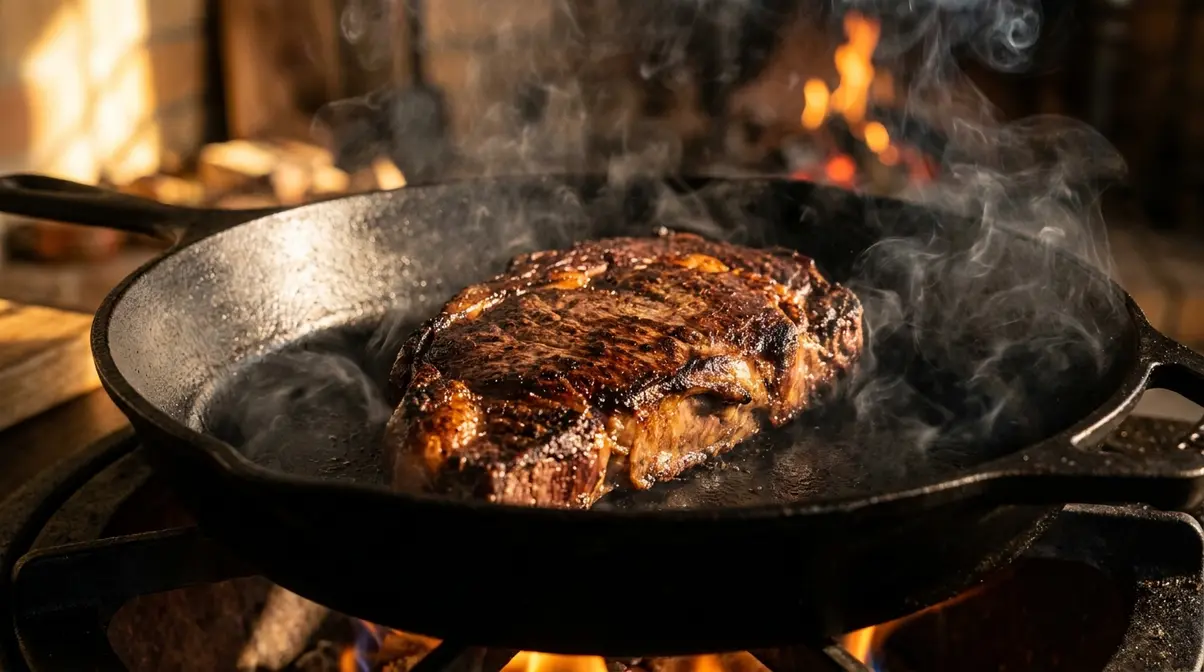
Checkpoint: Both sides are deeply browned, edges are seared, and your instant-read thermometer reads 120–125°F for medium-rare. Remove the steak from the pan immediately.
Step 6: Rest, Slice, and Serve Your Wagyu
The sear is done, but the cooking isn’t finished. Resting is not optional — it’s where the steak reaches its final temperature and where the juices redistribute throughout the meat.
How to Rest Wagyu Steak
Place the steak on a wire rack or cutting board (not back in the hot pan) and rest for 5 minutes. During this time, carryover cooking (the heat already inside the steak continuing to cook it) will raise the internal temperature by approximately 5–10°F. This is why you pull the steak at 120–125°F rather than 130°F — the rest finishes the job.
Do not tent with foil. Tenting creates steam, which softens the crust you just worked to build.
Slice and Serve
For A5 Japanese Wagyu, slice into thin strips — approximately ¼ inch thick — against the grain (perpendicular to the direction the muscle fibers run). This shortens the fibers and makes each bite tender. Because A5 is so rich, thin slices served across a plate are the traditional Japanese approach. A full 3–4 oz steak is typically enough for one person.
For American Wagyu, you can slice thicker — ½ inch — or serve as a whole steak for individuals who prefer it. Add freshly cracked black pepper and a pinch of flaky sea salt at this point.
Master the pan-sear method for Wagyu from start to finish and your serve presentation will match the quality of the steak.
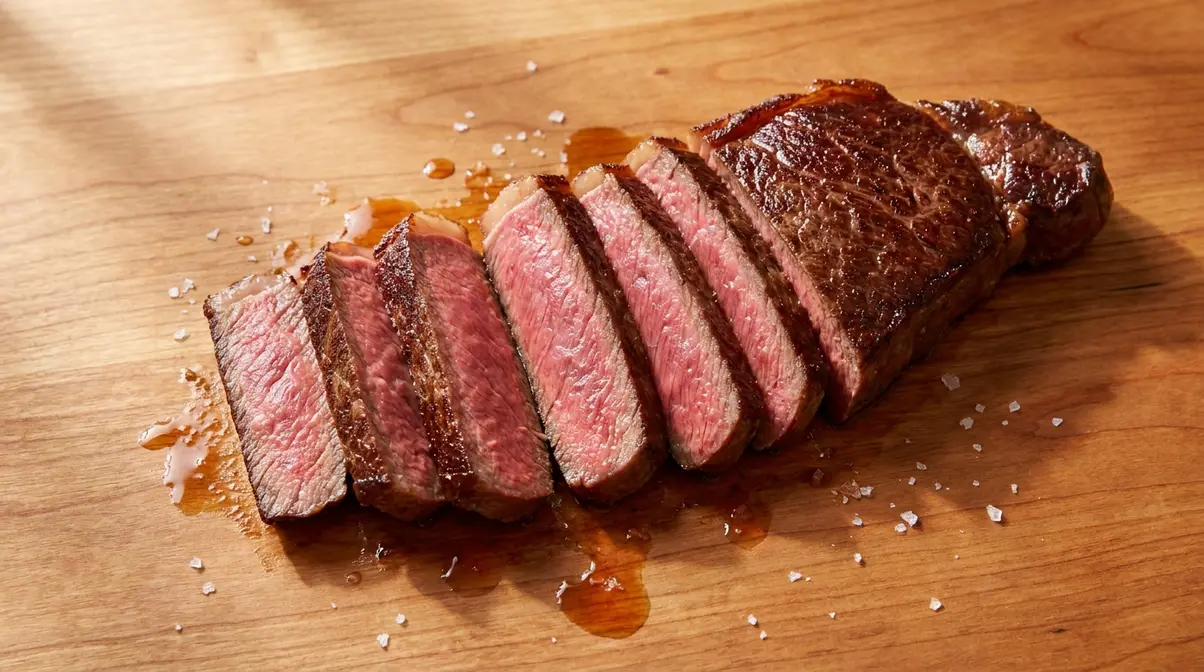
Checkpoint: Your steak has rested 5 minutes, reached 130–135°F internally, and is sliced against the grain. You’re ready to serve.
Verify Your Results: Wagyu Doneness Guide
Use this quick reference to confirm you’ve hit the right result before serving. Achieving the perfect doneness is critical because Wagyu’s high intramuscular fat requires sufficient heat to melt and soften, but too much heat will render it out completely, leaving the meat dry and tough.
| Visual Cue | Internal Temp | Verdict |
|---|---|---|
| Deep brown crust, bright pink center | 130–135°F | ✅ Perfect medium-rare |
| Brown crust, light pink center | 135–140°F | ✅ Medium — acceptable |
| Pale grey exterior, minimal browning | Any | ❌ Pan wasn’t hot enough |
| Brown crust, grey center throughout | 145°F+ | ❌ Overcooked — fat rendered out |
| Steak stuck to pan during searing | — | ❌ Pan too cold or flipped too early |
The internal temperature is your most reliable indicator. Trust the instant-read meat thermometer over visual cues alone — Wagyu’s high fat content can make the exterior look done while the interior is still climbing. Always remember that carryover cooking during the resting phase will increase the internal temperature by 5 to 10 degrees. Therefore, pulling the steak off the heat at 120–125°F ensures it gently coasts to that ideal 130–135°F medium-rare sweet spot by the time you slice it.
The Wagyu Wellness Framework
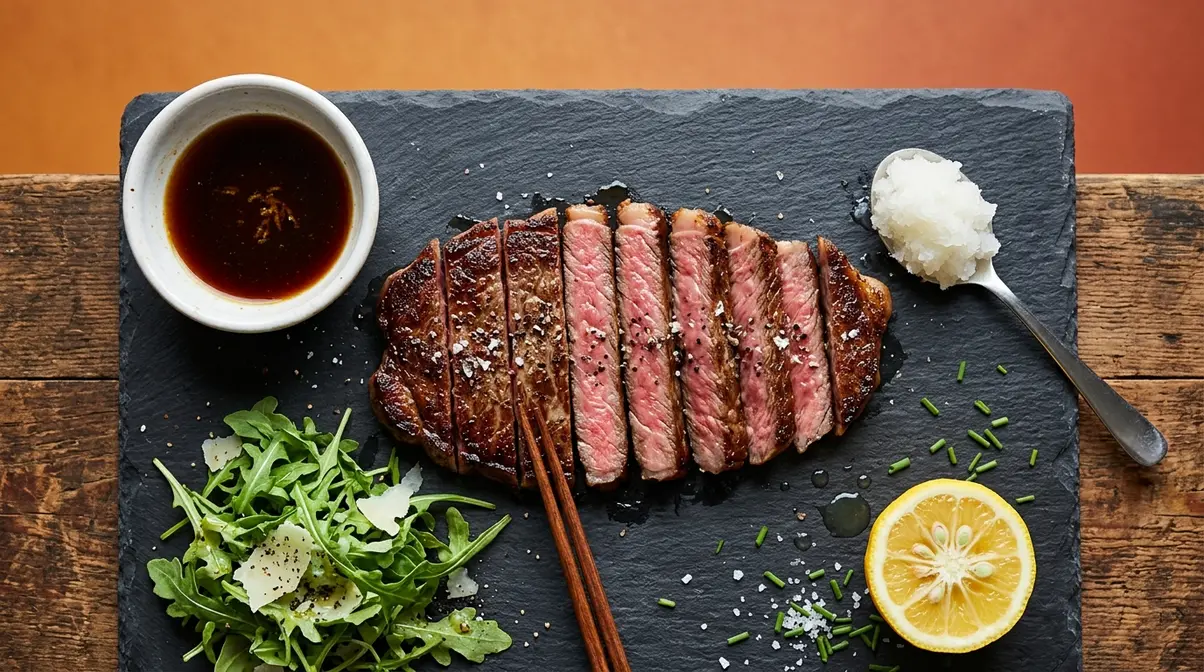
Here’s what most Wagyu guides completely ignore: the eating experience after the steak. Five of the top competitor guides say nothing about portioning or digestion — and it’s why so many first-time Wagyu eaters report feeling uncomfortably full, nauseous, or bloated after an otherwise perfect meal. The Wagyu Wellness Framework is a portioning and pairing system designed to make your Wagyu experience as enjoyable in the hour after dinner as it is during it.
Stomach hurt after eating Wagyu?
Stomach discomfort after Wagyu is caused by its extremely high fat content overwhelming your digestive system. The science is straightforward. Research from Liv Hospital (2026) confirms that high-fat foods delay gastric emptying — food stays longer in the stomach, causing fullness, heaviness, and bloating. Saturated fat also stimulates the release of cholecystokinin (CCK), a hormone that slows digestion further. Wagyu’s extraordinary fat content means these effects are amplified compared to regular beef. Eating a 12 oz A5 steak the way you’d eat a 12 oz ribeye is a recipe for discomfort.
Ideal Wagyu Portion Sizes
A5 Japanese Wagyu: 3–4 oz per person. This is not a cultural quirk — it’s a biological reality. At 33.9% intramuscular fat, A5 delivers more fat per ounce than almost any other food. Three to four ounces of A5 provides the full sensory experience without overwhelming your digestive system. Japanese Wagyu restaurants typically serve A5 in 2–3 oz tasting portions for exactly this reason.
American Wagyu: 6–8 oz per person. The lower fat content makes American Wagyu more forgiving in larger portions, though it’s still richer than USDA Prime. A 6 oz American Wagyu steak is a satisfying, complete meal without the digestive load of a large A5 serving.
Eating more than 4 oz of A5 Wagyu in a single sitting significantly increases the risk of digestive discomfort — high-fat meals delay gastric emptying and stimulate CCK release, slowing digestion and causing prolonged fullness (Liv Hospital, 2026).
Best Acidic Pairings
Acidic accompaniments serve a practical purpose alongside Wagyu — they cut through the fat, stimulate digestion, and refresh the palate between bites. These are the four pairings that work best:
1. Ponzu sauce — a citrus-based Japanese condiment (yuzu or lemon juice + soy sauce). Ponzu is the traditional A5 accompaniment for a reason: the citric acid cuts fat, while the umami of the soy sauce complements the beef. A small dipping bowl alongside thin A5 slices is the classic serving method.
2. Daikon radish (grated) — the enzyme content in fresh daikon actively supports fat digestion. Japanese steakhouses serve grated daikon with Wagyu as a palate cleanser and digestive aid. A tablespoon alongside each serving is sufficient.
3. Arugula — the peppery bitterness of arugula creates a natural contrast to Wagyu’s richness. Tossed simply with lemon juice and good olive oil, a small arugula salad served alongside (not underneath) the steak works well for American Wagyu portions.
4. Citrus elements — a squeeze of lemon or yuzu over sliced A5 Wagyu brightens the entire dish. The acid interacts with the fat on your palate, reducing the sensation of heaviness without masking the steak’s flavor.
These four pairings form the core of the Wagyu Wellness Framework. Together, they transform a potentially overwhelming richness into a balanced, memorable meal.
Alternative Cooking Methods for Wagyu
The pan-sear in a cast-iron skillet is the recommended method for beginners — but it’s not the only viable option. Understanding the alternatives helps you choose the right method for your grade, your equipment, and the occasion. If you are experimenting with thicker cuts, you might wonder about water bath techniques. While we often explore how long you should sous vide a tomahawk steak or debate sous vide vs instant pot for conventional beef, sous vide is generally not recommended for A5 Wagyu. The prolonged low heat renders out too much of the delicate fat before the steak ever reaches the searing pan.
Grilling Wagyu Steak
Grilling works well for American Wagyu but requires careful management for A5. The challenge with grilling is fat flare-ups — as Wagyu’s intramuscular fat renders, it drips onto the heat source and causes flames that can char the exterior before the interior reaches temperature.
For American Wagyu on the grill:
- Preheat your grill to high (450–500°F grate temperature)
- Clean and oil the grates to prevent sticking
- Sear 2–3 minutes per side over direct heat
- Move to indirect heat if the steak needs more time to reach temperature
- Pull at 120–125°F and rest 5 minutes
For A5 on the grill: If you must grill A5, use a cast-iron grill pan placed on the grill grates rather than direct grate contact. This prevents fat from dripping through and flaring. Keep sear time to 60–90 seconds per side.
User consensus among Wagyu enthusiasts consistently rates the cast-iron pan-sear as superior to grilling for A5 — the controlled environment produces a more consistent crust and eliminates flare-up risk.
Reverse Searing American Wagyu
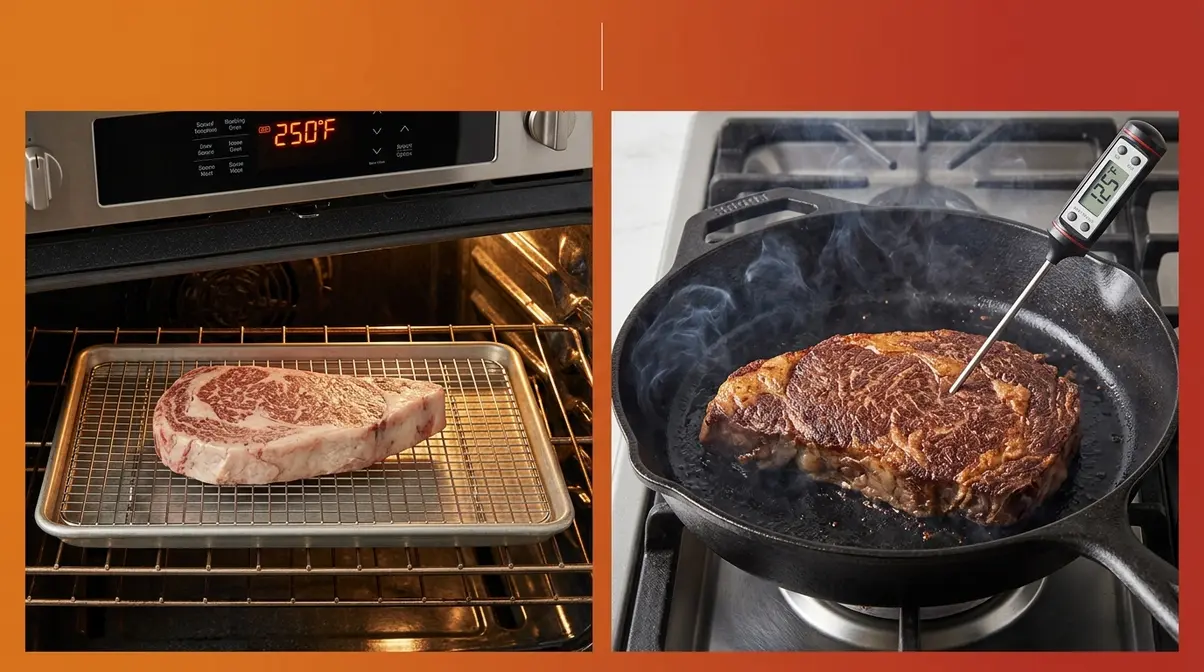
The reverse sear is a two-stage technique: you bring the steak to near-target temperature in a low oven first, then finish with a high-heat sear. It’s particularly well-suited to American Wagyu steaks that are 1 inch or thicker, because it produces exceptional edge-to-edge doneness — often called “wall-to-wall” doneness in culinary communities.
How to reverse sear American Wagyu:
- Preheat your oven to 250°F (low and slow)
- Place the seasoned steak on a wire rack over a baking sheet
- Cook in the oven until the internal temperature reaches 110–115°F (approximately 25–45 minutes depending on thickness)
- Remove from oven and rest 10 minutes while you heat your cast-iron pan to 425°F+
- Sear 60–90 seconds per side in the screaming-hot dry pan
- Rest 5 minutes and serve
The reverse sear is not recommended for A5 Japanese Wagyu — the low oven phase allows too much fat to render before the final sear, reducing the crust quality. The cold-start direct sear remains the superior method for A5.
Troubleshooting Common Mistakes
Even with the best preparation, things can go sideways. Here are the most frequent problems home cooks encounter when cooking Wagyu, and how to fix them.
Problem: Grey exterior with no crust
Cause: Pan wasn’t hot enough (below 375°F), or the steak surface was wet.
Fix: Always verify pan temperature with an IR thermometer before adding the steak. Pat the steak completely dry — even a small amount of surface moisture creates steam that prevents browning.
Problem: Steak stuck to the pan
Cause: You flipped too early. The Maillard reaction hasn’t completed the crust yet, so the steak bonds to the pan surface.
Fix: Wait. A properly searing steak releases naturally when the crust forms. If it resists, give it another 20–30 seconds.
Problem: Overcooked interior (grey throughout)
Cause: Pan too hot for too long, sear time too extended, or steak wasn’t pulled at the right temperature.
Fix: Use your instant-read thermometer continuously during the sear — not just at the end. Pull A5 at 120–125°F without exception.
Problem: Steak tastes greasy or heavy
Cause: Portion too large (especially A5), added unnecessary oil or butter, or skipped the acidic pairing.
Fix: Apply the Wagyu Wellness Framework. Limit A5 to 3–4 oz, skip added fats entirely, and serve with ponzu or a squeeze of lemon.
Problem: Bitter or burnt flavor
Cause: Pepper or herbs added before the sear, or butter used in the pan.
Fix: Season with salt only before cooking. Add pepper and any aromatics after the sear. Use tallow instead of butter if any added fat is needed.
Problem: Steak cooked unevenly (well-done edges, rare center)
Cause: Pan not preheated evenly, or steak too thick for the direct-sear method.
Fix: For thick American Wagyu (over 1 inch), use the reverse sear method. For A5, which is typically sold thinner, the direct sear produces even results when pan temperature is correct.
Frequently Asked Questions
Best way to cook Wagyu steak?
The best way to cook Wagyu steak is a dry pan-sear in a cast-iron skillet heated to at least 425°F, with no added oil or butter. Season with kosher salt only before cooking, sear 60–90 seconds per side for A5 or 2–3 minutes for American Wagyu, and pull at 120–125°F internal temperature for medium-rare. Rest 5 minutes before slicing. This method preserves Wagyu’s natural fat content and produces a dark, crackling crust without diluting the steak’s unique flavor profile.
Grill or pan fry Wagyu steak?
Pan-frying in a cast-iron skillet is generally better than grilling for Wagyu, especially A5 Japanese Wagyu. Grilling introduces flare-up risk as fat renders and drips onto the heat source, which can char the exterior before the interior reaches temperature. A cast-iron pan provides controlled, even heat and contains the rendering fat for the self-basting technique. Grilling works reasonably well for American Wagyu with careful heat management, but for A5, the pan is the superior tool.
Oil or butter to cook Wagyu?
No — you do not need oil or butter to cook A5 Wagyu steak. Wagyu’s intramuscular fat — up to 33.9% of the steak’s composition (Sains Malaysiana, 2026) — renders into the pan within seconds of contact, creating its own cooking medium. Adding butter risks burning (butter’s smoke point is approximately 300°F, well below the 425°F+ needed for a proper sear) and dilutes the steak’s natural flavor. For American Wagyu, a small amount of beef tallow is the best option if any added fat is needed.
Common Wagyu cooking mistakes?
The most common Wagyu cooking mistakes are using an insufficiently hot pan, adding unnecessary oil or butter, and overcooking the steak. Other frequent errors include: treating all Wagyu grades identically (A5 cooks from cold; American Wagyu from room temperature), adding pepper before the sear (it burns at high heat), serving portions that are too large for A5, and skipping the rest period after cooking. Using a thermometer — both IR for the pan and instant-read for the steak — eliminates most of these problems at once.
Why limit Wagyu beef portions?
You can’t eat a lot of Wagyu beef at once because its extraordinary fat content — up to 33.9% intramuscular fat in A5 — places a significant load on your digestive system. This is not a quality problem; it’s a biological feature of the world’s most marbled beef. High-fat meals stimulate CCK release and delay gastric emptying, meaning the digestive workload is far higher than with conventional beef. A 3–4 oz A5 serving delivers the full sensory experience while keeping the fat load manageable. Japanese Wagyu culture treats A5 as a tasting experience, not a full-sized entrée — and the portion guidance reflects centuries of culinary wisdom.
Can you cook Wagyu steak in the oven?
While you can use the oven for the reverse sear method with thicker American Wagyu cuts, it is not recommended for A5 Japanese Wagyu. The low ambient heat of an oven will cause the delicate intramuscular fat of A5 to render out before a crust can form, resulting in a dry, overcooked steak. Always stick to a fast, hot pan-sear for A5 to preserve its unique texture and flavor.
Should you dry brine Wagyu steak?
Dry brining—salting the steak and leaving it uncovered in the fridge—is excellent for American Wagyu, but you should not dry brine A5 Japanese Wagyu for extended periods. American Wagyu benefits from the deep seasoning and moisture extraction. However, A5 should be salted just before it goes into the hot pan straight from the refrigerator to prevent its delicate fat from softening prematurely.
Limitations and When to Seek Alternatives
Common Pitfalls to Anticipate
Pitfall 1 — Buying the wrong cut for this method. The cast-iron pan-sear described in this guide works best for steaks 1 inch or thinner (A5 is typically sold at ½–¾ inch). If you have a thick-cut American Wagyu ribeye (1.5 inches+), the direct sear alone will produce an overdone exterior before the center reaches temperature. Use the reverse sear method for anything over 1 inch.
Pitfall 2 — Skipping the IR thermometer. Without a pan surface thermometer, you’re guessing. A pan that looks hot and a pan that reads 425°F are not the same thing. Testing by culinary teams at ThermoWorks found that visual cues alone (smoke, shimmer) can correspond to a wide temperature range. The IR thermometer costs approximately $20–$30 and eliminates the most common failure point entirely.
Pitfall 3 — Resting in the wrong place. Placing the rested steak back in the still-hot pan, or on a plate sitting on the warm stovetop, continues cooking it past your target temperature. Always rest on a wire rack or room-temperature cutting board, away from the stove.
When to Choose Alternative Methods
Choose the reverse sear if your American Wagyu is over 1 inch thick, if you’re cooking for multiple people and need consistent results across several steaks, or if you’re new to high-heat cooking and want more control over doneness.
Choose grilling for American Wagyu if you prefer the slight smokiness that grilling imparts, or if you’re cooking outdoors for a group. Grilling is not recommended for A5.
Skip Wagyu entirely if you or your guests have known gallbladder disease, severe IBS, or strong sensitivity to high-fat foods. The fat load is genuinely significant, and the Wagyu Wellness Framework reduces — but does not eliminate — digestive risk for those with underlying conditions.
When to Seek Expert Help
If you’re planning to serve Wagyu to guests with dietary restrictions, consulting a nutritionist about appropriate portion sizes for their specific health context is worthwhile. If you experience significant abdominal pain 30–120 minutes after eating high-fat foods consistently, this pattern may indicate gallbladder disease or another GI condition — consult a physician rather than adjusting your Wagyu technique.
For home cooks who want to learn exactly how to cook wagyu steak at home, the 6-step dry pan-sear method delivers a perfect medium-rare result with a crackling crust. Wagyu’s extraordinary fat content — up to 33.9% intramuscular fat (Sains Malaysiana, 2026) — means it self-bastes in its own rendered fat, requires no added oil, and rewards those who understand the grade-specific approach: A5 from cold, American Wagyu from room temperature, both pulled at 120–125°F.
The Wagyu Wellness Framework is the element most guides omit entirely: limit A5 to 3–4 oz per person, pair with acidic accompaniments, and the meal remains as enjoyable in the hour after dinner as during it. Understanding your steak’s biology — not just its cooking time — is what separates a memorable experience from an expensive disappointment.
Your next step is straightforward: gather your cast-iron skillet, both thermometers, and your Wagyu. Follow the 6 steps in sequence. The first time you hear that aggressive sizzle when a cold A5 steak hits a 425°F+ pan, you’ll know you’ve done it right.

Dave King
Recipe developer and writer at Quick Dish Cookbook.