

📅 Last Updated: July 2026 — We review this guide every 6 months to keep pricing, model references, and health research current.
What’s in this guide
“I’m thinking of buying one but am not sure. What functions do they fulfill? Why use one over frying on a regular stove and for fast cooking in microwaves?”
That question comes up constantly in home cooking communities — and it’s a completely fair one. Air fryers have been everywhere for years now, but the hype doesn’t always translate to honest answers. Over 40% of U.S. households now own one, which means plenty of people have bought them, loved them, and plenty of others have quietly shoved them into a cabinet.
The wrong choice means a $100+ appliance gathering dust on your counter within three months. The right choice means faster weeknight meals, less oil, and a kitchen tool you actually reach for every day. This guide covers the real reasons to buy an air fryer — and the equally real reasons you might not need one — alongside what health experts actually say. By the end, you’ll know exactly whether an air fryer fits your kitchen. If it doesn’t, we’ll tell you that too.
No products found.
7 Reasons to Buy an Air Fryer (And Why They Actually Matter)
There are seven compelling reasons to buy an air fryer — and they go well beyond just making crispier fries. Air fryers use up to 80% less oil than traditional deep frying, reducing calorie intake without sacrificing crunch (Cleveland Clinic dietitians on reducing unhealthy fats, 2023). For anyone cooking weeknight meals for a small household, that combination of speed and health impact is genuinely hard to ignore.
An air fryer is a compact countertop appliance that circulates hot air around food to crisp it with minimal oil. It uses convection cooking — a method that moves hot air rapidly around food to brown it evenly — in a much smaller chamber than a full-size oven. That smaller space is the key to almost everything that makes it useful.
Cooks Food Up to 30% Faster Than a Conventional Oven
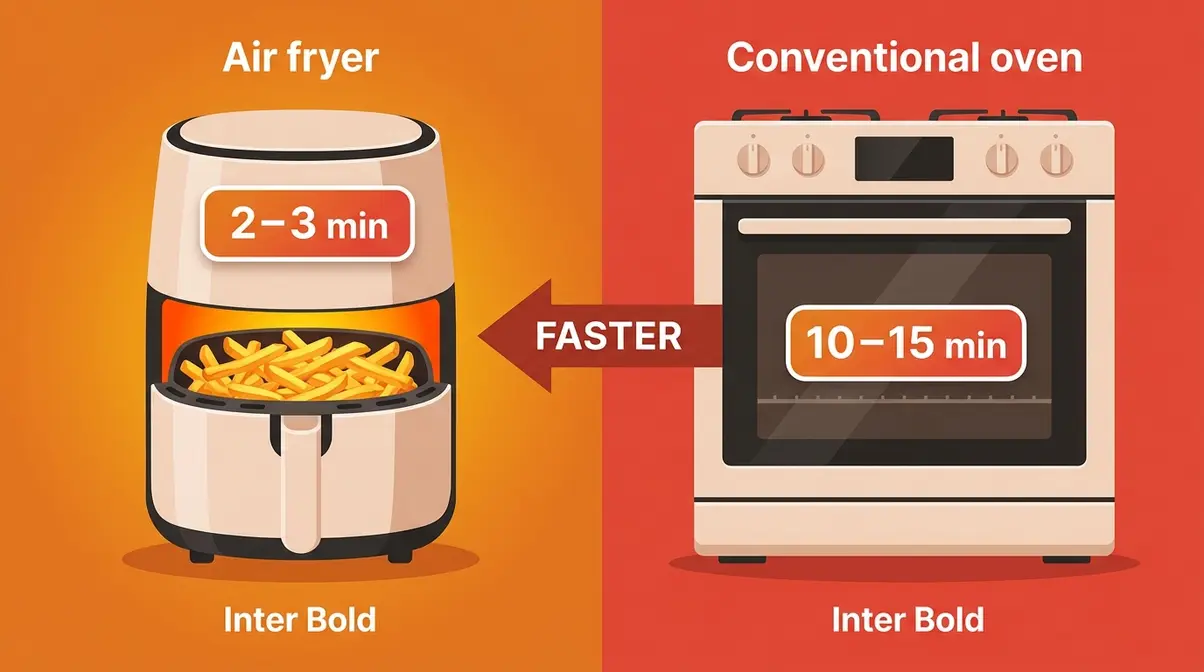
The biggest real-world time saver most users notice isn’t the cooking itself — it’s the preheat gap. A conventional oven takes 10–15 minutes to reach 400°F. An air fryer reaches the same temperature in 2–3 minutes. That gap alone changes the math on weeknight cooking.
Actual cook times back this up with specific examples. Frozen fries take roughly 12 minutes in an air fryer versus 25 minutes in an oven. Chicken wings go from about 35 minutes oven time down to 20 minutes. Reheated pizza — one of the most-cited use cases — is done in 3–4 minutes versus 10–12 in an oven. Air fryers cook approximately 25–30% faster than conventional ovens for most small-portion meals, according to user consensus across cooking communities.
One honest caveat: for large batches — a full sheet pan of roasted vegetables or a whole chicken — a conventional oven is still faster because it doesn’t require multiple rounds in a smaller basket. For a weeknight dinner of four chicken thighs and a side of broccoli, though, an air fryer cuts total kitchen time from around 45 minutes to under 25.
Why this matters for you: If you regularly skip cooking because it feels like too much effort after a long day, cutting 20 minutes off meal prep time is a meaningful quality-of-life change.
Uses Up to 80% Less Oil for Healthier Everyday Meals
Air fryers use up to 80% less oil than deep frying — and the science behind why it works is straightforward. The rapidly circulating hot air triggers the Maillard reaction: the same chemical process that makes toast brown and steak sear. Food gets that golden, crispy exterior without being submerged in fat.
The calorie difference is real. A serving of traditional deep-fried french fries contains roughly 400–500 calories. The same portion made in an air fryer drops to approximately 150–200 calories, primarily because you’re using a teaspoon of oil instead of four to six cups. (Cleveland Clinic dietitians on reducing unhealthy fats, 2023).
However, a note of intellectual honesty borrowed from Harvard nutrition researchers is worth adding here: air frying is a healthier method, but it doesn’t make unhealthy food healthy. Air-fried frozen fries are still processed food. The method reduces fat — it doesn’t transform the nutritional profile of the ingredient itself (Harvard T.H. Chan School of Public Health).
Foods that benefit most from this method: chicken tenders, salmon fillets, frozen vegetables, tofu, and anything breaded. All get genuinely crispy texture with a fraction of the oil.
Why this matters for you: If you love fried food but are trying to reduce your fat intake, air frying gives you a practical, sustainable way to eat the same foods with a meaningfully lower calorie load.
Saves Energy and Cuts Your Electricity Bill
Air fryers use significantly less energy than full-size ovens for small portions — because they heat a much smaller space. A standard air fryer draws 1,400–1,700 watts. A conventional oven draws 2,000–5,000 watts. For a 20-minute cook, that difference adds up over hundreds of meals per year.
According to a BBC analysis on air fryer energy consumption, air fryers can use considerably less electricity than electric ovens for small portions — but the savings are conditional. Cooking multiple batches for a larger family can actually consume more electricity than a single oven run and negate the savings entirely (BBC News, 2022).
A practical rule of thumb: if you’re cooking for 1–3 people most nights, an air fryer will likely reduce your energy use for that meal. If you’re regularly cooking for five or more people and running two or three batches back-to-back, a conventional oven may actually be more efficient overall.
Why this matters for you: The energy savings are real, but they’re household-size dependent. Don’t buy an air fryer primarily to save on electricity if you’re cooking for a large family.
After H3 Energy, here is the comparison table showing how air fryers stack up against the alternatives:
| Feature | Air Fryer | Convection Oven | Deep Fryer |
|---|---|---|---|
| Preheat Time | 2–3 minutes | 10–15 minutes | 5–10 minutes |
| Oil Required | 1 tsp–1 tbsp | None | 4–6 cups |
| Cooking Speed | Fast (25–30% faster than oven) | Moderate | Fast |
| Health Impact | High (low fat) | High (low fat) | Low (high fat) |
| Best For | Small portions, crispy food | Large batches, baking | Authentic fried texture |
| Approx. Running Cost | Low–Medium | Medium–High | Medium |
For an even deeper breakdown, discover the top reasons to own an air fryer on our dedicated buying guide.
More Versatile Than You Think: Beyond Just Frying
Many beginners assume air fryers only make fries and wings. That’s a common misconception worth correcting directly. Air fryers also bake (muffins, cookies, small cakes), roast (vegetables, chicken pieces, salmon), reheat leftovers, and some models can even dehydrate food like fruit slices and jerky.
The reheating use case is one of the most cited reasons users say an air fryer “lived up to the hype.” Reheated pizza comes out with a crispy crust in 3–4 minutes — something a microwave simply cannot do. Leftover fried chicken regains its crunch in about 5 minutes. Common feedback from home cooks across cooking communities consistently highlights reheating as the unexpected standout feature.
Foods air fryers handle exceptionally well:
- Frozen foods (fries, nuggets, spring rolls)
- Chicken wings and tenders
- Salmon and other fish fillets
- Roasted broccoli and Brussels sprouts
- Baked potatoes
- Reheated pizza and fried chicken
- Tofu and halloumi
One honest limit: it’s not a full oven replacement. Large items — a whole roast, multiple racks of cookies, a lasagne — still need a conventional oven. A convection oven, which uses the same hot-air principle but in a larger, built-in format, handles those jobs better.
Why this matters for you: If you’ve been thinking of an air fryer as a single-use gadget, the versatility case is stronger than most marketing suggests — as long as you’re cooking for a small household.
Easier Cleanup Than Deep Frying
The cleanup advantage is one of the most straightforward reasons to buy an air fryer. Most air fryer baskets are dishwasher-safe or wipe clean in under five minutes. Compare that to a traditional deep fryer, which requires cooling the oil, straining it, storing or disposing of several cups of hot fat, and scrubbing a greasy vessel.
After making chicken wings in an air fryer, cleanup takes roughly 3–5 minutes. After deep frying the same batch, it takes 15–20 minutes including oil management. One honest caveat: greasy foods like bacon and fatty meats can splatter during cooking and require a more thorough wipe-down of the interior walls. Not every basket remains fully non-stick after extended use, either.
Why this matters for you: If the mess of deep frying has stopped you from making fried food at home, an air fryer removes that barrier almost entirely.
Honest Downsides: Reasons You Might Not Need an Air Fryer

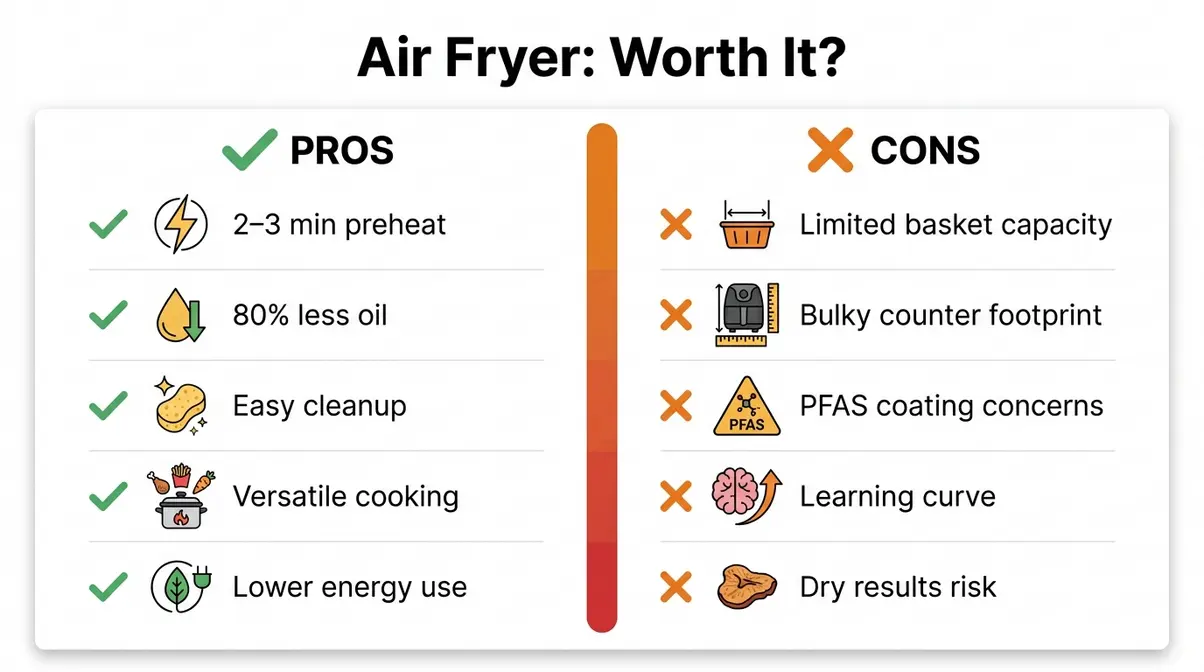
Air fryers are useful for a lot of people — but not all people. This section covers the five real reasons you might want to pass, because the best buying decision is an informed one. The Air Fryer Fit Test is as much about knowing when to say no as when to say yes.
Limited Capacity: Not Ideal for Larger Families
This is the most common source of buyer’s remorse. Most standard air fryers have a basket capacity of 4–6 quarts — enough for two to four servings at a time. For a family of five or more, that means cooking in batches, which erases the speed advantage and can leave early portions cold while later ones cook.
A serving of chicken wings for four people typically requires two separate batches in a standard 5-quart model. The first batch sits waiting while the second cooks. For weeknight family dinners, this workflow quickly becomes frustrating rather than convenient.
Larger models (8–10 quart dual-basket designs) partially address this, but they also take up significantly more counter space and cost considerably more. According to product reviews aggregated by The Kitchn, capacity management is the number-one complaint among households cooking for four or more people.
Why this matters for you: If you regularly cook for five or more people, check capacity specifications carefully before buying — or consider whether a convection oven might serve you better.
Counter Space: It’s a Bulky Appliance
Air fryers are not small. A standard 5-quart model typically measures around 11–13 inches tall and 10–12 inches wide. In a kitchen with limited counter space, that footprint competes directly with a coffee maker, toaster, or stand mixer.
Some users solve this by storing the air fryer in a cabinet and pulling it out as needed. The problem: an appliance that lives in a cabinet tends to be used far less. Out of sight genuinely does mean out of mind for most people’s cooking habits.
If your kitchen counters are already crowded, an air fryer may end up displacing something you use more often — or simply not getting used at all. Common feedback from home cooks in apartment kitchens specifically highlights counter space as the deciding factor in whether the appliance stays or goes.
Why this matters for you: Before buying, physically measure the space where you’d keep it. If you can’t leave it on the counter permanently, be honest about whether you’ll actually pull it out of a cabinet regularly.
Non-Stick Coating Concerns (PFAS and Teflon)
This is the downside that most buying guides skip, but it deserves a direct answer. Many air fryer baskets use non-stick coatings — some of which have historically contained PFAS (per- and polyfluoroalkyl substances, a group of synthetic chemicals used in non-stick coatings). At very high temperatures or when the coating is scratched or damaged, there are legitimate concerns about chemical leaching.
The U.S. Environmental Protection Agency has flagged certain PFAS compounds as persistent environmental and health concerns, and research continues into their long-term effects (EPA, 2023). Traditional PTFE-based coatings (commonly known as Teflon) are generally considered safe at normal cooking temperatures below 500°F — but degraded or overheated coatings are a different matter.
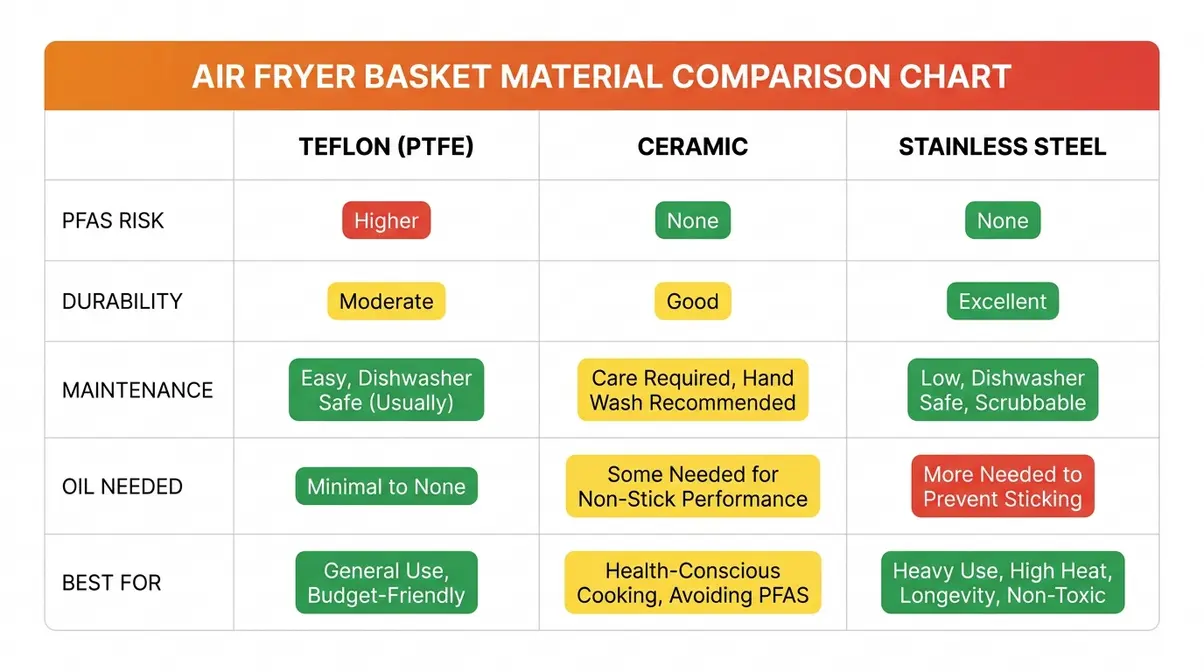
The practical guidance: if PFAS is a concern for you, look for air fryers with ceramic-coated or stainless steel baskets, which avoid these chemicals entirely. Avoid metal utensils in any coated basket, and replace the basket if the coating becomes visibly scratched or flaking.
Why this matters for you: This isn’t a reason to avoid air fryers entirely — it’s a reason to pay attention to which model you buy and how you maintain it.
The Learning Curve and the Dry Food Problem
Air fryers do have a learning curve. The circulating hot air that makes food crispy can also dry it out if you’re not careful with timing and temperature. Lean proteins — chicken breast, pork tenderloin, fish fillets — can come out dry and tough if overcooked by even a few minutes.
Delicate foods also present challenges. Leafy greens, light batters, and anything very thin can blow around inside the basket from the fan, leading to uneven cooking. Cheese can melt and drip through the basket before it browns. These aren’t dealbreakers, but they do require some recipe adjustment and experimentation before you get consistent results.
Most new air fryer owners report a two-to-four week period of trial and error before they feel confident cooking a range of foods. If you’re someone who follows recipes closely, you’ll need to re-learn timing for almost every dish.
Why this matters for you: If you’re a beginner cook who wants a plug-and-play solution with zero learning curve, the adjustment period is real and worth factoring in.
Why People End Up Getting Rid of Theirs
Understanding why people abandon air fryers is arguably more useful than reading reasons to buy one. The pattern is consistent across cooking communities and consumer feedback: the appliance gets used heavily for the first few weeks, then sits unused.
The most common reasons, based on aggregated user feedback and consumer surveys:
- Capacity mismatch — bought for a larger household than the basket can serve
- Counter space conflict — moved to a cabinet, then forgotten
- Repetitive cooking — used it for fries and wings, ran out of ideas after two weeks
- Dry results — overcooked lean proteins before mastering timing
- Cleaning fatigue — greasy interiors from fatty meats required more effort than expected
Consumer Reports data suggests that kitchen appliances with a narrow perceived use case have significantly higher abandonment rates than versatile ones. An air fryer used only for fries is an appliance with a short shelf life in most kitchens.
Why this matters for you: Before buying, ask yourself honestly: do you cook varied meals at home at least four times a week? If the answer is yes, an air fryer will likely earn its place. If you rarely cook, it probably won’t change that habit.
What Health Experts Actually Say About Air Fryers
The health claims around air fryers range from genuinely evidence-backed to outright marketing exaggeration. This section covers what the science actually shows — and where the honest limits of that evidence are. For personalized dietary advice, always consult a registered dietitian or your doctor.
Is Air Frying Good for High Cholesterol?
The short answer: air frying can be a better choice than deep frying for people managing high cholesterol — but the benefit depends heavily on what you’re cooking, not just how you cook it.
Deep frying adds significant amounts of saturated and trans fats to food, both of which are linked to raised LDL (low-density lipoprotein, often called “bad” cholesterol) levels. By using up to 80% less oil, air frying substantially reduces that added fat load. Mayo Clinic health experts note that cooking methods that reduce added fat are generally supportive of heart health goals (Mayo Clinic Health System, 2023).
However, there’s an important nuance. Research has identified a category of compounds called cholesterol oxidation products (COPs) — formed when cholesterol-containing foods are exposed to high heat. Some studies suggest that high-heat cooking methods, including air frying, can produce COPs in fatty meats. The practical implication: cooking lean proteins and vegetables in an air fryer carries a very different risk profile than cooking fatty meats at maximum temperature.
The Food Revolution Network’s analysis of air fryer health data concludes that for most people eating a varied diet, air frying represents a meaningful improvement over deep frying — particularly for reducing total fat intake — while acknowledging that no single cooking method eliminates all dietary risk (Food Revolution Network, 2023).
Health Disclaimer: This section is informational only. For personalized dietary advice based on your specific cholesterol levels and health history, consult a registered dietitian or your doctor.
Acrylamide, AGEs, and What the Science Really Shows
Two chemical compounds come up repeatedly in discussions of air fryer safety: acrylamide and AGEs (advanced glycation end-products). Understanding both requires a little context.
Acrylamide is a chemical compound formed during high-heat cooking of starchy foods — it’s produced when sugars and the amino acid asparagine react at temperatures above 250°F. It forms in fried potatoes, bread, coffee, and many other cooked foods. The concern: animal studies have linked high doses of acrylamide to cancer risk, though the evidence in humans at typical dietary exposure levels remains inconclusive (Food and Drug Administration, 2023).
Here’s where air frying shows a genuine advantage. Research published in the Journal of Food Science found that air frying potato products produced significantly lower acrylamide levels compared to deep frying — in some studies, reductions of 40–90% depending on temperature and cooking time. The lower oil content and shorter cooking times at moderate temperatures appear to limit acrylamide formation.
AGEs (advanced glycation end-products) are compounds formed when proteins or fats combine with sugars under heat — they’re associated with inflammation and are a factor in chronic disease research. High-heat, dry cooking methods (including air frying at maximum temperatures) do produce AGEs. Lower-temperature air frying and marinating proteins before cooking appear to reduce AGE formation, according to research reviewed by the Good Housekeeping Institute.
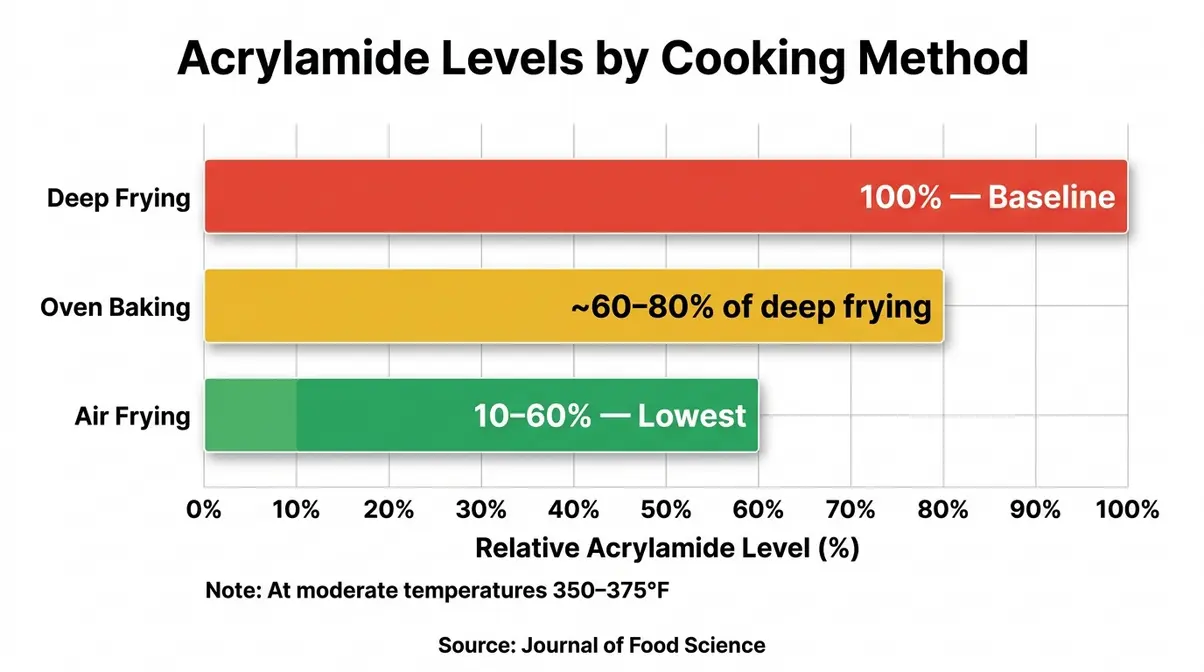
The practical takeaway: air frying at moderate temperatures (350–375°F) rather than maximum settings, and avoiding cooking food to a very dark brown, keeps both acrylamide and AGE formation at lower levels.
What Doctors Actually Recommend (And What They Caution Against)
The medical consensus on air fryers is cautiously positive — with clear conditions. Physicians and dietitians generally support air frying as a healthier alternative to deep frying, particularly for patients managing weight, cardiovascular disease risk, or high cholesterol. The reduction in added dietary fat is the primary cited benefit.
What doctors caution against is using air frying as a nutritional loophole. Air-fried processed foods are still processed foods. Air-fried bacon is still high in saturated fat. The cooking method improves the fat profile of a meal — it doesn’t transform the underlying nutritional quality of the ingredient.
Mayo Clinic health professionals specifically note that air fryers can support a heart-healthy diet when used to prepare lean proteins, vegetables, and whole foods — and that the method is particularly useful for people transitioning away from deep frying (Mayo Clinic Health System, 2023). Cleveland Clinic dietitians echo this framing, positioning air fryers as a practical tool within a broader healthy eating pattern rather than a standalone solution (Cleveland Clinic, 2023).
The caution from most health professionals: don’t let the “healthier cooking method” framing become a justification for eating more fried food overall. Frequency and food choice matter as much as cooking method.
Common Air Fryer Myths, Answered
A few persistent questions about air fryers deserve direct answers — particularly ones that come from celebrity opinions and conflicting online advice.
What Does Gordon Ramsay Say About Air Fryers?
Gordon Ramsay has been publicly skeptical of air fryers, describing them in interviews and social media appearances as producing inferior results to proper frying or oven cooking — particularly for foods where texture and crust quality matter to a professional chef. His criticism centers on the idea that air fryers can produce dry, uniformly-browned results that lack the depth of flavour achieved through traditional cooking methods.
It’s worth putting that opinion in context. Ramsay’s standards are those of a professional kitchen, where a traditional deep fryer, a high-BTU gas range, and a proper convection oven are all available simultaneously. His critique is valid for restaurant-quality cooking. For a home cook making weeknight chicken wings or reheating pizza, the comparison point isn’t a Michelin-starred kitchen — it’s the alternative of not cooking at all, or deep frying at home.
Common feedback from home cooks who’ve switched from deep frying to air frying indicates that the texture trade-off is real but acceptable for everyday meals. The question isn’t whether air-fried food is identical to deep-fried food — it isn’t. The question is whether it’s good enough to be worth the convenience and health benefits. For most home cooks, the answer is yes.
Who Should — and Shouldn’t — Buy an Air Fryer
This is the core of The Air Fryer Fit Test — a self-qualifying framework to determine whether an air fryer genuinely fits your household, cooking habits, and health goals before you spend the money.
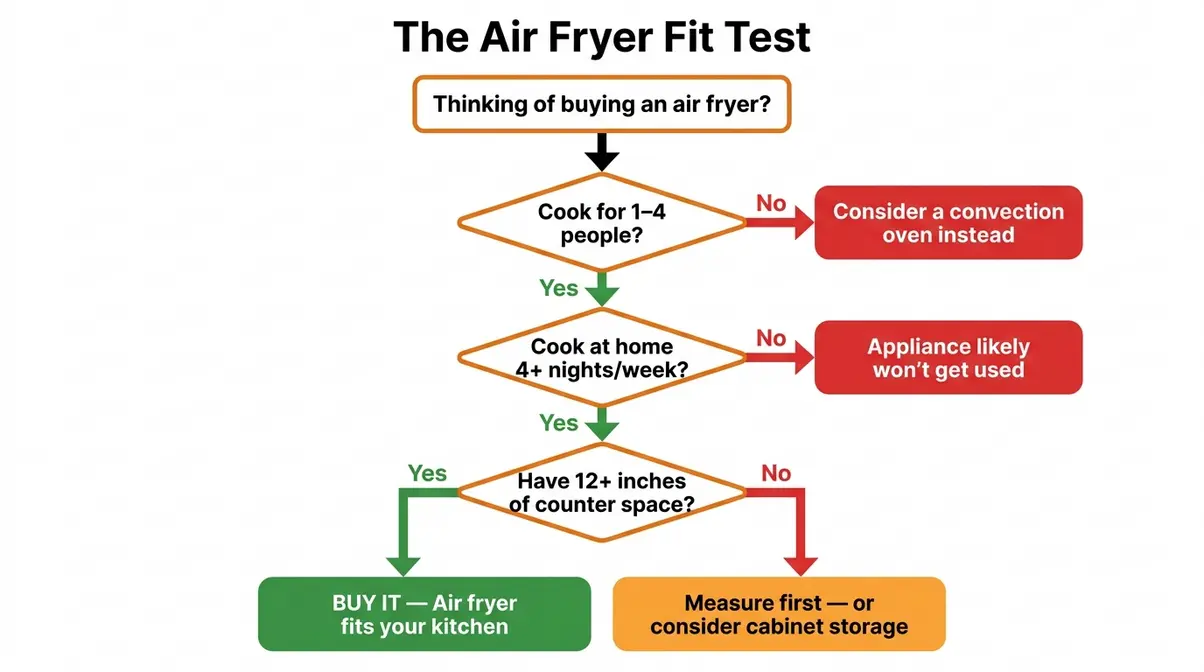
- Buy an air fryer if:
- You cook for 1–4 people at least 4 nights a week
- You have at least 12 inches of permanent counter space to spare
- You want to reduce oil and fat in everyday meals
- You regularly eat foods that air fry well (chicken, frozen foods, vegetables, fish)
- You currently deep fry at home and want a lower-maintenance alternative
- Skip if:
- You regularly cook for 5 or more people and batch cooking would be required
- Your kitchen counter space is already at capacity
- You rarely cook at home — the appliance won’t change that habit
- You primarily cook large items (roasts, full sheet-pan meals, multi-rack baking)
- You’re sensitive to PFAS and aren’t willing to specifically seek out ceramic or stainless basket models
The honest answer for most people in the 1–4 person household who cook regularly: an air fryer is worth it. For larger families or infrequent cooks, it’s a harder case to make.
Frequently Asked Questions
Is it really worth buying an air fryer?
For households of 1–4 people who cook regularly, an air fryer is genuinely worth buying. It preheats in 2–3 minutes versus 10–15 for an oven, uses up to 80% less oil than deep frying, and handles a wider range of foods than most people expect. The value equation shifts for larger families, where limited basket capacity creates batch-cooking frustration that erases the speed advantage. If you cook at home at least four nights a week and primarily cook for a small household, the investment typically pays off within a few months of regular use.
What is the downside of an air fryer?
The biggest downsides of an air fryer are limited basket capacity, counter space requirements, and a real learning curve. Standard 5-quart models serve two to four people comfortably — cooking for larger families requires multiple batches. The appliance itself is bulky, typically 11–13 inches tall, which is a significant counter space commitment. Lean proteins like chicken breast can come out dry if overcooked by even a few minutes, and most new owners report a two-to-four week adjustment period before getting consistent results. Non-stick coating concerns (PFAS) are also worth investigating before choosing a specific model.
Why are people getting rid of their air fryers?
Most people abandon air fryers due to a mismatch between expectations and actual use patterns. The most common reasons: the basket was too small for their household size, the appliance got moved to a cabinet and forgotten, or they ran out of recipe ideas after the first few weeks. Dry results from overcooked lean proteins also contribute to early disillusionment. Consumer feedback patterns consistently show that air fryers work best for people who already cook regularly — they improve an existing habit rather than creating a new one. They rarely convert non-cooks into regular home cooks.
Is air frying good for high cholesterol?
Air frying can support a cholesterol-friendly diet by significantly reducing added fat compared to deep frying. Deep frying adds substantial saturated and trans fats — both linked to raised LDL cholesterol — while air frying uses only a teaspoon of oil for the same result. Mayo Clinic health professionals note that lower-fat cooking methods are generally supportive of heart health goals (Mayo Clinic Health System, 2023). However, the benefit depends on what you cook: air-fried lean chicken and vegetables have a very different cholesterol impact than air-fried fatty meats. For personalized guidance, consult a registered dietitian or your doctor.
What do doctors say about air fryers?
Doctors and dietitians are cautiously supportive of air fryers as a healthier alternative to deep frying — with clear conditions. The reduction in added dietary fat is the primary cited benefit, particularly for patients managing weight or cardiovascular risk. Cleveland Clinic dietitians position air fryers as a practical tool within a broader healthy eating pattern (Cleveland Clinic, 2023). The consistent medical caution: air frying doesn’t transform the nutritional quality of what you cook. Air-fried processed food is still processed food. The method improves the fat profile of a meal — it doesn’t make an unhealthy ingredient healthy. Frequency and food choice matter as much as cooking method.
The Verdict: Does an Air Fryer Fit Your Kitchen?
Air fryers are one of the rare kitchen buys that live up to most of their practical claims — faster preheating, significantly less oil, easier cleanup than deep frying, and genuine versatility beyond just fries. For households of 1–4 people who cook at home regularly, the combination of speed, reduced fat intake, and lower cleanup burden makes a strong case. Research consistently supports air frying as a meaningful improvement over deep frying for fat reduction, with acrylamide levels running 40–90% lower than deep-fried equivalents in multiple studies (Journal of Food Science).
The Air Fryer Fit Test exists because the appliance isn’t universally right. Larger families, small kitchens, and infrequent cooks face real trade-offs that no amount of enthusiasm about crispy fries can paper over. The honest question isn’t “are air fryers good?” — it’s “does an air fryer fit my specific kitchen, household, and cooking habits?”
If you’ve worked through the framework in this guide and the answer is yes — look for a model with a ceramic or stainless steel basket to sidestep PFAS concerns, choose at least a 5-quart capacity for two to four people, and give yourself two to three weeks to dial in timing on your most-cooked meals. If the answer is no, that’s a good outcome too — a confident pass beats a dusty appliance every time.

quickdishcook
Recipe developer and writer at Quick Dish Cookbook.