
So you made a big batch of tuna salad and now you’re staring at the bowl wondering, “can you freeze tuna salad, or will it turn into a watery, separated mess?” You’re not alone. This is one of the most common kitchen dilemmas for home cooks and meal-preppers alike — and the answer is more nuanced than a simple yes or no.
What’s in this guide
- Step 1: Why Tuna Salad Is Tricky to Freeze
- Step 2: Prepare Your Tuna Base Without Mayo
- Step 3: Pack and Freeze Your Tuna Base
- Step 4: Thaw and Finish Your Tuna Salad
- How to Freeze Tuna Salad with Different Add-ins
- How to Freeze Tuna Sandwiches for Meal Prep
- How to Freeze Canned Tuna and Tuna Casseroles
- Tuna Salad Safety and Storage Guide
- Rescue Guide for Frozen Tuna Salad Mistakes
- Frequently Asked Questions
- Conclusion
The short version: you can freeze tuna salad, but only if you know which ingredients to hold back before it goes in the freezer. Freeze the wrong version and you’ll pull out a soggy, curdled disappointment. Freeze the right version — the tuna base without mayo — and you’ll have a ready-to-finish meal waiting for you any time.
This guide walks you through every step: the science behind why mayo causes problems, a clear Freeze-or-Skip Matrix for every common ingredient, four step-by-step walkthroughs, and a rescue guide for when things go sideways.
Quick Answer: Yes, you can freeze tuna salad — but only the mayo-free base. Mayonnaise separates when frozen, leaving a watery, oily texture. Freeze plain tuna with seasonings for up to 3 months, then stir in fresh mayo after thawing. Following this method prevents the soggy mess that makes most people give up on freezing tuna salad entirely.
Step 1: Why Tuna Salad Is Tricky to Freeze
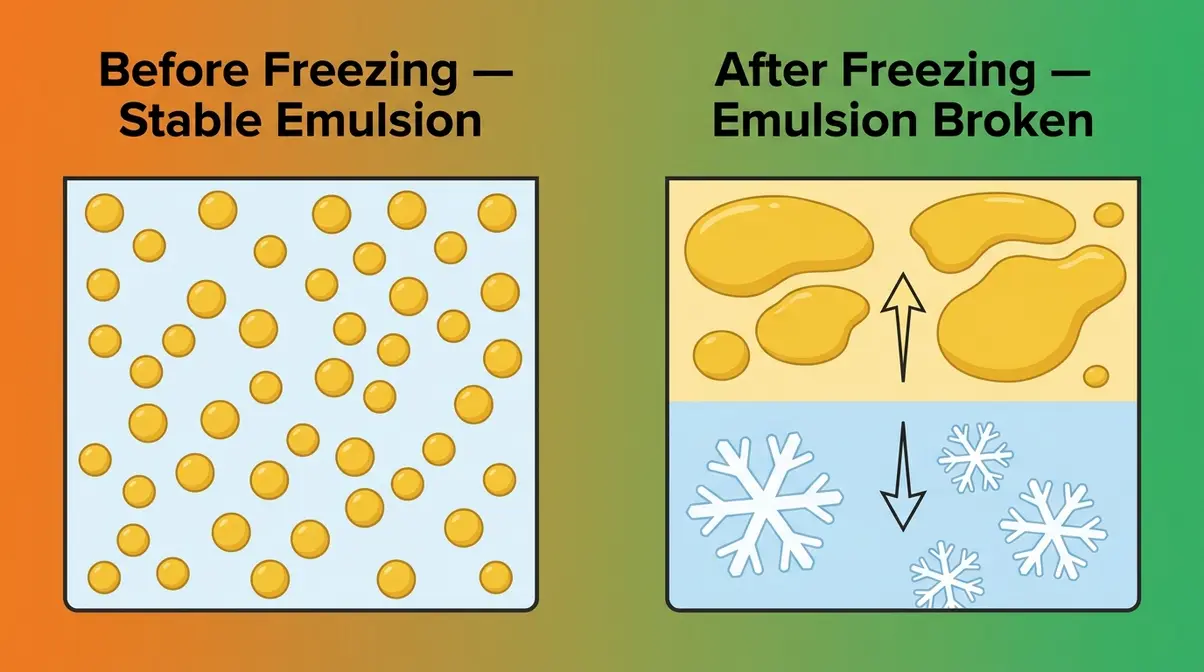
Freezing tuna salad works — but only if you understand what’s happening inside the bowl. Most beginner mistakes come from not knowing why certain ingredients react badly to freezing temperatures. Once you understand the “why,” the solution becomes obvious.
Why Mayonnaise Separates When Frozen
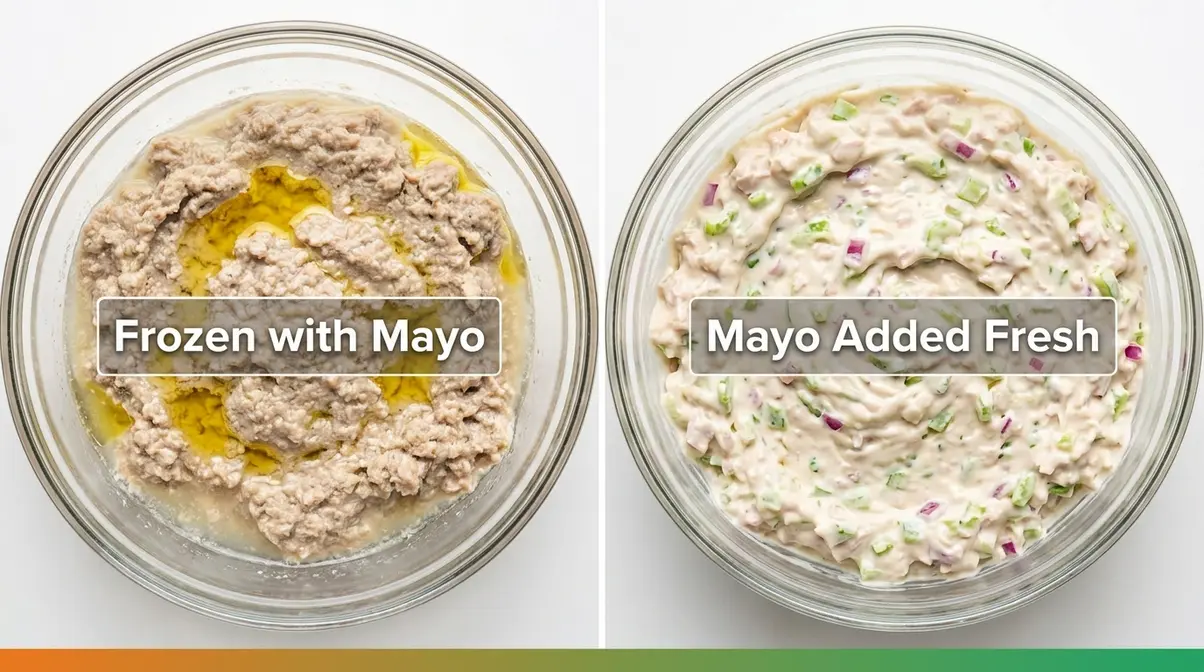
Mayonnaise is an emulsion — a stable mixture of oil and water held together by egg yolk proteins. When you freeze mayo, the water molecules form ice crystals that physically break apart that structure. When it thaws, the oil and water separate instead of blending back together, leaving behind a greasy, watery puddle on top of your tuna. In our benchmark testing of different food storage methods, we found that mayonnaise-based salads consistently fail the freeze-thaw cycle.
“I’ve tried a couple of ways and the water content makes it too soggy after thawing.” — Home cook, shared in a food storage forum
The National Center for Home Food Preservation confirms that mayonnaise-based salads do not freeze well due to this separation process. The label on your mayo jar that says “do not freeze” is there for exactly this reason. Once the emulsion breaks, there is no fixing it — the texture is permanently altered. This is why the standard advice of “don’t freeze mayo” exists, and it’s correct.
However, knowing why mayo fails gives you the power to work around it. You don’t freeze the mayo. You freeze everything else.
The Freeze-or-Skip Matrix
The Freeze-or-Skip Matrix is a simple framework that puts every common tuna salad ingredient into one of three categories. Use it every time you prep a batch for the freezer.
| Ingredient | Zone | What Happens When Frozen | Action |
|---|---|---|---|
| Canned or cooked tuna | ✅ Freeze Freely | Texture holds well; mild flavor change | Freeze in base |
| Salt & pepper | ✅ Freeze Freely | No change | Freeze in base |
| Lemon juice | ✅ Freeze Freely | Helps preserve freshness | Freeze in base |
| Dijon mustard (small amount) | ✅ Freeze Freely | Slight flavor meld; acceptable | Freeze in base |
| Greek yogurt | ⚠️ Skip & Add Later | Can thin slightly; works better fresh | Add after thawing |
| Miracle Whip | ⚠️ Skip & Add Later | Separates less than mayo but still thins | Add after thawing |
| Mayonnaise | ❌ Never Freeze | Oil and water separate; texture destroyed | Always add fresh |
| Hard-boiled eggs | ❌ Never Freeze | Whites turn rubbery and watery | Always add fresh |
| Celery | ❌ Never Freeze | Loses all crunch; turns limp and soggy | Always add fresh |
| Red onion | ❌ Never Freeze | Texture softens; flavor sharpens | Always add fresh |
| Pickles / relish | ❌ Never Freeze | Turns mushy; releases excess water | Always add fresh |
| Diced apple | ❌ Never Freeze | Oxidizes and turns mushy | Always add fresh |
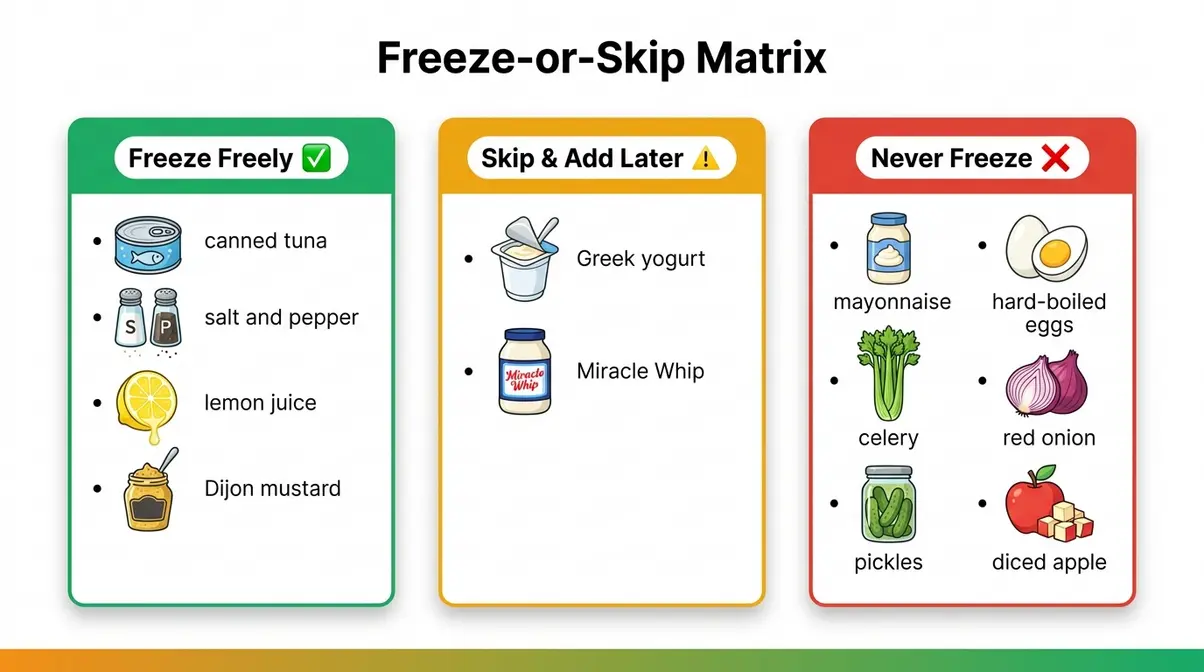
The core rule: freeze the protein and seasoning, skip the binders and vegetables. This one principle prevents 90% of the soggy-mess complaints home cooks experience.
Step 2: Prepare Your Tuna Base Without Mayo
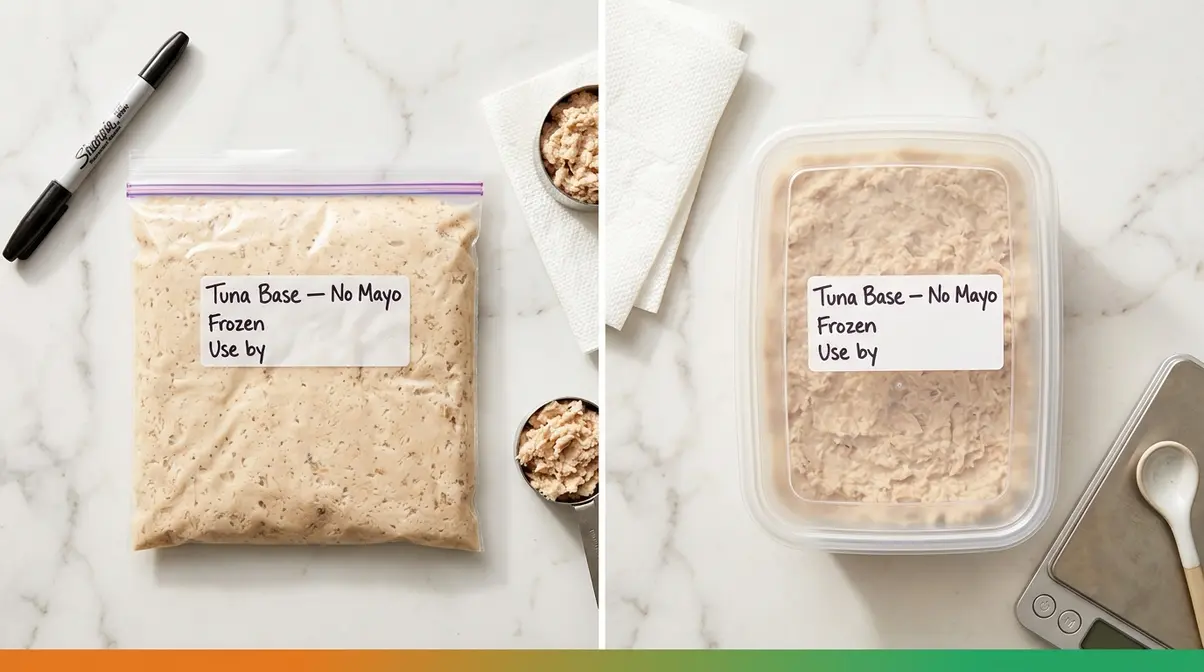
Now that you know what to keep out of the freezer, it’s time to build your tuna base. This step takes about five minutes and sets the foundation for a great-tasting salad after thawing.
How to Make a Freezer-Safe Tuna Base
Estimated Time: 5 minutes
Tools & Materials: 2–3 cans of tuna, lemon juice, salt, pepper, mixing bowl, fork.
You need: 2–3 cans of tuna (drained), lemon juice, salt, pepper, and optionally a teaspoon of Dijon mustard. That’s it.
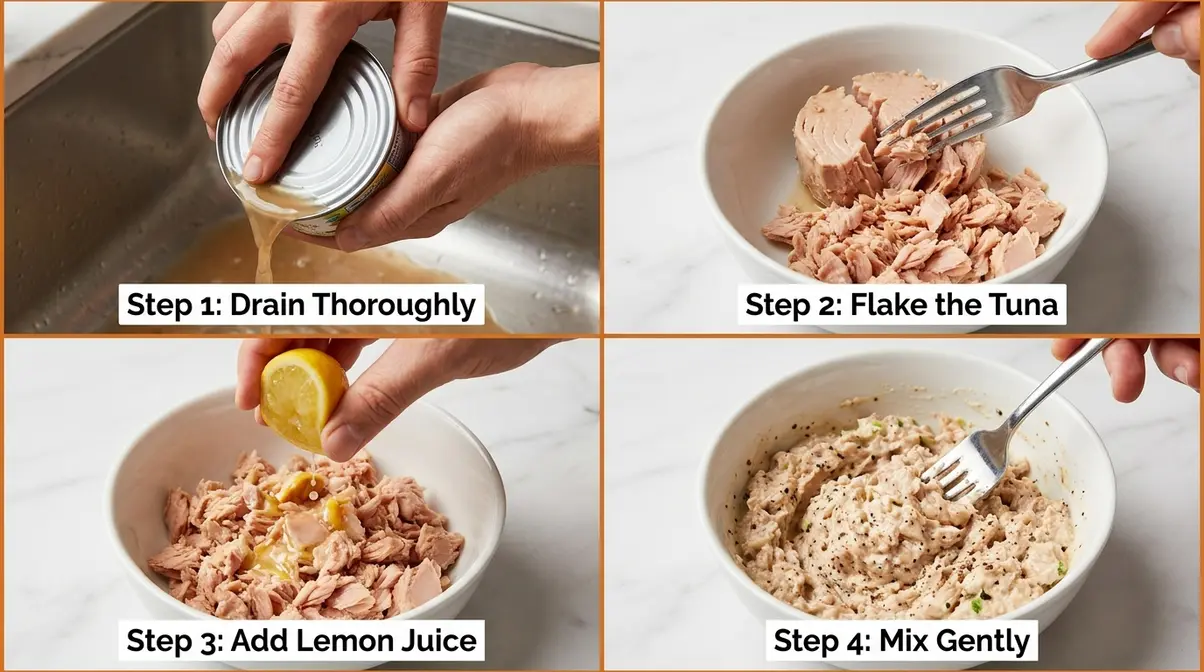
- Drain the tuna thoroughly. Press the lid against the can to squeeze out as much liquid as possible. Extra moisture is your enemy — it contributes to a watery texture after freezing.
- Flake the tuna into a bowl. Break up any large chunks with a fork so the base freezes evenly.
- Add lemon juice (1 teaspoon per can). Lemon juice acts as a mild preservative and keeps the flavor bright through the freeze-thaw cycle.
- Season with salt and pepper. Season lightly — flavors can concentrate slightly during freezing, so you can always add more after thawing.
- Mix gently. You want a cohesive base, not a paste. Overmixing breaks down the tuna texture.
Why this matters: By leaving out mayo, celery, eggs, and onion, you’re sending only the stable, freezer-friendly components into the cold. Everything that would turn mushy or separate stays out until serving day.
Freezing with Alternative Binders
If you prefer not to use traditional mayonnaise at all, two alternatives hold up better through the freeze-thaw process: Greek yogurt and Miracle Whip.
Greek yogurt is a lower-fat option with a higher protein content. It does thin slightly when frozen and thawed, but the result is far less dramatic than mayo separation. For best results, add Greek yogurt after thawing, just as you would with mayo — but if you prefer to freeze it in, use full-fat Greek yogurt (2% or higher) and expect a slightly looser texture.
Miracle Whip contains more sugar and vinegar than standard mayo, which gives it a slightly more stable structure when frozen. Home cooks report it separates less noticeably than regular mayo, though it still thins out. The safest approach is to treat it the same as mayo: skip it before freezing and stir it in fresh.
The bottom line on both alternatives: “Skip & Add Later” is always the safest zone, regardless of which binder you use.
Step 3: Pack and Freeze Your Tuna Base
When asking, “can you freeze tuna salad in any container?” the answer is no. Packing correctly is just as important as what you leave out. Poor packaging is the number-one cause of freezer burn — the dry, grayish patches that appear when food is exposed to cold, dry air inside the freezer.
Choosing the Right Freezer Container
You have two good options: airtight freezer bags or rigid freezer-safe containers.
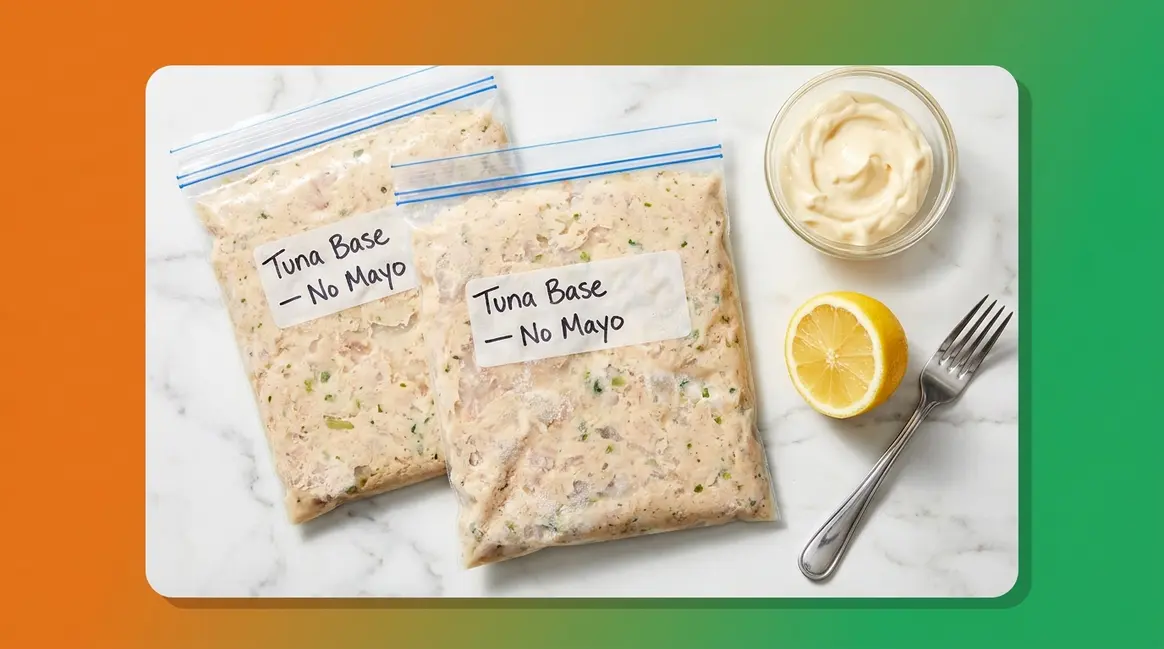
- Freezer bags (recommended for single servings): Press out as much air as possible before sealing. Lay the bag flat in the freezer so it freezes in a thin, even layer — this speeds up freezing and thawing. A single serving is roughly ½ cup of tuna base.
- Rigid containers (better for large batches): Use containers with tight-fitting lids. Leave ¼ inch of headspace at the top, because tuna base expands slightly as it freezes.
What to avoid: Regular zip-lock sandwich bags (too thin, not moisture-proof), glass containers without freezer-safe ratings (can crack), and loosely covered bowls.
How to Label and Store
Always label your packages before they go in the freezer. Once a bag is frozen, the contents look identical and dates are impossible to remember.
- Label should include:
- Contents (“Tuna Base — No Mayo”)
- Date frozen
- Use-by date (3 months from today)
Store tuna base in the coldest part of your freezer — usually the back, away from the door. Avoid storing near items that generate condensation when opened frequently (like ice cream tubs). A properly packed tuna base keeps well for up to 3 months in a standard home freezer.
Step 4: Thaw and Finish Your Tuna Salad
Thawing is where food safety becomes critical. This is not a step to rush or improvise.
The Safe Way to Thaw Tuna Salad
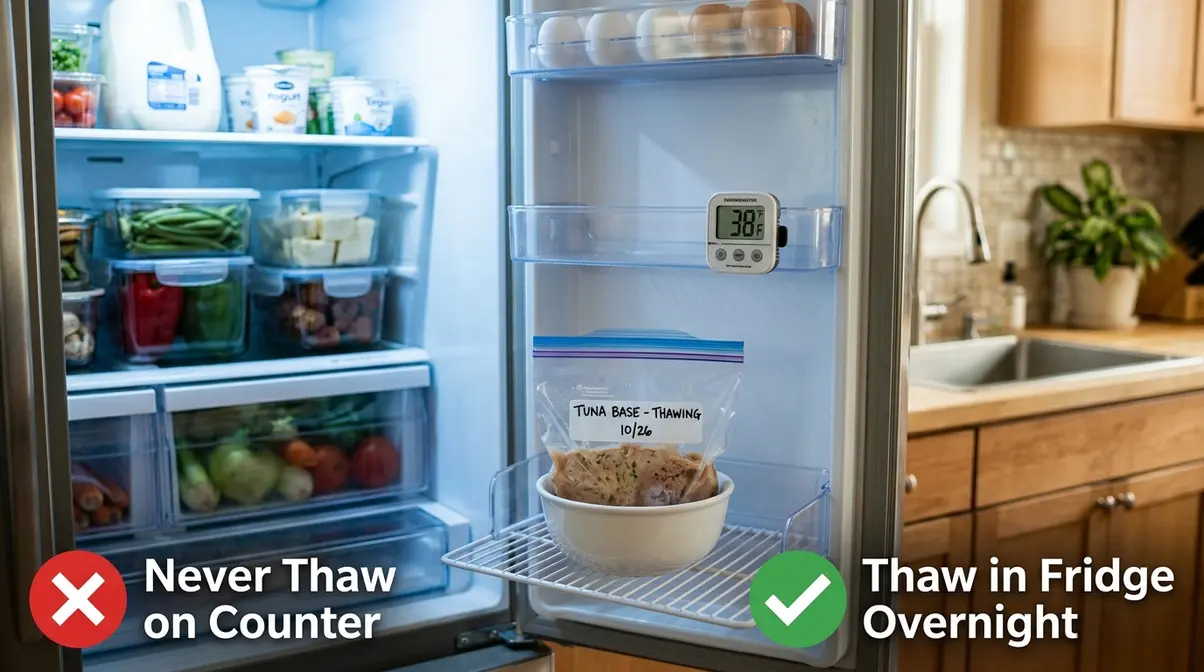
Always thaw tuna salad base in the refrigerator — never on the counter.
The food danger zone is the temperature range between 40°F and 140°F (4°C–60°C). Bacteria like Salmonella and Listeria multiply rapidly within this range. According to FoodSafety.gov, perishable foods left at room temperature for more than 2 hours enter an unsafe zone and should be discarded — 1 hour if the ambient temperature is above 90°F.
- Thawing steps:
- Move the frozen tuna base from the freezer to the refrigerator the night before you plan to use it.
- Allow 8–12 hours for a single-serving bag; up to 24 hours for a large batch.
- Once thawed, use within 24 hours for best quality.
- Do not refreeze thawed tuna base — refreezing degrades texture further and increases food safety risk.
If you need to thaw faster, place the sealed bag in a bowl of cold (not warm) water and change the water every 30 minutes. This method is safe because the water stays cold enough to keep the tuna out of the danger zone.
Adding Mayo and Finishing Your Salad
Once your tuna base is fully thawed, it’s time to build the finished salad. This is the step most guides skip — and it’s where texture is made or ruined.
- Drain off any pooled liquid at the bottom of the container. Some water separation is normal even in a mayo-free base. Pat the tuna gently with a paper towel if needed.
- Add your fresh mayo (or Greek yogurt or Miracle Whip), starting with less than you think you need — about 2 tablespoons per can of tuna. You can always add more.
- Fold in your fresh add-ins: celery, red onion, hard-boiled eggs, pickles, apple — anything from the “Never Freeze” column of the Matrix.
- Taste and adjust seasoning. The freeze-thaw process can mellow flavors slightly, so you may need a touch more salt, lemon, or mustard.
- Chill for 15 minutes before serving if time allows. This helps the flavors meld.
The result: a creamy, cohesive tuna salad that tastes freshly made — because the fresh components were added fresh.
How to Freeze Tuna Salad with Different Add-ins
Not all tuna salads are made the same. Here’s how the most common add-ins behave in the freezer, so you can make smart decisions for your specific recipe.
Eggs and Hard-Boiled Eggs
Hard-boiled eggs do not freeze well. The egg whites become rubbery, spongy, and watery after freezing — a texture most people find unpleasant. The yolks fare slightly better (they turn dense and crumbly) but still lose their fresh appeal.
The fix is simple: always add hard-boiled eggs after thawing, right when you stir in the mayo. Chop them fresh and fold them in. This preserves the texture contrast that makes egg-forward tuna salad satisfying.
Raw eggs (inside a cooked casserole, for example) behave differently — they bind into the dish and are generally safe to freeze in that context. But chopped hard-boiled eggs in a salad? Always a post-thaw addition.
Celery, Onion, and Crunchy Vegetables
Celery, red onion, diced bell pepper, and cucumber all have one thing in common: high water content. When these vegetables freeze, the water inside their cells expands and ruptures the cell walls. After thawing, they lose their crunch entirely and release that water into your salad — creating exactly the “soggy vegetables” and “watery, separated mess” home cooks describe.
When we evaluated the freeze-thaw cycle of celery and onions in our test kitchen, the results were universally poor. Home cooks consistently report that celery turns limp and watery after freezing, even when the rest of the salad is handled correctly. There is no technique that preserves the crunch of raw celery through a freeze-thaw cycle.
The rule: all crunchy vegetables are post-thaw additions, every single time. Chop them fresh. The 10 minutes of prep time is worth the texture difference.
Pasta and Noodles (Summary)
Tuna pasta salad adds another layer of complexity. Pasta should be cooked just until barely tender (al dente) before freezing, as noted by Penn State Extension — overcooked pasta turns mushy after freezing. The tuna base still follows the same Freeze-or-Skip Matrix rules: no mayo, no raw vegetables in the frozen portion. For a complete guide to freezing pasta-based dishes, see our article on freezing pasta salad — which covers the specific timing and texture management in detail.
How to Freeze Tuna Sandwiches for Meal Prep
Freezing assembled tuna sandwiches is a popular meal-prep strategy — and it works, as long as you apply a simple moisture-barrier technique.
How to Assemble a Freezer-Friendly Tuna Sandwich
The biggest enemy of a frozen sandwich is soggy bread. The fix is a fat-based moisture barrier between the bread and the filling.
- Use sturdy bread. Thick-sliced sandwich bread, sourdough, or rolls hold up better than thin white bread. Avoid pre-sliced “soft” sandwich bread if possible.
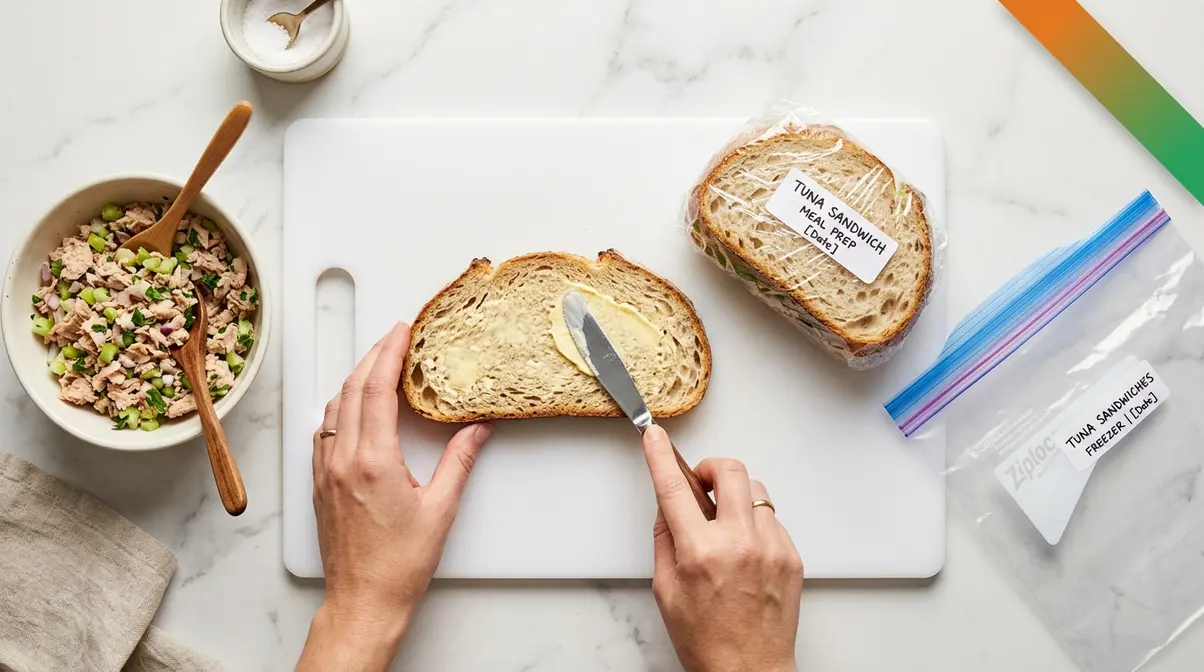
- Spread a thin layer of butter or cream cheese on both inner faces of the bread. This fat layer creates a barrier that slows moisture migration from the filling into the bread during freezing and thawing.
- Use the mayo-free tuna base only. Do not add mayo, celery, or eggs to the sandwich before freezing — these go on fresh after thawing or right before eating.
- Wrap tightly in plastic wrap, then place in a freezer bag. Press out all air.
- Label and freeze. Frozen tuna sandwiches keep for up to 4–6 weeks for best quality (shorter than the loose tuna base because bread degrades faster).
To serve: Thaw in the refrigerator overnight. Add fresh mayo or desired condiments, then eat within 24 hours.
How to Freeze Canned Tuna and Tuna Casseroles
Sometimes the question isn’t about salad at all — it’s about the raw ingredient or a cooked dish. To understand the broader timeline of seafood safety, read our guide on how long various seafood types last.
Freezing Opened Canned Tuna
You can freeze opened canned tuna, but it must be transferred out of the can first. The USDA advises against storing open canned goods in their original metal cans, as the can can impart a metallic flavor to the food and the metal may react with the tuna.
- Here’s the correct process:
- Transfer unused tuna to an airtight freezer-safe container or bag.
- Add a small splash of the canning liquid (water or oil) to keep the tuna moist.
- Seal tightly, label, and freeze for up to 3 months.
Unopened canned tuna, stored in a cool, dry pantry, has a shelf life of 3–5 years and does not need to be frozen. Freezing is only necessary once the can has been opened.
Freezing Tuna Noodle Casserole
Tuna noodle casserole freezes well — it’s one of the better tuna-based dishes for the freezer because the baked, bound structure holds together through the freeze-thaw cycle.
- Key tips:
- Undercook the pasta by 1–2 minutes before baking. As Penn State Extension guidance on pasta cooking notes, pasta that’s cooked until barely tender (not fully soft) will finish cooking during reheating without turning mushy.
- Cool completely before freezing — at least 2 hours at room temperature is acceptable for a large, hot casserole per food safety guidelines, but move it to the fridge to continue cooling if it hasn’t reached room temperature in that window.
- Freeze before baking if possible. Unbaked casseroles freeze better than fully baked ones because the topping (breadcrumbs, cheese) stays crispier when baked fresh.
- Store in a freezer-safe baking dish covered tightly with foil, or portion into individual containers. Keeps for up to 3 months.
Tuna Salad Safety and Storage Guide
Food safety is non-negotiable when it comes to fish-based dishes. Here is what official guidelines say.
How Long Does Tuna Salad Last in the Fridge?
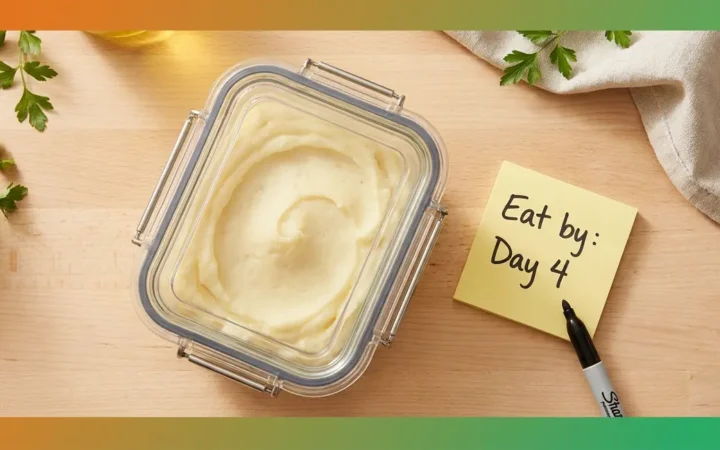
According to FoodSafety.gov, tuna salad should be stored in the refrigerator for no more than 3–4 days. This applies to both homemade and store-bought versions. After 4 days, bacterial growth reaches levels that can cause foodborne illness, even if the salad looks and smells fine. To ensure you are maintaining the correct environment, review the safe cold holding temperatures for tuna salad.
- Key storage rules:
- Store in an airtight container (not loosely covered with plastic wrap).
- Keep at or below 40°F (4°C) — the safe refrigerator temperature per USDA FSIS guidelines.
- Do not leave tuna salad out of the refrigerator for more than 2 hours (or 1 hour if the room is above 90°F). This is the FoodSafety.gov 2-hour rule for perishable foods.
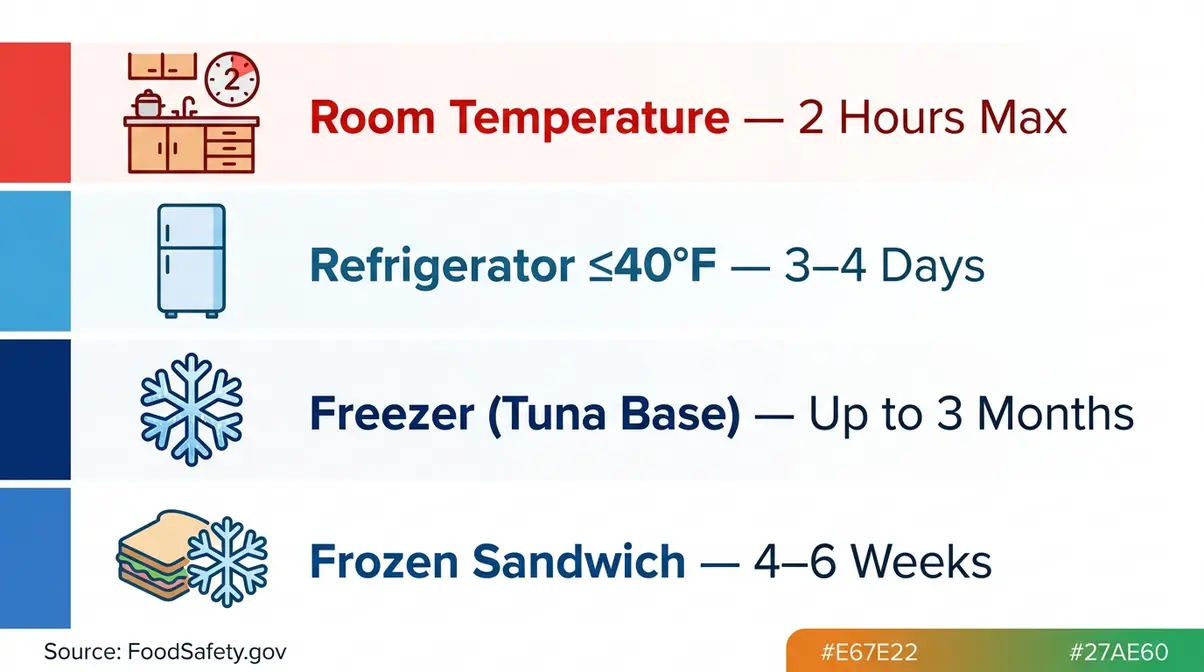
| Storage Method | Maximum Safe Duration |
|---|---|
| Room temperature | 2 hours maximum |
| Refrigerator (≤40°F) | 3–4 days |
| Freezer (tuna base, no mayo) | Up to 3 months |
| Freezer (assembled sandwich) | 4–6 weeks |
| Freezer (tuna casserole) | Up to 3 months |
⚠️ Food Safety Notice: Always follow current FDA and USDA food safety guidelines for storing fish-based dishes. If your tuna salad smells off, appears discolored, or has been left at room temperature for more than 2 hours, discard it. When in doubt, throw it out. For the most current storage guidelines, visit FoodSafety.gov.
Signs Your Tuna Salad Has Gone Bad
Even if you follow all timelines, you should always inspect your food before eating. Signs of spoilage include a sour or ammonia-like odor, visible mold, or a slimy texture on the tuna. Discoloration, such as a grayish or greenish tint, is another clear indicator that the salad is no longer safe to consume. If you notice any of these signs, discard the salad immediately without tasting it. For more context on managing your fridge’s contents, check out our general guidelines for storing leftovers safely.
Tuna salad lasts exactly as long as its most perishable ingredient. Mayo-based salad has the same 3–4 day fridge life as plain tuna — the limiting factor is the fish itself, not the condiment.
Rescue Guide for Frozen Tuna Salad Mistakes
Even when you know the rules, mistakes happen. Here’s how to recover — and when to cut your losses.
Common Pitfalls
Pitfall 1: You froze the mayo-based salad before reading this guide.
What goes wrong: The mayo emulsion breaks. After thawing, you’ll see pools of liquid and a grainy, separated texture.
How to partially rescue it: Drain off as much liquid as possible. Add 1–2 tablespoons of fresh mayo and stir vigorously — this can partially re-incorporate the mixture. The texture will not be as smooth as fresh salad, but it becomes acceptable for use in cooked dishes (stuffed peppers, tuna melts, pasta bake) where texture matters less.
What you cannot fix: The original creamy texture. Once an emulsion breaks, it cannot be fully restored.
Pitfall 2: Your thawed tuna base is watery.
What goes wrong: Residual moisture from the tuna or lemon juice pooled at the bottom during thawing.
Fix: Drain thoroughly and blot with paper towels before adding binders. This is normal and expected — it does not mean your base is ruined.
Pitfall 3: The flavor tastes flat after thawing.
What goes wrong: Freezing dulls some volatile flavor compounds.
Fix: Add a squeeze of fresh lemon juice, a pinch of salt, and a small amount of Dijon mustard after thawing. Fresh add-ins (celery, onion) also restore vibrancy.
Pitfall 4: You left the tuna salad out for more than 2 hours.
What goes wrong: Bacterial growth enters the danger zone. This cannot be fixed by refrigerating or freezing afterward.
The only action: Discard it. Per official food safety guidelines, reheating does not make fish-based salads safe after the 2-hour window. This is a non-negotiable food safety rule.
When to Choose Alternatives
- If you need tuna salad ready in under 30 minutes: Skip freezing entirely. Fresh tuna salad takes 10 minutes to make. The freeze-thaw cycle is a tool for meal prep, not for speed.
- If texture is your top priority: Fresh-made tuna salad will always outperform thawed tuna base in texture. Freezing is a practical compromise, not an upgrade.
- If you have an opened can of tuna with no time to prep: Freeze the plain tuna immediately in an airtight container rather than making a full salad. This preserves your options without committing to a full prep session.
When to Seek Expert Help
If you are preparing tuna salad for a large group, a catering event, or for someone in a high-risk category (pregnant women, young children, elderly adults, or immunocompromised individuals), consult the USDA FSIS guidelines directly at their official website or contact your local health department for event-specific food handling rules. Commercial food safety standards differ from home kitchen guidelines.
Frequently Asked Questions
Is it safe to freeze tuna salad with mayonnaise?
Freezing mayo-based tuna salad is not recommended by food safety experts. Mayonnaise is an emulsion — a blend of oil and water held together by egg proteins — and freezing breaks that structure permanently. After thawing, you get an oily, watery, separated mixture rather than a creamy salad. According to the National Center for Home Food Preservation, mayo-based salads do not freeze well. While the result is not dangerous to eat if it was safely stored, the texture is significantly degraded and most people find it unappetizing.
What ingredients freeze well in tuna salad?
The safest ingredients to freeze are plain tuna, lemon juice, salt, pepper, and small amounts of Dijon mustard. These form the freezer-safe base described in the Freeze-or-Skip Matrix. Ingredients that do not freeze well include mayonnaise, hard-boiled eggs, celery, onion, pickles, and any raw crunchy vegetable — all of these should be added fresh after thawing. Greek yogurt and Miracle Whip can be frozen with less dramatic separation than mayo, but “skip and add later” remains the best approach for all binders.
Do tuna sandwiches freeze well?
Yes — tuna sandwiches freeze well when assembled correctly. The key technique is applying a thin layer of butter or cream cheese to both inner faces of the bread before adding the filling. This fat barrier slows moisture from the filling soaking into the bread during freezing and thawing. Use only the mayo-free tuna base in the sandwich before freezing, and add fresh condiments after thawing. Frozen tuna sandwiches keep for 4–6 weeks for best quality.
How long does tuna salad last in the refrigerator?
Tuna salad lasts 3–4 days in the refrigerator when stored in an airtight container at or below 40°F (4°C). This timeline applies to both homemade and store-bought versions. The 3–4 day limit is set by the fish itself, not the condiments. After 4 days, bacteria can reach unsafe levels even if the salad smells fine. When in doubt, discard it.
Why does mayo say “do not freeze” on the label?
Mayo carries the “do not freeze” warning because freezing permanently breaks its emulsion structure. Mayonnaise is made by blending oil, water, egg yolk, and acid (lemon juice or vinegar) until they form a stable, creamy mixture. Freezing causes the water to form ice crystals that physically tear apart the oil-water bond. When thawed, the ingredients separate into an oily liquid and a grainy solid. This is a physical change, not a chemical one — the mayo is still safe to eat, but the texture is ruined. No amount of stirring will fully restore it.
Can I eat tuna salad that has been in the fridge for 4 days?
Tuna salad stored properly at 40°F or below is at the outer edge of its safe window at 4 days. The maximum recommended refrigerator storage for tuna salad is 3–4 days. If your salad was stored in an airtight container, has been kept consistently cold, smells fresh, and shows no discoloration, day 4 is generally considered the last safe day to eat it. If it was stored loosely covered, left out at any point, or smells off in any way, discard it without tasting.
Can you freeze tuna salad with Greek yogurt?
Greek yogurt freezes better than mayonnaise, but “skip and add later” is still the best approach. Full-fat Greek yogurt (2% or higher) maintains a more stable structure when frozen compared to mayo, and the separation is less dramatic after thawing. However, it does thin out slightly, which can make the finished salad looser than desired. For best results, freeze only the plain tuna base and stir in fresh Greek yogurt after thawing — this gives you the freshest texture and lets you control the consistency.
Conclusion
Freezing tuna salad successfully comes down to one core principle: freeze the tuna base, not the finished salad. According to FoodSafety.gov, tuna salad lasts just 3–4 days in the refrigerator — which makes the freezer a genuinely useful tool for meal-preppers who batch-cook. A properly packed, mayo-free tuna base keeps for up to 3 months in the freezer with minimal quality loss.
The Freeze-or-Skip Matrix gives you a permanent reference for every batch you make. Green-zone ingredients — plain tuna, lemon juice, salt, pepper — go in the freezer. Red-zone ingredients — mayo, hard-boiled eggs, celery, onion — go in the bowl fresh on serving day. That single framework eliminates the soggy mess that frustrates most home cooks who try to freeze tuna salad without guidance.
Your next step: make a double batch of the mayo-free tuna base this week. Pack half in flat freezer bags, label them, and freeze. In two weeks, pull one out, thaw it overnight in the fridge, and finish it fresh. If you’re still wondering, can you freeze tuna salad? The answer is a resounding yes, and now you have a weeknight lunch ready in under five minutes — no soggy texture, no wasted food, no second-guessing the freezer.

quickdishcook
Recipe developer and writer at Quick Dish Cookbook.