
⚠️ Nutritional Disclaimer: The calorie and nutritional data in this article is for informational purposes only and does not constitute medical or dietary advice. Individual kebab calorie counts vary by restaurant, portion size, and preparation. Always consult a registered dietitian or qualified healthcare professional before making significant dietary changes, especially if you have a medical condition such as diabetes.
What’s in this guide
- Shish Kebab vs Doner Kebab: Calorie & Macro Comparison
- What Is Shish Kebab and How Many Calories Does It Contain?
- What Is Doner Kebab and How Many Calories Does It Contain?
- Shish Kebab vs Doner Kebab: Feature-by-Feature Breakdown
- Why Is Doner Kebab So High in Calories?
- Hidden Calorie Add-Ons: Bread, Sauces, and Sides
- Choosing a Kebab for Diabetes and Special Diets
- Who Should Choose Shish Kebab?
- Who Should Choose Doner Kebab?
- How We Evaluated These Kebabs
- Frequently Asked Questions
- Final Recommendation: Shish vs Doner — Winner by Category
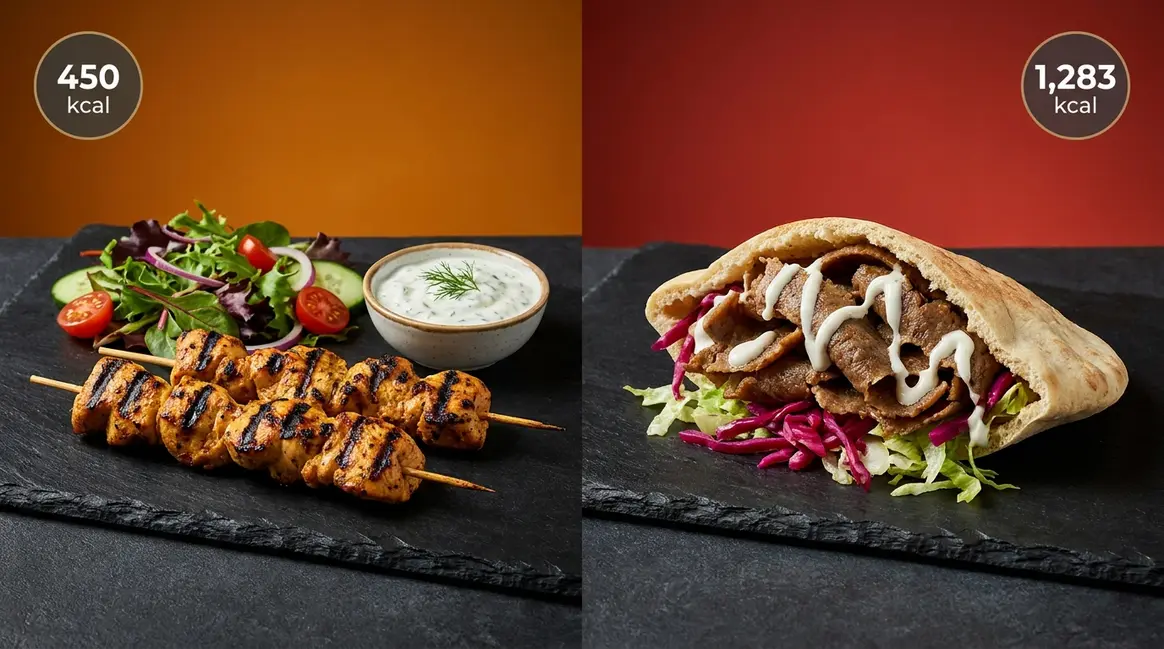
You’re standing at the takeaway counter, the spit-roasted doner glistening on one side and the chargrilled shish skewers on the other. The choice feels simple — but when it comes to shish kebab vs doner kebab calories, one option can carry more than twice the calories of the other. Most people assume a kebab is just a kebab. The reality? A full lamb doner with pitta and garlic mayo can stack up to 1,283 calories (Nesta/Food Standards Scotland data, 2025) — and that’s before you’ve even thought about chips.
Quick Verdict: Shish kebab wins for calorie control and weight management — a grilled chicken shish with salad averages 450–550 kcal. Doner kebab is higher in calories and fat but offers richer flavour and is more widely available. The key difference: shish uses whole-muscle grilled meat; doner uses processed, spit-roasted meat that bastes in its own fat. Full calorie breakdown and ordering templates are below.
By the end of this guide, you’ll know the exact calorie difference between every major kebab type, which option fits your health goal, and how to order a healthier kebab at any takeaway. We cover calorie data, fat content, diabetes-friendly options, and five ordering templates — all backed by NHS and government nutrition sources.
Key Takeaways: Shish Kebab vs Doner Kebab Calories
Shish kebab vs doner kebab calories differ dramatically: a chicken shish averages 450–550 kcal per serving — roughly half the calories of a full lamb doner with pitta and sauce (up to 1,283 kcal, per Nesta/Food Standards Scotland, 2025).
- Calories: Shish = ~450–550 kcal | Doner = ~900–1,283 kcal (with bread and sauce)
- Fat: Doner meat averages 2–3× the fat of whole-muscle shish cuts per 100g
- Healthiest choice: Chicken shish, no pitta, yogurt sauce — the lowest-calorie takeaway option
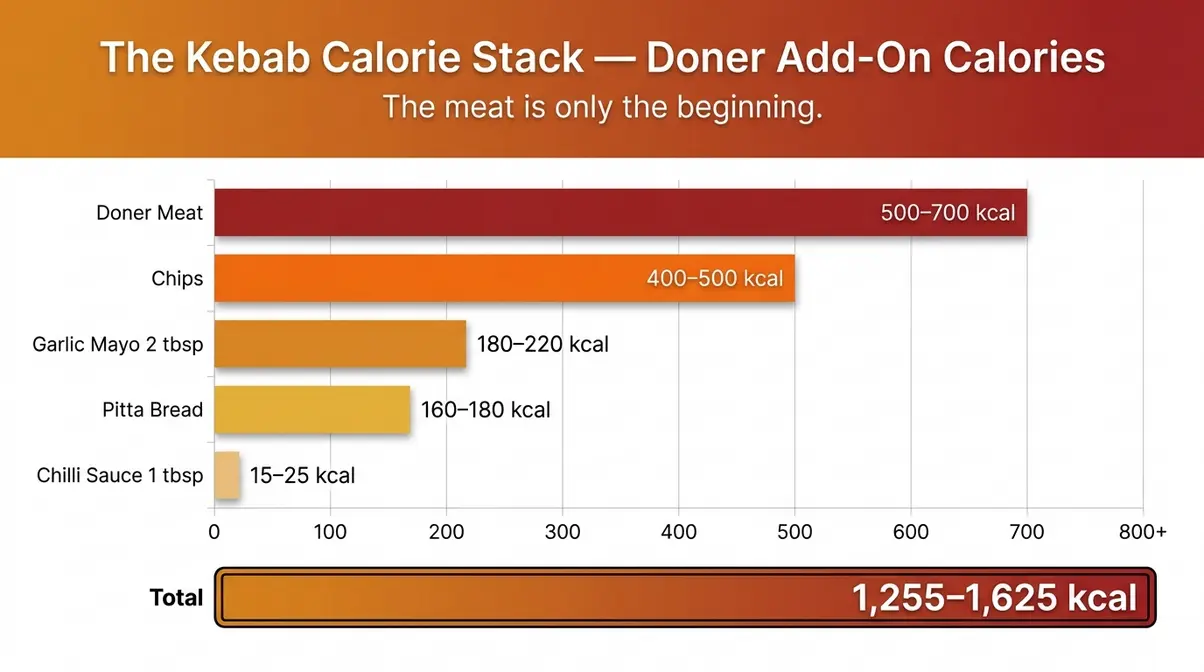
- The Kebab Calorie Stack: A doner’s true calorie count triples once bread, garlic mayo, and chips are added — this is the concept that changes how you order
- For diabetics: Grilled chicken or lamb shish without pitta is the safest option (always consult your diabetes care team first)
Shish Kebab vs Doner Kebab: Calorie & Macro Comparison
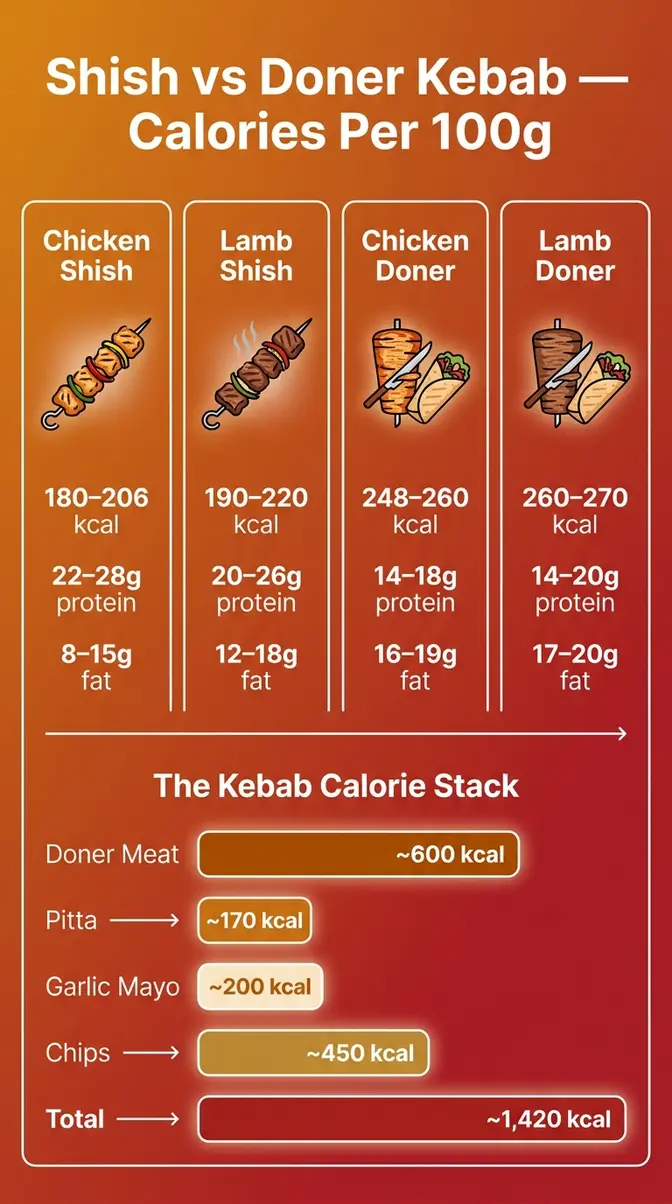
The main difference between shish kebab and doner kebab calories is significant. Shish kebab uses whole-muscle grilled meat averaging around 180–206 kcal per 100g (USDA FoodData Central via Nutridex, 2026), while doner kebab uses processed spit-roasted meat averaging around 248–270 kcal per 100g (Nutracheck, 2026). Add pitta and sauces, and a full doner meal can exceed 1,283 kcal (Nesta/Food Standards Scotland, 2025) — more than half an average adult’s recommended daily energy intake in a single sitting.
This is where “The Kebab Calorie Stack” comes in. A doner kebab’s true calorie count is not just the meat in isolation — it is the cumulative stack of meat + bread + sauce + sides. Adding pitta (~160–180 kcal), two tablespoons of garlic mayo (~180–220 kcal), and a portion of chips (~400–500 kcal) to a lamb doner can push a single meal well past 1,800 kcal. Understanding the stack — not just the meat — is the single most useful insight you can take away from this comparison.
For a fuller picture, the table below compares shish and doner across the metrics that matter most. Macronutrients (the protein, fat, and carbohydrates in your food) are shown per 100g — a standardised way to compare foods fairly, regardless of portion size.
| Feature | Shish Kebab | Doner Kebab |
|---|---|---|
| Calories per 100g (meat only) | ~180–206 kcal | ~248–270 kcal |
| Calories — chicken variant (serving) | ~450–550 kcal | ~750–900 kcal |
| Calories — lamb variant (serving) | ~500–650 kcal | ~900–1,283 kcal |
| Total fat per 100g | ~8–15g | ~16–20g |
| Saturated fat per 100g | ~2–4g | ~6–10g |
| Protein per 100g | ~22–28g | ~14–20g |
| Carbohydrates (meat only) | ~0–2g | ~0–3g |
| Carbohydrates (with pitta) | ~40–50g | ~55–70g |
| Sodium per serving | ~600–900mg | ~1,500–2,800mg |
| Meat type | Whole-muscle cuts (chicken breast, lamb leg) | Processed minced/compressed meat (lamb, chicken, or mixed) |
| Cooking method | Chargrilled on skewers | Spit-roasted on a vertical rotisserie |
| Best for | Calorie control, high protein, weight loss | Flavour, protein density, availability |
“A standard lamb doner kebab with pitta and sauces contains approximately 1,283 calories — more than half the average adult’s daily energy intake in a single meal” (Nesta/Food Standards Scotland, 2025).
For a deeper breakdown of how these figures were compiled, see the healthier kebab comparison guide at quickdishcookbook.com.
What Is Shish Kebab and How Many Calories Does It Contain?
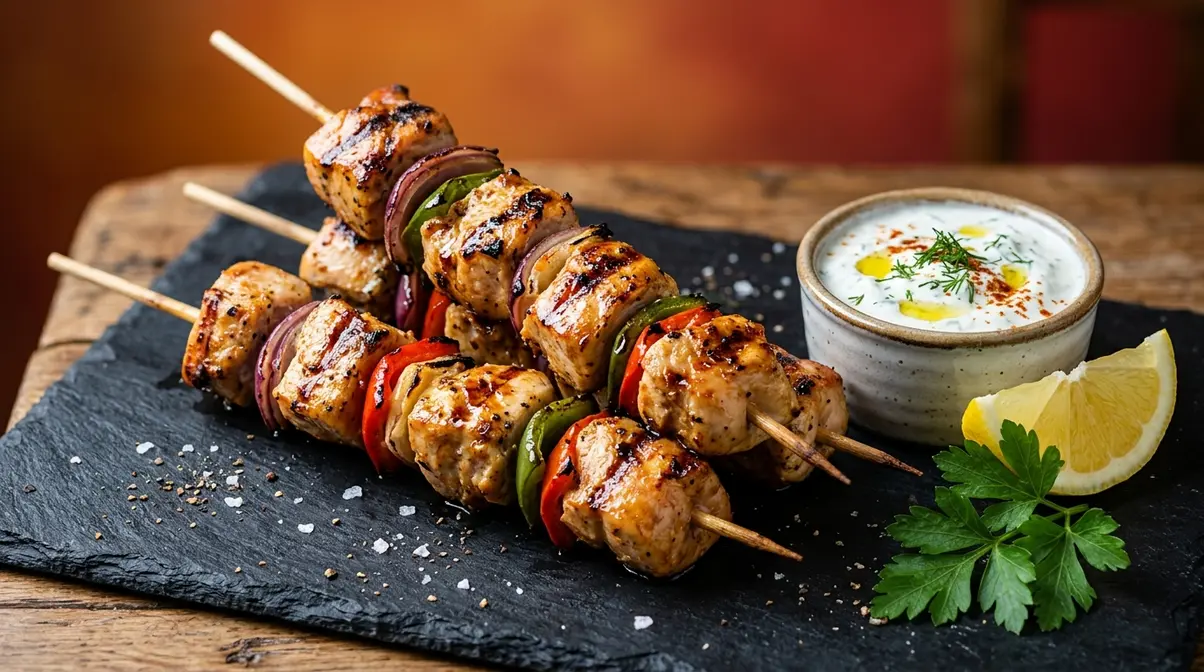
What Is Shish Kebab?
Shish kebab is a dish made from whole-muscle cuts of meat — typically chicken breast or lamb leg — marinated and threaded onto skewers, then cooked directly over a charcoal or gas grill. Because it uses intact muscle rather than processed or minced meat, it retains a leaner fat profile. The word “shish” comes from the Turkish word for skewer. You get the char-grilled flavour without the processed fat content that comes with doner meat.
Shish Kebab Calories and Macros
Nutritional data from USDA FoodData Central (via Nutridex, 2026) puts shish kebab meat at around 206 kcal per 100g. A typical serving of grilled chicken shish — around 200–250g of meat — comes to approximately 450–550 kcal before any bread or sauce. Lamb shish runs slightly higher, at roughly 500–650 kcal per serving, due to the naturally higher fat content in lamb compared to chicken breast.
Protein is where shish genuinely shines. Whole-muscle chicken breast delivers around 22–28g of protein per 100g — significantly more than doner meat per equivalent weight. Saturated fat (the type linked to heart disease) is also much lower: roughly 2–4g per 100g versus 6–10g in doner. For anyone tracking macros, this is a meaningful difference.
| Shish Variant | Calories (meat, ~200g serving) | Protein | Fat |
|---|---|---|---|
| Chicken shish | ~450–550 kcal | ~44–56g | ~16–30g |
| Lamb shish | ~500–650 kcal | ~40–52g | ~24–40g |
| Chicken shish + pitta | ~610–730 kcal | ~46–58g | ~17–32g |
| Lamb shish + pitta | ~660–830 kcal | ~42–54g | ~25–42g |
Best For
Grilled chicken shish is the healthiest option at a takeaway for people focused on weight management, high protein intake, or keeping calories in check. It is also the option most consistently recommended by NHS trusts for people with diabetes or those trying to reduce their fat intake (Cambridge University Hospitals NHS, 2026).
What Is Doner Kebab and How Many Calories Does It Contain?
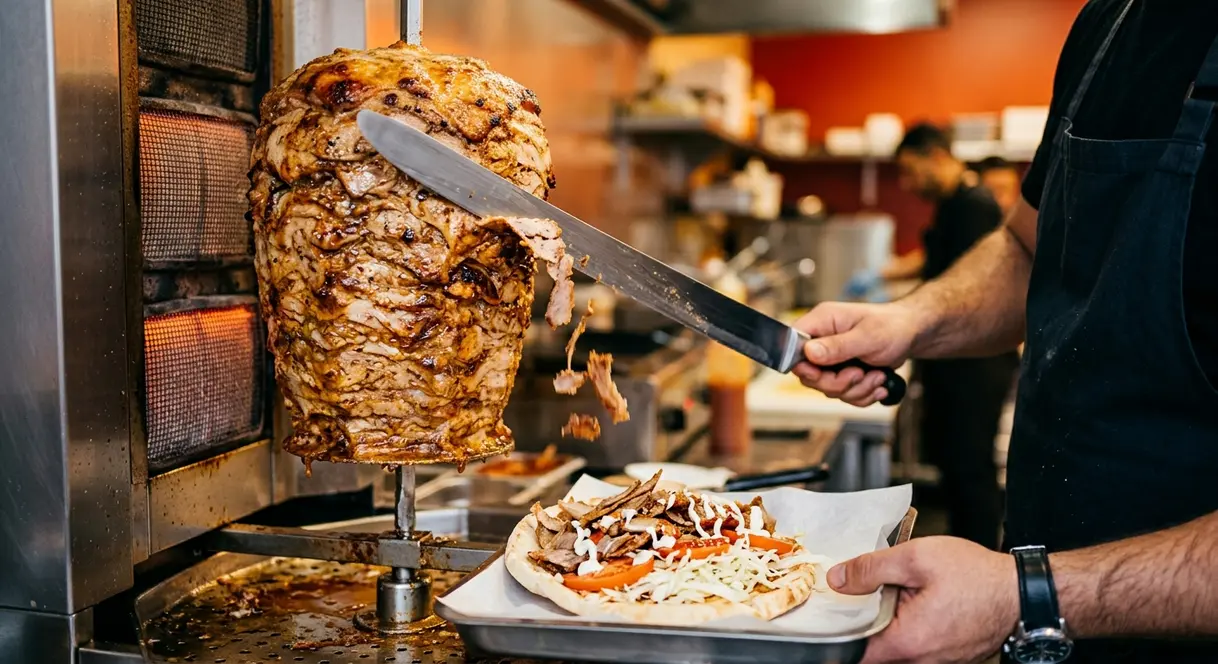
What Is Doner Kebab?
Doner kebab is made from seasoned, compressed minced or ground meat — most commonly lamb, chicken, or a mixture — formed into a large cone shape and cooked on a vertical rotating spit (rotisserie). As it cooks, the outer layer bastes continuously in the fat that renders from the meat above it. The result is richly flavoured, widely available, and genuinely satisfying — but also significantly higher in fat and calories than shish.
Doner Kebab Calories and Macros
The calorie picture for doner is eye-opening. Nutritional data from Nutracheck (2026) puts doner kebab in pitta at around 248 kcal per 100g — but that figure is for the combined pitta-and-meat portion. The meat alone averages 250–270 kcal per 100g, with some samples reaching higher depending on fat content and preparation.
“A doner kebab with sauce can contain around 1,005 calories with a whopping 57g of fat and 4.5g of salt.”
Research by Nesta and Food Standards Scotland (2025) found the average doner kebab served in Scottish takeaways contained 1,283 calories — 64% of the recommended daily amount for an adult woman — along with 50% more saturated fat than the recommended daily limit. Sodium levels were also alarming: doner kebabs averaged 7.7g of salt per portion, which is 28% above the NHS-recommended maximum of 6g per day (Food Standards Scotland, 2026).
| Doner Variant | Calories (serving, with pitta) | Fat | Salt |
|---|---|---|---|
| Chicken doner + pitta | ~750–900 kcal | ~30–45g | ~3–5g |
| Lamb doner + pitta | ~900–1,283 kcal | ~45–64g | ~4–7.7g |
| Lamb doner + pitta + garlic mayo | ~1,080–1,500 kcal | ~55–80g | ~4.5–8g |
| Lamb doner + pitta + garlic mayo + chips | ~1,480–2,000+ kcal | ~70–100g+ | ~5.5–10g |
Best For
Doner kebab has genuine strengths: it is protein-dense (around 14–20g per 100g), widely available at virtually every takeaway, and delivers rich, satisfying flavour that keeps you full. For most people, it is best enjoyed occasionally and with thoughtful customisation — swapping garlic mayo for yogurt sauce and skipping chips makes a meaningful calorie difference.
Shish Kebab vs Doner Kebab: Feature-by-Feature Breakdown
Calories
Shish kebab wins the calorie comparison clearly. At around 180–206 kcal per 100g of meat (USDA/Nutridex, 2026), it contains roughly 30–40% fewer calories than doner meat per equivalent weight. For a full serving, the gap widens: a chicken shish with salad sits around 450–550 kcal, while a chicken doner in pitta typically reaches 750–900 kcal. Lamb doner with full accompaniments can push past 1,283 kcal (Nesta/Food Standards Scotland, 2025).
The practical implication is straightforward. If your daily calorie target is 1,800–2,000 kcal, a full lamb doner with pitta and sauce accounts for 64–71% of your entire daily intake in one meal. A chicken shish with salad accounts for 22–30%.
Fat
This is where the difference becomes most striking. Doner meat contains roughly 16–20g of total fat per 100g, including 6–10g of saturated fat. Shish kebab meat contains around 8–15g of total fat per 100g, with only 2–4g of saturated fat. Saturated fat is the type most strongly linked to raised LDL cholesterol and cardiovascular disease risk, according to NHS guidance on fat.
A full lamb doner with sauce can deliver 57–64g of fat in a single serving — nearly an entire day’s recommended fat intake for an adult (NHS recommends no more than 70g per day for women, 90g for men). Shocking levels of fat in a single meal, by any standard.
Protein
Both kebab types deliver solid protein. Shish kebab edges ahead on a per-100g basis, at 22–28g of protein versus 14–20g for doner meat. However, doner portions at takeaways tend to be generous — a large doner serving may contain 200–250g of meat, giving a total protein count of 28–50g. Neither option is low in protein. The difference is that shish delivers more protein per calorie, making it the more efficient choice for anyone prioritising lean protein.
Preparation
Cooking method matters more than most people realise. Shish kebab is cooked directly over a high flame or grill, allowing fat to drip away from the meat during cooking. Doner kebab cooks on a vertical spit, where the fat from the upper layers continuously bastes the layers below as it melts. This self-basting process is what creates doner’s characteristic richness — and its higher fat content. The processing step also matters: doner meat is typically mixed with breadcrumbs, spices, and binders before cooking, which can add carbohydrates and sodium that whole-muscle shish does not contain.
Why Is Doner Kebab So High in Calories?
Processed Meat Composition
Doner meat is not a single cut of meat. It is a processed product made from minced or ground lamb, chicken, or a mixture, combined with fat, breadcrumbs, spices, and binders before being compressed and cooked. This processing step means the fat content of the final product is largely determined by how much fat was mixed in during production — and takeaway doner meat is typically made to a rich, flavourful specification. Research from Nesta (2025) found that doner kebabs in Scottish takeaways contained 50% more saturated fat than the recommended daily limit per portion.
The Rotisserie Effect
The vertical spit-roasting method amplifies the fat issue. As the outer layer of the doner cone cooks, the fat from the upper portions melts and runs down the entire cone, continuously coating the meat below. When the outer layer is sliced off and served, it carries all of that accumulated fat with it. This is fundamentally different from grilling, where fat drips away from the meat and is not reabsorbed. The rotisserie method is why doner meat is so juicy and flavourful — but it is also why a portion of doner meat can contain two to three times the fat of an equivalent weight of grilled shish.
Sodium and Saturated Fat
The salt content of doner kebab is a separate concern. Food Standards Scotland (2026) data shows doner kebabs averaging 7.7g of salt per portion — 28% above the NHS recommended maximum of 6g per day. High sodium intake is linked to raised blood pressure and increased risk of stroke and heart disease, according to NHS guidance on salt. The combination of high saturated fat and high sodium makes doner kebab one of the most nutritionally dense takeaway options available — not in a positive sense.
Hidden Calorie Add-Ons: Bread, Sauces, and Sides
The Kebab Calorie Stack is the reason most people underestimate their kebab’s true calorie count. Research and nutritional database data show that the add-ons — not just the meat — are where the real calorie damage happens. Most people think of their kebab calories as “the meat.” The reality is that a full doner meal with all the extras can easily reach 1,800–2,000 kcal before you’ve considered a drink.
Pitta Bread
A standard medium white pitta (approximately 57–65g) contains around 145–180 kcal (Tesco nutritional data, 2026; KimEcopak, 2026). That might sound modest on its own — but it adds roughly 30–40g of refined carbohydrates to your meal. Wholemeal pitta is a better choice if available: it has a similar calorie count but more fibre, which slows digestion and helps you feel fuller for longer. Skipping the pitta entirely and asking for your shish or doner with extra salad instead saves 145–180 kcal and significantly reduces the carbohydrate load.
Sauces
This is where many people are genuinely surprised. A single tablespoon of regular garlic mayonnaise contains approximately 90–110 kcal (EatHealthy365, 2025). Most takeaways apply two to three tablespoons generously — meaning your garlic mayo alone can add 180–330 kcal. Chilli sauce is much lighter, at around 15–25 kcal per tablespoon. Yogurt-based sauces (tzatziki or plain yogurt) typically come in at 20–40 kcal per tablespoon. The swap from garlic mayo to yogurt sauce alone saves approximately 150–280 kcal per meal.
| Sauce / Add-On | Typical Serving | Calories Added |
|---|---|---|
| Garlic mayo | 2–3 tbsp (~30–45g) | ~180–330 kcal |
| Chilli sauce | 1–2 tbsp (~15–30g) | ~15–50 kcal |
| Yogurt/tzatziki | 2–3 tbsp (~30–45g) | ~40–80 kcal |
| Pitta bread (medium) | 1 piece (~60g) | ~145–180 kcal |
| Chips (side portion) | ~200g | ~400–500 kcal |
| Salad (lettuce, tomato, onion) | Standard portion | ~15–30 kcal |
Sides
A portion of takeaway chips adds approximately 400–500 kcal to your meal (based on standard nutritional data for fried chips, ~200g portion). This is the single biggest calorie add-on available at a kebab shop. Ordering your kebab without chips — or replacing chips with extra salad — is the most impactful single change you can make to reduce the total calorie count of a kebab meal. NHS trust guidance specifically advises: “Avoid extra chips with a kebab; the bread around the kebab gives you all the carbohydrate or energy you need” (Cumbria, Northumberland, Tyne and Wear NHS Foundation Trust, accessed 2026).
Choosing a Kebab for Diabetes and Special Diets
This information is not a substitute for personalised advice from your diabetes care team. Always consult your GP, diabetes nurse, or registered dietitian before making significant changes to your diet.
Is a Kebab OK for Diabetics?
People with diabetes can eat kebabs, but the type and accompaniments matter significantly. Doner kebab in full pitta with garlic mayo and chips is a high-fat, high-carbohydrate, high-glycaemic meal. A 2024 nutrition analysis estimated the glycaemic index (GI — a measure of how quickly a food raises blood sugar) of a standard doner kebab at approximately 85, with a glycaemic load of 53.6 — both in the “high” category (LowCarbCheck, 2024). High-fat meals can also delay the peak blood sugar rise, meaning readings may spike later than expected.
NHS guidance consistently recommends choosing grilled shish or chicken kebab over doner for people managing blood sugar. Cambridge University Hospitals NHS (2026) advises: “Go for shish kebabs served with pitta and salad and resist the dressings rather than doner kebabs to cut calories.” The Royal Wolverhampton NHS Trust (2025) recommends aiming for no more than 40–50g of carbohydrate per meal for people with diabetes — a target that is easier to meet with shish than with a full doner-in-pitta.
Diabetes UK advises people with diabetes to estimate the carbohydrate content of takeaway meals, adjust insulin or medication timing if needed, and check blood glucose at one to two hours after eating to understand how the meal has affected them (Diabetes UK, 2025).
What Meat Won’t Raise Blood Sugar?
Protein and fat alone do not raise blood sugar directly — carbohydrates are the primary driver. This means the meat portion of a kebab (both shish and doner) has a relatively limited direct impact on blood glucose compared to the pitta, chips, and sweet sauces. However, the fat in doner meat can slow digestion and delay the glucose response from the bread, sometimes causing a delayed spike hours after eating.
Grilled chicken shish without pitta is the safest kebab option for blood sugar management. It is lean, high in protein, very low in carbohydrates, and does not contain the processed binders or breadcrumbs sometimes found in doner meat. Lamb shish is also a good choice, though slightly higher in fat. If you do choose doner meat, the Diabetes UK guidance on eating out recommends asking for half the pitta, skipping chips, and choosing yogurt sauce over garlic mayo (Diabetes UK, 2025).
5 Takeaway Ordering Templates
These templates are our recommendations based on NHS guidance and nutritional data — they are not personalised medical advice. Adjust portions and accompaniments based on your own dietary needs and in consultation with your care team.
- Template 1 — Weight Loss (Calorie Target: ~450–550 kcal)
- 200g grilled chicken shish
- No pitta (ask for extra salad instead)
- Yogurt or tzatziki sauce (2 tbsp max)
- No chips
- Why it works: Maximises lean protein (44–56g), keeps carbs under 10g, total meal under 550 kcal
- Template 2 — Diabetes-Friendly (Carb Target: ~40–50g per meal)
- 150–200g grilled chicken or lamb shish
- Half a pitta (saves ~70–90 kcal and halves the carb load)
- Chilli sauce or yogurt sauce only — no garlic mayo
- Salad instead of chips
- Check blood glucose at 1–2 hours after eating
- Why it works: Stays within the NHS-recommended 40–50g carbohydrate per meal target (Royal Wolverhampton NHS Trust, 2025)
- Template 3 — High Protein (Target: 50g+ protein)
- 250g grilled chicken shish (no pitta)
- Yogurt sauce
- Side salad
- Why it works: Delivers approximately 55–70g protein with under 600 kcal and minimal carbohydrate
- Template 4 — Occasional Doner (Damage Limitation)
- Chicken doner (not lamb — lower fat)
- Half a pitta
- Chilli sauce only (no garlic mayo)
- No chips — ask for extra salad
- Why it works: Reduces the full-doner calorie count from 900–1,283 kcal to approximately 550–700 kcal by eliminating the highest-calorie add-ons
- Template 5 — Balanced Family Meal (Moderate Calories, Satisfying)
- Lamb shish with pitta
- Yogurt sauce
- Small side salad
- Skip chips or share one portion between two
- Why it works: Delivers a satisfying, flavourful meal at approximately 660–830 kcal — roughly 33–41% of a 2,000 kcal daily target
Who Should Choose Shish Kebab?
Shish kebab is the clear choice if your priority is calorie control, weight management, or managing blood sugar. Grilled chicken shish with salad and yogurt sauce is one of the genuinely healthiest options available at a standard takeaway — a point that NHS trusts across the UK consistently make in their patient guidance. The higher protein-to-calorie ratio also makes it the better option for anyone focused on muscle maintenance or trying to stay full on fewer calories.
It suits people who are actively tracking macros, following a calorie deficit, or managing a health condition such as type 2 diabetes or high blood pressure (given the significantly lower sodium content versus doner). Worcestershire Acute Hospitals NHS Trust patient guidance describes grilled shish with pitta and vegetables as “a fairly low fat option and a good choice” — which is about as close to an NHS endorsement of a takeaway as you will find.
Who Should Choose Doner Kebab?
Doner kebab earns its place on the menu. It is more widely available than shish at most takeaways, delivers rich, satisfying flavour, and provides a generous protein hit — 14–20g per 100g of meat. For people without specific dietary restrictions who are eating a takeaway occasionally, a thoughtfully ordered doner (chicken over lamb, half pitta, no chips, yogurt sauce instead of garlic mayo) is an entirely reasonable choice.
It also suits people who find shish too dry or lean for their taste, or those ordering for a group where doner is the easiest option. The key is managing the Kebab Calorie Stack: the meat itself is not the only problem — it is the cumulative add-ons that turn a 500-kcal doner portion into a 1,500-kcal meal. Order with intention and the gap between shish and doner narrows considerably.
How We Evaluated These Kebabs
Our analysis of shish kebab vs doner kebab calories drew from multiple nutritional databases and NHS-linked sources. Primary calorie and macronutrient data was sourced from USDA FoodData Central (via Nutridex, 2026), Nutracheck (2026), and the Nesta/Food Standards Scotland research report published July 2025. Per-100g figures were standardised using these databases to enable direct comparison across variants (chicken shish, lamb shish, chicken doner, lamb doner).
Sauce and accompaniment data was sourced from EatHealthy365 (2025), Tesco nutritional labelling (2026), and FatSecret (2026). NHS guidance references were drawn from Cambridge University Hospitals NHS Foundation Trust (updated July 2026), Cumbria, Northumberland, Tyne and Wear NHS Foundation Trust (accessed 2026), and The Royal Wolverhampton NHS Trust (May 2025). Diabetes-specific guidance was cross-referenced against Diabetes UK (2025) and NutriScan (2026).
All calorie figures represent typical ranges rather than absolute values, as nutritional content varies meaningfully between takeaway providers, portion sizes, and preparation methods. Nutritional data in this article was verified in 2026. Calorie figures may vary by restaurant and are subject to change — always check with your specific takeaway provider for the most accurate information.
Frequently Asked Questions
What is healthier, doner or shish?
Shish kebab is healthier than doner kebab across virtually every nutritional measure. Shish uses whole-muscle grilled meat containing roughly 180–206 kcal per 100g, compared to doner’s 248–270 kcal per 100g. Shish also contains significantly less saturated fat (2–4g per 100g versus 6–10g) and far less sodium. Cambridge University Hospitals NHS (2026) specifically advises choosing shish over doner to cut calories and fat. For the healthiest option, choose chicken shish with salad and yogurt sauce, and skip the pitta.
Is doner kebab high in calories?
Yes — doner kebab is one of the highest-calorie takeaway options available. Research by Nesta and Food Standards Scotland (2025) found the average doner kebab served in Scottish takeaways contained 1,283 kcal — 64% of the recommended daily intake for an adult woman. The meat alone averages 248–270 kcal per 100g. Add pitta (~160 kcal), garlic mayo (~180–220 kcal for two tablespoons), and chips (~400–500 kcal), and a full doner meal can easily exceed 1,800 kcal.
Is a kebab OK for diabetics?
People with diabetes can eat kebabs, but the choice and customisation matter greatly. Grilled chicken or lamb shish without pitta is the safest option, as it is low in carbohydrates and high in protein without the blood-sugar-spiking combination of refined carbs, fat, and salt found in a full doner meal. A 2024 nutrition database estimated doner kebab’s glycaemic index at approximately 85 — classified as high (LowCarbCheck, 2024). NHS guidance advises aiming for 40–50g carbohydrate per meal and checking blood glucose one to two hours after eating. Always consult your diabetes care team before changing your diet.
Why is doner considered unhealthy?
Doner kebab is considered unhealthy primarily because of its high saturated fat, salt, and calorie content. Food Standards Scotland (2026) data shows doner kebabs averaging 7.7g of salt per portion — 28% above the NHS recommended maximum. The same research found doner kebabs contained 50% more saturated fat than the daily recommended limit per portion. The processed nature of doner meat (minced, compressed, and self-basted in fat during rotisserie cooking) concentrates calories and fat in a way that whole-muscle shish does not.
How unhealthy is doner kebab?
A full doner kebab meal can be extremely high in calories, fat, and salt. The average doner in Scottish takeaways contained 1,283 kcal (Nesta, 2025), but some laboratory analyses have found individual doner kebabs reaching 1,800–1,990 kcal in a single portion. Salt levels averaging 7.7g per portion exceed the NHS daily maximum in one meal alone. However, a smaller chicken doner without chips and with yogurt sauce can come in closer to 550–700 kcal — the meal is not inherently disastrous if ordered carefully.
What is the healthiest type of kebab?
Grilled chicken shish with salad and yogurt sauce, without pitta, is the healthiest kebab option. It delivers approximately 450–500 kcal, 44–56g of lean protein, minimal saturated fat, and low sodium compared to doner. NHS trusts including Cumbria, Northumberland, Tyne and Wear NHS Foundation Trust (2026) describe a grilled chicken kebab with salad as “one of the healthiest takeaway options you can choose.” Lamb shish is a close second — slightly higher in fat but still significantly healthier than any doner variant.
Is doner healthy for weight loss?
Doner kebab is not well-suited to weight loss unless carefully customised. A full lamb doner with pitta and sauce at 900–1,283 kcal represents a large proportion of most people’s daily calorie target. However, a chicken doner — ordered without chips, with half a pitta and yogurt sauce instead of garlic mayo — can be brought down to approximately 550–700 kcal, which is manageable within a calorie-controlled diet. Shish remains the better choice for weight loss, delivering more protein per calorie with significantly less fat.
What meat won’t raise blood sugar?
Protein and fat alone do not directly raise blood sugar — carbohydrates are the primary driver. This means the meat portion of both shish and doner kebab has a limited direct impact on blood glucose. Grilled chicken breast (as used in chicken shish) is the lowest-fat, lowest-calorie option and the one most consistently recommended by NHS guidance for people managing blood sugar. The danger with doner kebab and blood sugar is not the meat itself — it is the combination of pitta, sweet sauces, and chips that creates a high-carbohydrate, high-fat meal with a significant glycaemic impact (LowCarbCheck, 2024).
Final Recommendation: Shish vs Doner — Winner by Category
For most people with health goals, shish kebab is the better choice. The calorie gap is real and significant: chicken shish with salad comes in at 450–550 kcal versus a full lamb doner at 900–1,283 kcal. The fat difference is even more pronounced, with doner meat carrying 2–3 times the saturated fat of whole-muscle shish cuts per 100g.
| Category | Winner | Why |
|---|---|---|
| Fewest calories | Shish | ~180–206 kcal/100g vs ~248–270 kcal/100g |
| Lowest fat | Shish | ~8–15g fat/100g vs ~16–20g for doner |
| Highest protein per calorie | Shish | ~22–28g protein/100g, more efficient |
| Best flavour | Doner | Richer, more complex from rotisserie cooking |
| Widest availability | Doner | Served at virtually every kebab shop |
| Best for diabetics | Shish | Lower carb, lower GI impact (NHS guidance) |
| Best for weight loss | Shish | Higher protein-to-calorie ratio |
| Best for occasional treat | Doner (customised) | Chicken doner, half pitta, yogurt sauce |
That said, doner kebab is not something to feel guilty about enjoying. It is protein-rich, genuinely satisfying, and part of the food culture of most UK high streets. The key insight from The Kebab Calorie Stack is this: the meat is only the beginning. The cumulative stack of pitta, sauce, and chips is what transforms a 500-kcal doner portion into a 1,800-kcal meal. Control the stack, and you control the damage.
If you eat kebabs regularly and want to make smarter choices, start here: swap garlic mayo for yogurt sauce, skip the chips, and consider asking for half a pitta or none at all. Those three changes alone can reduce the calorie count of a doner meal by 600–800 kcal. For the lowest-calorie option every time, grilled chicken shish with salad remains the standout choice — and one that NHS guidance across the UK consistently backs.

quickdishcook
Recipe developer and writer at Quick Dish Cookbook.