Cooking with Beef Tallow: 7 Techniques + Honest Health Facts

What’s in this guide
- What Is Beef Tallow, and Where Does It Come From?
- What Makes Beef Tallow Special as a Cooking Fat?
- Is Cooking with Beef Tallow Healthy? What the Research Actually Shows
- How to Cook with Beef Tallow: 7 Techniques Every Beginner Should Know
- Beef Tallow vs. Other Cooking Fats: How Does It Compare?
- What to Do with Beef Tallow After Cooking
- Common Mistakes When Cooking with Beef Tallow — and Who Should Limit It
- Frequently Asked Questions About Cooking with Beef Tallow
- The Precision Approach: Beef Tallow Has a Place in Your Kitchen
You’ve probably seen it mentioned on Reddit, spotted it behind the counter at a steakhouse, or watched someone swear by it in an Instagram reel. Beef tallow is everywhere right now — but if you’ve tried to research it, you’ve likely run into two completely opposite reactions: enthusiastic cooks calling it the secret to perfect fries, and health writers warning you away from it entirely.
Neither camp gives you the full picture. The culinary cheerleaders skip the health context. The medical warnings skip every single recipe. You’re left wondering whether cooking with beef tallow is worth trying — or whether you should just stick with what you know.
This guide bridges both worlds. You’ll get the honest, research-backed health information you need to make an informed decision, plus 7 specific cooking techniques with precise temperatures, a full fat comparison table, and a storage guide that most resources never bother to include.
“Inject it into brisket. Fries or veggies. Oil to sear steak in. Fried eggs. Lightly coat brisket while it’s unwrapped.”
— Home cook, r/Cooking
That’s the kind of practical, versatile use that’s driving tallow’s revival. Let’s start with the basics.
What Is Beef Tallow, and Where Does It Come From?
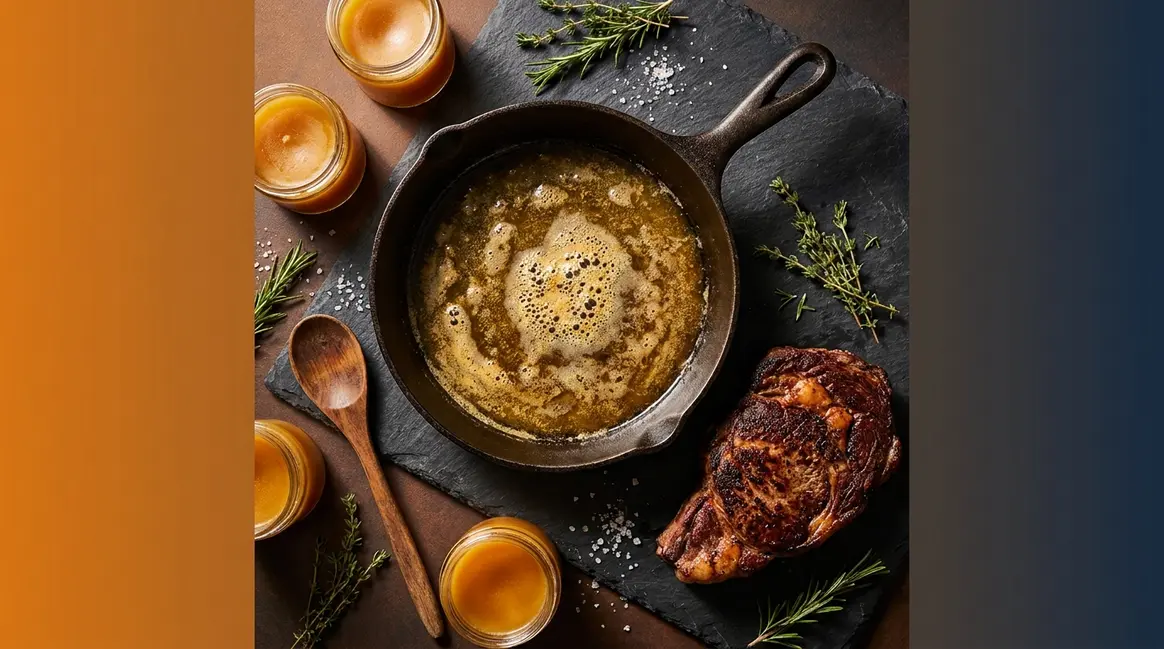
Beef tallow is the rendered fat from cattle — specifically from suet, the dense, firm fat found around the kidneys and loins. To make it, raw suet is slowly heated until the pure liquid fat separates from the connective tissue and impurities. That process is called rendering. The result is a clean, shelf-stable cooking fat that has been used in kitchens for centuries — and is now making a strong comeback in home cooking.
You can find tallow at butcher shops, farmers markets, and online specialty retailers. Many grocery stores carry it near the lard or specialty fats. You can also render it yourself at home if your butcher sells raw suet — which many will set aside for you if you ask.
If you’re buying pre-rendered tallow, look for grass-fed or pasture-raised options when possible. Many cooks and nutrition researchers consider grass-fed tallow to be higher quality, as cattle raised on pasture tend to produce fat with a slightly better nutrient profile (including higher conjugated linoleic acid content).
What makes tallow especially interesting is a simple rule that determines when it outperforms every other fat in your kitchen — we’ll get to that shortly.
How Beef Tallow Is Made
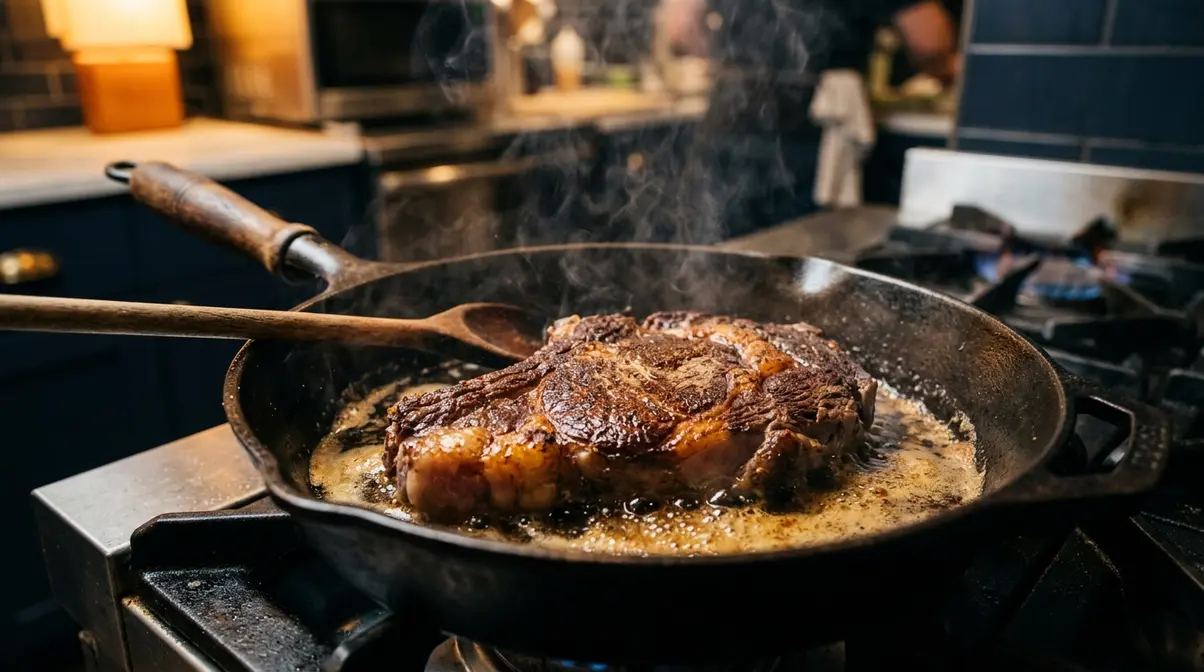
Rendering tallow is a slow, low-effort process. There are two reliable methods.
Stovetop method: Place roughly chopped suet in a heavy-bottomed pot over the lowest heat setting. Cook for 2–3 hours, stirring occasionally. You’re not trying to fry anything — you’re gently coaxing the fat out of the tissue. High heat is the enemy here: it burns the fat before it fully renders, creating bitter, off-flavors in your final product.
Oven method: Spread the chopped suet in a roasting pan and place it in an oven set to 250°F. Again, plan for 2–3 hours of patient, low-heat rendering.
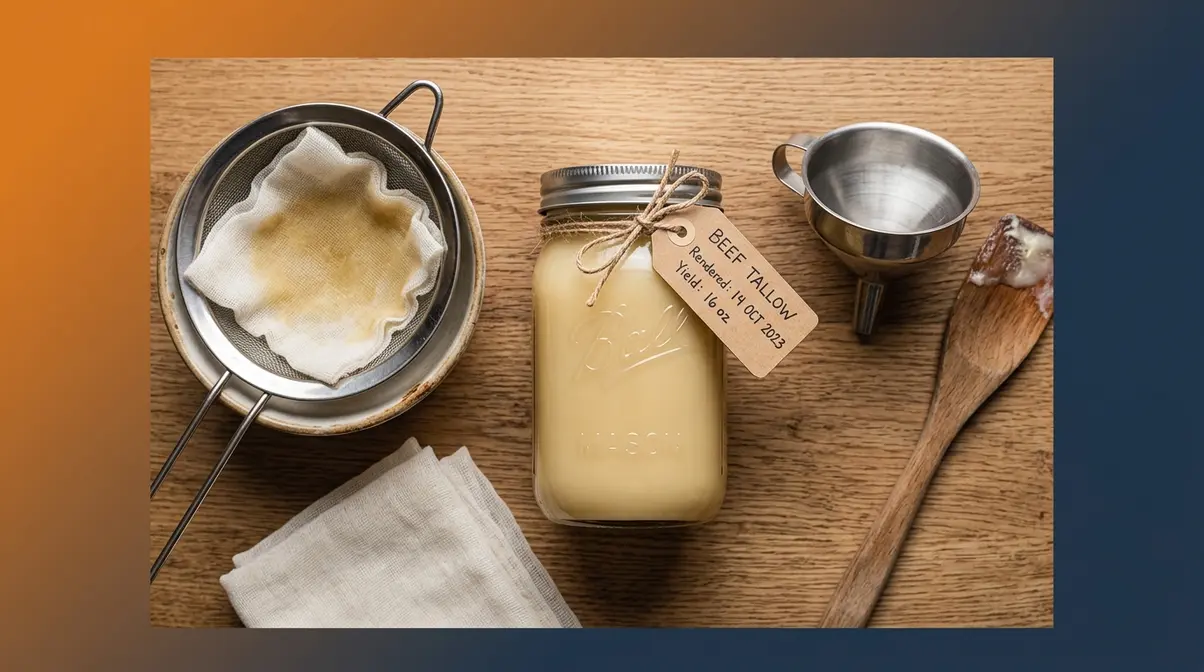
In both cases, you’ll know it’s ready when the solid fat pieces shrink, turn golden, and become slightly crispy. Those crispy bits are called cracklings — strain them out (or eat them as a cook’s snack) and pour the clear, golden liquid fat through a fine mesh strainer lined with cheesecloth into a clean glass jar.
If you buy pre-rendered tallow from a butcher or online, skip this step entirely. It arrives ready to use, straight from the jar.
Why Home Cooks Are Bringing Beef Tallow Back
The revival of beef tallow is partly a reaction. A growing community of home cooks has become skeptical of highly processed seed oils — the industrial vegetable oils like soybean, canola, corn, and sunflower that dominate supermarket shelves. Terms like “seed oils,” “lard and butter,” and “avocado oil” populate cooking forums precisely because people are re-examining what they’re cooking with and why.
Beyond the seed oil conversation, there’s a simple flavor argument that’s hard to dispute. Tallow imparts a rich, savory, beefy depth that vegetable oils simply can’t replicate. Home cooks on r/Cooking consistently describe fries cooked in tallow as having a “nostalgia-level” crunch and flavor that modern oils can’t match. Roasted potatoes develop a golden crust. Steak sears with a deeper Maillard crust.
There’s also a practical appeal: tallow is shelf-stable, versatile, and reusable. Strain it after cooking, let it cool, and it’s ready for next time.
Before you start cooking, though, it’s worth understanding what the science actually says about beef tallow’s effect on your health — especially if you’re making it a regular part of your kitchen.
What Makes Beef Tallow Special as a Cooking Fat?
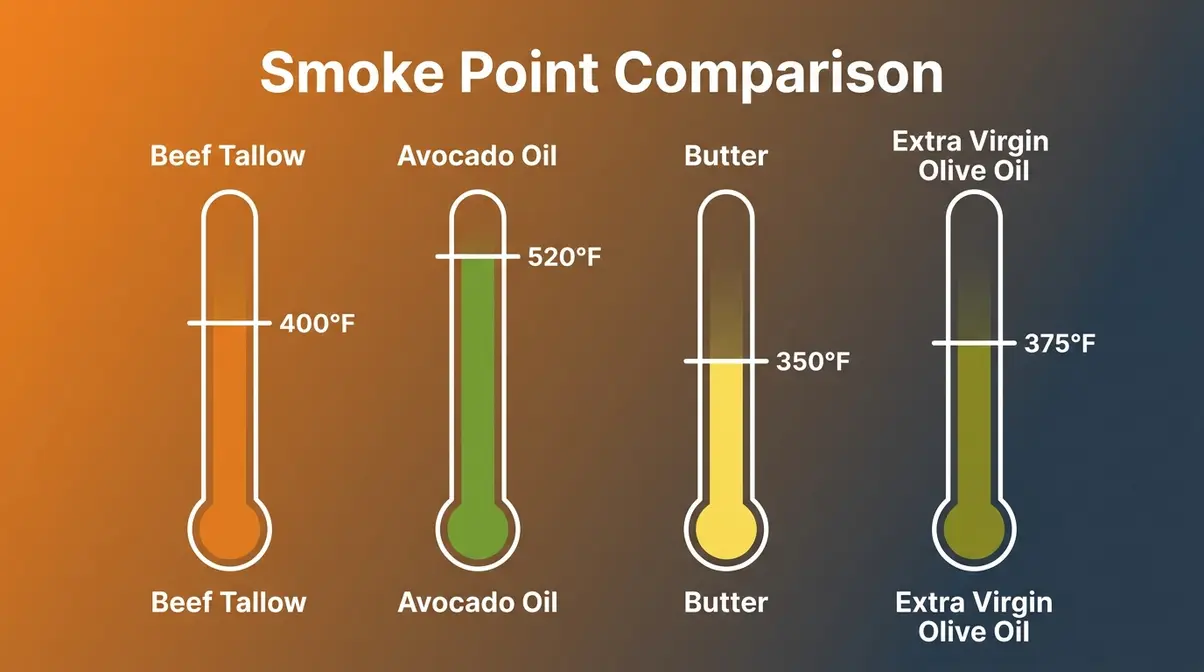
Beef tallow stands out from other cooking fats for one key reason: it stays stable at very high heat. Its smoke point — the temperature at which a fat starts to smoke, break down, and release harmful compounds — sits at approximately 400°F (204°C), with a practical range of 375–420°F depending on how refined the tallow is (Fatworks, 2025). That’s higher than unsalted butter at roughly 350°F and extra virgin olive oil at around 375°F (Snake River Farms, 2025).
Think of the smoke point like a car’s redline. Push past it and things start to break down — the fat oxidizes, flavors turn acrid, and potentially harmful compounds form. Tallow’s high redline gives you a wide, forgiving window for high-heat cooking.
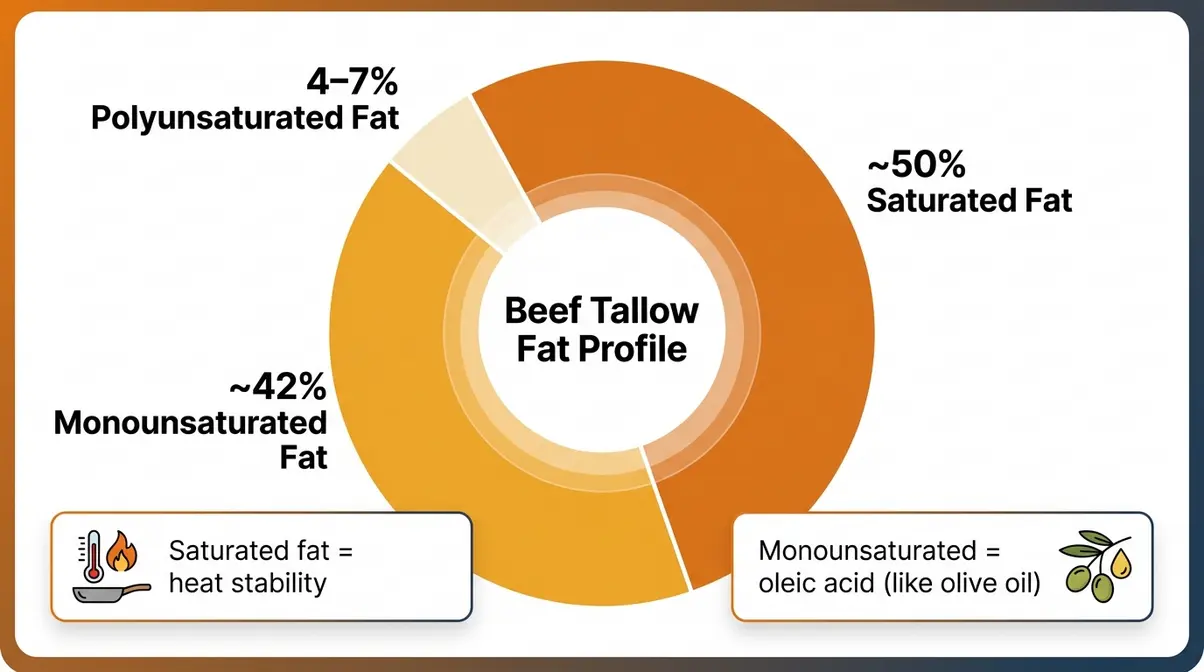
Heat stability is the deeper story. Tallow is approximately 50% saturated fat and 42% monounsaturated fat (USDA via Wikipedia, 2026). Saturated fats are chemically stable — their molecular structure resists oxidation at high temperatures. Polyunsaturated fats, by contrast, are structurally vulnerable to heat and can break down faster, releasing free radicals. This is why many seed oils — which are high in polyunsaturated fats — are better suited for dressings and low-heat cooking than for a screaming-hot cast iron pan.
The Maillard reaction — the browning process responsible for the crust on a seared steak or golden roasted potato — requires sustained, even, high heat. Tallow’s stability means it delivers that heat consistently without degrading mid-cook. You get better browning, better flavor, and less smoke.
Tallow also brings a rich, savory, beefy flavor profile that works beautifully for savory applications. It’s not neutral like refined avocado oil — it contributes to the dish. That’s a feature in steak, fries, and brisket; it’s a potential mismatch in delicate fish or sweet baked goods.
This is the foundation of what we call The Heat Threshold Rule — more on that in the next section.
Now that you know what makes tallow tick in the pan, let’s address the question that stops most people from trying it: is cooking with beef tallow actually healthy?
Is Cooking with Beef Tallow Healthy? What the Research Actually Shows
Nutritional Disclaimer: This section is for informational purposes only and does not constitute medical or dietary advice. Consult your doctor or a registered dietitian before making significant changes to your diet, especially if you have existing cardiovascular conditions.
The honest answer is nuanced. Beef tallow is not a health superfood — but it’s also not a uniquely dangerous food when used with intention and moderation. Here’s what the research actually shows, without the evangelical claims or the blanket scare tactics.
For additional context on the health and nutritional benefits of beef tallow, you can explore the health and nutritional benefits of beef tallow on this site.
The Nutritional Profile of Beef Tallow
A single tablespoon of beef tallow (approximately 13g) contains roughly 115 calories, 12.8g of total fat, and about 6.4g of saturated fat (Cleveland Clinic, 2025). It contains no carbohydrates and no protein. The fat breakdown is approximately 50% saturated fat, 42% monounsaturated fat (primarily oleic acid — the same heart-friendly fat found in olive oil), and 4–7% polyunsaturated fat (USDA FoodData Central via MD Anderson, 2025).
That monounsaturated fat content is worth noting. Oleic acid has well-documented neutral-to-positive associations with cardiovascular markers. Tallow is not simply a wall of saturated fat — its fat profile is more complex than critics often acknowledge.
Tallow also contains fat-soluble vitamins — A, D, E, and K — particularly when sourced from grass-fed cattle. These are minor contributors in typical cooking quantities, but they’re real nutrients that pure seed oils lack entirely.
The critical number, however, remains the saturated fat figure. At roughly 6.4g per tablespoon, a single serving supplies approximately half of the daily saturated fat limit recommended by the American Heart Association — which advises keeping saturated fat to no more than 6% of daily caloric intake on a 2,000-calorie diet (Cleveland Clinic, 2025). That’s not a reason to avoid tallow entirely, but it is a reason to be deliberate about when and how often you use it.
What Cardiologists Say About Beef Tallow
Cardiologists are not tallow enthusiasts — but their position is more specific than a blanket warning. The concern centers on LDL cholesterol — often called “bad” cholesterol because it can build up in artery walls, increasing cardiovascular disease risk.
Multiple randomized clinical trials have documented rises in LDL cholesterol in people who consume beef tallow, compared with people consuming unsaturated plant oils (Harvard Health Publishing, 2026). A 2026 peer-reviewed clinical review published on PubMed concluded that “saturated fat from beef tallow raises LDL-C, a causal risk factor for atherosclerotic CVD, compared to seed oils and other plant-based oils” (PMC, 2026).
The American Heart Association consistently recommends limiting saturated fat intake to reduce LDL and cardiovascular risk. A 2026 AARP analysis of a large-scale fat meta-analysis found tallow ranked “less bad than butter” for heart health — but still significantly worse than plant oils like sunflower or canola (AARP, 2026).
Beef tallow is more than 50% saturated fat, and randomized clinical trials document that diets enriched with beef tallow raise LDL cholesterol compared to diets enriched with polyunsaturated fats (Harvard Health Publishing, 2026).
Cardiologists interviewed for a 2026 TODAY Health report noted “considerable evidence of possible harm” from beef tallow’s LDL-elevating effects, while stopping short of calling it categorically dangerous for healthy adults using it occasionally.
The Cholesterol Question: Does Stearic Acid Change Things?
Here’s where the story gets more nuanced — and where many online arguments get stuck. Beef tallow contains about 14% stearic acid (a specific type of saturated fat) and roughly 26% palmitic acid (another saturated fat). These two fats behave differently in the body.
Palmitic acid is the saturated fat most strongly linked to LDL cholesterol elevation. Stearic acid, however, is different. Multiple studies published in peer-reviewed journals, including a randomized controlled trial and a PubMed review, have found that stearic acid has a neutral or slightly favorable effect on LDL compared with other saturated fats — it doesn’t raise LDL the way palmitic acid does (PubMed, 2010; ScienceDirect, 2021).
This nuance is real. However, it doesn’t overturn the overall picture. Stearic acid makes up only about 14% of tallow’s total fat — palmitic acid (the cholesterol-raising one) makes up approximately 26%. As Dr. Neal Barnard noted in a 2025 analysis, “most of is the type that raises your cholesterol level.” The stearic acid nuance is a legitimate scientific point, not a green light.
The practical takeaway: tallow is not as harmful as pure palmitic acid, but it still raises LDL compared with unsaturated plant oils. Moderation and context matter.
Why Was Beef Tallow “Banned”? The McDonald’s Story
Beef tallow was never legally banned in the United States. The story is more interesting than that.
From roughly the 1940s through 1990, McDonald’s cooked its iconic french fries in beef tallow — and the fries were legendary for their flavor. In July 1990, the company announced it would switch to 100% vegetable oil, phasing out the tallow blend by the end of that year. McDonald’s claimed the change would deliver “no cholesterol” and approximately a 45% reduction in saturated fat per serving (Chicago Tribune, 1990; The New York Times, as cited in The Week, 2025).
The switch was driven not by government mandate but by a sustained public pressure campaign from Phil Sokolof, a Nebraska businessman who had suffered a heart attack in 1966 and founded the National Heart Savers Association. Sokolof ran full-page newspaper ads targeting McDonald’s, framing tallow-fried food as a public health hazard. The campaign worked — McDonald’s capitulated (Food Republic, 2025).
The irony is that the vegetable oils McDonald’s switched to were partially hydrogenated, which introduced trans fats — a type of fat now widely recognized as far more dangerous to cardiovascular health than the saturated fat in tallow. McDonald’s later reformulated again in the 2000s to remove trans fats entirely (The Week, 2025).
Tallow was not banned. It was replaced under public pressure — by an oil that turned out to be worse.
Potential Benefits of Cooking with Beef Tallow
The benefits of cooking with beef tallow are real, but they’re primarily culinary rather than nutritional. Here’s what the evidence supports:
Heat stability: Tallow’s saturated fat structure makes it highly resistant to oxidation at cooking temperatures, meaning fewer breakdown products form in the pan compared with polyunsaturated seed oils at the same high heat.
Fat-soluble vitamins: Grass-fed tallow contains vitamins A, D, E, and K in small but meaningful amounts — nutrients absent from most refined plant oils.
No additives or processing: Unlike many commercial seed oils, which undergo extensive chemical extraction and deodorization, rendered tallow is a single-ingredient product.
Reusability: Properly strained tallow can be reused multiple times, making it economical for frequent fryers.
The key framing, however, is this: The Heat Threshold Rule — use beef tallow when cooking above 375°F for maximum flavor and stability; choose unsaturated fats like olive oil or avocado oil for lower-heat cooking, dressings, and daily use to protect cardiovascular health. This rule gives you the best of both worlds: tallow’s superior high-heat performance when it matters, and heart-friendlier fats when the temperature doesn’t demand tallow’s unique properties.
How to Cook with Beef Tallow: 7 Techniques Every Beginner Should Know
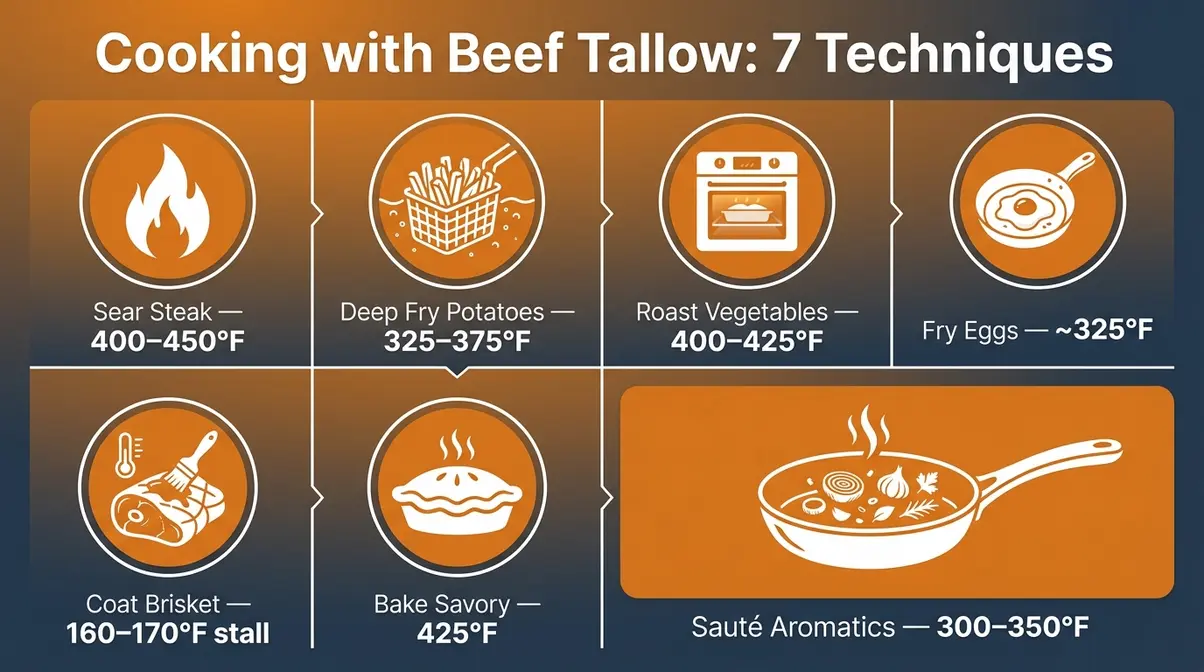
This is where cooking with beef tallow earns its place in your kitchen. The 7 techniques below cover the most common and rewarding uses — from a perfect steak sear to golden roasted vegetables. Each one includes the specific temperature, the method, and the “why” behind the technique.
Before you start: Scoop tallow from the jar with a spoon — it’s solid at room temperature, like cold coconut oil. A tablespoon or two is typically enough for a standard pan. It melts quickly once the pan heats up.
Technique 1: Searing Steak in Beef Tallow
Tallow is arguably the best fat for searing steak. Here’s why: a proper sear requires the pan surface to reach 400–450°F. At those temperatures, butter burns and most seed oils begin to break down. Tallow stays stable, delivering sustained, even heat that drives the Maillard reaction — the chemical process that creates that deep brown, flavorful crust.
How to do it:
- Pat your steak completely dry with paper towels. Moisture is the enemy of a good sear.
- Heat a cast iron or stainless steel pan over high heat for 2–3 minutes until it’s very hot.
- Add 1–1.5 tablespoons of tallow. It will melt and shimmer within 30 seconds.
- Place the steak in the pan and do not move it. Sear for 2–3 minutes per side for a 1-inch steak.
- For thicker cuts, finish in a 400°F oven after searing.
- Baste with the rendered tallow in the pan during the final minute of cooking.
Why tallow works here: The fat’s stability at high heat means the pan stays at searing temperature throughout. Basting with tallow continuously recoats the surface, building layers of crust and flavor. User consensus across cooking communities indicates this delivers a noticeably deeper, more complex crust than neutral oils.
Technique 2: Frying Potatoes and French Fries
This is tallow’s most famous application — and for good reason. Deep frying in tallow at 350–375°F produces fries with a crisp exterior and fluffy interior that vegetable oils struggle to replicate. The beefy, savory flavor of the fat permeates the crust slightly, adding a depth you can’t get from a neutral oil.
How to do it:
- Fill a heavy pot (Dutch oven works well) with 2–3 inches of tallow. Heat to 350°F, using a thermometer — precision matters here.
- Cut potatoes into your preferred shape and soak in cold water for 30 minutes. Dry thoroughly before frying.
- Fry in small batches to maintain oil temperature. Crowding the pot drops the temperature and produces soggy fries.
- First fry: 5–6 minutes at 325°F until just cooked through but not golden. Remove and drain.
- Second fry: 2–3 minutes at 375°F until deeply golden and crisp.
- Drain on a wire rack (not paper towels, which trap steam). Season immediately.
Why tallow works here: The double-fry method is standard for restaurant-quality fries. Tallow’s stability across the 325–375°F range means the fat doesn’t degrade between the first and second fry, keeping flavors clean.
Technique 3: Roasting Vegetables
Roasting at 400–425°F is where tallow shines for vegetables. The fat coats each piece evenly and promotes caramelization — the browning that makes roasted carrots, potatoes, Brussels sprouts, and parsnips taste dramatically better than steamed versions.
How to do it:
- Preheat your oven to 400–425°F.
- Melt 2 tablespoons of tallow in the roasting pan in the oven for 2–3 minutes before adding vegetables.
- Toss your vegetables in the hot tallow directly in the pan — every surface gets coated.
- Spread into a single layer with space between pieces. Crowding creates steam, not caramelization.
- Roast for 20–35 minutes depending on vegetable density, flipping halfway through.
Why tallow works here: At 400°F+, many oils begin to smoke. Tallow remains stable, allowing the vegetables to roast — not steam in degraded oil — for the full cooking time.
Technique 4: Frying Eggs
Fried eggs in tallow are a revelation for many home cooks. A thin layer of tallow in a medium-hot pan (approximately 325°F) creates crispy, lacy edges while keeping the yolk runny — a texture that butter achieves only at lower temperatures where the edges don’t crisp.
How to do it:
- Heat a small skillet over medium heat. Add about 1 teaspoon of tallow.
- Once melted and shimmering (not smoking), crack your egg directly into the fat.
- For crispy edges: tilt the pan slightly and spoon the hot tallow over the whites repeatedly.
- Cook for 2–3 minutes for a runny yolk with set whites.
Why tallow works here: The savory fat complements the egg’s flavor without overwhelming it. The slightly higher heat tolerance compared with butter means you can get crispier edges without burning the fat.
Technique 5: Injecting or Coating Brisket
This is the technique that appears most often in BBQ communities — and it’s exactly what the r/Cooking user described. Beef tallow is used in two distinct ways for brisket.
Method A — Coating during the unwrapped phase: When your brisket reaches the stall (typically around 160–170°F internal temperature) and you unwrap it to firm the bark, brush or spoon melted tallow over the surface. This rehydrates the bark, promotes deeper color, and adds richness.
Method B — Injecting before the cook: Melt tallow until fully liquid (it must be warm enough to stay fluid through the injector). Inject into the thickest parts of the flat before the cook. This adds moisture and flavor to the leanest part of the brisket — the area most prone to drying out during a long smoke.
Why tallow works here: Tallow is chemically compatible with the beef’s own fat, so it integrates naturally rather than sitting on the surface like a foreign oil. The result is a juicier flat and a richer bark.
Technique 6: Baking with Beef Tallow
Tallow can substitute for butter or lard in savory baking — pie crusts, biscuits, savory scones, and Yorkshire pudding. It produces a flaky, tender crumb with a subtle savory note.
How to do it:
- Use chilled tallow (scooped from a refrigerated jar) in place of cold butter. The fat-to-flour ratio is the same as for butter.
- For pie crust: work cold tallow into flour until pea-sized clumps form, then add ice water.
- For Yorkshire pudding: heat tallow in the muffin tin in a 425°F oven until smoking, then pour in the batter immediately.
Important note: Tallow’s beefy flavor makes it a poor choice for sweet baked goods. Stick to savory applications — or use it specifically where the beef flavor is an asset, as in Yorkshire pudding or savory hand pies.
Why tallow works here: Tallow’s fat structure creates lamination similar to lard, producing a flakier texture than butter in many applications. Its high smoke point handles the high oven temperatures required for Yorkshire pudding without burning.
Technique 7: Sautéing Aromatics
For sautéing onions, garlic, leeks, or other aromatics that form the base of soups, stews, and braises, tallow adds a savory richness from the first step. Use it at medium heat (300–350°F pan surface) — you don’t need the high-heat properties here, but the flavor contribution is meaningful.
How to do it:
- Add 1–2 teaspoons of tallow to a cold pan, then heat to medium.
- Once melted and shimmering, add your aromatics.
- Stir frequently; the fat coats the vegetables evenly and prevents sticking.
- Use this as the fat base for beef stews, French onion soup, or pot roast braises.
Why tallow works here: In beef-based dishes, starting the sauté in tallow creates flavor continuity — the fat echoes the protein, deepening the savory foundation of the dish. Research from culinary communities consistently identifies this as a low-effort, high-impact upgrade for braised beef dishes.
Beef Tallow vs. Other Cooking Fats: How Does It Compare?
Understanding how tallow stacks up against butter, lard, olive oil, and seed oils helps you apply The Heat Threshold Rule with precision. The right fat depends on your cooking temperature, flavor goal, and health priorities — not on any single fat being universally “best.”
The Full Comparison Table
| Fat | Smoke Point | Saturated Fat % | Flavor Profile | Heart Health | Best Use |
|---|---|---|---|---|---|
| Beef Tallow | ~400°F (375–420°F range) | ~50% | Rich, beefy, savory | Moderate concern (raises LDL) | High-heat searing, frying, roasting above 375°F |
| Butter | ~350°F | ~50–51% | Rich, creamy, sweet-savory | Moderate concern (raises LDL) | Low–medium heat, finishing sauces, baking |
| Lard | ~370°F | ~39% | Mild, slightly porky | Moderate concern | Baking, frying, sautéing; slightly lower sat-fat than tallow |
| Extra Virgin Olive Oil | ~375°F | ~14% | Fruity, grassy, peppery | Favorable (lowers LDL) | Dressings, low–medium heat cooking, Mediterranean dishes |
| Avocado Oil (refined) | ~520°F | ~12% | Neutral, mild | Favorable (high in oleic acid) | Very high-heat cooking; neutral flavor applications |
| Seed Oils (soybean, corn, canola) | ~400–450°F | ~7–15% | Neutral | Mixed (high in PUFAs; some refined processing concerns) | High-heat frying; not ideal for flavored dishes |
Sources: Offcuts Kitchen (2026); Cleveland Clinic (2025); Harvard Health (2026); Snake River Farms (2025)
When Tallow Wins: Applying The Heat Threshold Rule
The Heat Threshold Rule is simple: when your cooking temperature exceeds 375°F, tallow earns its place at the front of the shelf.
At those temperatures, butter burns and olive oil begins to break down. Tallow’s stability means consistent heat delivery, better browning, and no acrid smoke from a degraded fat. For steak searing, deep frying, oven-roasting root vegetables, and Yorkshire pudding, tallow delivers culinary results that are genuinely difficult to replicate with other fats.
Tallow also wins on flavor in beef-centric dishes. When you’re cooking a ribeye, braising short ribs, or building a beef stew base, tallow’s flavor profile reinforces the dish rather than competing with it. It’s the fat that belongs in those applications the way duck fat belongs in confit.
Reusability is another practical advantage. Properly strained tallow can be reused 3–5 times for frying before flavor begins to degrade. That makes it more economical than premium oils for repeated high-heat cooking sessions.
When to Choose a Different Fat
Below 375°F — for sautéing delicate vegetables, making salad dressings, finishing pasta, or cooking fish — the calculus shifts. The flavor profile that makes tallow ideal for beef dishes becomes a liability in lighter, more delicate applications.
For daily cooking at medium heat, extra virgin olive oil remains the most evidence-backed choice for cardiovascular health. Its monounsaturated fat content is associated with lower LDL cholesterol — the opposite direction from tallow (Harvard Health, 2026). For very high-heat cooking where you want a neutral flavor, refined avocado oil’s smoke point of ~520°F gives you even more headroom than tallow.
For anyone actively managing LDL cholesterol or cardiovascular risk factors, The Heat Threshold Rule also has a frequency dimension: reserve tallow for the high-heat applications where it genuinely outperforms alternatives, and default to olive or avocado oil for everyday cooking. This isn’t about avoiding tallow — it’s about using it with precision.
What to Do with Beef Tallow After Cooking
One of tallow’s most practical advantages is what happens after you’re done cooking. Unlike many oils that degrade quickly after high-heat use, properly handled tallow can be saved, stored, and reused — making it an economical fat for anyone who fries or sears regularly.
How to Store Beef Tallow
The storage process is straightforward, but a few details matter for both safety and quality.
After cooking: Allow the used tallow to cool to a safe handling temperature (not boiling, but still liquid — roughly 150–180°F). Strain it through a fine mesh strainer lined with cheesecloth or a coffee filter directly into a clean glass jar. Remove all food particles — they’re the primary cause of rancidity and off-flavors in reused fat.
Container matters: Glass is the preferred storage vessel. It doesn’t leach chemicals into the fat at any temperature, and it’s easy to clean thoroughly between uses. Avoid plastic containers for long-term storage — fat can absorb compounds from plastic over time.
Labeling tip: Write the date on the jar. This is the single most useful habit for managing fat quality over time.
Fresh tallow (unused, from a butcher or rendered at home):
| Storage Location | Container | Shelf Life |
|---|---|---|
| Room temperature / pantry | Glass jar, sealed | Up to 3 months |
| Refrigerator | Glass jar, sealed | 6–12 months |
| Freezer | Glass jar or freezer-safe container | Up to 2 years |
Used/reused tallow: Follow the same storage rules, but plan to use within 1–2 months at room temperature and 3–4 months refrigerated. Flavor degrades faster after each use.
Shelf Life and How to Spot Rancidity
Tallow is more shelf-stable than most cooking fats — its high saturated fat content means it resists oxidation better than seed oils or even olive oil. However, it does go rancid eventually, particularly if stored improperly or if food particles contaminate the jar.
Signs that your tallow has gone rancid:
- Smell: The clearest signal. Fresh tallow smells neutral, slightly beefy, or faintly meaty. Rancid tallow smells distinctly sour, musty, or like old crayons — a sharp, unpleasant off-note you won’t miss.
- Color: Fresh rendered tallow is pale yellow to cream-colored when solid, and clear golden when liquid. Darkening or unusual discoloration can indicate degradation.
- Texture: Rancid tallow may develop a gummy or sticky surface texture that differs from the smooth, waxy feel of fresh fat.
If you detect any of these signs, discard the tallow. Rancid fat not only tastes bad — it produces oxidized compounds that are counterproductive to the health rationale for using tallow in the first place.
The single most effective storage habit: Always strain thoroughly before storing. One overlooked food particle can accelerate rancidity across the entire jar.
Common Mistakes When Cooking with Beef Tallow — and Who Should Limit It
Common Pitfalls to Avoid
Overheating the fat. The most frequent beginner mistake. Tallow’s smoke point is approximately 400°F — pushing well past it causes the fat to smoke, break down, and create off-flavors. The fix: use a thermometer when deep frying, and don’t preheat an empty pan on the highest burner setting before adding tallow.
Using it for the wrong dishes. Tallow’s savory, beefy flavor is an asset in steak, fries, and roasted root vegetables. It becomes a liability in mild fish dishes, delicate vegetable sautés, or anything sweet. Applying The Heat Threshold Rule means not just checking temperature — it means checking flavor compatibility.
Not straining before storage. Food particles left in stored tallow accelerate rancidity dramatically. Always strain through cheesecloth or a coffee filter after every use.
Treating it as a health food. A growing segment of social media frames tallow as a superfood replacement for seed oils. The evidence doesn’t support that framing. Use it as a precision high-heat cooking fat, not as a health intervention.
Skipping the dry pat before searing. Moisture on the surface of steak (or any protein) creates steam that prevents the Maillard reaction. Pat dry before the fat goes in the pan — every time.
Who Should Limit or Avoid Tallow
People managing LDL cholesterol or cardiovascular disease risk should use tallow sparingly, if at all, and only after discussing dietary fat choices with their doctor or a registered dietitian. At approximately 6.4g of saturated fat per tablespoon, tallow adds up quickly against the AHA’s recommended daily cap (Cleveland Clinic, 2025).
People following a low-saturated-fat diet as prescribed by a healthcare provider should default to olive oil, avocado oil, or other unsaturated fat options for all cooking applications.
People cooking for children daily may want to reserve tallow for occasional high-heat applications rather than using it as an everyday cooking fat, given the saturated fat load per serving.
Tallow is not dangerous for healthy adults who use it occasionally and deliberately — but it is not appropriate as a daily cooking fat replacement for anyone with cardiovascular risk factors. The Heat Threshold Rule applies here too: precision over frequency.
Frequently Asked Questions About Cooking with Beef Tallow
Is beef tallow healthier than butter?
Beef tallow and butter have very similar saturated fat profiles — roughly 50% for tallow versus 50–51% for butter per 100g (MD Anderson, 2025). One large-scale meta-analysis found tallow is “less bad” than butter for heart health, but the difference is small. Neither is considered heart-healthy by major medical organizations. For cardiovascular benefit, both should be used in moderation, with unsaturated fats like olive oil preferred for daily cooking. Choose tallow over butter when you need a higher smoke point — approximately 400°F versus butter’s 350°F.
Is beef tallow healthier than olive oil for cooking?
For cardiovascular health, extra virgin olive oil is the stronger choice. Olive oil is approximately 73% monounsaturated fat (primarily oleic acid) and only about 14% saturated fat — a profile consistently associated with lower LDL cholesterol (Harvard Health, 2026). Tallow, at 50% saturated fat, raises LDL in clinical trials. However, for cooking above 375°F, tallow’s higher smoke point and stability give it a practical advantage. The Heat Threshold Rule resolves this: use olive oil below 375°F, tallow above it.
Is it good to cook with beef tallow?
Yes — for specific high-heat applications. Cooking with beef tallow produces superior results for searing steak, deep frying potatoes, and roasting vegetables above 375°F. Its stability at high heat prevents the oxidation and off-flavors that can affect seed oils at the same temperatures. The trade-off is its saturated fat content, which means it’s best used as a precision cooking tool rather than an everyday fat. For healthy adults without cardiovascular risk factors, occasional use is generally considered acceptable.
What are the downsides of beef tallow?
The primary downside is its high saturated fat content — approximately 50%, which clinical trials link to elevated LDL (“bad”) cholesterol (Harvard Health, 2026; PMC, 2026). A single tablespoon provides roughly half the daily saturated fat limit recommended by the American Heart Association. Secondary downsides include its strong beefy flavor (a mismatch for delicate or sweet dishes), its solid state at room temperature (minor inconvenience), and the fact that it’s not suitable for people managing cardiovascular risk. It’s also not appropriate for vegetarian or vegan diets.
What do cardiologists say about beef tallow?
Cardiologists generally advise limiting beef tallow due to its saturated fat content and its documented LDL-raising effects. A 2026 TODAY Health report noted that cardiologists cited “considerable evidence of possible harm” from tallow’s LDL-elevating properties (TODAY Health, 2026). The American Heart Association recommends keeping saturated fat below 6% of daily calories — a limit that a single tablespoon of tallow can approach. Cardiologists don’t universally call tallow dangerous for healthy adults using it occasionally, but they don’t endorse it as a health-positive food either.
Why was beef tallow banned in the US?
Beef tallow was never legally banned in the United States. The common misconception stems from McDonald’s 1990 decision to stop frying its french fries in a beef tallow blend, switching to 100% vegetable oil. The change was driven by a sustained public pressure campaign from activist Phil Sokolof and his National Heart Savers Association — not by any government regulation (The New York Times, as cited in The Week, 2025; Chicago Tribune, 1990). Ironically, the partially hydrogenated vegetable oils McDonald’s switched to contained trans fats — now considered more harmful to cardiovascular health than the saturated fat in tallow.
The Precision Approach: Beef Tallow Has a Place in Your Kitchen
Beef tallow is not a dietary villain, and it’s not a health revolution. It’s a precision cooking tool — one that performs exceptionally well in a specific, well-defined set of applications and deserves a more nuanced conversation than it usually gets.
The Heat Threshold Rule gives you that precision. Above 375°F — for searing steak, deep frying potatoes, roasting root vegetables — tallow’s heat stability and flavor depth outperform most alternatives. Below that threshold, or for daily cooking, olive oil and avocado oil are the better choices for both flavor and cardiovascular health. Randomized clinical trials document that beef tallow raises LDL cholesterol compared with unsaturated plant oils (Harvard Health Publishing, 2026) — that’s a real consideration, not a scare tactic.
The 7 techniques in this guide — steak searing, deep frying, roasting, eggs, brisket, baking, and sautéing — represent the clearest, highest-value uses. Each one benefits specifically from tallow’s properties at high heat. None of them require you to use tallow every day or abandon the fats that serve you well in other contexts.
Your next step: pick one technique and try it this week. Sear a steak in tallow and compare it to your usual method. Fry a batch of potatoes at 375°F and taste the difference. Form your own opinion from real experience — then layer in the health considerations with the help of your doctor or a registered dietitian if you’re managing cholesterol. That’s the informed, practical approach that actually works.

Dave King
Recipe developer and writer at Quick Dish Cookbook.
![How Long to Cook Pork Shoulder at 250°F [Chart]](https://quickdishcookbook.com/wp-content/uploads/2026/07/pork-shoulder-cook-time-250f-720x450.webp "How Long To Cook Pork Shoulder At 250°F [Chart] 7")