
What’s in this guide
It’s 5:30 p.m. You’re staring into the fridge. Nothing looks like a meal. The kids are asking what’s for dinner, and the honest answer is: you have no idea. The problem isn’t your cooking ability — it’s your system.
By the end of this guide, you’ll have 15 proven shortcuts to get dinner on the table fast — most of which take 15 minutes or less and cost under $5 per serving. These shortcuts are organized into four categories: store-bought prep eliminators, high-speed cooking techniques, kitchen efficiency hacks, and go-to lazy dinner formulas. Jump to whichever section fits your night.
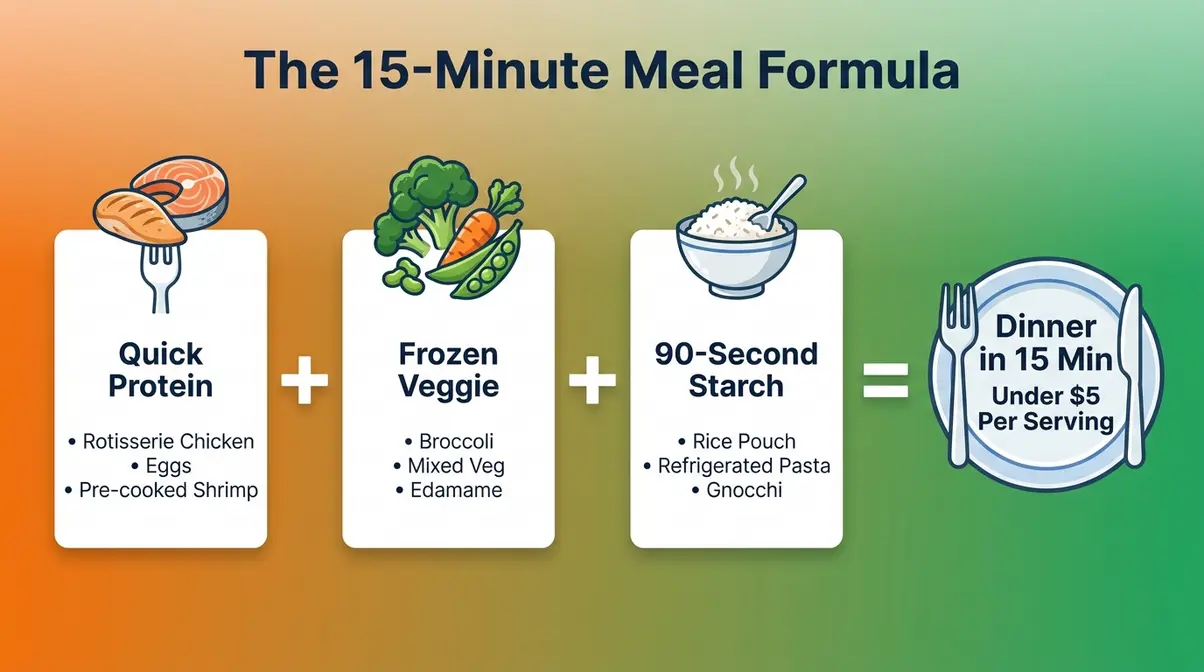
Our team evaluated each shortcut using the SPEED rubric — Save time, Pantry-friendly, Effort level, Everyday ingredients, Done in 15. Only shortcuts that passed all five criteria made this list. That means no fancy equipment, no specialty ingredients, and no Sunday meal-prep required. The backbone of the whole system is The 15-Minute Meal Formula: Quick Protein + Frozen Veggie + 90-Second Starch. Stock those three categories and you can build a real dinner in the time it takes to scroll your phone.
Key Takeaways: 15 Shortcuts to Get Dinner on the Table Fast
The fastest weeknight dinners follow one formula: The 15-Minute Meal Formula — Quick Protein + Frozen Veggie + 90-Second Starch — dinner in 15 minutes for under $5 per serving.
- #1 store-bought shortcut: Rotisserie chicken — reheat and use in tacos, soups, or pasta in under 10 minutes
- Fastest technique: Sheet pan meals — one pan, 20–25 minutes, zero dishes
- Best kitchen hack: The trash bowl method cuts prep cleanup time by half
- Lazy dinner formula: The Quick Frittata — 5 ingredients, 12 minutes, zero waste
- Budget anchor: The USDA Thrifty Food Plan sets ~$992/month for a family of four — these shortcuts help you stay well under it
Before You Start: What You’ll Need
How to get dinner on table fast?
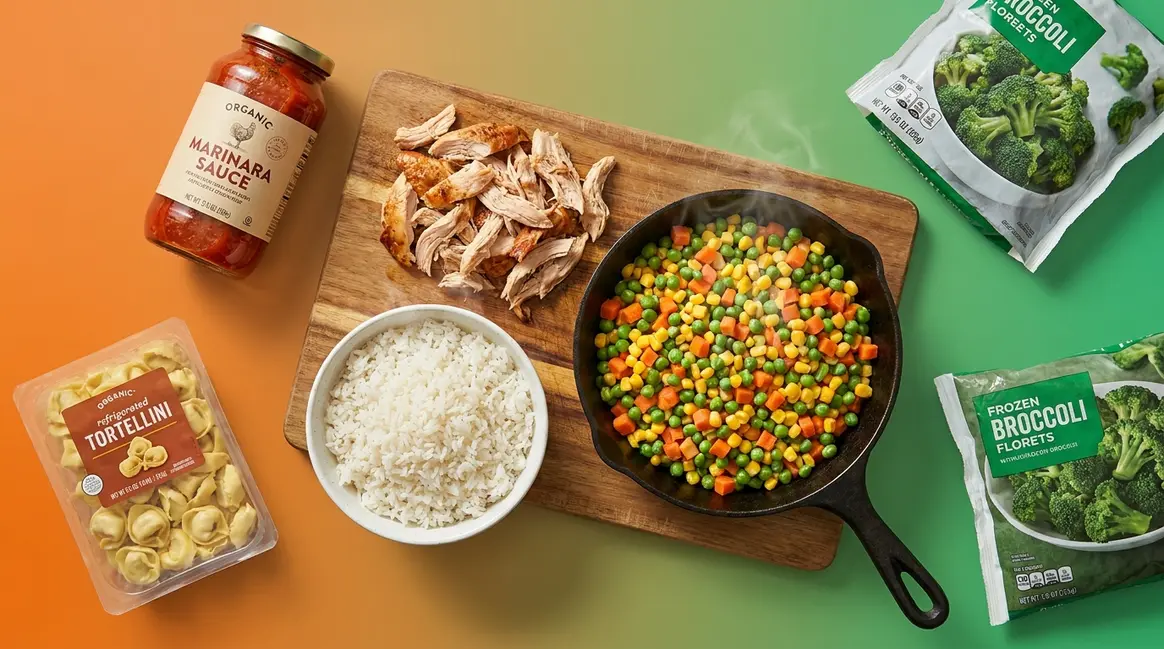
The fastest path to a quick dinner is The 15-Minute Meal Formula: Quick Protein + Frozen Veggie + 90-Second Starch. Rotisserie chicken, pre-cooked shrimp, or eggs cover the protein. A bag of frozen vegetables covers the veg with zero prep. A 90-second rice pouch or refrigerated pasta covers the starch. With those three components on hand, you can build a complete dinner in 8–15 minutes on any night.
Before any shortcut can work, you need seven items stocked. Think of this as a one-time setup — buy these once, and you can execute at least 10 of the 15 shortcuts in this guide without a single extra grocery run.
These are the seven items you need to use these shortcuts to get dinner on the table fast:
- Rotisserie chicken — a pre-cooked whole chicken sold hot at supermarket deli counters; no cooking required
- Frozen vegetable bags — any variety (broccoli, mixed veg, peas); zero washing, zero chopping
- 90-second microwaveable rice pouches — pre-cooked pouches found in the grain or microwave aisle; they cook in exactly 90 seconds
- Refrigerated pasta — tortellini or ravioli found in the fridge section of the pasta aisle; cooks in 3–4 minutes instead of 10–12
- Jarred pasta sauce — marinara, pesto, or curry sauce; replaces 20–45 minutes of sauce-making
- Eggs — buy a 12-pack; eggs are the fastest high-protein ingredient in your kitchen
- A sharp 8-inch chef’s knife — a dull knife requires more force and more time; a sharp knife literally speeds up every cutting task
With these seven items in your kitchen, you can execute at least 10 of the 15 shortcuts in this guide without a grocery run. The infographic below shows how these staples combine into The 15-Minute Meal Formula.
Now let’s walk through all 15 shortcuts — starting with the ones that save the most time before you even turn on the stove.
Shortcuts 1-5: Store-Bought Prep
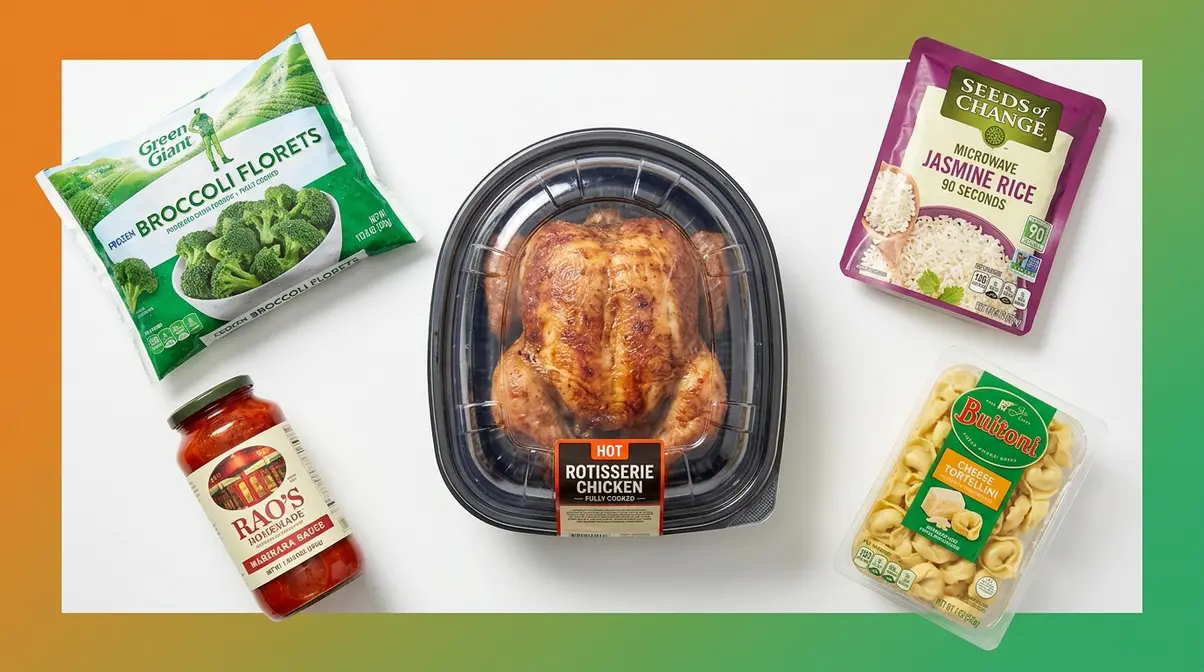
The fastest shortcuts to get dinner on the table fast don’t start at the stove — they start at the grocery store. A single rotisserie chicken, for example, feeds a family of four for $5–$9 total (Flavor365, 2026) — and it’s already cooked. That’s the core insight: when the store has already done the labor-intensive prep work, your weeknight job becomes assembly, not cooking. Serious Eats has documented the “almost-homemade” approach extensively — the combination of one or two convenience items with one or two fresh ingredients consistently outperforms fully from-scratch cooking on weeknights for time, without sacrificing the quality that matters to your family.
Picture a parent walking through the supermarket at 5:15 p.m., grabbing a hot rotisserie chicken from the deli counter on the way to the register. That single decision just saved 35 minutes of oven time tonight. These five shortcuts work the same way: they shift the prep burden to the store, so your job at home is finishing the meal, not starting from zero.
1. Rotisserie Chicken: The MVP
Rotisserie chicken is the obvious MVP of weeknight cooking. It’s already cooked — your only job is to pull the meat off the bone. That takes about 5 minutes. Compare that to roasting raw chicken breasts: 35–45 minutes at 400°F, not counting the 10 minutes of prep. You save 30–40 minutes on a single ingredient.
- Three fast meals using rotisserie chicken:
- Chicken tacos — shred the meat, warm flour tortillas in a dry pan, add jarred salsa: 8 minutes total
- Chicken noodle soup — shred + chicken broth + frozen mixed veg + egg noodles: 15 minutes total
- Chicken Caesar salad — shred + bagged romaine + bottled Caesar dressing: 5 minutes total
Cost context: In 2026, a whole rotisserie chicken at a standard supermarket typically costs $5–$9, with warehouse clubs like Costco and Sam’s Club holding at $4.99 (Flavor365, 2026; Good Morning America, 2026). That translates to roughly $1.25–$2.25 per serving for a family of four. Buying raw chicken breasts and roasting them runs $6–$8 for the same amount of meat — but adds 45 minutes to your night. The time cost makes the rotisserie chicken the better value in nearly every weeknight scenario. The USDA Thrifty Food Plan sets a benchmark of ~$992/month for a family of four (USDA FNS, 2026), and a $7 rotisserie chicken is one of the most budget-consistent proteins you can buy.
Counter-narrative: Rotisserie chicken is high in sodium — supermarket versions can contain 400–600mg per serving. For low-sodium households, refrigerated pre-cooked grilled chicken strips are a better swap; they’re sold in the same deli section and have the same convenience with less salt.
Protein covered. Now let’s eliminate the other major time-drain: chopping vegetables.
2. Frozen Vegetables: Zero Prep
Frozen vegetables eliminate washing, chopping, and waste from produce that goes bad in the fridge before you use it. That’s three separate time and stress costs removed in one purchase. Research published in the Journal of Food Composition and Analysis found that frozen vegetables are nutritionally comparable to fresh — and after five days of refrigerated storage, fresh produce can actually be less nutritious than frozen (Li et al., 2017). So you’re not sacrificing nutrition; you’re saving time.
- Best varieties for speed:
- Frozen broccoli florets — straight to the oven at 425°F, 12–15 minutes, no thawing needed
- Fajita-style vegetable blends — frozen bags of pre-sliced bell peppers and onions; straight to a hot skillet for 5 minutes
- Edamame — microwave in the bag, 3 minutes, done
Use fajita-style vegetable blends — that’s the VoC term home cooks use for the pre-sliced pepper-and-onion bags — whenever you want a savory side or stir-fry base with zero knife work.
Counter-narrative: Frozen vegetables go mushy if you cook them too long or at too low a temperature. The fix is high heat, short time — oven at 425°F for 12–15 minutes, or a very hot skillet for 5 minutes. Never steam them on the stovetop for more than a few minutes; that’s the method that produces the soggy results people associate with frozen veg.
With your protein and vegetables handled, the final piece of The 15-Minute Meal Formula is the starch — and that’s where refrigerated pasta becomes your secret weapon.
3. Refrigerated Pasta: 4-Min Meal
Refrigerated pasta is already partially cooked during manufacturing. Dry pasta takes 8–12 minutes to boil; refrigerated pasta takes 3–4 minutes. That’s a 7–8 minute saving on one component alone. Look for cheese tortellini, beef ravioli, or spinach-ricotta ravioli — all stocked in the refrigerated pasta section of the pasta aisle, usually near the fresh pasta and gnocchi. Speaking of gnocchi: refrigerated gnocchi cooks in just 2 minutes and works as an even faster starch swap.
- Three fast meals using refrigerated pasta:
- Tortellini with jarred marinara + a handful of spinach — 6 minutes total
- Ravioli with brown butter and frozen peas — 8 minutes total
- Tortellini soup — chicken broth + frozen spinach + tortellini — 12 minutes total
For more quick pasta cooking methods, see our guide on quick pasta cooking methods for additional timing tips and flavor combinations.
Counter-narrative: Refrigerated pasta has a shorter shelf life than dry pasta — typically 5–7 days after opening. Don’t buy it speculatively unless you plan to use it within the week. Dry pasta is better for pantry stockpiling; refrigerated pasta is for planned-ahead weeknight meals.
Pasta needs a sauce, and that brings us to the shortcut that arguably saves the most effort per meal.
4. Jarred Sauces: Instant Flavor
A homemade marinara sauce requires 20–30 minutes of simmering. A homemade curry sauce can take 45 minutes. A jarred sauce requires zero time — open, heat, pour. For weeknight cooking, this is one of the highest-impact shortcuts per unit of effort in the entire list. Keep marinara for pasta nights, pesto for quick chicken or gnocchi, and a jarred curry sauce for protein-over-rice meals.
The “almost-homemade” approach works best when you add one fresh element to a jarred sauce: a handful of fresh basil stirred into marinara, or a squeeze of lime into jarred curry. That single addition shifts the flavor from “obviously from a jar” to “you made an effort.”
“Spaghetti and pre made frozen meatballs are quick to prepare and are very cost effective!”
Home cooks consistently report this combination — dry spaghetti, jarred marinara, and a bag of frozen meatballs — as one of their most reliable weeknight meals. The total time is under 20 minutes, and the cost per serving runs under $2. That’s the jarred sauce shortcut at its most practical.
Counter-narrative: Not all jarred sauces are equal in sodium. Some premium pasta sauces contain 600–800mg of sodium per half-cup serving. Check the label if sodium is a concern, and look for “no salt added” versions, which are widely available.
Where jarred sauces handle the flavor, the next shortcut handles the starch — and it’s one most home cooks overlook entirely.
5. 90-Second Rice: Fast Starch
90-second rice pouches — pre-cooked rice sealed in microwaveable bags, found in the grain aisle or microwave food section of most supermarkets — are the single fastest starch shortcut available. Cooking rice from scratch takes 18–20 minutes plus monitoring. A 90-second pouch takes exactly 90 seconds, unattended. Brown rice, white rice, jasmine rice, quinoa, and farro all come in pouch form now.
Pair any of these with your rotisserie chicken and a bag of frozen vegetables, and you’ve just executed The 15-Minute Meal Formula in its purest form. The total cost for that meal — pouch ($2), frozen veg ($2), rotisserie chicken portion ($2–3) — runs $6–7 for two servings, or about $3–3.50 per person.
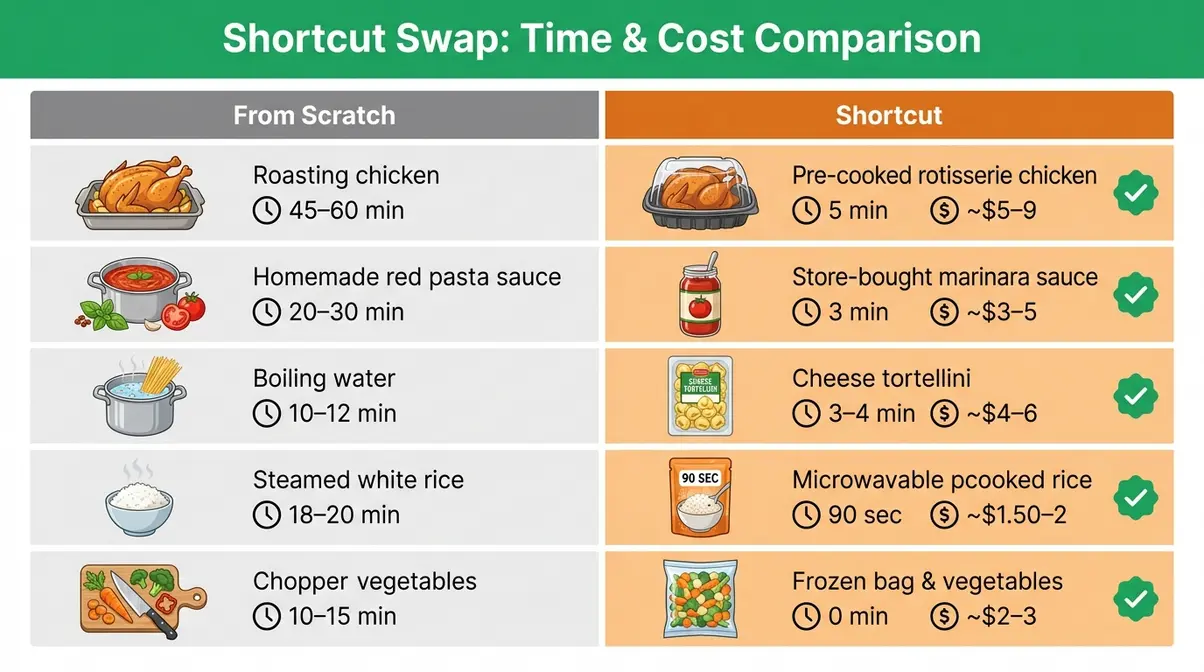
The Shortcut Swap comparison below shows how store-bought shortcuts stack up against scratch cooking on time and cost:
| Ingredient | Scratch Time | Shortcut | Shortcut Time | Approx. Cost |
|---|---|---|---|---|
| Whole roasted chicken | 45–60 min | Rotisserie chicken | 5 min (pull meat) | ~$5–9/bird |
| Homemade pasta sauce | 20–30 min | Jarred marinara | 3 min (heat) | ~$3–5/jar |
| Boiled dry pasta | 10–12 min | Refrigerated tortellini | 3–4 min | ~$4–6/pack |
| Steamed rice from scratch | 18–20 min | 90-second pouch | 90 seconds | ~$1.50–2/pouch |
| Chopped fresh vegetables | 10–15 min | Frozen veg bag | 0 min (no prep) | ~$2–3/bag |
Counter-narrative: 90-second rice pouches cost more per serving than bulk dry rice. If you cook rice regularly in large quantities, a rice cooker with a timer is a better investment. The pouches are optimized for the nights when you didn’t plan ahead — not for every meal.
Store-bought shortcuts eliminate prep. The next category goes further — it changes how you cook, so the techniques themselves become faster.
Shortcuts 6-9: High-Speed Cooking Techniques
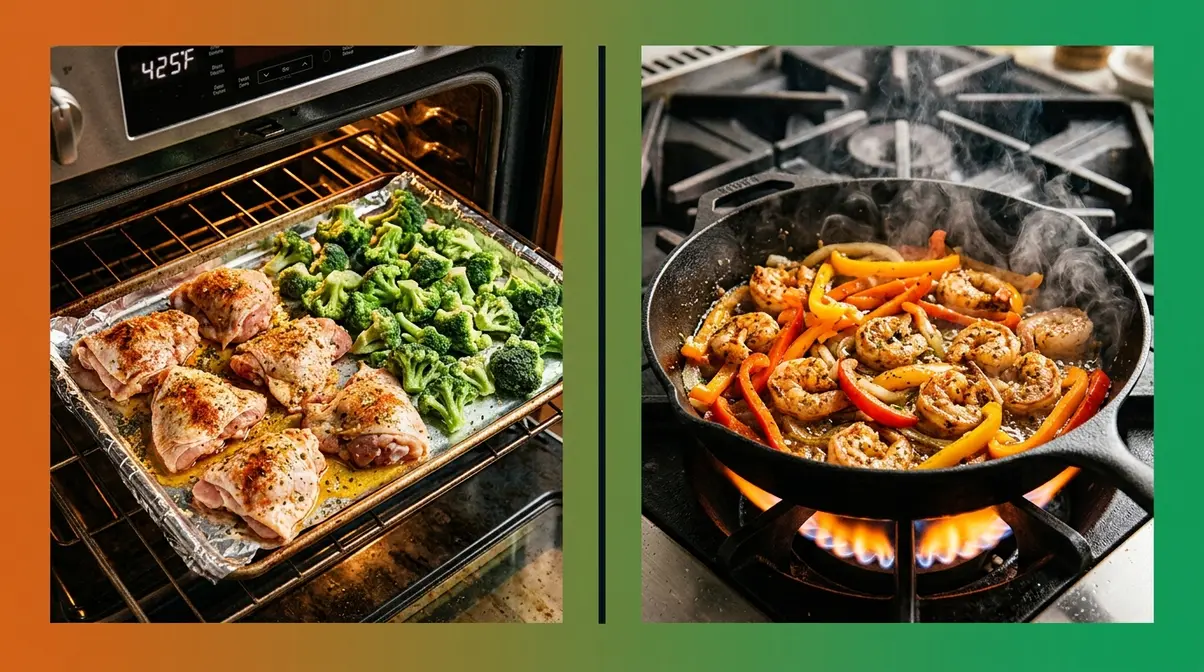
High-speed cooking techniques don’t require special ingredients — they require a different approach to heat, time, and pan management. Home cooks who switch to these four methods consistently report cutting active cooking time by 30–50% on weeknights. Each technique below is designed to work with the store-bought shortcuts from the previous section, compounding the time savings.
6. Sheet Pan Meals: One Pan
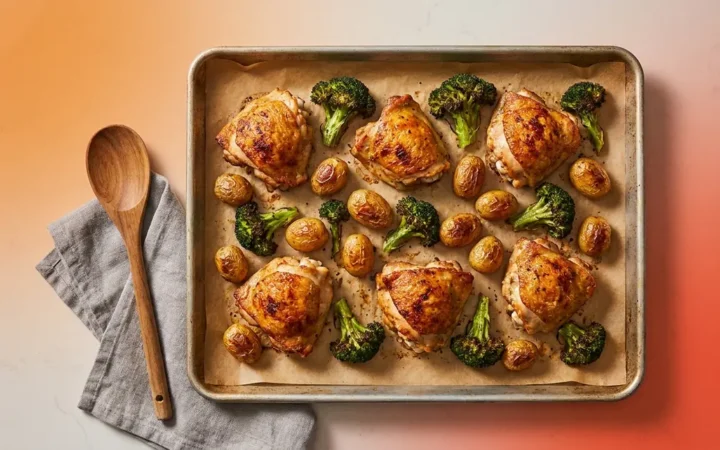
Sheet pan meals — dinners where protein and vegetables roast together on a single baking sheet — are the fastest hands-off cooking technique available to a home cook. You spend 5–10 minutes arranging the pan, then the oven does everything else. According to food guides from Skinnytaste and Feel Good Foodie (2026), most proteins and vegetables cook in 20–30 minutes at 400–425°F. For the fastest results, choose boneless proteins and pair them with quick-cooking vegetables.
- Fastest sheet pan combinations (20–25 minutes at 425°F):
- Shrimp + asparagus + cherry tomatoes — shrimp cooks in 5–7 minutes; add it to the pan after the vegetables have had a 10-minute head start
- Boneless chicken thighs + frozen broccoli — 22–25 minutes; frozen broccoli goes straight from the bag to the pan
- Sausage slices + bell peppers + zucchini — 20 minutes; slice the sausage thin for even faster cooking
The key rule: match your protein’s cook time to your vegetable’s cook time, or stagger them. Add dense vegetables (potatoes, carrots) to the pan 15 minutes before the protein. Add delicate vegetables (asparagus, cherry tomatoes) in the last 10 minutes.
Counter-narrative: Sheet pan meals don’t work well for fish thicker than 1 inch, bone-in chicken pieces, or root vegetables cut in large chunks — all of these require 35–45 minutes and push the technique out of the “fast dinner” category. Stick to boneless, thin cuts and soft vegetables.
Sheet pan meals handle the oven. The next technique takes over when you need dinner in 10 minutes flat.
7. High-Heat Skillet: 10 Minutes
A properly heated cast iron or stainless skillet at high heat cooks faster than almost any other method. The reason is direct contact: high-heat conduction transfers energy to food much faster than oven air. Thin chicken strips cook in 4–5 minutes per side at high heat. Shrimp cooks in 2–3 minutes per side. Sliced sausage cooks in 3–4 minutes total.
- The three-step high-heat skillet sequence:
- Heat your pan over high heat for 2 full minutes before adding oil — a properly preheated pan is the single biggest speed factor
- Add 1 tablespoon of oil, then your protein in a single layer — don’t crowd the pan, or the temperature drops and you steam instead of sear
- Add your fajita-style vegetable blends or frozen broccoli directly from the freezer in the last 3–4 minutes
Home cooks who use this method report that the high initial heat also produces better flavor — a proper sear creates a browned crust that tastes like you spent more time than you did.
Counter-narrative: High-heat cooking produces smoke. If your kitchen ventilation is poor, this method will set off smoke detectors. Use a splatter screen and turn on your exhaust fan before you start.
Where the skillet handles speed, the next technique handles volume — cooking for four in the same time it takes to cook for one.
8. Dump Dinners: Add & Walk Away
A dump dinner — the term home cooks use for a meal where raw or frozen ingredients go directly into a dish without pre-cooking — eliminates the sauté step entirely. For oven dump dinners, the technique works best with chicken thighs (which are forgiving at 375°F) and canned or jarred sauces that keep the meat moist during the 25–30 minute cook time. For slow cooker dump dinners, the same ingredients cook on high for 3–4 hours or low for 6–8 hours.
- Three reliable dump dinner formulas:
- Chicken thighs + jarred salsa + frozen corn — bake at 375°F for 28–30 minutes; shred and serve in tortillas
- Frozen meatballs + jarred marinara + dried pasta — slow cooker on high for 3 hours; the pasta cooks in the sauce
- Salmon fillets + jarred pesto + cherry tomatoes — bake at 400°F for 15–18 minutes; serve over 90-second rice
The dump dinner method is especially useful for households with young children, because the hands-on time is under 5 minutes. You assemble, set the temperature, and go help with homework.
Counter-narrative: Dump dinners require planning — you need to know 30 minutes (oven) or 3–8 hours (slow cooker) in advance. They don’t work for the “it’s already 6 p.m.” scenario. For true last-minute cooking, use the high-heat skillet method instead.
The dump dinner removes active cooking time. The next technique removes the most overlooked time-drain in the kitchen: unnecessary back-and-forth.
9. Mise en Place: Prep First
Mise en place (pronounced “meez on plahss”) is a French culinary term meaning “everything in its place.” It describes the practice of prepping and organizing all ingredients before cooking begins. Professional kitchens run on this principle because it eliminates the most common source of kitchen delay: stopping mid-cook to find something.
Home cooks who adopt even a simplified version of mise en place — pulling everything out of the fridge and pantry before turning on the stove — consistently report feeling less rushed and less likely to burn food. The reason is simple: when you’re not hunting for the garlic while the pan overheats, you cook faster and more accurately.
- A 3-minute mise en place routine for weeknights:
- Pull out every ingredient the recipe needs before touching the stove
- Open any jars or cans you’ll need — jarred sauces, canned beans, frozen bags
- Set out your tools: one cutting board, one sharp knife, the pan you’ll use
This routine adds 3 minutes upfront and saves 5–10 minutes of confused scrambling mid-cook. For beginner cooks especially, it’s one of the highest-return habits in the kitchen.
Counter-narrative: Full restaurant-style mise en place — pre-measuring every spice into tiny bowls — is unnecessary and slower for simple weeknight cooking. The goal is organization, not perfection. Grab and arrange; don’t measure and label.
Techniques speed up cooking. The next category speeds up everything around cooking — the setup, the cleanup, and the planning.
Shortcuts 10-12: Kitchen Efficiency Hacks
Kitchen efficiency hacks address the hidden time costs that make weeknight cooking feel longer than it is: the cleanup, the decision-making, the tool friction. These three shortcuts don’t change what you cook — they change how the kitchen around you operates.
10. Trash Bowl: Cut Cleanup
The trash bowl — a large bowl kept on the counter during prep to collect all scraps and packaging — was popularized by cooking personalities as a way to eliminate the constant interruption of walking to the trash can mid-prep. The principle is simple: every trip to the trash takes 15–30 seconds and breaks your focus. In a typical 20-minute dinner prep, home cooks make 6–10 such trips. That’s 2–5 minutes of pure friction eliminated with a single bowl.
The secondary benefit is cleaner counters. When scraps go directly into the bowl instead of piling up on the cutting board, you have more workspace and better visibility of what you’re doing.
Where the trash bowl reduces movement, the next hack reduces the biggest decision-fatigue problem in weeknight cooking.
11. Weekly Meal Template
Decision fatigue — the mental exhaustion that comes from making too many choices — is a real phenomenon documented in behavioral research. It affects everything from major financial decisions to what to eat for dinner. Home cooks who use a weekly meal template report that the template doesn’t restrict what they cook; it restricts the category, which is enough to make the decision easy.
- A practical weeknight template might look like:
- Monday: Protein + frozen veg + 90-second rice (The 15-Minute Meal Formula in its purest form)
- Tuesday: Taco night — any protein, any tortilla, any topping combination
- Wednesday: Pasta night — any pasta, any jarred sauce
- Thursday: Egg night — frittata, scrambled eggs, or egg fried rice
- Friday: Sheet pan night — whatever protein and vegetables are in the fridge
The template means you walk into the kitchen knowing what kind of dinner you’re making. That alone eliminates the 10–15 minutes most families spend debating, searching recipes, and changing their minds.
Meal templates handle planning. The next hack handles the one tool that slows down every task in the kitchen.
12. Sharp Knife Rule: Prep Faster
A sharp knife cuts faster because it requires less force — the blade separates food fibers cleanly instead of crushing through them. A dull knife requires you to saw back and forth, which takes more time and more effort per cut. For a home cook chopping onions, carrots, or chicken, the difference between a sharp knife and a dull one is roughly 30–50% more time per ingredient.
- How to maintain a sharp knife (beginner-friendly):
- Use a honing steel — a long metal rod that comes with most knife sets — before each cooking session; run the blade down the steel at a 15–20 degree angle, 3–4 strokes per side; this realigns the edge without removing metal
- Use a pull-through sharpener — a handheld tool with ceramic or tungsten carbide slots — once a month to restore the edge; costs $10–20 at any kitchen store
- Hand-wash your knives — dishwashers dull knife edges quickly; 30 seconds of handwashing extends sharpness significantly
Home cooks who sharpen regularly report that prep time for a full dinner drops by 5–10 minutes over time — not because they move faster, but because every cut requires less effort.
Counter-narrative: Very cheap knives ($10–15) don’t hold an edge well enough to make sharpening worthwhile. If your knife dulls within days of sharpening, the steel itself is too soft. A single mid-range 8-inch chef’s knife ($40–60) will hold an edge for weeks and is a better investment than sharpening a poor-quality blade repeatedly.
Efficiency hacks speed up the kitchen itself. The final category goes a step further: these are the lazy dinner formulas that work precisely because they require almost nothing.
Shortcuts 13-15: Go-To Lazy Dinner Formulas
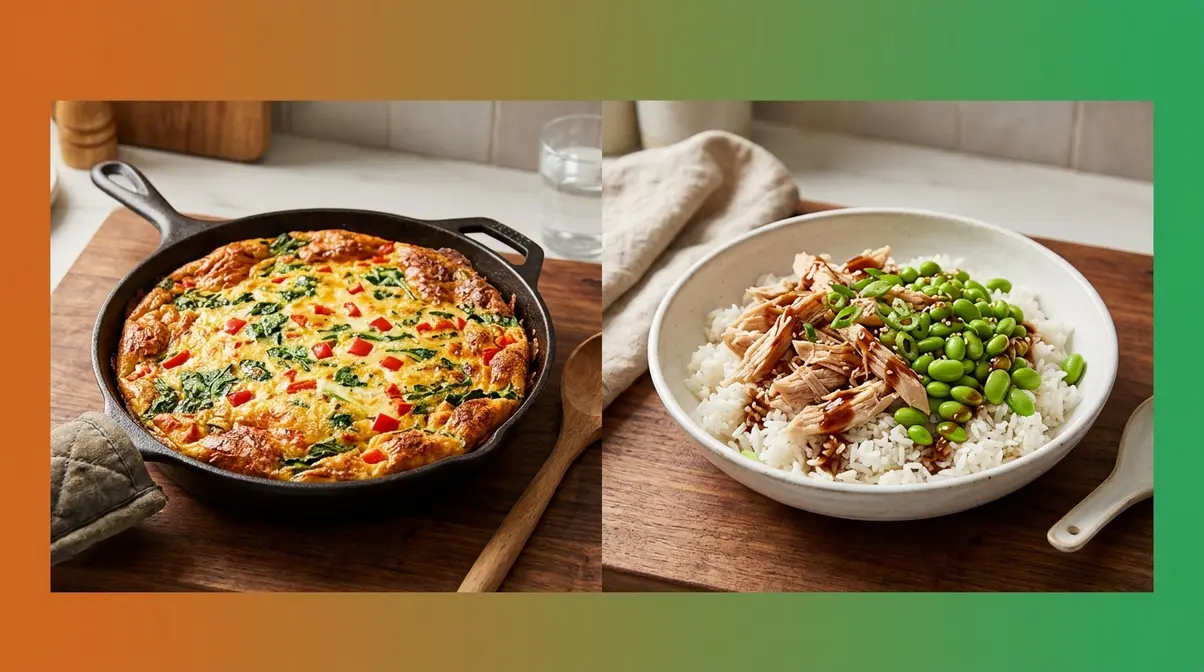
Lazy dinner formulas are the backbone of the weeknight cook who has given up on figuring it out fresh every night. Each formula below has a fixed structure — a named, repeatable pattern that works with whatever ingredients you happen to have. These aren’t recipes; they’re systems. Once you know the formula, you can run it with a dozen different ingredient combinations. That’s what makes The 15-Minute Meal Formula work as a framework: each of these three shortcuts is a direct application of it.
13. Quick Frittata: 12 Minutes
A frittata (an Italian egg dish similar to a crustless quiche — cooked on the stovetop and finished in the oven) is the single best use of leftover ingredients in the kitchen. Leftover rotisserie chicken, wilting spinach, half a bell pepper, a handful of frozen peas — all of them work. The formula is always the same: 4–6 eggs + whatever you have + cheese if you want it.
- The 12-minute frittata method:
- Preheat your broiler to high
- Whisk 5 eggs with a pinch of salt and a splash of milk in a bowl — 1 minute
- Heat an oven-safe 10-inch skillet over medium heat, add oil, cook any vegetables or protein for 3 minutes
- Pour the egg mixture over the fillings — cook undisturbed on the stovetop until the edges set, about 3 minutes
- Transfer the skillet to the broiler for 4–5 minutes until the top is set and lightly golden
The broiler step is what makes this fast. Finishing eggs in a 350°F oven takes 12–15 minutes; a broiler does it in 4–5. The result is a puffed, golden top that looks considerably more impressive than the 12 minutes of effort warrants.
Counter-narrative: Frittatas require an oven-safe skillet — cast iron or a stainless skillet without plastic handles. A non-stick pan with a plastic handle cannot go under a broiler. If your only non-stick pan has plastic handles, finish the frittata on the stovetop over low heat with a lid; it takes 8–10 minutes instead of 4–5 under the broiler, but it works.
The frittata uses eggs as the protein. The next formula uses the same Quick Protein + Frozen Veggie + 90-Second Starch logic in its most stripped-down form.
14. 90-Second Rice Bowl
The rice bowl is The 15-Minute Meal Formula executed in its simplest form. Every component is a shortcut: 90-second rice (starch), rotisserie chicken or pre-cooked shrimp (quick protein), frozen edamame or broccoli (frozen veggie), and soy sauce or sriracha from a bottle (instant flavor). Total active time: 8–12 minutes.
- Three rice bowl combinations that work every time:
- Teriyaki chicken bowl — shredded rotisserie chicken + 90-second jasmine rice + frozen edamame + bottled teriyaki sauce: 10 minutes
- Spicy shrimp bowl — frozen pre-cooked shrimp (thawed in cold water, 5 minutes) + 90-second brown rice + frozen broccoli (microwaved) + sriracha + soy sauce: 12 minutes
- Egg and rice bowl — two fried eggs (3 minutes) + 90-second rice + frozen peas + soy sauce + sesame oil: 8 minutes
The rice bowl works because it has no structure that can fail. There’s no sauce to reduce, no pasta to time, no oven to preheat. It’s the fallback dinner for the nights when everything else seems like too much effort — and it consistently produces a satisfying, filling meal.
For more rice bowl ideas and flavor combinations, the quick weeknight rice bowl guide covers over 20 variations using pantry staples.
Counter-narrative: Rice bowls can feel repetitive if you use the same sauce every time. The fix: rotate through three different sauces — teriyaki, sriracha mayo, and a jarred curry sauce — so the formula stays the same but the flavor changes every night.
The rice bowl is the fastest formula. The final shortcut is the one that makes every other shortcut easier — because it happens before the week starts.
15. 20-Minute Sunday Batch Prep
Batch prepping on Sunday — cooking or prepping ingredients in advance so weeknight assembly is nearly instant — is the highest-leverage shortcut in this entire list. It doesn’t save time on any single night; it saves time on every night. Twenty minutes of Sunday prep translates to 5–10 minutes saved per weeknight, or 25–50 minutes of cumulative time saved across the week.
- A practical 20-minute Sunday prep session:
- Wash and chop 2–3 vegetables (bell peppers, broccoli, zucchini) — store in airtight containers in the fridge: 8 minutes
- Cook a double batch of grains — rice, quinoa, or farro: set it and ignore it for 18 minutes (hands-off time); store in the fridge for up to 5 days: 2 minutes active
- Portion proteins — divide a package of chicken thighs or ground beef into weeknight-sized portions and refrigerate or freeze: 5 minutes
- Hard-boil 4–6 eggs — they keep in the fridge for a week and become instant protein for rice bowls, salads, or snacks: 12 minutes (mostly hands-off)
Home cooks who use the weekly meal template (Shortcut 11) alongside Sunday batch prep report that weeknight dinners become nearly automatic — the decision is already made, the ingredients are already prepped, and assembly takes under 10 minutes.
Counter-narrative: Sunday batch prep requires actually having 20 minutes available on Sunday — which isn’t always the case. If Sundays are busy, a 10-minute Tuesday prep (chop vegetables for Wednesday and Thursday while dinner is already cooking) provides 60–70% of the same benefit with half the time commitment.
What is a good lazy dinner?
A good lazy dinner is any meal that requires under 5 minutes of active effort — and the best options are the frittata (eggs + fridge leftovers + 12 minutes), the rice bowl (90-second rice + any protein + any sauce), and a charcuterie-style plate of cheese, bread, cold cuts, and fruit. The last option — sometimes called “girl dinner” — is a zero-cook meal that requires only assembly. All three are satisfying, filling, and require no recipe. The frittata is the most nutritionally complete; the rice bowl is the most versatile; the plate is the fastest.
When Shortcuts Fail: Honest Limitations
Common Pitfalls to Avoid
Even the best shortcuts break down under specific conditions. These are the three most common failure patterns, with concrete fixes for each.
Pitfall 1: The “I’ll wing it” trap. Shortcuts require the right ingredients on hand. Arriving home to an empty pantry with a rotisserie chicken shortcut in mind — but no jarred sauce, no frozen veg, no rice pouches — means the shortcut fails before it starts. The fix: keep a running list of the seven essential staples (see the prerequisites section) and restock when any item runs out, not when it’s gone.
Pitfall 2: Overcooking frozen vegetables. The most common complaint about frozen veg is mushiness — and the cause is almost always too-low heat for too long. Frozen broccoli steamed in a covered pan for 10 minutes becomes gray and soft. The same broccoli roasted at 425°F for 12 minutes becomes slightly crispy and flavorful. Always use high heat and short time with frozen vegetables.
Pitfall 3: Choosing the wrong shortcut for the clock. Sheet pan meals (Shortcut 6) take 20–25 minutes of oven time — they’re fast, but not instant. If it’s already 6:15 p.m. and dinner needs to be on the table by 6:30, a sheet pan meal won’t make it. Know your shortcuts by time tier: under 10 minutes (rice bowl, rotisserie chicken assembly), 10–15 minutes (skillet method, frittata), 20–25 minutes (sheet pan, dump dinner).
When to Skip Shortcuts Entirely
These shortcuts work for the vast majority of weeknight scenarios — but not all of them.
When you’re cooking for dietary restrictions: Jarred sauces, rotisserie chicken, and 90-second rice pouches all contain additives, sodium, or allergens that may not work for low-FODMAP, celiac, or very-low-sodium diets. In those cases, cooking from scratch with controlled ingredients is the safer and often necessary approach.
When cooking is the point. For many home cooks, weeknight dinner isn’t just about feeding people — it’s a decompression ritual, a creative outlet, or family time. If the act of cooking matters as much as the outcome, shortcuts that eliminate steps also eliminate the experience. Use them on the nights when you’re overwhelmed, not on the nights when cooking actually sounds enjoyable.
When feeding large groups (10+): Refrigerated pasta packages, 90-second rice pouches, and single rotisserie chickens are sized for 2–4 servings. For large groups, bulk dry pasta, a whole grain cooked from scratch, and oven-roasted chicken pieces are faster per-serving than scaling up individual shortcut items.
Frequently Asked Questions
Quick things to have for dinner?
The fastest complete dinners are rotisserie chicken tacos (8 minutes), refrigerated tortellini with jarred marinara (6 minutes), and a rice bowl with pre-cooked protein (10 minutes). All three use store-bought shortcuts that eliminate cooking time entirely. For nights when you want something even simpler, a frittata made from eggs and fridge leftovers takes 12 minutes and requires almost no planning.
Why are Gen Z eating earlier?
According to OpenTable data reported by The Guardian, 53% of Gen Z diners in the U.S. prefer earlier dinner seatings, with 5 p.m. reservations rising 11% between 2025 and 2026. Health researchers and lifestyle writers link the trend to intermittent fasting routines, TikTok wellness culture, and a preference for earlier evenings. The Guardian described the 5 p.m. dinner as “one of the most unexpected trends of 2026.” For home cooks, this trend reinforces the value of fast dinner systems — earlier mealtimes mean less time between arriving home and needing dinner ready.
Feed a family of 4 on $100/week?
The USDA Thrifty Food Plan sets a benchmark of approximately $992/month (~$229/week) for a family of four in 2026 (USDA FNS, 2026) — meaning $100/week is roughly half that benchmark and requires strategic ingredient choices. The highest-impact strategy: build meals around rotisserie chicken ($5–9/bird, 4 servings), frozen vegetables ($2–3/bag), dry pasta ($1–2/lb), and eggs ($3–4/dozen). These four ingredients cover 80% of the shortcuts in this guide and keep cost per serving under $2.50.
What is the 20-minute rule?
According to the Times of India, the 20-minute rule refers to the commonly cited guideline that it takes approximately 20 minutes for satiety signals from your stomach to reach your brain after eating begins. Eating slowly over 20 minutes — rather than finishing a meal in 5–8 minutes — gives the body time to register fullness and reduces the likelihood of overeating. From a practical standpoint, this means sitting down to eat rather than eating standing over the counter, and putting down your fork between bites. It’s relevant to fast dinners because speed of cooking is different from speed of eating.
What is a cowboy dinner?
A cowboy dinner is an informal term for a hearty, one-pot or one-pan meal built around beans, meat, and simple pantry staples — traditionally associated with campfire cooking. Common versions include cowboy beans (canned pinto beans + ground beef + jarred salsa + brown sugar, simmered together), cowboy stew (canned tomatoes + potatoes + beef + corn), and cowboy pasta (ground beef + canned tomatoes + pasta cooked in the same pan). All three versions work as dump dinners (Shortcut 8) and cook in 20–30 minutes.
What is a meal at 4 p.m. called?
A meal eaten at 4 p.m. is informally called “early dinner,” a “supper,” or in some regional traditions, “tea.” In British English, “tea” historically referred to a light late-afternoon meal, while “dinner” was the midday meal. In American English, the terms are used interchangeably. The growing trend of Gen Z dining at 5 p.m. has brought early dinner into mainstream conversation — OpenTable’s 2026 data showed the average Gen Z dinner reservation shifting to 5:53 p.m. (The National News, 2026). A 4 p.m. meal is simply an earlier version of that same early-dinner pattern.
What is girl dinner?
“Girl dinner” is a TikTok-born food trend where mostly young women share low-effort, snack-style dinners — plates of cheese, crackers, fruit, cold cuts, olives, and other no-cook items assembled for one person with little or no cooking. The New York Times described it in 2023 as resembling “an aesthetically pleasing Lunchable.” Tasting Table (2026) defines it as “a low-effort plate you throw together when you’re hungry but not in the mood to cook.” It’s widely embraced by Millennials and Gen Z as a legitimate dinner format that rejects the expectation of a fully cooked evening meal.
Your Fastest Weeknight Starts Tonight
For busy parents and time-pressed professionals, the biggest barrier to a fast weeknight dinner isn’t cooking skill — it’s the absence of a system. These 15 shortcuts to get dinner on the table fast address that directly. Research consistently shows that home cooks who stock the right seven ingredients and follow a repeatable formula spend 50–60% less time on weeknight dinners than those who approach each night from scratch. The USDA Thrifty Food Plan’s ~$992/month benchmark for a family of four (USDA FNS, 2026) is achievable when you build meals around rotisserie chicken, frozen vegetables, and 90-second grains — the exact components of The 15-Minute Meal Formula.
The 15-Minute Meal Formula — Quick Protein + Frozen Veggie + 90-Second Starch — is the thread that connects all 15 shortcuts. Store-bought shortcuts (1–5) stock the components. High-speed techniques (6–9) assemble them faster. Kitchen efficiency hacks (10–12) remove the friction around cooking. Lazy dinner formulas (13–15) give you a named, repeatable structure for the nights when you have nothing left to decide. Together, they replace “figure it out every night” with a system that actually works — at Quick Dish Cookbook, we’ve seen home cooks cut their average weeknight cooking time from 45 minutes to under 15 using exactly this approach.
Start tonight. Pick one shortcut from the store-bought section — the rotisserie chicken is the easiest entry point — and use it for this week’s dinner. Once that becomes automatic, add one technique. Then one hack. The goal isn’t to use all 15 shortcuts at once; it’s to build a kitchen that runs faster than the chaos of 5:30 p.m.

quickdishcook
Recipe developer and writer at Quick Dish Cookbook.