
What’s in this guide
- What You'll Need Before You Start
- Step 1: Build the No-Chop Flavor Bomb
- Step 2: Make the Panade for Maximum Moisture
- Step 3: Gently Mix the Meatloaf Mixture
- Step 4: Shape the Loaf and Apply the Glaze
- Step 5: Bake to a Safe Internal Temperature
- Step 6: Rest, Slice, and Serve
- Verify Your Results: What Success Looks Like
- Pro Tips: The Science Behind a Juicy Meatloaf
- Easy Variations and Adaptations
- Troubleshooting Common Meatloaf Problems
- Frequently Asked Questions
- Conclusion
To make a quick easy meatloaf, combine ground beef with a milk-soaked panade, add the No-Chop Flavor Bomb aromatics, shape into a loaf, glaze with ketchup, and bake at 350°F. This 6-step recipe takes about 15 minutes of prep and 55 minutes total — zero vegetable chopping required.
It’s 5:30 PM on a Tuesday. You’re staring into the fridge, craving something warm and hearty — not a sad salad, not another rotation of pasta. You want meatloaf. The real kind. But the last time you tried it, the loaf came out dry and crumbly, and it took 90 minutes you didn’t have.
“How do you make your meatloaf when you don’t have much on hand but it’s seriously what you’re craving???!!!”
That feeling is real — and it’s exactly what this guide is built for. Dry, disappointing meatloaf is almost always the result of two fixable mistakes: skipping the moisture science and spending too long on prep. By the end of this guide, you’ll have a juicy, flavorful meatloaf on the table in under an hour — using the No-Chop Flavor Bomb method that changes how you think about weeknight comfort food. This guide walks through 6 clear steps, 4 cooking method variations, and the pro tips that families come back to again and again.
What You’ll Need Before You Start
Before you cook, take 2 minutes to gather everything. Home cooks who prep ahead consistently report fewer mistakes and a smoother experience — especially on the first attempt.
- Equipment:
- Large mixing bowl
- 9×5-inch loaf pan or a rimmed baking sheet (a flat pan with low sides that lets fat drain away — often produces a better crust than a loaf pan)
- Instant-read meat thermometer (a probe thermometer that tells you the exact internal temperature — the only reliable way to know your meatloaf is safe and perfectly cooked; no guesswork, no cutting open the loaf)
- Measuring cups and spoons
- Knife and cutting board — optional; the No-Chop method skips the board entirely
Ingredients overview: The full list with quantities is in Step 1. This recipe serves 6–8 people and uses 1.5 lbs of ground beef as the base. Most ingredients are pantry staples you likely already have, keeping the estimated cost to around $8–12 total.
- Time estimate:
- Prep: 15 minutes
- Bake: 40–55 minutes (varies by method — see Step 5)
- Rest: 10 minutes
- Traditional method total: ~65–80 minutes
- Air fryer mini-loaf method total: ~30 minutes
Once you have everything ready, here’s how to put it all together — starting with the ingredient trick that saves 15 minutes of prep time.
Step 1: Build the No-Chop Flavor Bomb
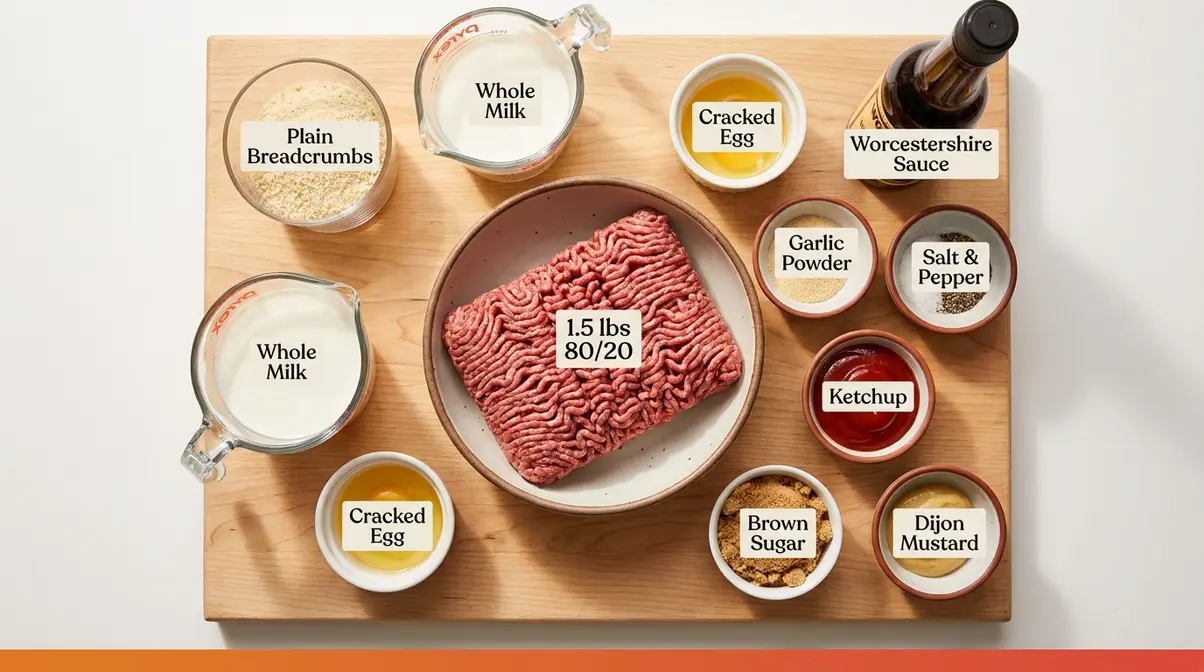
Starting a quick easy meatloaf recipe doesn’t mean you need a full fridge. This recipe uses fewer than 10 pantry ingredients, and the No-Chop Flavor Bomb — a trio of liquid and powdered aromatics — replaces the most time-consuming part of traditional meatloaf prep entirely.
The Complete Ingredient List
- For the Meatloaf:
- 1.5 lbs ground beef (80/20) — the 80% lean, 20% fat ratio keeps the loaf moist during baking; leaner beef tends to dry out even with a panade
- 1 cup plain breadcrumbs — the starch base for your moisture-locking panade (see Step 2)
- ¾ cup whole milk — activates the panade; whole milk adds richness, but 2% works fine
- 1 large egg — acts as a binder to hold the loaf together
- 2 tbsp Worcestershire sauce — the heart of the No-Chop Flavor Bomb; delivers fermented umami depth
- 1 tsp garlic powder — replaces minced garlic; no chopping, no burning
- 1 tsp onion powder — replaces sautéed onion; same savory base, zero prep time
- 1 tsp salt
- ½ tsp black pepper
Substitution tips: No Worcestershire? Use soy sauce or steak sauce as a 1:1 swap. No whole milk? Broth or plant-based milk both work in the panade.
- For the Glaze (mix separately in a small bowl):
- ½ cup ketchup
- 2 tbsp brown sugar
- 1 tsp Dijon mustard
This is a genuinely easy meatloaf recipe with few ingredients — everything here is a pantry staple. No specialty items, no store runs.
The No-Chop Flavor Bomb Explained
The No-Chop Flavor Bomb is the combination of Worcestershire sauce, garlic powder, and onion powder used as a trio of liquid and powdered aromatics — replacing the traditional step of finely chopping and sautéing fresh onions and garlic before mixing them into the meat.
Why does it work? Worcestershire sauce contains fermented anchovies, tamarind, and vinegar — a concentrated source of umami (the savory, mouth-coating depth you get from slow-cooked aromatics) that delivers the same flavor payoff in seconds. Garlic powder and onion powder round out the aromatic base without any prep at all. Replacing chopped onions and garlic with Worcestershire sauce eliminates 10–15 minutes of prep time while preserving the same savory umami depth — a technique home cooks increasingly favor for weeknight efficiency.
Compare this to Paula Deen’s classic meatloaf, which uses fresh onion and green pepper, finely chopped and sautéed first — a delicious method, but one that adds 15 minutes and a dirty pan. Martha Stewart’s version similarly relies on fresh onions. Both are wonderful for weekend cooking. The No-Chop method trades that prep time for the same flavor result via liquid aromatics — a smart weeknight shortcut that never disappoints.
Optional upgrade: Swap 1 tablespoon of Worcestershire for Bloody Mary mix when you want a tomato-forward umami boost that pairs beautifully with the ketchup glaze.
Checkpoint: You should now have all your ingredients measured and separated into two groups: the meatloaf base (with Flavor Bomb add-ins) and the glaze ingredients. Nothing should be mixed yet.
With your ingredients measured and your Flavor Bomb ready, the next step is the one technique that separates a juicy meatloaf from a dry one.
Step 2: Make the Panade for Maximum Moisture
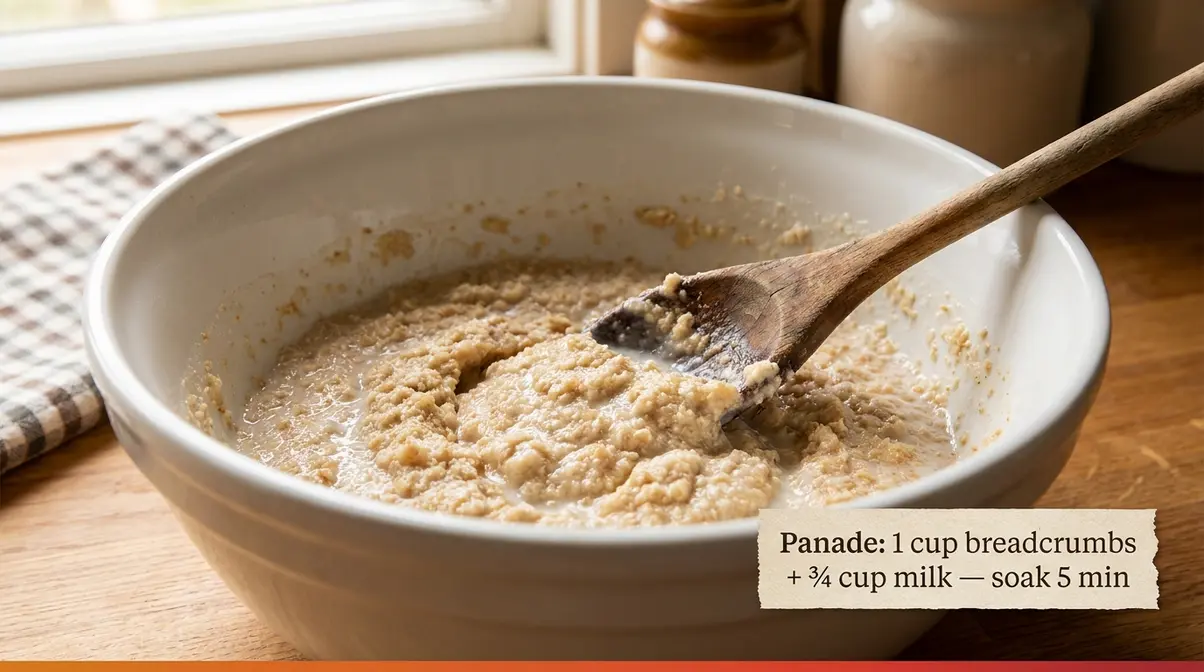
A panade — a French culinary term for a mixture of bread and liquid used as a moisture-locking binder — is the single step that separates a juicy meatloaf from a dry one. For this quick and easy meatloaf recipe, the ratio is 1 cup breadcrumbs to ¾ cup whole milk, soaked for 5 minutes before anything else is mixed. That short soak is doing more work than it looks like.
Why the Panade Works (the Science in Plain English)
Think of the panade like a sponge embedded inside your meatloaf. When breadcrumbs absorb milk and swell, they form a starchy gel. As the meatloaf bakes, the protein in the beef contracts — tightening and squeezing, the way a wet cloth wrings out water. Without a panade, that squeezing action pushes moisture out and it evaporates in the oven. The starch gel physically holds water in place, so even when the beef is fully cooked, the loaf stays tender instead of chalky.
A panade — breadcrumbs soaked in milk — physically traps moisture inside meatloaf as the protein network contracts during baking, preventing the dry, crumbly texture home cooks most want to avoid (Texas A&M AgriLife Extension routinely pairs milk and breadcrumbs in this way, and food scientist Jessica Gavin confirms the hydrated starch gel mechanism). Research on fiber-based binders in restructured meat loaf supports the same principle: research on water retention in meat loaf (Food Research International, ScienceDirect) found that fiber-based binders significantly increase water retention capacity — the same mechanism as a breadcrumb panade.
One important note: adding milk directly to the meat mixture is not the same as soaking the breadcrumbs first. The soak creates the gel that locks moisture in. Skipping it means the liquid evaporates during baking and never makes it into the meat. Quick oats work as a 1:1 panade binder too — the same water-retention principle applies, and they’re a great option for an easy meatloaf recipe with quick oats.
- Instructions:
- In your large mixing bowl, combine 1 cup breadcrumbs and ¾ cup whole milk.
- Stir briefly and let sit for 5 minutes — the breadcrumbs should absorb the milk and form a thick, wet paste.
- Add the egg to this mixture and beat lightly to combine.
- The panade is now ready. Do not proceed to mixing until the full 5-minute soak is complete.
Checkpoint: You should now have a thick, porridge-like paste in your bowl — the breadcrumbs should be fully saturated with no dry pockets. If the mixture looks too dry, add 1–2 tablespoons of milk and stir again.
What liquid should you use in meatloaf?
Whole milk is the best liquid for meatloaf because it hydrates the breadcrumbs to form a panade — a moisture-locking starch gel. The milk’s fat and protein content also add richness to the finished loaf. Broth, 2% milk, or unsweetened plant-based milk all work as substitutes and produce the same moisture-retention effect. Water works too, though it contributes less flavor. The key is soaking the breadcrumbs in the liquid before mixing with the meat — not adding liquid directly to the meat mixture.
Now that your moisture foundation is set, it’s time to add the meat — and to avoid the one technique that ruins more meatloaves than any other: overmixing.
Step 3: Gently Mix the Meatloaf Mixture
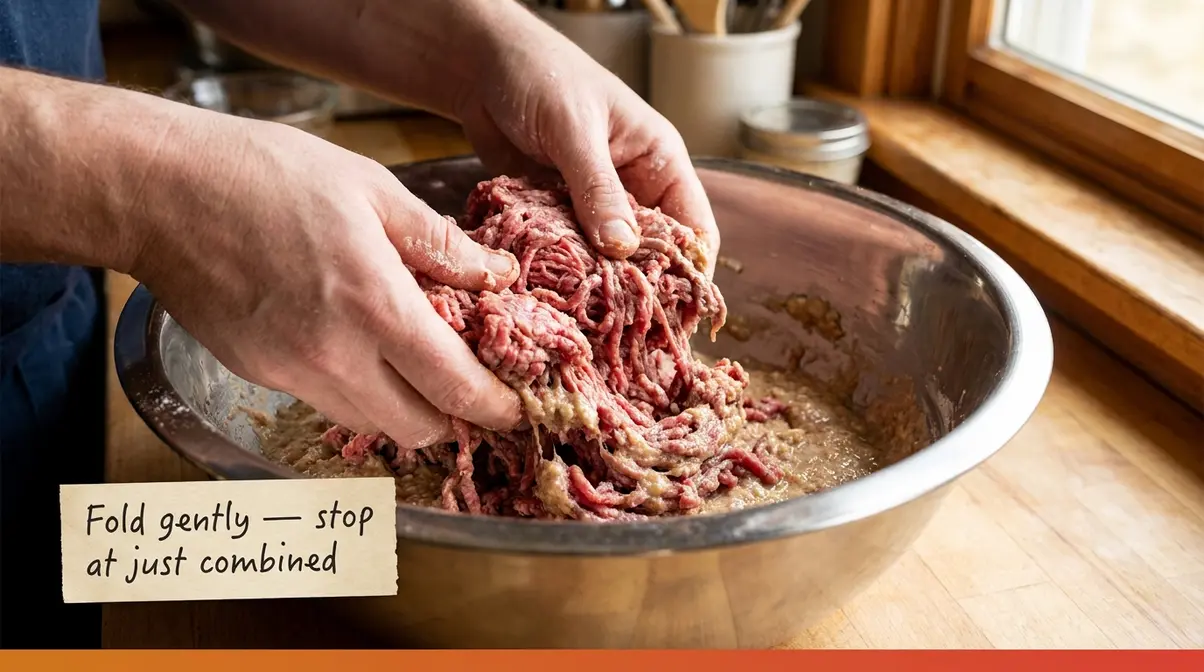
Overmixing is the single biggest mistake home cooks make with meatloaf. Meatloaf should be mixed for no more than 30–45 seconds after all ingredients are combined — overmixing activates proteins that create a dense, rubbery texture instead of a tender, juicy loaf. Think of it like kneading bread: the more you work it, the tougher it gets. Mix by hand, and stop at the moment everything is combined.
- Instructions:
- Add the ground beef directly to the panade bowl.
- Add the Worcestershire sauce, garlic powder, onion powder, salt, and pepper on top of the beef.
- Using clean hands (or a fork — but hands give better texture control), mix with a folding motion, not a kneading motion.
- Mix until just combined — the moment you can no longer see distinct pink streaks of unmixed beef, stop immediately.
- The mixture will look slightly shaggy and uneven. That is correct.
Beginner tip: If you’re nervous about whether it’s mixed enough, do a quick press test — press a small ball of the mixture between your fingers. If it holds together without crumbling, it’s ready.
This is an easy classic meatloaf recipe at its core — the technique isn’t complicated, but the discipline to stop mixing early is what separates a tender loaf from a dense one. Using 80/20 ground beef is strongly recommended here. Leaner beef (90/10 or higher) has less fat to compensate for moisture loss — even with a panade, leaner beef tends to dry out more noticeably.
Checkpoint: You should now have a combined meat mixture that holds its shape when pressed but doesn’t feel stiff or paste-like. If it feels very dense, you may have overmixed — the loaf will still taste good but may be firmer in texture.
Your mixture is ready. Now it’s time to shape it into a loaf and add the sweet-savory glaze that gives meatloaf its iconic caramelized crust.
Step 4: Shape the Loaf and Apply the Glaze
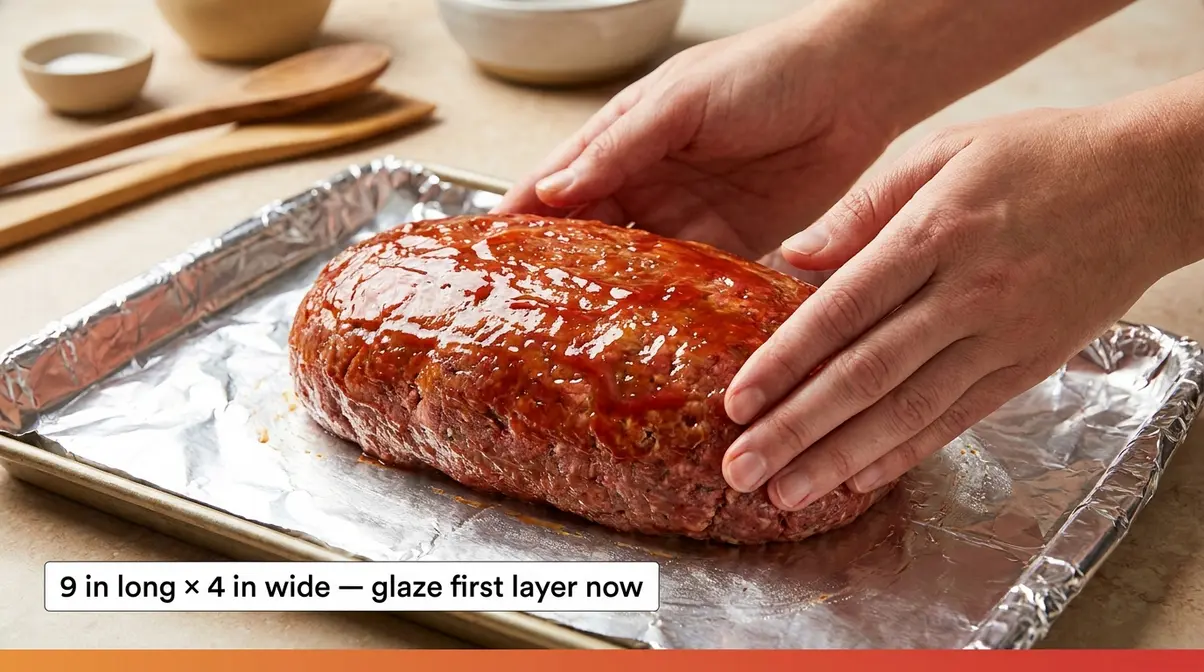
Transfer the meat mixture to a foil-lined rimmed baking sheet (preferred) or a 9×5-inch loaf pan. If using a baking sheet, shape the mixture into a loaf roughly 9 inches long and 4 inches wide, with rounded ends. The baking sheet method allows fat to drain away from the loaf as it cooks, which produces a crispier exterior on all sides — a detail most quick meatloaf recipes skip over entirely.
- Shaping instructions:
- Lightly wet your hands — this prevents the mixture from sticking to your palms.
- Place the mixture on the prepared surface and gently press it into a loaf shape.
- Smooth the top and sides with the back of a spoon or your palm. Don’t press hard — you’re shaping, not compacting.
- The loaf should have an even thickness throughout so it bakes uniformly.
The Sweet-and-Savory Glaze
The glaze is what gives meatloaf its nostalgic, caramelized finish — that sweet-and-savory balance that families come back to again and again.
- Glaze recipe:
- ½ cup ketchup
- 2 tbsp brown sugar
- 1 tsp Dijon mustard
Whisk all three together in a small bowl until smooth. Spread half the glaze evenly over the top and sides of the shaped loaf now, before baking. Reserve the other half to apply during the final 10 minutes of cooking — this two-stage application builds a deeper, lacquered crust instead of a thin coating.
Checkpoint: Your loaf should be shaped, sitting on a foil-lined pan or in a loaf pan, with the first layer of glaze applied. It should look like a rounded rectangle with a glossy red-orange top.
Do you bake meatloaf in a pan or on a sheet?
Both work, but a rimmed baking sheet produces a crispier exterior. A loaf pan insulates the sides and bottom, which creates a moister, softer exterior — some home cooks prefer this. A rimmed baking sheet (a flat pan with low sides) allows fat to drain away from all sides of the loaf, producing a crispier crust on the bottom and sides while keeping the interior moist (thanks to the panade). The sheet pan method also bakes slightly faster — 45–55 minutes versus 55–65 minutes — because there’s no pan insulation to work through. Try both and choose based on your texture preference.
Step 5: Bake to a Safe Internal Temperature
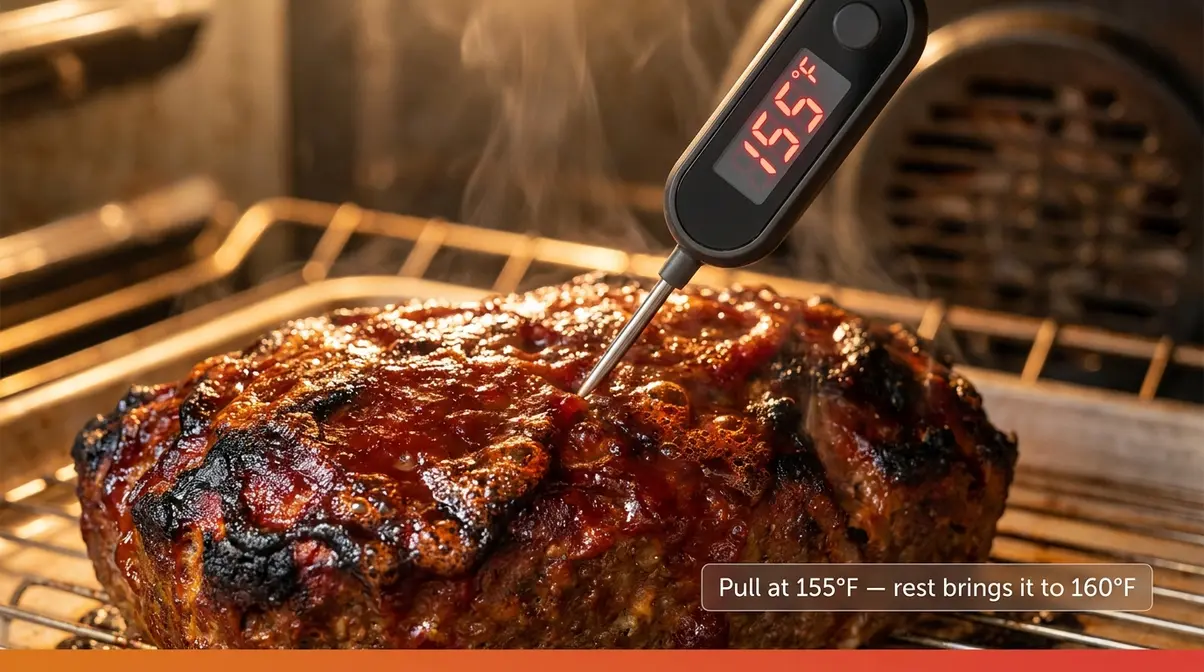
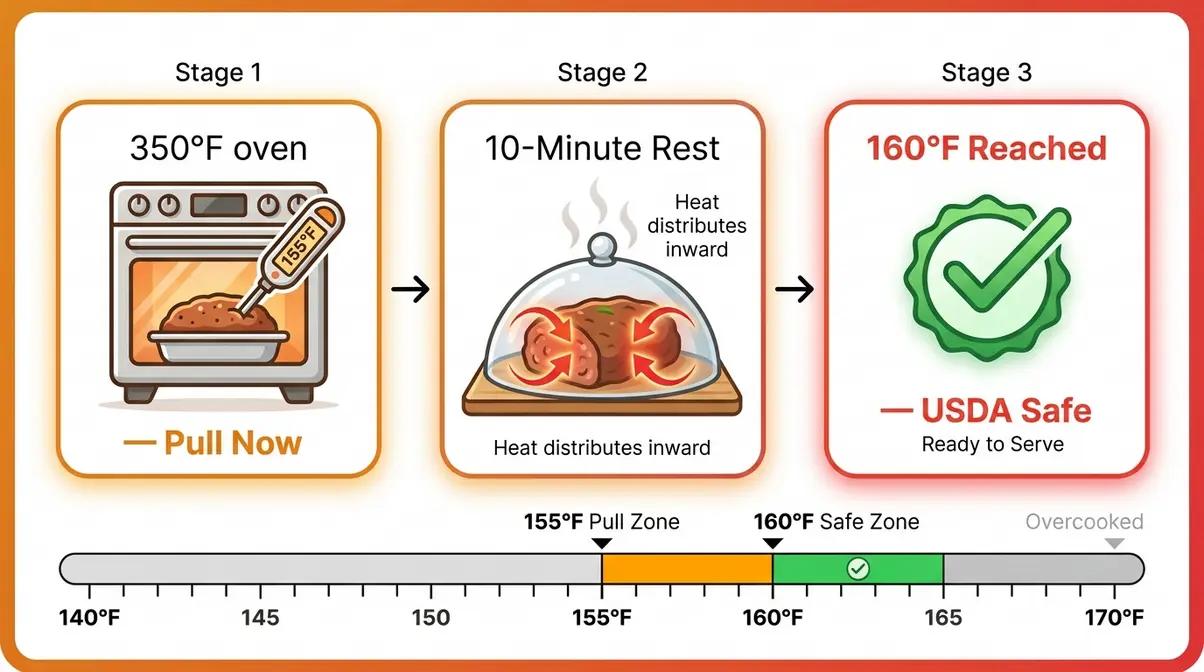
The USDA recommends cooking ground beef to an internal temperature of 160°F (71°C) as the safe minimum (USDA FSIS Safe Minimum Internal Temperature Chart). Here’s the professional cook’s approach: pull the loaf at 155°F and let carryover cooking — the continued rise in internal temperature after the meat leaves the oven, caused by residual heat from the hotter outer layers moving into the cooler center — bring it to 160°F during the mandatory 10-minute rest. This results in a juicier loaf without any food safety compromise.
4 Cooking Method Variations
| Method | Temperature | Time | Notes |
|---|---|---|---|
| Traditional Loaf Pan | 350°F | 55–65 min | Classic method; moister interior, softer crust |
| Sheet Pan (Free-Form) | 350°F | 45–55 min | Crispier exterior; faster since no pan insulation |
| Muffin Tin (Mini Loaves) | 375°F | 20–25 min | Great for meal prep; individual portions cook evenly |
| Air Fryer (Mini Loaves) | 375°F | 12–15 min | Fastest method; shape into 4–6 small loaves about 2 inches thick |
Air fryer notes: Shape the mixture into 4–6 small loaves and air fry at 375°F for 12–15 minutes until the center reaches 155°F, then apply the remaining glaze and cook for 1–2 more minutes until caramelized. Multiple recipe developers testing this method recently report consistent results in this time range (AirFryingFoodie; Dinners Done Quick). Always verify with a thermometer — air fryer wattage varies significantly between models.
For all methods: Insert the thermometer into the thickest part of the center, avoiding the bottom of the pan. Pull at 155°F and rest for 10 minutes. The temperature will climb to 160°F as it rests.
Checkpoint: Your meatloaf thermometer reads 155°F at the center. You’ve applied the second layer of glaze during the last 10 minutes of baking. The glaze looks dark, sticky, and caramelized. Remove from the oven and do not cut yet — the rest period in Step 6 is essential.
How do you speed up meatloaf?
The fastest way to speed up meatloaf is to use the air fryer mini-loaf method. Shape the mixture into 4–6 small loaves about 2 inches thick and air fry at 375°F for 12–15 minutes until the center reaches 155°F. This cuts total cook time from 55+ minutes to about 15–18 minutes. Alternatively, muffin tin mini loaves bake in 20–25 minutes at 375°F in a standard oven. Both methods use the same mixture — only the shape and cooking vessel change. The No-Chop Flavor Bomb also saves 10–15 minutes of prep time compared to recipes requiring chopped vegetables.
Step 6: Rest, Slice, and Serve
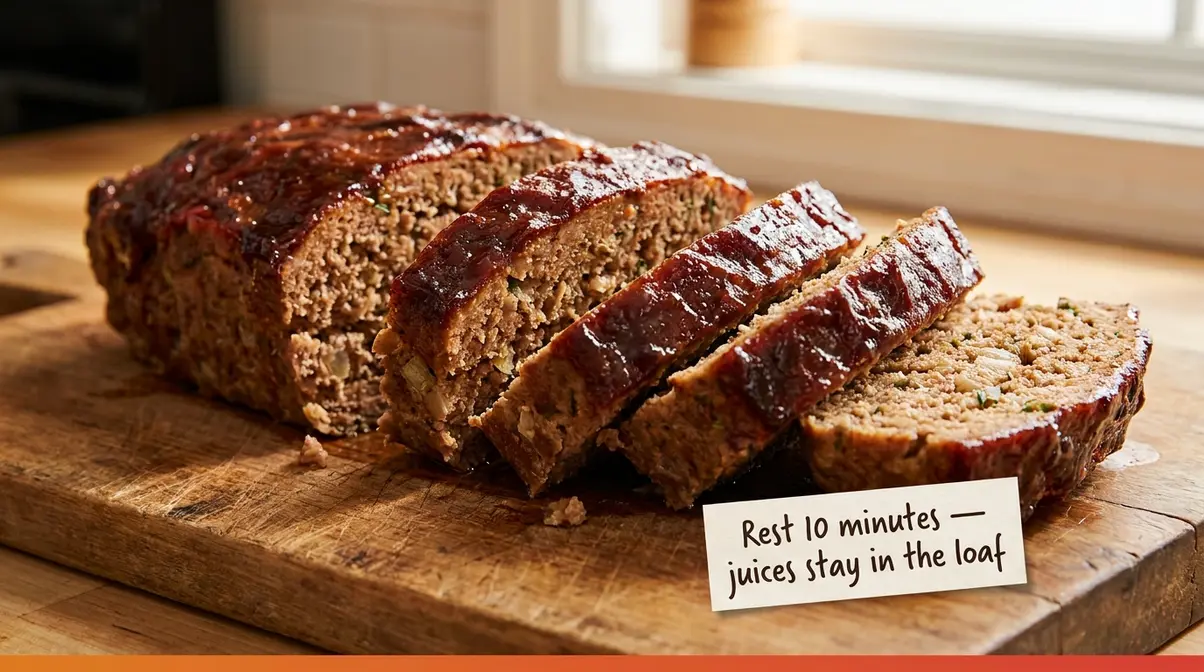
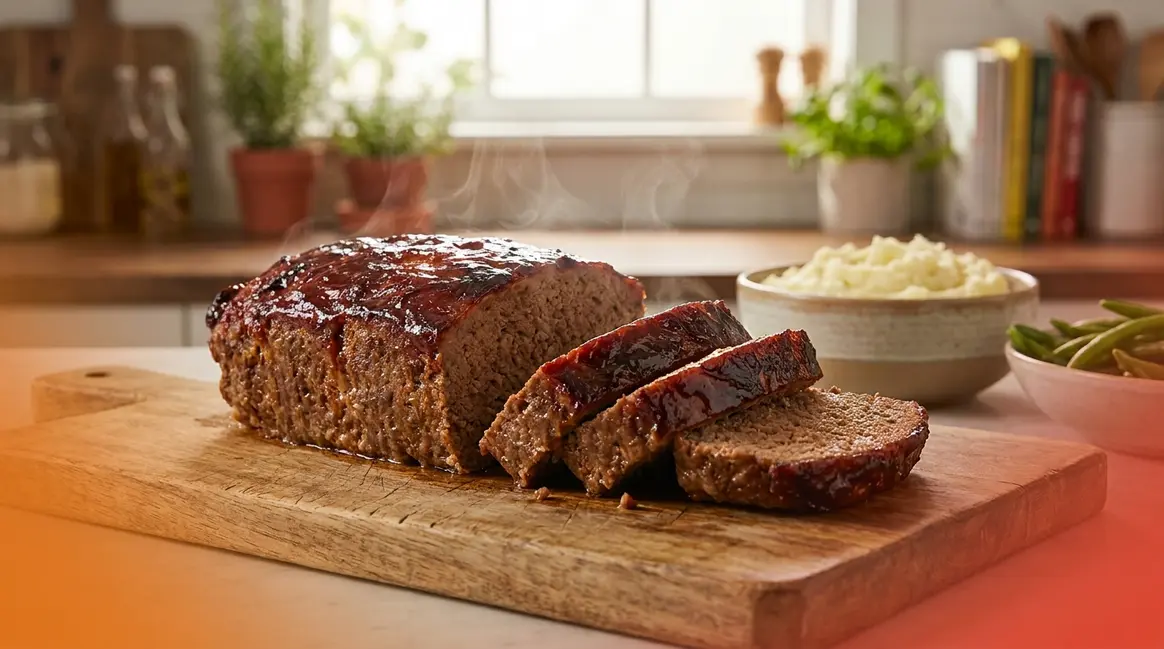
Resting is not optional. When meatloaf comes out of the oven, the juices inside are still actively moving. Cutting immediately forces all of that moisture onto the cutting board instead of staying in the meat. Let the loaf rest, uncovered, for 10 minutes on the pan before slicing.
- Serving instructions:
- After 10 minutes, re-insert your thermometer to confirm the center has reached 160°F.
- Use a sharp knife to slice into 1-inch portions — a sawing motion works better than pressing straight down.
- A standard 1.5-lb loaf yields 6–8 slices, depending on thickness.
Serving suggestions: This easy weeknight meatloaf pairs naturally with mashed potatoes, roasted green beans, or buttered egg noodles. Leftover slices make exceptional sandwiches the next day — the flavors deepen overnight, and the glaze caramelizes further when reheated in a skillet.
Checkpoint: Your meatloaf has rested 10 minutes, reached 160°F, and slices cleanly without crumbling. The interior should look moist and uniform — not pink, not grey and dry. If it slices cleanly and holds together, the No-Chop Flavor Bomb and panade did their job.
For more weeknight dinner ideas that use the same minimal-prep approach, bookmark this easy meatloaf recipe for a no-fuss philosophy you can rely on.
Verify Your Results: What Success Looks Like
A perfectly executed quick and easy meatloaf recipe has a few unmistakable signs. The exterior glaze should be dark, sticky, and slightly caramelized at the edges — not pale or watery. The interior should be uniformly cooked with no pink areas, moist enough that slices hold together without crumbling. When you press a slice lightly, it should feel springy, not stiff.
- Visual success checklist:
- ✅ Dark, caramelized glaze on top and sides
- ✅ No pink in the center (confirmed by thermometer reading 160°F+)
- ✅ Slices hold their shape without falling apart
- ✅ Moist interior — no dry, grey crumbling at the edges
- ✅ Clear juices pooling at the base of the loaf (not red — red juices indicate undercooking)
Troubleshooting triggers: If your loaf crumbled when you sliced it, the mixture was likely overmixed or underbaked. If the exterior is burnt but the interior is still underdone, your oven runs hot — reduce to 325°F next time and extend the baking time. If the glaze looks pale, you may have applied it too early; reserve half for the final 10 minutes as directed in Step 4.
Pro Tips: The Science Behind a Juicy Meatloaf
Home cooks report that understanding why a technique works makes them far more confident executing it. Here are the three science-backed principles behind this recipe’s results.
The Panade: Your Moisture Insurance Policy
The panade is the single most underexplained technique in home meatloaf recipes. As food scientist Jessica Gavin explains, the hydrated starch in a panade coats some of the meat proteins and sets into a gel when heated — so the loaf stays softer and juicier rather than dense and dry (Jessica Gavin’s panade guide). Most beginner recipes just say “add milk” — but adding milk directly to the meat mixture is not the same thing. The breadcrumbs need to absorb the milk first to form the gel that does the actual work.
The ratio matters: 1 cup breadcrumbs to ¾ cup milk is the sweet spot for a 1.5-lb loaf. Too little milk and the panade is dry and crumbly; too much and the mixture becomes too wet to hold its shape. Quick oats at the same ratio produce an almost identical result with a slightly heartier texture — worth trying if you’re out of breadcrumbs.
The 155°F Pull Trick (Carryover Cooking Explained)
Most recipes tell you to bake meatloaf until it hits 160°F — then you pull it out and slice it immediately, wondering why it’s drier than expected. The issue is carryover cooking: when meat is removed from the oven, the hotter outer layers continue transferring heat inward, raising the center temperature by roughly 5–8°F over the next 10 minutes (Thermapen UK; Salt Pepper Skillet). For a meatloaf, that means pulling at 155°F and resting for 10 minutes delivers a final temperature of 160°F — the USDA-safe minimum for ground beef — while keeping the interior noticeably juicier than loaves pulled at 160°F and sliced immediately.
Pull at 155°F. Rest 10 minutes. Confirm 160°F before serving. That sequence is the professional cook’s approach, and it works every time.
The No-Chop Flavor Bomb: Umami Without the Work
The No-Chop Flavor Bomb — Worcestershire sauce, garlic powder, and onion powder used as liquid aromatics — works because Worcestershire is fermented. Fermentation concentrates glutamates (the compounds responsible for umami, or savory depth) in a way that raw onion and garlic simply can’t match without cooking. When you sauté onions and garlic, you’re developing those same savory compounds through the Maillard reaction. Worcestershire delivers them pre-developed, straight from the bottle.
The result: the same deeply savory, aromatic base flavor in 10 seconds of measuring, compared to 15 minutes of chopping and sautéing. For weeknight easyrecipes, that trade-off is the entire point. The No-Chop Flavor Bomb is what makes this a true comfort food recipe that families can pull off on a school night without a second thought.
Easy Variations and Adaptations
One of the best things about a classic meatloaf is how forgiving it is. The core structure — panade + binder + protein + flavor — stays the same; almost everything else is adjustable.
The Minimalist Version (5 Ingredients)
When you genuinely don’t have much on hand, strip it down: ground beef, breadcrumbs, milk, egg, and ketchup. Skip the Worcestershire, garlic powder, and onion powder. The panade still keeps it moist; the ketchup glaze still delivers flavor. Home cooks consistently report that even this bare-bones version satisfies the craving. It’s not as complex as the full No-Chop Flavor Bomb version, but it’s better than no meatloaf at all.
Binder Swaps (When You’re Out of Breadcrumbs)
| Binder | Ratio | Notes |
|---|---|---|
| Plain breadcrumbs | 1 cup per 1.5 lbs beef | Standard — best texture |
| Quick oats | 1 cup per 1.5 lbs beef | Heartier texture; same moisture retention |
| Crushed crackers (Ritz, saltines) | ¾ cup per 1.5 lbs beef | Adds slight saltiness; reduce added salt by ¼ tsp |
| Panko breadcrumbs | ¾ cup per 1.5 lbs beef | Lighter texture; soak time may need an extra minute |
All of these binders work on the same panade principle — they absorb the milk and form a moisture-locking gel. The texture varies slightly, but the result is reliably tender.
Special Dietary Versions
Turkey meatloaf: Substitute 1.5 lbs ground turkey (93/7 lean) for the beef. Note that the USDA safe minimum for poultry is 165°F — pull at 160°F and rest 10 minutes to reach 165°F via carryover cooking. Ground turkey is leaner than 80/20 beef, so the panade is even more critical — don’t skip it.
Gluten-free version: Replace breadcrumbs with certified gluten-free oats or almond flour (¾ cup per 1.5 lbs beef). The panade still forms; texture is slightly denser but still satisfying.
Dairy-free version: Substitute unsweetened oat milk or chicken broth for the whole milk in the panade. The starch gel still forms; flavor is slightly less rich but the moisture-retention effect is preserved.
Scaling up: If you need an easy 2 pound meatloaf recipe, simply increase the ground beef to 2 lbs, use 1 1/3 cups of breadcrumbs, and 1 cup of milk, keeping the single egg and scaling up the glaze slightly.
Troubleshooting Common Meatloaf Problems
Even with a reliable recipe, things sometimes go sideways. Here are the five most common issues home cooks encounter — and exactly how to fix each one.
Problem 1: Dry, crumbly loaf
Cause: Skipped or rushed the panade soak, used lean beef (90/10+), or baked past 165°F internal temperature.
Fix: Always soak breadcrumbs in milk for the full 5 minutes before mixing. Use 80/20 ground beef. Pull at 155°F and rest — don’t push to 165°F for a beef loaf.
Problem 2: Dense, rubbery texture
Cause: Overmixed the meat. Working the mixture too long activates proteins that bind tightly, creating a sausage-like density instead of a tender loaf.
Fix: Mix only until you can no longer see pink streaks — roughly 30–45 seconds of gentle folding. Hands work better than a spoon for texture control.
Problem 3: Loaf falls apart when sliced
Cause: Insufficient binder (not enough breadcrumbs or egg), meat mixture too wet, or sliced before resting.
Fix: Confirm ratios: 1 cup breadcrumbs and 1 egg per 1.5 lbs beef. Let the loaf rest a full 10 minutes before cutting. If the mixture felt very wet before baking, add 2 tablespoons of breadcrumbs next time.
Problem 4: Pale, uncaramelized glaze
Cause: Glaze applied too early and dried out, or oven temperature too low.
Fix: Apply the first layer before baking and reserve the second layer for the final 10 minutes of baking. The second application is what creates the sticky, caramelized finish. If the glaze still looks pale, broil for 2–3 minutes at the end — watch closely.
Problem 5: Undercooked center with overcooked exterior
Cause: Loaf too thick or too cold when it went into the oven, or oven temperature too high.
Fix: Shape the loaf no thicker than 3 inches at the tallest point. Let the mixture sit at room temperature for 10 minutes before baking. If your exterior consistently burns before the center is done, reduce oven temperature to 325°F and extend baking time by 10–15 minutes.
Frequently Asked Questions
How do you make easy quick meatloaf?
Making a quick meatloaf takes about 15 minutes of prep and 55 minutes of baking. Combine 1.5 lbs ground beef (80/20) with a panade of 1 cup breadcrumbs soaked in ¾ cup milk, one egg, and the No-Chop Flavor Bomb (2 tbsp Worcestershire, 1 tsp each garlic and onion powder). Shape, glaze with ketchup and brown sugar, and bake at 350°F until the internal temperature reaches 155°F — then rest 10 minutes. Total active time: under 20 minutes.
What is in Paula Deen’s meatloaf?
Paula Deen’s meatloaf uses ground beef, fresh chopped onion, green bell pepper, saltine crackers as the binder, eggs, milk, and a ketchup-based glaze — a classic Southern-style approach. The main difference from the No-Chop Flavor Bomb method is that Paula Deen’s recipe calls for finely chopped and often sautéed fresh vegetables, which adds 10–15 minutes of prep. Both methods produce flavorful results; the No-Chop approach trades the fresh vegetable sauté for Worcestershire sauce and powdered aromatics on weeknights when prep time is limited.
What is the secret to making a great meatloaf?
The secret to great meatloaf is the panade — breadcrumbs soaked in milk before mixing with the beef. This starch gel physically traps moisture inside the loaf as the proteins contract during baking, preventing the dry, crumbly result most home cooks dread. The second secret is pulling the loaf at 155°F and resting 10 minutes rather than baking to 160°F and slicing immediately. Carryover cooking brings the temperature to the USDA-safe 160°F while keeping the interior noticeably juicier.
What is the basic meatloaf formula?
The basic meatloaf formula is roughly 1 lb ground meat + ¼ cup breadcrumbs + ¼ cup liquid + 1 egg per pound of meat. For a 1.5-lb loaf, that scales to 1.5 lbs beef, 1 cup breadcrumbs, ¾ cup milk, and 1 egg. Season with salt, pepper, and aromatics of your choice. Shape into a loaf approximately 9 inches long and 3 inches thick. Glaze with ketchup. Bake at 350°F until the center reads 155°F, rest 10 minutes, then serve. This ratio produces a loaf that holds its shape and slices cleanly.
What is the one ingredient upgrade for better meatloaf?
Worcestershire sauce is the single biggest upgrade for meatloaf flavor. Most home recipes use it as a minor seasoning (a splash), but treating it as a primary flavor driver — 2 full tablespoons per 1.5 lbs of beef — transforms the depth of the finished loaf. Worcestershire contains fermented anchovies, tamarind, and vinegar, which together deliver concentrated umami depth that raw onion and garlic alone can’t replicate without cooking. It’s the core of the No-Chop Flavor Bomb, and it’s why this recipe stands the test of time even on the simplest weeknights.
Conclusion
For time-pressed home cooks, this quick easy meatloaf recipe delivers a juicy, deeply flavored weeknight dinner in under an hour — without chopping a single vegetable. The panade technique, backed by food science and used in extension-service recipes like Texas A&M’s Dinner Tonight meatloaf, is what keeps the loaf tender. Pulling at 155°F and resting to 160°F — the USDA-safe minimum for ground beef — is what keeps it juicy. Together, these two techniques solve the problems that make most meatloaf attempts disappointing.
The No-Chop Flavor Bomb is what makes this recipe repeatable on school nights. Worcestershire sauce, garlic powder, and onion powder replace the traditional chopping-and-sautéing step without sacrificing the savory depth that makes comfort food worth making. When you understand why each step works — the panade traps moisture, the carryover cooking finishes the job, the liquid aromatics build flavor fast — you stop following the recipe nervously and start cooking with confidence.
Make this recipe tonight. Use the air fryer method if you’re short on time (12–15 minutes for mini loaves), or the traditional sheet pan method for a crispier crust. Either way, your family will be asking you to make it again next week — and you’ll actually want to.

quickdishcook
Recipe developer and writer at Quick Dish Cookbook.