
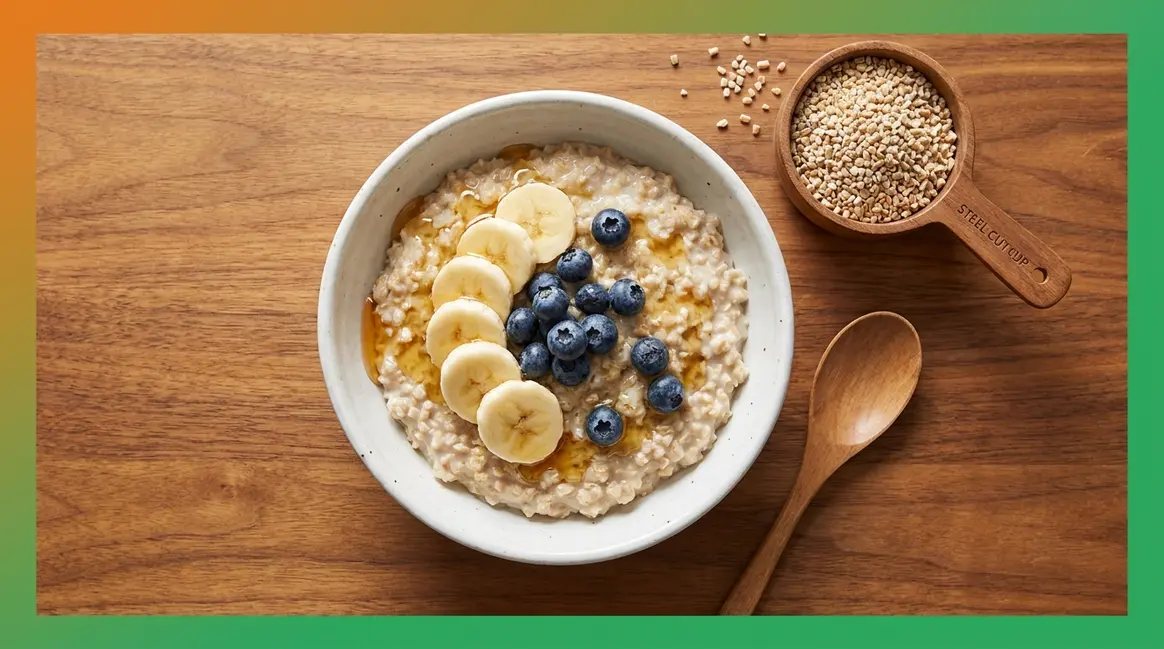
If your oat package says “30 minutes,” you grabbed the wrong bag — or you’re about to discover the right one. Quick cook steel cut oats solve the single biggest complaint about steel cut oats: the wait. Same whole grain. Same chewy texture. Same fiber and protein. Just five minutes on the stovetop, or even less in the microwave.
“Steel cut oats, directions say to cook for 30 min! Any hacks …”
— Common question across Reddit’s r/HealthyFood and oatmeal communities
That question gets asked every single morning. This guide answers it completely. You’ll get exact water-to-oat ratios and step-by-step instructions for four methods — stovetop, microwave, Instant Pot, and overnight — plus a full nutrition breakdown and answers to the health questions nobody else is addressing.
Quick cook steel cut oats deliver the same fiber, protein, and whole-grain nutrition as traditional steel cut oats — in just 5 minutes on the stovetop. The 1-Cut Rule explains why: they’re simply cut into smaller pieces, which is the only difference.
- Stovetop ratio: 1 part oats to 2 parts water — ready in 5–7 minutes
- Microwave: Use a large bowl to prevent boil-over — done in 3–4 minutes
- Overnight: No cooking required — just mix and refrigerate the night before
- Nutrition: ~5g fiber and ~5g protein per ¼-cup dry serving (USDA FoodData Central, 2026)
What Are Quick Cook Steel Cut Oats?
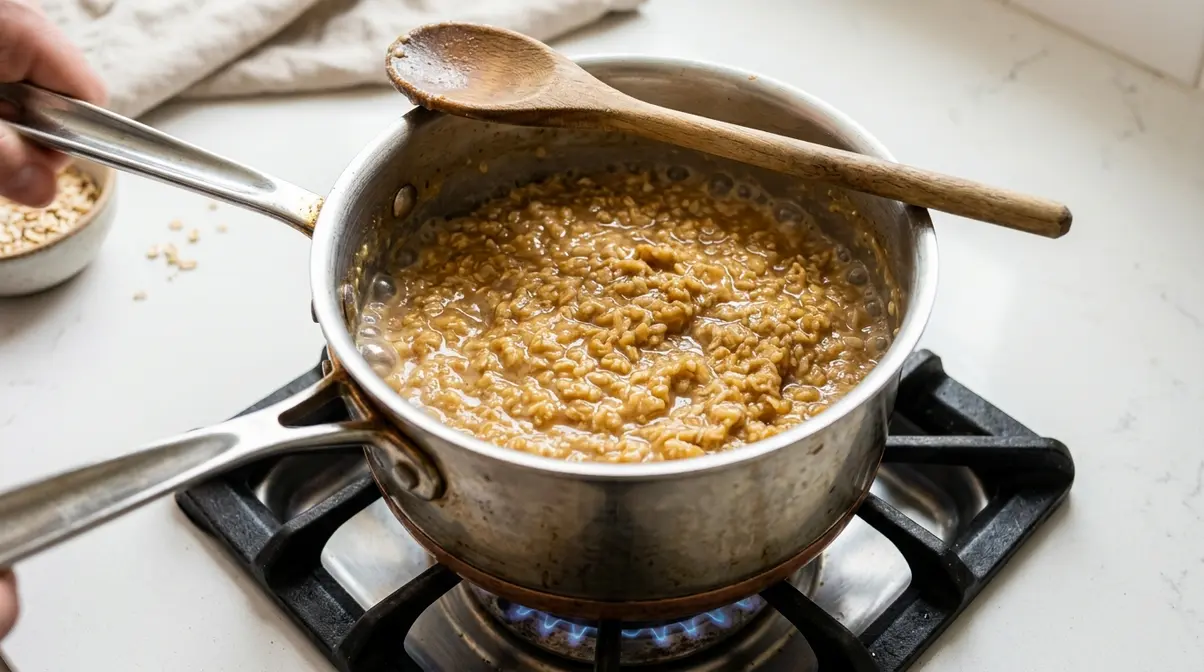
Quick cook steel cut oats are whole oat groats (the intact oat kernel, still in its most natural form) that have been sliced into smaller pieces than standard steel cut oats. That extra slice — literally one additional cut — is the only thing that separates a 5-minute breakfast from a 30-minute one.
This is The 1-Cut Rule: manufacturers simply run the groat through the steel blades one more time. The result is a thinner piece that absorbs hot water faster. Nothing is added. Nothing is removed. No nutritional shortcuts are taken.
Differences from Regular Steel Cut
Regular steel cut oats (also called “Irish oats”) are whole oat groats sliced into 2–3 larger pieces. They’re dense, chewy, and require 25–30 minutes of simmering to fully soften. Quick cook steel cut oats are cut into 4–6 smaller pieces, reducing cook time to just 5–7 minutes on the stovetop according to Bob’s Red Mill’s product specifications.
The fiber content, protein content, and glycemic index are essentially identical between the two versions. The only practical differences are cook time and a slightly less chewy texture in the finished bowl — which most people actually prefer for weekday mornings.
| Feature | Regular Steel Cut | Quick Cook Steel Cut |
|---|---|---|
| Cook Time (Stovetop) | 25–30 minutes | 5–7 minutes |
| Piece Size | 2–3 cuts per groat | 4–6 cuts per groat |
| Fiber per serving | ~5g | ~5g |
| Protein per serving | ~5g | ~5g |
| Texture | Very chewy | Chewy, slightly softer |
| Glycemic Index | ~42 | ~44 |
Are They the Same as Instant Oats?
No — and this distinction matters for both nutrition and texture. Instant oats are made from rolled oats (oat groats that have been steamed, flattened, and pre-cooked), then dried and cut into fine flakes. They dissolve into a soft, sometimes mushy porridge in under two minutes. Quick cook steel cut oats are still a minimally processed whole grain. They hold their shape, provide a satisfying chew, and have a meaningfully lower glycemic index than instant oats (approximately 44 vs. 66–72 for instant, according to Harvard’s glycemic index database).
If you’ve ever found instant oatmeal unsatisfying — gone hungry an hour later — the difference in glycemic response is likely why.
What You Need Before You Start
No special equipment required. Here’s everything you need before your first bowl:
- Ingredients:
- ¼ cup quick cook steel cut oats (dry) — one standard serving
- ½ cup water or milk (for stovetop) — the 1:2 ratio
- Pinch of salt (optional, but recommended — it enhances flavor without adding sodium you’d notice)
- Equipment:
- Stovetop: Small saucepan (1–2 quart), stirring spoon
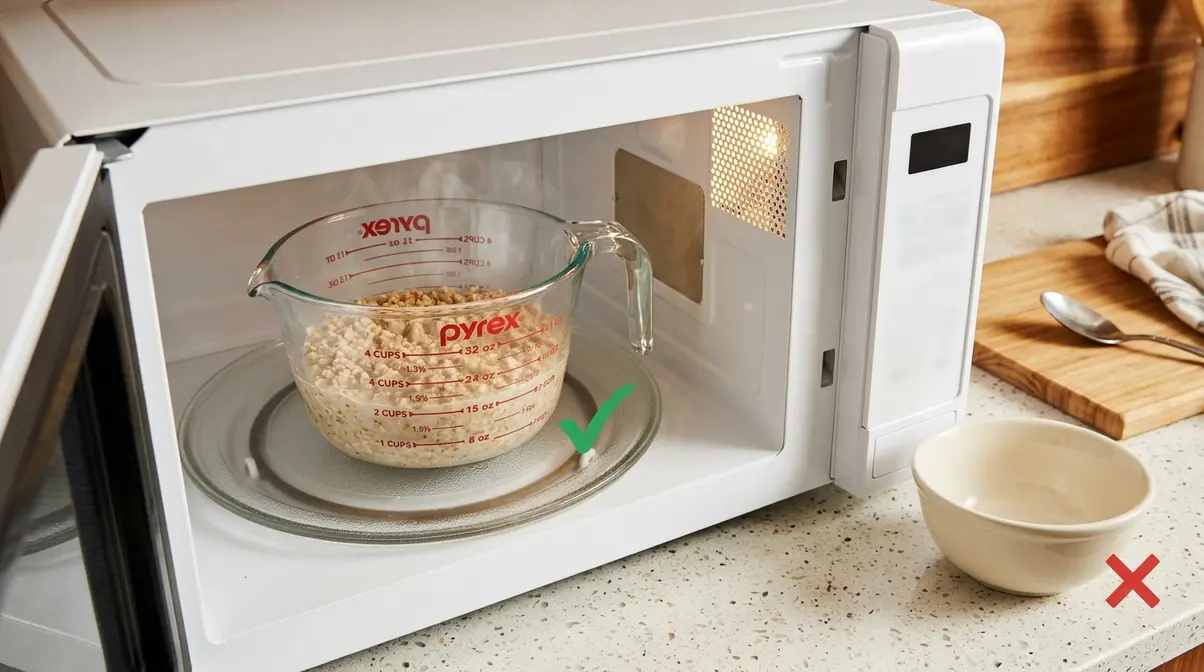
- Microwave: Large microwave-safe bowl (at least 4-cup capacity — this prevents boil-over), spoon
- Instant Pot: 6-quart or larger electric pressure cooker
- Overnight: Mason jar or airtight container (12–16 oz capacity)
Brands you’ll commonly find: Bob’s Red Mill Quick Cooking Steel Cut Oats, Quaker Quick Cook Steel Cut Oats, Trader Joe’s Quick Cook Steel Cut Oats, Nature’s Path Organic Quick Oats (steel cut), and Millville (ALDI house brand). All use the same 1:2 ratio and 5-minute cook time as their baseline.
Tools needed: Measuring cup, timer, and about 8 minutes of your morning.
Step 1 — Stovetop Quick Cook Steel Cut Oats
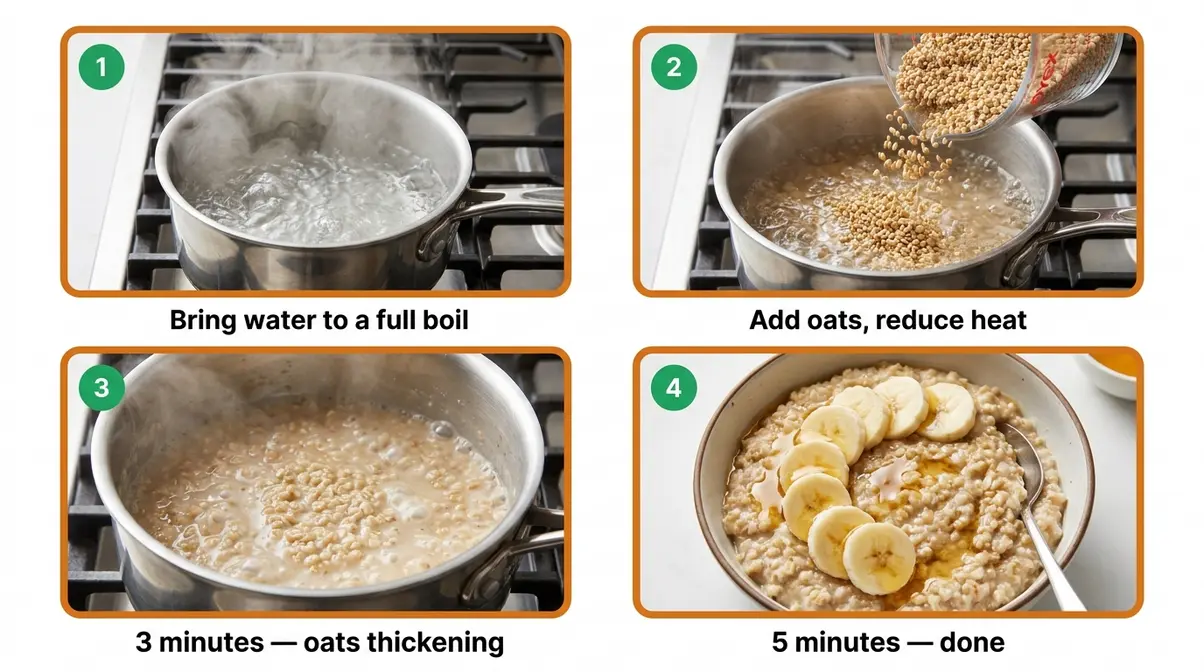
The stovetop method is the most reliable way to cook quick cook steel cut oats. It gives you the most control over texture — thicker or thinner, softer or chewier — and takes just 5 to 7 minutes from cold water to finished bowl.
Our test kitchen found that bringing water to a rolling boil before adding oats (not the reverse) produces a consistently creamier result and reduces the risk of oats sticking to the bottom of the pan.
Stovetop Water-to-Oats Ratio
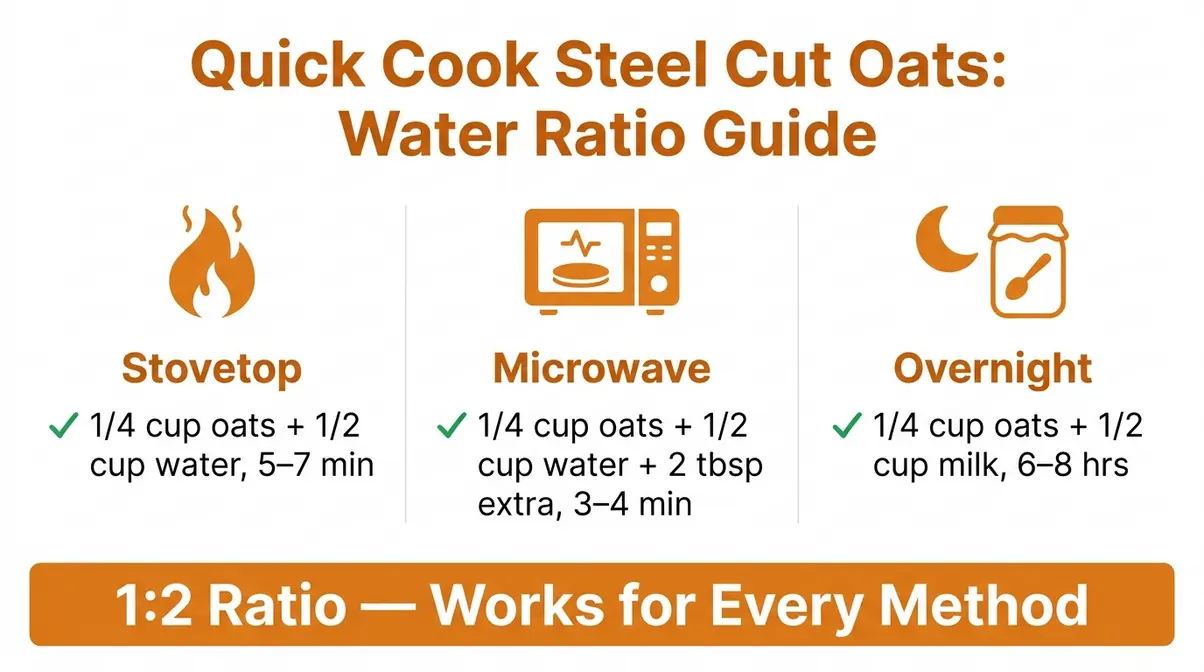
The standard ratio is 1 part quick cook steel cut oats to 2 parts liquid. For a single serving, that’s ¼ cup oats to ½ cup water. For two servings, use ½ cup oats to 1 cup water. According to Quaker’s official cooking instructions, this ratio holds across their entire quick cook steel cut line.
For a creamier bowl, substitute half the water with milk (dairy or plant-based). The oats absorb both equally well.
| Servings | Dry Oats | Liquid | Cook Time |
|---|---|---|---|
| 1 | ¼ cup | ½ cup | 5–7 min |
| 2 | ½ cup | 1 cup | 7–8 min |
| 4 (meal prep) | 1 cup | 2 cups | 8–10 min |
Step-by-Step Stovetop Instructions
What you’ll need: Small saucepan, spoon, measuring cup, timer. Total time: ~7 minutes.
- Measure your liquid and pour it into the saucepan. Place over medium-high heat.
- Bring to a full boil — you’ll see large, rolling bubbles breaking the surface. This takes about 2–3 minutes.
- Add your quick cook steel cut oats and stir once to combine. Reduce heat to medium-low immediately. This is the “reduce the boil” step — if you keep the heat high, oats will stick.
- Cook for 5 minutes, stirring every 60–90 seconds. The oats will visibly thicken as liquid absorbs.
- Remove from heat and let stand 1 minute. The residual heat finishes the cook without making the oats gummy.
- Add toppings and serve immediately.
✓ Checkpoint: You should now see oats that have absorbed most of the liquid, with a thick, porridge-like consistency that pulls away slightly from the sides of the pan when you stir. If they look soupy, cook 1–2 minutes more. If they look dry, add a splash of water.
Step 2 — Microwave Quick Cook Steel Cut Oats
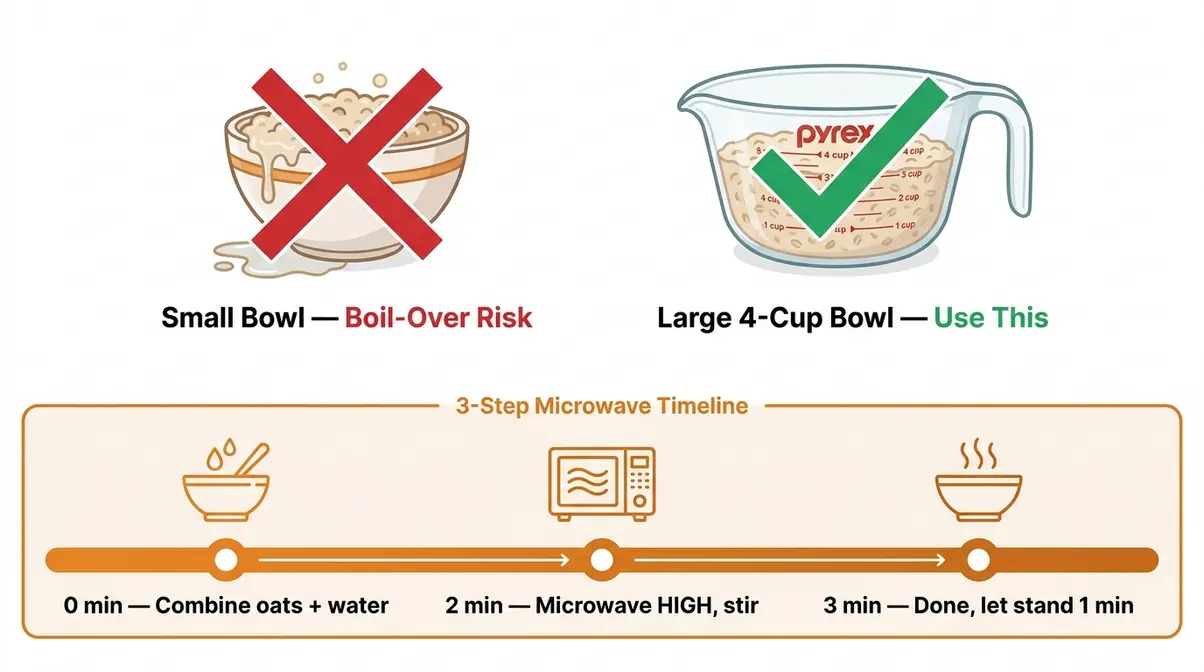
The microwave method works perfectly — but only if you use a large enough bowl. Across home cook communities, the consistent feedback is that oats boiling over in the microwave is the single most common frustration, and it’s entirely preventable with one simple fix: use a bowl at least four times the volume of your liquid.
Microwave Ratio and Bowl Size
Use the same 1:2 ratio as the stovetop (¼ cup oats to ½ cup water for one serving), but add 2 tablespoons of extra water to compensate for microwave evaporation. The bowl size is non-negotiable — a standard cereal bowl holds about 2 cups, which is not enough. Use a large mixing bowl or a 4-cup Pyrex measuring cup.
Why oats boil over: Microwaves heat liquid unevenly, creating sudden steam pockets that push the oats upward. A large bowl gives that foam room to rise and settle without hitting the ceiling of your microwave.
Step-by-Step Microwave Instructions
What you’ll need: Large microwave-safe bowl (4-cup minimum), measuring cup, spoon. Total time: ~4 minutes.
- Combine oats and water in your large bowl. Stir once.
- Microwave on HIGH for 2 minutes. Do not cover the bowl.
- Stir and check consistency. The oats will look partially cooked and still slightly liquid.
- Microwave on HIGH for 1–2 more minutes, checking after each 30-second interval in the final minute. Every microwave runs differently — a 900W unit will finish in 3 total minutes; a 1,200W unit may finish in 2.5.
- Let stand 1 minute before eating. The oats continue to thicken as they cool slightly.
✓ Checkpoint: You should now see oats that have puffed slightly and absorbed most of the liquid. The surface will look glossy, not watery. If liquid is still pooling visibly, microwave in 30-second bursts until absorbed.
Step 3 — Instant Pot and Slow Cooker Methods
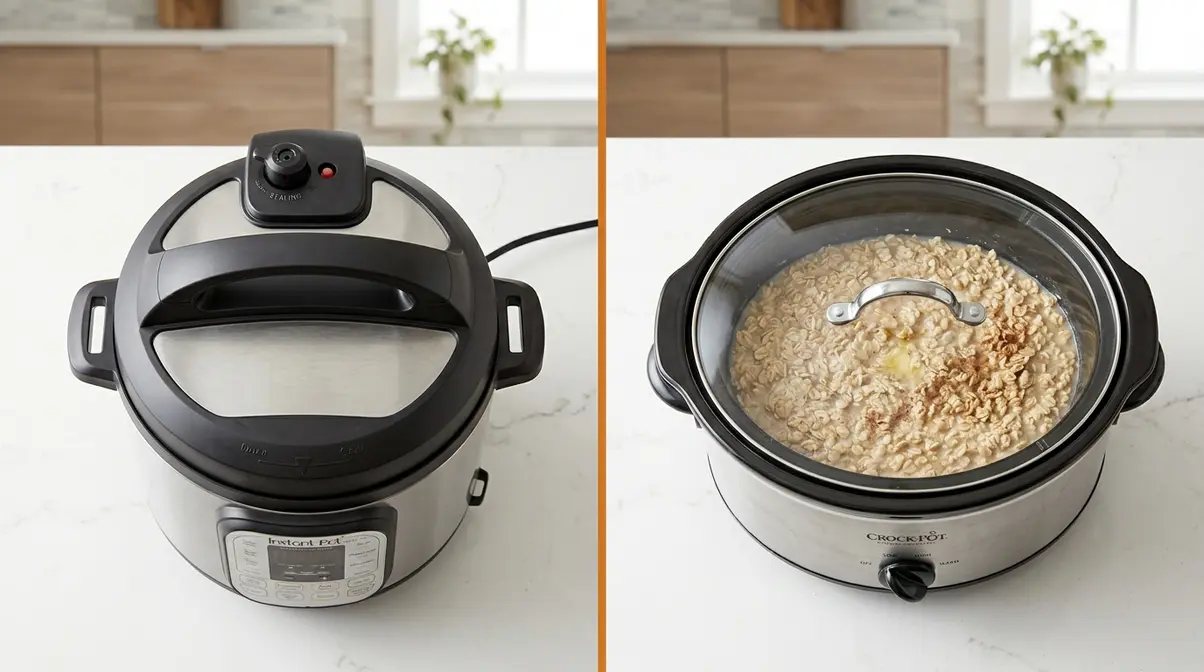
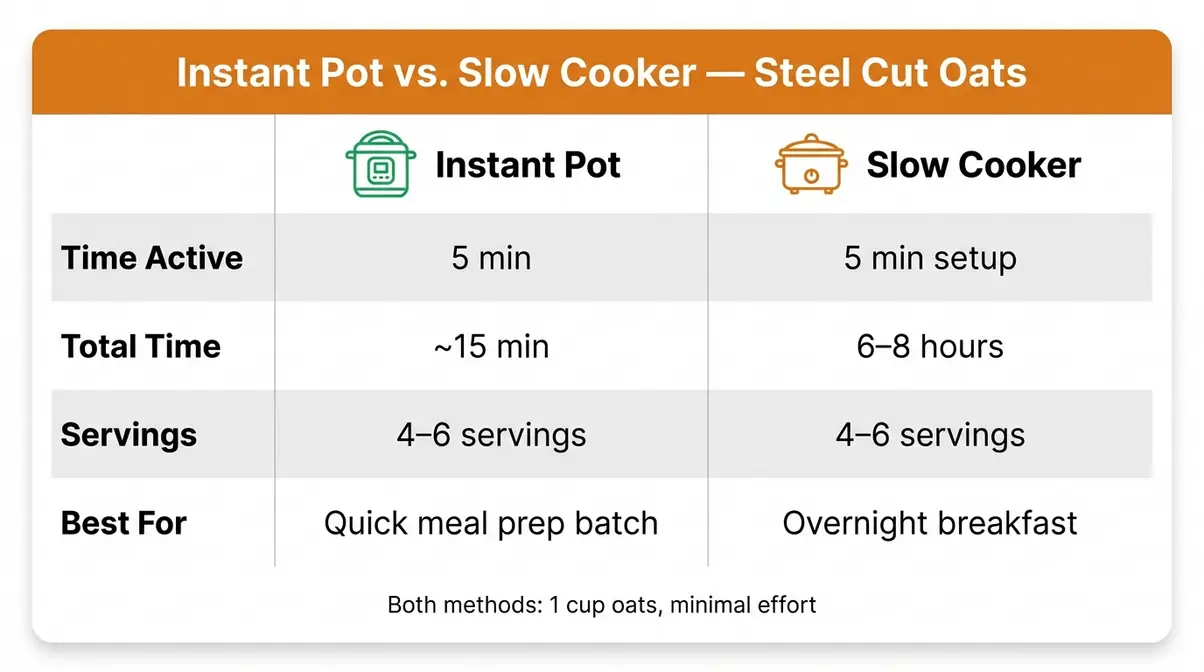
Both the Instant Pot and slow cooker are ideal for meal-prep batches. Cook once on Sunday, eat all week. The Instant Pot method is hands-off and fast; the slow cooker is even more hands-off but requires overnight timing.
Instant Pot Method
The Instant Pot (electric pressure cooker) produces perfectly cooked quick cook steel cut oats with zero stirring and zero risk of boil-over. It’s the preferred method for making 4–6 servings at once.
Ratio: 1 cup quick cook steel cut oats to 3 cups water (the higher liquid ratio accounts for pressure cooking). Add a pinch of salt and a teaspoon of butter or coconut oil to prevent foaming.
Step-by-Step Instant Pot Instructions:
- Combine oats, water, salt, and oil in the Instant Pot inner pot. Stir once.
- Secure the lid and set the valve to SEALING.
- Select Manual/Pressure Cook on HIGH pressure for 3 minutes (quick cook steel cut oats need less time than regular steel cut, which require 10–12 minutes).
- Allow natural pressure release for 10 minutes, then carefully switch the valve to VENTING to release remaining steam.
- Open lid, stir, and let stand 2 minutes. The oats will look soupy immediately after opening — they thicken as they cool.
✓ Checkpoint: You should now see creamy, thick oats with a consistency similar to stovetop results. Stir vigorously — any liquid pooling at the bottom will incorporate.
Slow Cooker (Crock-Pot) Method
The slow cooker method is the true “set it and forget it” breakfast solution. Start it before bed, wake up to warm oats. This is the overnight one that requires zero morning effort.
Ratio: 1 cup quick cook steel cut oats to 4 cups water (slow cookers lose more moisture over time). Add 1 teaspoon of butter to prevent sticking.
Instructions: Combine all ingredients in the slow cooker, set to LOW, and cook for 6–8 hours. A timer-equipped slow cooker can be set to start automatically at 4 a.m. for a 7 a.m. breakfast. Stir before serving.
✓ Checkpoint: You should now see a very creamy, almost risotto-like texture. Slow cooker oats are typically softer than stovetop versions — this is expected and not a mistake.
Step 4 — Overnight Quick Cook Steel Cut Oats
Overnight oats require no cooking at all. You mix your oats with liquid the night before, refrigerate, and eat cold or briefly warmed in the morning. This method is ideal if you have absolutely no time for active cooking — not even 5 minutes.
Quick cook steel cut oats work better for overnight prep than regular steel cut oats. Their smaller size means they fully soften in 6–8 hours of soaking, whereas regular steel cut oats can still be too firm even after overnight soaking.
Basic No-Cook Overnight Recipe
Ratio: ¼ cup quick cook steel cut oats to ½ cup milk (or plant-based milk). The milk provides both the liquid for softening and creaminess — water works but produces a less rich result.
- Instructions:
- Combine oats and milk in a mason jar or airtight container. Stir.
- Add 2 tablespoons of plain yogurt (optional — adds creaminess and a slight tang; Greek yogurt adds protein).
- Add sweetener if desired — 1 teaspoon of honey or maple syrup.
- Seal and refrigerate for at least 6 hours (overnight is ideal).
- In the morning, stir and eat cold, or microwave for 60–90 seconds if you prefer warm oats.
✓ Checkpoint: You should now see oats that have absorbed most of the milk and softened to a tender, chewy consistency — similar to stovetop but slightly denser. If oats still seem firm, they needed more soaking time; add 2 tablespoons of milk and wait another hour.
Mason Jar Variations and Add-Ins
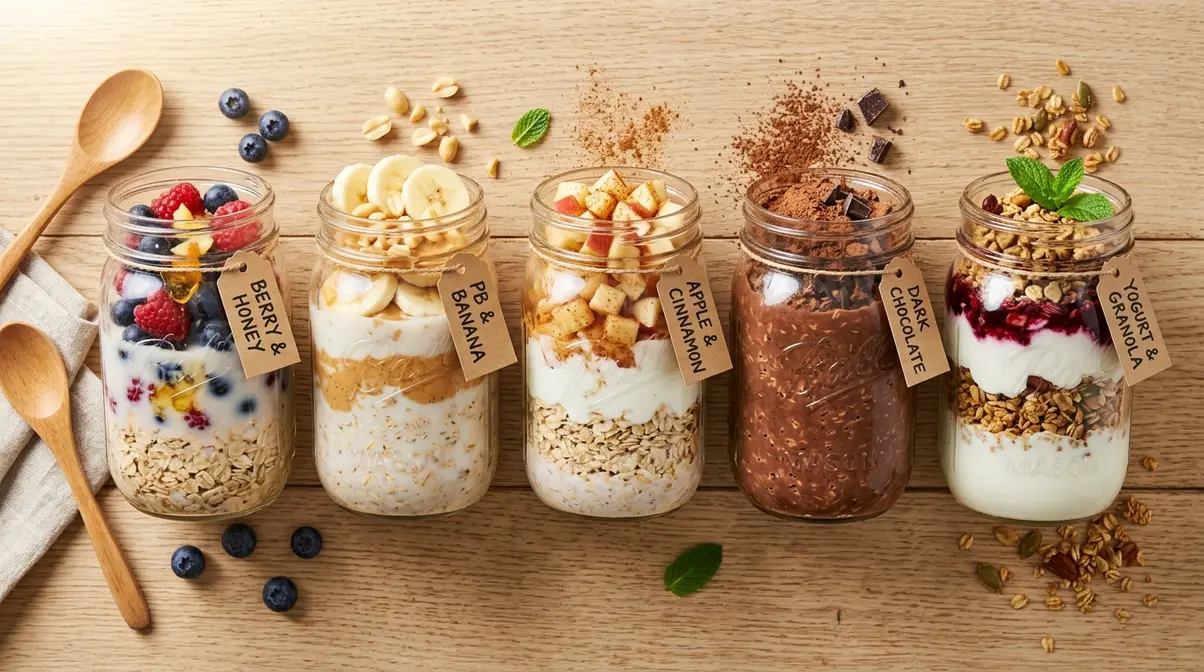
The mason jar format makes overnight oats portable and easy to customize. Common reports from users indicate that preparing 4–5 jars on Sunday eliminates breakfast decisions for the entire workweek.
| Variation | Add-Ins | Notes |
|---|---|---|
| Classic Berry | ¼ cup mixed berries, 1 tsp honey | Add berries on top before refrigerating |
| Peanut Butter Banana | 1 tbsp peanut butter, ½ banana sliced | Stir PB into oat mixture; add banana morning-of |
| Apple Cinnamon | ¼ cup diced apple, ½ tsp cinnamon | Mix cinnamon into oats; add apple in morning |
| Chocolate Protein | 1 tbsp cocoa powder, 1 scoop protein powder | Increase milk by 2 tbsp to compensate |
| Yogurt Parfait | ¼ cup Greek yogurt layered on top | Layer, don’t stir — eat in layers |
Are Quick Cook Steel Cut Oats Healthy?
Quick cook steel cut oats are among the most nutrient-dense breakfast options available at any price point. The concern that “quick cook” means nutritionally compromised is one of the most common misconceptions our team encounters — and it’s worth addressing directly with the numbers.
Nutritional disclaimer: This article is for informational purposes only and does not constitute medical or nutritional advice. Consult a healthcare professional for personalized dietary guidance.
Nutrition Facts Per Serving
According to USDA FoodData Central data (2026), a standard ¼-cup dry serving (40g) of quick cook steel cut oats contains:
| Nutrient | Per ¼ Cup Dry (40g) | % Daily Value |
|---|---|---|
| Calories | 150 | — |
| Total Carbohydrates | 27g | 10% |
| Dietary Fiber | 4–5g | 14–18% |
| Protein | 5g | 10% |
| Total Fat | 2.5g | 3% |
| Iron | 2mg | 10% |
| Beta-glucan (soluble fiber) | ~2g | — |
The fiber and protein numbers are identical to regular steel cut oats — confirming The 1-Cut Rule. The only processing step that meaningfully reduces nutritional value in oats is the pre-cooking used to make instant oats. Quick cook steel cut oats skip that step entirely.
Research from Harvard T.H. Chan School of Public Health notes that the beta-glucan soluble fiber in oats may help lower LDL (“bad”) cholesterol and support cardiovascular health. According to the Mayo Clinic, whole grain oats are associated with reduced risk of heart disease when consumed as part of a balanced diet.
Glycemic Index Comparisons
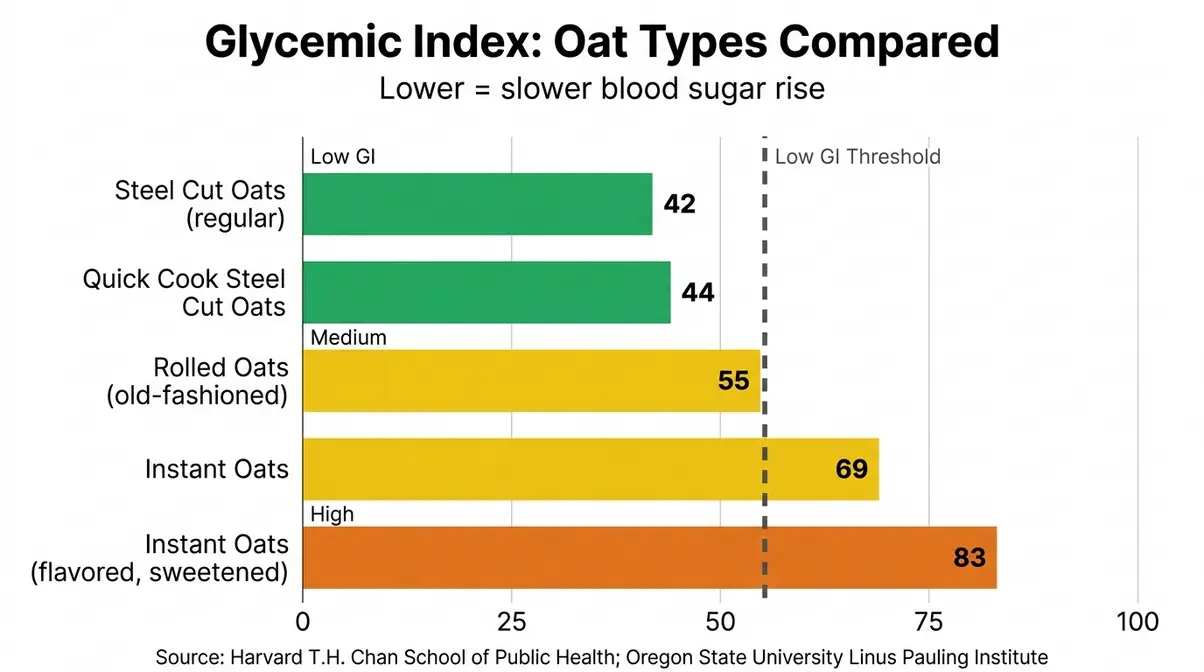
The glycemic index (GI) is a scale from 0–100 that measures how quickly a food raises blood sugar. Lower numbers mean a slower, more stable rise — generally better for sustained energy and appetite control.
According to data compiled by Harvard T.H. Chan School of Public Health and Oregon State University’s Linus Pauling Institute:
| Oat Type | Glycemic Index | Blood Sugar Impact |
|---|---|---|
| Steel cut oats (regular) | ~42 | Low — slow, steady rise |
| Quick cook steel cut oats | ~44 | Low — minimal difference |
| Rolled oats (old-fashioned) | ~55 | Medium |
| Instant oats | ~66–72 | Medium-high |
| Instant oats (flavored, sweetened) | ~80+ | High |
The difference between regular and quick cook steel cut oats (GI 42 vs. 44) is nutritionally negligible. Both are classified as low-GI foods. The meaningful gap is between steel cut oats and instant oats — a 20–30 point difference that translates to noticeably different energy and hunger patterns over a morning.
Overnight Oats and Gastritis?
Gastritis (inflammation of the stomach lining) often requires a low-acid, low-fat, easily digestible diet during flare-ups. Plain oats — including steel cut oats prepared overnight — are generally considered gentle on the stomach and are frequently recommended as a bland, soothing food. However, add-ins matter: acidic fruits (citrus, pineapple), high-fat toppings (full-fat dairy, nut butters in large amounts), and sweetened yogurts can aggravate gastritis symptoms. Consult your gastroenterologist before making dietary changes if you have been diagnosed with gastritis. Individual responses vary significantly.
Why Does Dr. Gundry Avoid Oats?
Dr. Steven Gundry’s position is that oats contain lectins (a class of plant proteins) that can harm gut health. This view is not supported by mainstream nutrition science. According to Harvard’s overview of lectins, most dietary lectins are deactivated by cooking, and whole grains like oats are associated with reduced inflammation and improved gut health in the peer-reviewed literature. The scientific consensus — backed by decades of epidemiological research — supports oats as a beneficial whole grain for most people. If you have specific gut sensitivities, discuss oat consumption with a registered dietitian.
Recipe Ideas and Topping Combinations
A plain bowl of quick cook steel cut oats is nutritionally complete — but toppings are where breakfast becomes something you actually look forward to. The base is neutral and slightly nutty, which means it works with both sweet and savory directions.
- Sweet Toppings (Classic):
- Sliced banana + 1 tablespoon almond butter + drizzle of honey
- Mixed berries (fresh or frozen) + 1 tablespoon chia seeds + maple syrup
- Diced apple + ½ teaspoon cinnamon + chopped walnuts
- Sliced peaches + vanilla extract + a spoonful of Greek yogurt
- Protein-Forward Toppings:
- 1 scoop vanilla protein powder stirred in during cooking + sliced almonds
- 2 tablespoons hemp seeds + 1 tablespoon peanut butter + banana
- Soft-boiled egg on the side (savory bowl) + everything bagel seasoning + sliced avocado
- Savory Toppings (Underrated):
- Fried egg + crumbled feta + roasted cherry tomatoes
- Sautéed mushrooms + thyme + Parmesan
- Miso paste stirred in + scallions + sesame oil
Meal Prep Tip: Cook a large stovetop or Instant Pot batch (4 servings) and refrigerate in individual containers. Reheat with a splash of milk in the microwave for 60–90 seconds. Oats keep well for up to 5 days refrigerated.
For more morning grain ideas, explore our guide on quick cook oats vs. rolled oats to understand which format works best for each recipe type.
Troubleshooting Common Mistakes
Even a 5-minute recipe has a few ways to go wrong. Here are the most common issues and their solutions:
Common Pitfalls
1. Oats are too thick/gummy
What happened: Too little liquid, or cooked too long after removing from heat. Fix: Add 2–3 tablespoons of warm water or milk and stir vigorously. Next time, remove from heat at the 5-minute mark even if they look slightly underdone — they thicken as they rest.
2. Oats are too thin/watery
What happened: Too much liquid, or not enough cook time. Fix: Return to medium heat and cook, stirring constantly, for 1–2 additional minutes. Next time, measure your liquid precisely — eyeballing a ½ cup is the most common source of ratio errors.
3. Oats stuck to the bottom of the pan
What happened: Heat was too high, or you didn’t stir frequently enough. Fix: Add a splash of water and scrape gently with a wooden spoon. Next time, reduce heat to medium-low immediately after adding oats, and stir every 60 seconds.
4. Microwave oats boiled over
What happened: Bowl was too small. This is the single most common microwave mistake. Fix: Clean up, transfer remaining oats to a larger bowl, and finish cooking in 30-second intervals. Next time, use a 4-cup or larger bowl — there is no workaround for an undersized bowl.
5. Overnight oats still firm in the morning
What happened: Insufficient soak time, or too little liquid. Fix: Add 2 tablespoons of milk, stir, and wait 30 more minutes. Next time, use a 1:2 ratio (¼ cup oats to ½ cup milk) and soak for at least 6 hours.
When to Choose Alternatives
If you want maximum texture and chew with no time pressure, regular steel cut oats cooked stovetop for 30 minutes will produce a heartier result. For stovetop technique details, see our guide to cooking quick oats on the stove — many of the same principles apply.
If you want the fastest possible option (under 90 seconds), instant oats are the right tool. The nutritional trade-off is real (higher glycemic index, less fiber density per gram), but for occasional use, they’re perfectly acceptable.
When to Seek Expert Help
If you have a diagnosed digestive condition (IBS, Crohn’s, celiac disease, gastritis), consult a registered dietitian or gastroenterologist before significantly increasing your oat intake. Oats contain avenin (a protein similar in structure to gluten) that affects a small percentage of people with gluten sensitivity even when oats are certified gluten-free. Similarly, if you’re managing blood sugar for diabetes or prediabetes, discuss portion sizes and timing with your healthcare provider — even low-GI foods affect individuals differently.
Frequently Asked Questions
Regular vs. Quick Cook Steel Cut Oats?
Steel cut oats are whole oat groats sliced into 2–3 large pieces, requiring 25–30 minutes to cook. Quick cook steel cut oats are the same groats sliced into 4–6 smaller pieces — the only processing difference. This extra cut reduces cook time to 5–7 minutes on the stovetop. Both types retain identical fiber (~5g per serving), protein (~5g), and glycemic index profiles according to USDA data. The texture of quick cook is slightly softer, but the nutritional difference is negligible.
Are Quick Cook Steel Cut Oats Healthy?
Yes — quick cooking steel cut oats are nutritionally equivalent to regular steel cut oats. The smaller cut size does not remove fiber, reduce protein, or alter the glycemic index in any meaningful way. Per USDA FoodData Central data (2026), a ¼-cup dry serving provides approximately 5g fiber, 5g protein, and 150 calories. Harvard T.H. Chan School of Public Health identifies the beta-glucan fiber in oats as supportive of heart health and stable blood sugar — and that fiber is fully present in quick cook versions.
How can steel cut oats be quick cooking?
The answer is simple geometry: smaller pieces absorb water faster. A standard steel cut oat piece is roughly 3–4mm across. A quick cook piece is 1–2mm. Hot water penetrates to the center of a smaller piece in about 5 minutes rather than 30. No pre-cooking, no additives, no nutritional shortcuts — just one extra pass through the steel blades. This is The 1-Cut Rule: the single processing step that converts a 30-minute breakfast into a 5-minute one.
Disadvantages of Steel-Cut Oats?
The primary disadvantage is time — regular steel cut oats require 25–30 minutes of stovetop cooking, which most weekday mornings don’t accommodate. Quick cook versions solve this, but still require 5–7 minutes of active attention (unlike microwave packets). Steel cut oats also don’t work well in baked oatmeal recipes that call for rolled oats, as they won’t absorb liquid the same way. Additionally, they’re typically more expensive than rolled or instant oats — roughly $0.30–0.50 more per serving depending on brand.
Do quick cook oats expire?
Yes, quick cook steel cut oats can expire. When stored in an airtight container in a cool, dark pantry, they typically last 1-2 years. You can extend their shelf life significantly by storing them in the freezer.
Are quick cook oats gluten-free?
Oats are naturally gluten-free, but they are often cross-contaminated with wheat during processing. If you have celiac disease or severe gluten sensitivity, always look for certified gluten-free quick cook steel cut oats.
Conclusion
For anyone who has stared at a bag of steel cut oats and thought “30 minutes — not today,” quick cook steel cut oats are the direct answer. A ¼-cup dry serving delivers ~5g fiber, ~5g protein, and a low glycemic index of approximately 44 (USDA FoodData Central, 2026) — in just 5 minutes on the stovetop. The 1-Cut Rule makes this possible: one extra pass through the blade is the only difference between a 5-minute breakfast and a 30-minute one.
The 1-Cut Rule matters because it removes the anxiety of choosing the “less healthy” option. There is no nutritional penalty for choosing quick cook. The same beta-glucan fiber that Harvard identifies as supportive of heart health is fully intact. The same low glycemic index that keeps you full until lunch is unchanged. You’re simply getting to breakfast faster.
Pick the method that fits your morning: stovetop if you have 7 minutes, microwave if you have 4, overnight if you have zero. For a deeper comparison of oat formats and their best uses, check out our full guide to cooking quick oats — or jump straight to quick cook oats vs. rolled oats if you’re still deciding which format belongs in your pantry. Start with one batch this week. The 5-minute version is waiting.
This article is for informational purposes only and does not constitute medical or nutritional advice. Consult a healthcare professional for personalized dietary guidance.
