How Long Does Seafood Last in the Fridge? Safety Guide

“Dad is reheating fried fish from the Friday fish fry over 10 days ago. Feels wrong. How long does leftover fish last in the fridge?”
What’s in this guide
- What Is the Seafood Fridge Life & Safety Matrix?
- Seafood Fridge Life Quick Reference Guide
- The 5-to-7 Day Myth: Smelling Fine Isn't Enough
- How to Tell If Seafood Has Gone Bad
- Advanced Storage Techniques for Seafood
- How to Store a Leftover Seafood Boil
- How Long Do Specific Seafood Dishes Last?
- Common Seafood Storage Mistakes to Avoid
- Seafood Fridge Life FAQs
- Keeping Seafood Safe at Home
That gut feeling is right. Ten-day-old fish is not safe to eat — and the danger isn’t always visible.
Here’s what makes seafood especially risky: harmful bacteria like Listeria and Vibrio can grow on fish that still looks fine and smells acceptable. According to the FDA, food contaminated with Vibrio parahaemolyticus “may look, smell, and taste normal” — meaning your senses can’t always protect you (FDA, 2026). Understanding how long does seafood last in the fridge isn’t just a matter of avoiding a bad smell. It’s about avoiding a genuine health risk.
⚠️ Food Safety Disclaimer: The storage times in this guide are based on USDA, FDA, and NOAA guidelines and represent the maximum safe storage window under ideal conditions (fridge at or below 40°F / 4°C). Individual results vary based on freshness at purchase, handling, and refrigerator temperature. When in doubt, throw it out. This article is for general information only and does not replace professional food safety advice.
By the end of this guide, you’ll know exactly how long your specific seafood is safe — and how to spot the warning signs before it’s too late. We cover raw fish, live shellfish, cooked leftovers, seafood boils, and specific dishes — all backed by government sources.
Key Takeaways: How Long Does Seafood Last in the Fridge?
How long does seafood last in the fridge? Raw fish and shellfish last 1–2 days; cooked seafood lasts 3–4 days (USDA, 2026).
- Raw fish (salmon, cod, tuna): 1–2 days at or below 40°F (4°C)
- Cooked seafood (shrimp, crab, lobster): 3–4 days in an airtight container
- Live shellfish (oysters, clams, mussels): Up to 7 days if shells close when tapped
- The 5-day myth is dangerous: Harmful bacteria can grow invisibly after 4 days — discard cooked seafood regardless of smell
- The Seafood Fridge Life & Safety Matrix below covers 10+ species with exact timelines, cross-referenced from FDA, USDA, NOAA, and Washington State DOH
What Is the Seafood Fridge Life & Safety Matrix?
Seafood is a broad category covering four main groups: finfish (like salmon and cod), shellfish (like oysters and clams), crustaceans (like shrimp and crab), and cephalopods (like squid). This guide covers all four. And all four spoil faster than chicken, beef, or pork — often much faster.
The Seafood Fridge Life & Safety Matrix is the species-specific, raw-vs-cooked reference framework at the center of this guide. Our editorial team cross-referenced 8 government and academic sources — including the FDA, USDA FSIS, NOAA Fisheries, NIH, Oregon State University, Washington State DOH, and Clemson University Extension — to build a single resource that maps more than 10 seafood types against verified storage windows and spoilage risk levels. No more guessing based on a generic “1–2 days” estimate.
According to the FDA refrigerator and freezer storage chart, all raw fish and shellfish should be stored at or below 40°F (4°C) — the threshold that slows (but does not stop) bacterial growth (FDA, 2026). The NOAA guidelines for fresh fish storage confirm that fresh fish should generally be consumed within 2 days of purchase as a practical rule of thumb (NOAA, 2026).
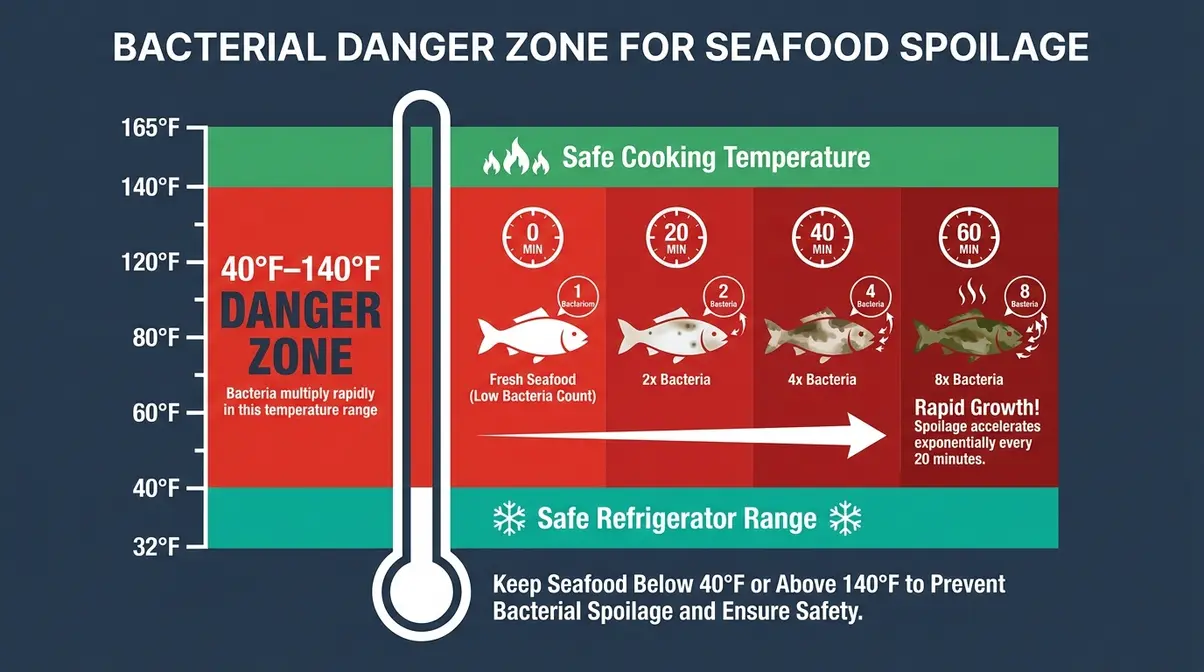
Now that you understand why seafood is time-sensitive, here are the exact storage windows for every major type — organized by species, raw vs. cooked.
Why Seafood Spoils Faster Than Meat
Seafood spoils 2–3× faster than red meat because its protein structure breaks down rapidly above 40°F (4°C) — a fact confirmed by NOAA Fisheries and the FDA’s cold food storage guidelines.
The first reason is bacterial origin. Unlike land animals, fish carry psychrotrophic bacteria (cold-adapted bacteria that keep multiplying even in your refrigerator) because they live in water that naturally contains these microbes. Think of it like buying produce that already has compost bacteria on it — the clock starts the moment it leaves the water. Listeria monocytogenes and Vibrio species are particularly concerning because they thrive in cold, moist conditions and can be present without any visible or olfactory warning signs (FDA, 2026).
The second reason is high water activity — the moisture content in fish flesh. Wet environments accelerate bacterial growth in the same way that wet bread molds faster than dry crackers. Fish muscle has significantly higher water activity than beef or pork, which is why fresh tuna bought Monday morning may smell off by Wednesday night, even if it looked perfect at the store.
The third factor is enzymatic breakdown. Fish enzymes continue dissolving muscle tissue after death, degrading texture even before bacteria cause safety concerns. This is why raw fish turns mushy faster than raw chicken — it’s chemistry, not just contamination.
Oregon State University’s explanation of seafood spoilage notes that bacteria in aging seafood produce specific compounds responsible for the distinct “fishy” odors and discolorations associated with spoilage (Oregon State University Extension, 2026). Cold doesn’t stop spoilage — it only slows it.
Understanding how long does fresh seafood last in the fridge starts with accepting this: your refrigerator is not a pause button. It’s a slow-motion button.
“With that science in mind, here are the exact numbers — organized by species — so you never have to guess again.”
How quickly does seafood spoil?
Raw seafood begins spoiling within hours at room temperature and can reach unsafe bacterial levels within 2 hours above 40°F (FDA, 2026). In the refrigerator at 40°F, raw fish spoils within 1–2 days. The speed of spoilage depends on the starting bacterial load, fridge temperature, and handling. Fish carried cold-adapted (psychrotrophic) bacteria from their aquatic environment — these keep multiplying even in the refrigerator, which is why even properly chilled seafood has a short shelf life compared to beef or poultry.
Seafood Fridge Life Quick Reference Guide
Most raw seafood lasts 1–2 days in the fridge; cooked seafood lasts 3–4 days. But the exact timeline depends on the species. The Seafood Fridge Life & Safety Matrix below — built from FDA, USDA, and NOAA data — gives you the specific numbers for more than 10 common types. Use it as your go-to reference every time you bring seafood home.
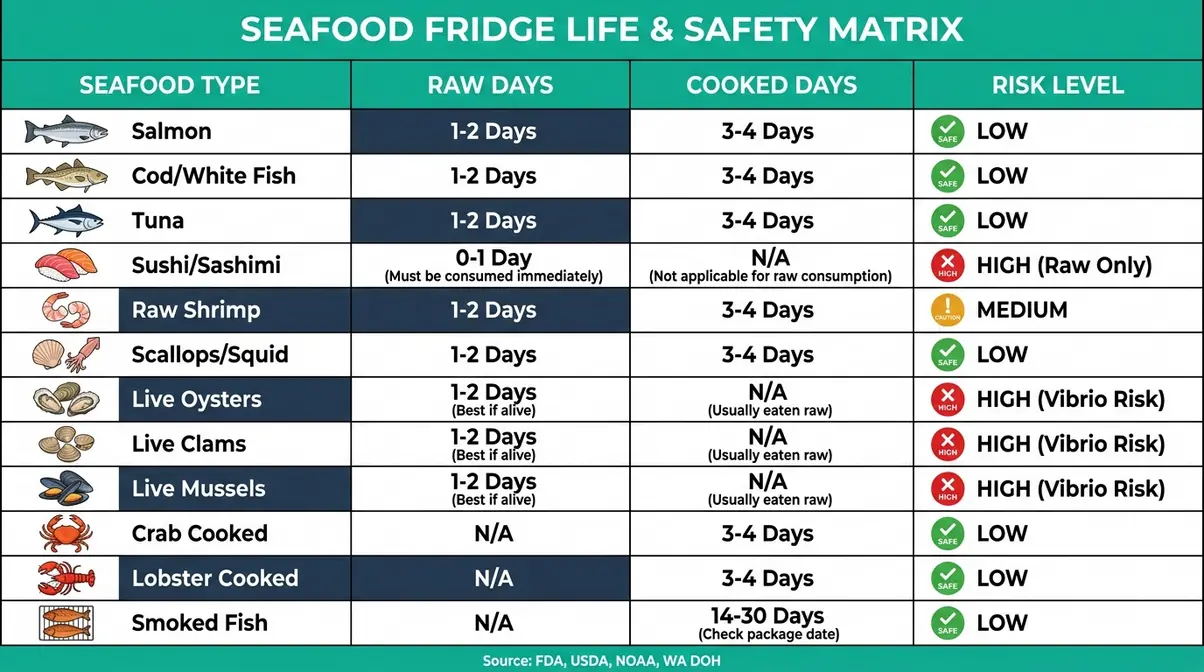
| Seafood Type | Raw (Days in Fridge) | Cooked (Days in Fridge) | Notes |
|---|---|---|---|
| Salmon | 1–2 | 3–4 | Store at back of fridge (coldest spot) |
| Cod / White Fish | 1–2 | 3–4 | Lean fish; absorbs odors easily |
| Tuna (fresh) | 1–2 | 3–4 | Sushi-grade: consume same day if possible |
| Sushi / Sashimi | 1–2 | N/A | Best within 24 hours; use coldest shelf |
| Raw Shrimp | 1–2 | 3–4 | Shell-on keeps slightly longer than peeled |
| Scallops / Squid | 1–2 | 3–4 | Very delicate; aim for 1 day raw |
| Live Oysters | Up to 7 | 3–4 (shucked) | Must close when tapped; see shellfish section |
| Live Clams | Up to 7 | 3–4 | Store in mesh bag, not sealed plastic |
| Live Mussels | Up to 5 | 3–4 | Discard any that don’t open when cooked |
| Crab (cooked whole) | 3–5 | 3–5 | Refrigerate within 2 hours of cooking |
| Lobster (cooked) | 3–4 | 3–4 | Keep in airtight container |
| Smoked Fish | 14 | 14 | Commercially smoked; check package date |
Sources: FDA Cold Food Storage Chart (2026); NOAA Fisheries; USDA FSIS; Washington State DOH.
All times assume storage at or below 40°F (4°C) in an airtight container.
What this means for you: An airtight container is any container with a sealed lid that blocks air and odors — a zip-lock bag with the air pressed out, a glass container with a snap lid, or a plastic tub with a tight-fitting cover all qualify. The moment air gets in, bacterial growth accelerates.
Raw Fish: Salmon, Tuna, and White Fish
How long does salmon last in the fridge? Raw salmon, cod, tuna, tilapia, and halibut all follow the same guideline: 1–2 days maximum in the refrigerator. According to NOAA guidelines for fresh fish storage, a reliable rule of thumb is to consume fresh fish within 2 days of purchase — but that means 2 days from the moment it was caught or processed, not 2 days from when it starts smelling off (NOAA Fisheries, 2026).
Here’s a practical way to think about it: if you bought salmon on Monday for a Wednesday weeknight dinner, cook it Monday or Tuesday — or freeze it immediately. Waiting until Wednesday is borderline, and Thursday is too late.
A few species-specific notes:
- Salmon: Fatty fish like salmon hold up marginally better than very lean white fish because fat slows bacterial surface colonization. However, 2 days remains the hard limit — don’t stretch it.
- Cod and white fish: Lean fish absorbs odors from neighboring foods in the fridge. Store it in an airtight container toward the back of the bottom shelf, where temperatures are coldest.
- Sushi-grade tuna and sashimi: These are best consumed the same day. How long does sushi last in the fridge? If you must store it, use the coldest part of your refrigerator (back of the bottom shelf) and consume within 24 hours. After that, the texture and safety both deteriorate.
For more details, check our general seafood storage guidelines.
Is raw shrimp ok in fridge 3 days?
Raw shrimp kept for 3 days in the fridge is past the safe storage window. The FDA and USDA both recommend using raw shrimp within 1–2 days of purchase (FDA, 2026). By day 3, bacteria on raw shrimp — including Vibrio species that naturally inhabit shrimp — have had enough time to multiply significantly, even at refrigerator temperatures. If you have raw shrimp that has been in the fridge for 3 days, check it carefully for sliminess, off-odors, or discoloration — and when in doubt, throw it out.
Shellfish — oysters, clams, and mussels — follow a different set of rules because they’re still alive when you bring them home.
Live Shellfish: Oysters and Clams
Here’s a fact that surprises most home cooks: live oysters and clams can safely stay in your refrigerator for up to 7 days — far longer than raw fish fillets. The reason is biological. Live shellfish are still alive and actively maintaining their own cellular defenses, which limits bacterial growth in a way that dead fish flesh cannot.
The Washington State Department of Health shellfish storage guidelines note that shellfish capable of closing their shells completely — such as oysters and butter clams — can be safely stored in the fridge for up to seven days (WA DOH, 2026). Mussels are slightly more delicate: aim for 5 days maximum.
The tap test is your essential safety check before cooking any live shellfish:
- Pick up the shellfish and tap the shell firmly against a hard surface or tap two shells together.
- A live shellfish will close its shell in response to the tap.
- If the shell stays open after tapping, the shellfish is dead — discard it immediately.
- Do not cook or eat shellfish that fail the tap test.
One critical storage rule: never store live shellfish in a sealed plastic bag. They are living creatures that breathe through their shells. A sealed bag suffocates them, causing them to die prematurely and spoil quickly. Instead, place them in a mesh bag or an open bowl covered with a damp cloth in the refrigerator.
Bought oysters for a Friday dinner party? If purchased on Monday, they’re still safe — but perform the tap test on every single one before serving.
Once your seafood is cooked, the clock resets — but it doesn’t stop.
Cooked Seafood Storage Times
How long can cooked fish stay in the fridge? According to the USDA FSIS, cooked seafood — fish, shrimp, crab, lobster, and scallops — lasts 3–4 days in the refrigerator when stored in an airtight container at or below 40°F (USDA FSIS, 2026).
How long does cooked shrimp last in fridge? The answer is the same: 3–4 days. After day 4, discard cooked shrimp regardless of how it looks or smells. Bacteria can produce toxins that survive even after the bacteria themselves are killed by reheating — so appearance is not a reliable safety indicator.
Cooked crab and lobster are slightly more conservative. Clemson University Extension lists cooked crab, lobster, and shrimp as safe for 2–3 days in the refrigerator (Clemson University Extension, 2026). The USDA gives 3–4 days for cooked fish. For safety, use the more conservative number for shellfish: plan to eat cooked crab and lobster within 2–3 days.
One more critical rule: the 2-hour rule. Cooked seafood left at room temperature for more than 2 hours (or 1 hour when the ambient temperature is above 90°F) must be discarded — not refrigerated. Bacteria multiply rapidly at room temperature, and chilling food that has already been in the danger zone for too long will not make it safe again (FDA, 2026).
A practical example using meal-prep language: leftover shrimp stir-fry from Tuesday’s weeknight dinner is safe through Friday. Saturday? Toss it without hesitation.
The key insight from the matrix: live shellfish outlast raw fish fillets, and cooked seafood always lasts longer than raw. Hold onto that framework — the next section explains why some people dangerously ignore it.
The 5-to-7 Day Myth: Smelling Fine Isn’t Enough
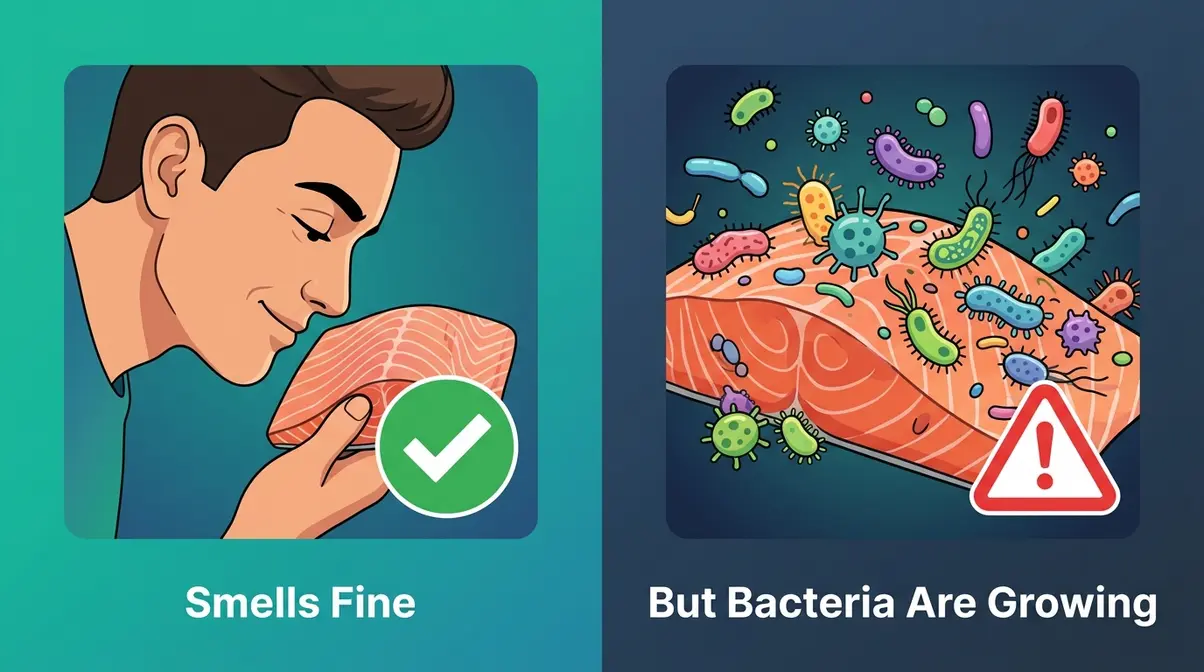
The most dangerous belief in home food safety is this: “If it doesn’t smell bad, it’s still safe to eat.” For seafood, that logic can send you to the hospital.
The “5-to-7 days is fine” myth persists because people often eat borderline seafood without getting sick — and survivorship bias does the rest. But the absence of symptoms doesn’t mean the food was safe. It means you got lucky. According to the CDC’s 2026 Vibrio surveillance data, among U.S. patients with domestically acquired vibriosis who reported eating seafood, 44% had eaten oysters, 43% had eaten shrimp, and 39% had eaten fish — most of which likely appeared normal before consumption (CDC, 2026).
Government food safety guidelines are minimums, not guarantees. When in doubt, throw it out.
The Invisible Bacterial Danger
Two pathogens make seafood uniquely risky beyond the standard spoilage timeline:
Listeria monocytogenes is a cold-tolerant bacteria that can continue growing in your refrigerator, even at temperatures as low as 34°F. It doesn’t produce obvious odors or visible signs. Ready-to-eat seafood — like smoked salmon, refrigerated crab meat, and pre-cooked shrimp — is especially high-risk because it isn’t cooked again before eating. In May 2024, crab meat from Irvington Seafood Inc. was recalled after 14 of 94 tested samples came back positive for Listeria monocytogenes — and no illnesses had yet been reported at the time, meaning the contamination was invisible to consumers (FDA recall notice, 2024).
Vibrio vulnificus and Vibrio parahaemolyticus are particularly dangerous in raw and undercooked shellfish. The FDA has explicitly warned that oysters contaminated with V. parahaemolyticus “may look, smell, and taste normal” (FDA, 2026). For people with liver disease, diabetes, or compromised immune systems, Vibrio infection can be life-threatening.
The key insight: cold slows bacterial growth but does not stop it. After 4 days, even properly refrigerated cooked seafood has accumulated enough bacterial load to pose real risk.
Why Bacteria Win After Day 4
Think of refrigeration like a dimmer switch, not an off switch. Bacteria that multiply every 20 minutes at room temperature still multiply — just more slowly — at 40°F. After 4 days of refrigerator storage, even a small initial bacterial population has gone through enough doubling cycles to reach dangerous levels.
This is why the USDA’s 3–4 day limit for cooked seafood is a hard cutoff, not a suggestion. The FDA’s Fish and Fishery Products Hazards and Controls Guidance specifies maximum cumulative exposure times for Listeria at different temperature ranges — at standard refrigerator temperatures (around 40°F), the maximum safe window is approximately 7 days for controlled commercial seafood processing, and significantly less for home conditions where temperatures fluctuate every time the door opens (FDA, 2026).
For home cooks, the practical takeaway is simple: day 4 is your absolute limit for cooked seafood, and day 2 is your limit for raw. After that, the risk outweighs any savings from avoiding food waste.
How to Tell If Seafood Has Gone Bad
The best approach to seafood safety is following the timeline — not waiting for signs of spoilage. However, recognizing the 4 key warning signs can help you catch seafood that has spoiled before its expected expiration due to poor handling, temperature fluctuations, or lower initial freshness.
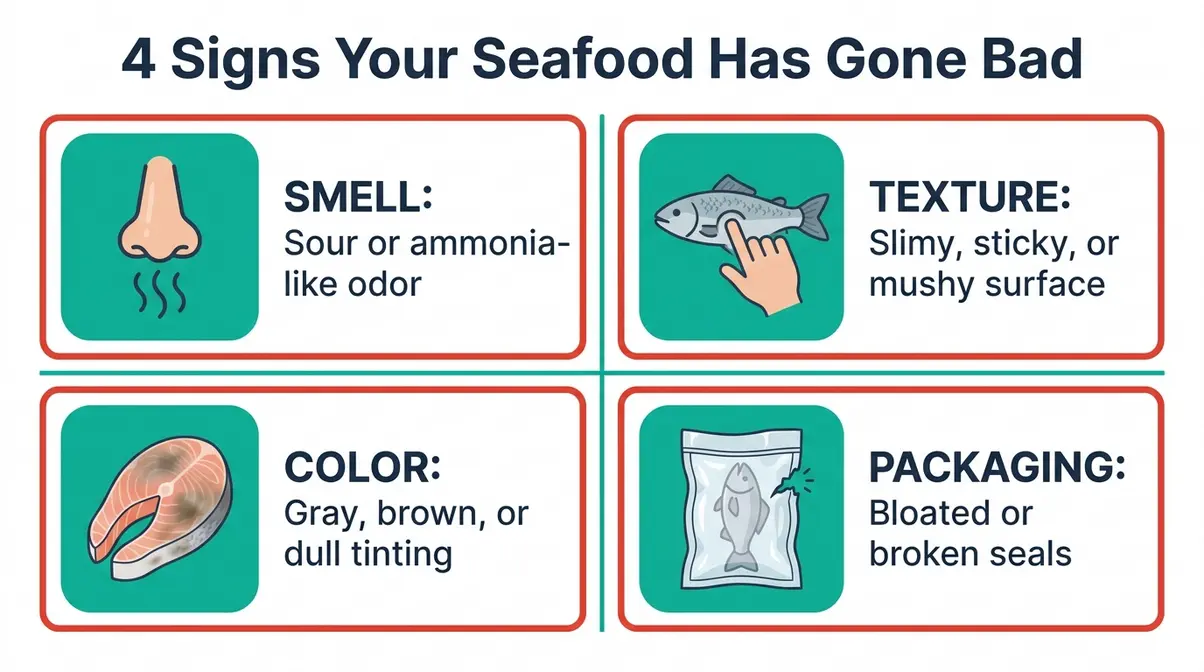
Sign 1: The Smell Test
Fresh raw fish should smell like the ocean — clean, briny, and mild. A sour, ammonia-like, or strongly “fishy” odor is the clearest sign of bacterial spoilage. The distinctive “fishy” smell comes from trimethylamine (TMA), a compound produced when bacteria break down fish proteins. The stronger and more sour the smell, the more advanced the spoilage.
However — and this is critical — the absence of a bad smell does not guarantee safety. Pathogens like Listeria and Vibrio do not produce the same odor compounds that cause the classic “off fish” smell. Research confirms that contaminated seafood can smell perfectly normal while harboring dangerous bacterial loads (Oregon State University Extension, 2026).
Sign 2: The Texture Check
Run your finger across the surface of raw fish. Fresh fish should feel firm and slightly moist — not slimy, sticky, or mushy. A slippery, mucus-like coating on the surface is a reliable sign of bacterial activity. Similarly, raw fish flesh that feels soft or falls apart when gently pressed has undergone significant enzymatic breakdown and should not be eaten.
For cooked seafood, watch for a slimy coating that wasn’t there when it was first cooked. That slick film is a biofilm — a community of bacteria establishing themselves on the food’s surface.
Sign 3: The Color Check
Raw fish should have vibrant, consistent color. Salmon should be deep pink to orange. White fish should be translucent to white. Tuna should be deep red or pink. Warning signs include:
- Grayish or brownish tinting on flesh that should be pink
- Yellow or green discoloration anywhere on the fish
- Dull, opaque appearance in fish that should look translucent
- Dark edges or dried-out patches on fillets (sign of prolonged storage)
For shellfish: live oysters and clams should have clear, slightly milky liquid inside. Cloudy, discolored, or dried-out interiors indicate spoilage.
Sign 4: The Packaging Check
This sign is often overlooked. Check the packaging before you even open it. Bloated, puffed-up, or swollen packaging on vacuum-sealed seafood is a serious red flag — it indicates gas-producing bacterial activity inside. Broken seals on vacuum-packed fish allow oxygen in and dramatically accelerate spoilage. Any packaging that looks inflated or compromised should result in the product being discarded without opening.
Additionally, check the original purchase date and “use by” or “best by” date. According to NOAA Fisheries, the freshness clock starts at the point of catch or processing — not the point of purchase (NOAA, 2026). If the store has been holding the fish for several days before you bought it, your 1–2 day window may already be partially used.
Advanced Storage Techniques for Seafood
Following the USDA and FDA storage timelines assumes your refrigerator is at or below 40°F and that your seafood is stored optimally. Most home refrigerators run warmer than their settings suggest — especially near the door or in the top shelf area. These three techniques can help you maximize freshness within the safe storage window.
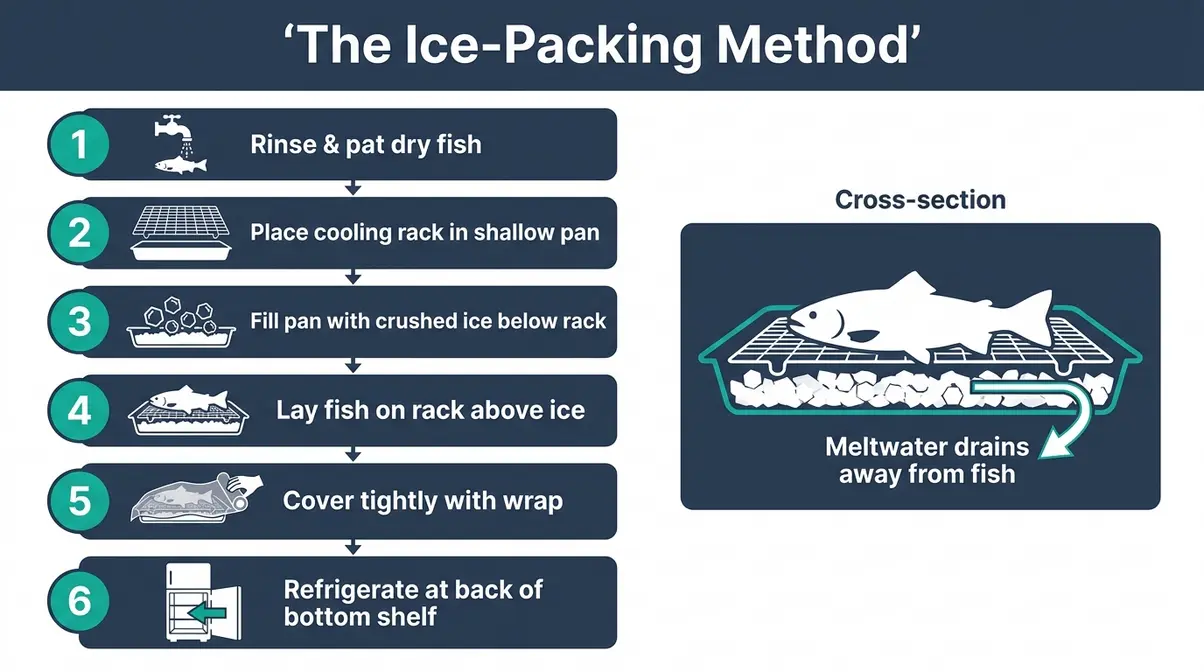
The Ice-Packing Method
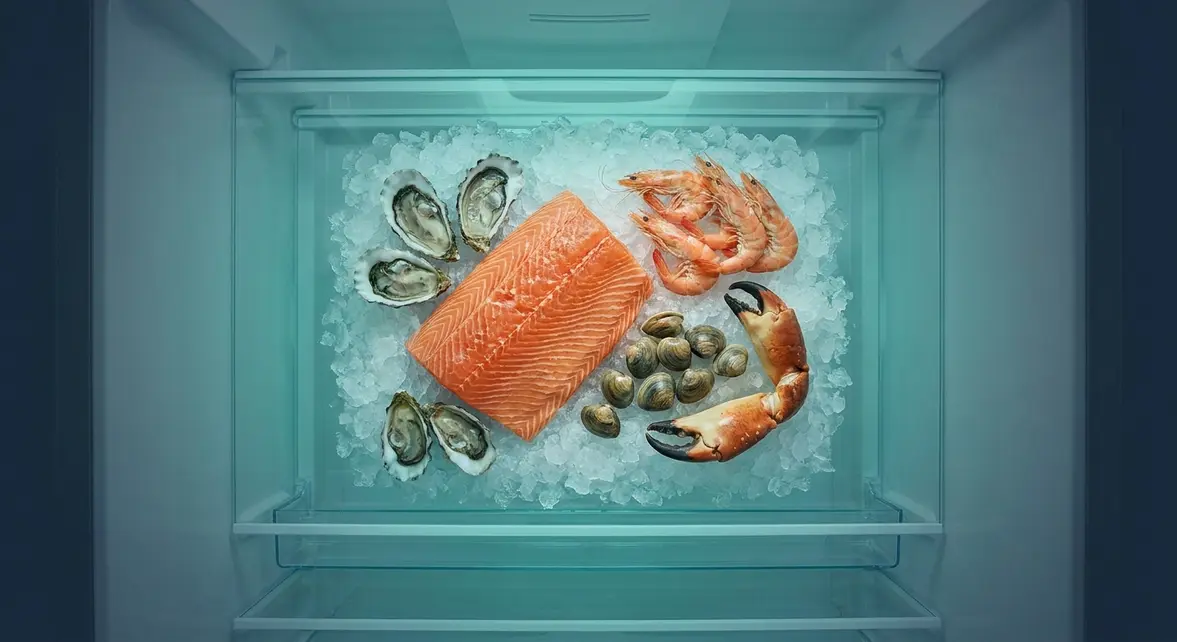
Professional seafood kitchens never rely on standard refrigerator shelves alone. They store fish directly on ice — and you can replicate this at home. NOAA Fisheries recommends storing fresh fish as close to 32°F (0°C) as possible, achieved by surrounding it with crushed ice in the refrigerator (NOAA, 2026).
Here’s how to do it at home:
- Remove the store packaging and rinse fish briefly under cold running water. Pat dry with paper towels.
- Place a cooling rack inside a shallow pan or roasting dish.
- Fill the pan with crushed ice so the level sits just below the rack — the fish should rest on the rack, above the ice, not submerged in meltwater.
- Lay fish in a single layer on the rack. Cover tightly with plastic wrap or foil.
- Refrigerate immediately and place in the coldest part of the fridge — the back of the bottom shelf.
- Drain meltwater and refresh ice every 24 hours if storing for more than one day.
The key is keeping the fish cold and dry. Fish sitting in meltwater deteriorates faster than fish resting on ice because the water accelerates bacterial growth and texture breakdown.
The Airtight Container Method
For cooked seafood and shellfish that can’t be ice-packed, an airtight container is non-negotiable. The goal is to block two things: oxygen (which accelerates oxidation and bacterial growth) and cross-contamination from other foods in the fridge.
Follow these steps:
- Let cooked seafood cool slightly — no more than 30 minutes at room temperature before refrigerating. Never let it sit out for more than 2 hours total.
- Transfer to a clean airtight container with a snap or screw-top lid. Glass containers are ideal because they don’t absorb odors.
- Press plastic wrap directly onto the surface of the seafood before sealing the lid — this eliminates the air gap above the food.
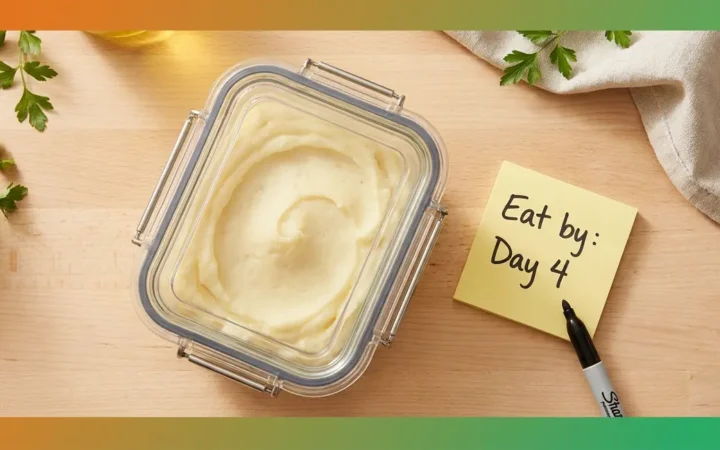
- Label with the date using a piece of tape and a marker. This removes all guesswork about how long it’s been in the fridge.
- Store on the bottom shelf toward the back of the refrigerator, never in the door (door temperatures fluctuate most).
Freezing as a Safety Net
If you bought seafood and know you won’t use it within the safe raw window (1–2 days), freeze it immediately — don’t wait until day 2. According to the FDA’s storage chart, lean fish like cod can be frozen for 6–8 months, fatty fish like salmon for 2–3 months, and cooked seafood for 4–6 months (FDA, 2026).
The critical rule: thawed seafood must be treated as fresh raw seafood. The original frozen date becomes irrelevant once it’s thawed. Use thawed raw fish within 1–2 days and never refreeze previously frozen seafood without cooking it first.
This is especially useful when meal prepping with seafood.
How to Store a Leftover Seafood Boil
A seafood boil — with crab, shrimp, corn, sausage, and potatoes — is one of the most common leftover challenges in home kitchens. The mix of ingredients means different components have different shelf lives, but the rule is simple: follow the shortest timeline in the pot.
How Long Does Seafood Boil Last?
Leftover seafood boil should be refrigerated within 2 hours of cooking and consumed within 2–3 days. This is the consensus from multiple food safety sources, and it applies to the entire dish — not just the seafood components (Clemson University Extension, 2026).
Here’s the breakdown by component:
| Component | Refrigerator Life | Freezer Life |
|---|---|---|
| Cooked shrimp | 3–4 days | 2–3 months |
| Cooked crab | 2–3 days | 2–3 months |
| Corn on the cob | 4–5 days (stored dry) | 10–12 months |
| Potatoes / sausage | 4–5 days (stored dry) | 2–3 months |
| Mixed seafood boil | 2–3 days | 2–3 months |
Because the seafood and non-seafood components are stored together and share cooking liquid, you should follow the 2–3 day limit for the whole dish. The shrimp or crab won’t wait for the potatoes to catch up.
Storing Leftover Seafood Boil
- Estimated Time: 10 minutes
- Tools & Materials Needed:
- Airtight glass or plastic containers
- Zip-top bags
- Marker and tape for labeling
- Slotted spoon for draining liquid
- Don’t let it sit. Get leftovers into the refrigerator within 30 minutes of finishing the meal — ideally faster. The 2-hour rule is a maximum, not a target.
- Separate components if possible. Transfer seafood (shrimp, crab, lobster) into one airtight container and vegetables (corn, potatoes, sausage) into a separate one. This lets you use the vegetables for an extra day or two after the seafood is gone.
- Drain excess liquid. Store components dry, not marinating in cooking liquid. Liquid accelerates bacterial growth and turns textures mushy faster.
- Use airtight containers. Zip-lock bags with air pressed out work well. Glass containers with snap lids are even better.
- Label with the date. Write the date on the container with a marker — especially important for seafood boil, where the mix of aromas can mask early spoilage signals.
- Refrigerate at or below 40°F. Place containers on the bottom shelf, away from the door.
Reheating Leftover Seafood Boil Safely
Reheat seafood boil to an internal temperature of 165°F (74°C) before eating. Use a food thermometer to verify — don’t rely on the “steam test.” Reheating methods that work well include:
- Stovetop: Add a small amount of water or broth to a covered pan and heat over medium heat for 5–7 minutes, stirring occasionally.
- Microwave: Cover loosely and heat in 60-second intervals, stirring between each, until steaming throughout.
- Oven: Spread in a single layer on a baking sheet, cover with foil, and heat at 350°F for 10–15 minutes.
Never reheat seafood boil more than once. Repeated heating and cooling cycles create multiple opportunities for bacterial growth in the danger zone.
How Long Do Specific Seafood Dishes Last?
Individual seafood dishes have slightly different storage windows depending on ingredients, sauces, and cooking methods. Here’s a practical breakdown for the most common leftover scenarios.
Cooked Shrimp and Shrimp Dishes
Cooked shrimp lasts 3–4 days in the refrigerator in an airtight container at or below 40°F (USDA FSIS, 2026). This applies to plain cooked shrimp, shrimp stir-fry, shrimp pasta, and shrimp cocktail.
One important note for shrimp cocktail: the cocktail sauce is often left at room temperature during serving. If the shrimp and sauce sat out for more than 2 hours during a party, discard both — regardless of how much is left. The 2-hour rule applies to the serving period, not just the storage period.
Cooked shrimp freezes very well. For meal prepping, cook a large batch, portion into airtight bags, and freeze for up to 3 months. Thaw overnight in the refrigerator — never on the counter — and use within 24 hours of thawing.
If you’re wondering how long it takes for shrimp to go bad, the answer is always tied to these strict temperature guidelines.
Can shrimp stay in fridge 5 days?
No — raw shrimp should not stay in the fridge for 5 days. Raw shrimp lasts only 1–2 days in the refrigerator at or below 40°F. Cooked shrimp lasts 3–4 days. Shrimp is particularly delicate; its high moisture content and fine protein structure make it one of the fastest-spoiling seafood types. If you bought shrimp and know you won’t cook it within 1–2 days, freeze it immediately. Frozen raw shrimp keeps well for 3–6 months (FDA, 2026).
Cooked Fish Fillets and Fish Dishes
How long can cooked fish stay in the fridge? Plain cooked fish fillets — baked salmon, grilled cod, pan-seared tilapia — last 3–4 days in the refrigerator (USDA FSIS, 2026). Fish in sauce or with vegetables is slightly shorter: plan for 2–3 days because the added moisture accelerates bacterial activity.
Fried fish — like the Friday fish fry mentioned at the top of this guide — follows the same 3–4 day cooked fish rule. Ten-day-old fried fish is not safe, full stop. Even the frying process, which kills bacteria on contact, does not prevent re-contamination during storage or protect against toxins that bacteria may have already produced before cooking.
Reheating fried fish is safe if done within the 3–4 day window and heated to an internal temperature of 145°F (63°C).
Crab, Lobster, and Clam Dishes
Cooked crab and lobster last 2–3 days in the refrigerator — slightly shorter than fish because shellfish proteins break down faster after cooking (Clemson University Extension, 2026). Crab cakes, lobster bisque, and clam chowder follow the same 2–3 day guideline.
For whole cooked crab, refrigerate it within 2 hours of cooking. Remove the meat from the shell before storing when possible — meat in the shell takes longer to cool to a safe temperature throughout, which extends the time spent in the danger zone. Store crab meat in a clean airtight container, not the original shell.
Smoked Fish and Lox
Commercially smoked fish — including lox, smoked salmon, smoked trout, and smoked mackerel — has a significantly longer refrigerator life than fresh fish: up to 14 days, as noted in the FDA storage chart (FDA, 2026). This is because the smoking process creates an antimicrobial environment through salt, heat, and smoke compounds.
However, once opened, commercially smoked fish should be consumed within 5–7 days. Always check the package “use by” date — it supersedes the general guideline. After opening, store smoked fish tightly wrapped in its original packaging or transferred to an airtight container.
Common Seafood Storage Mistakes to Avoid
Even well-intentioned home cooks make predictable errors when storing seafood. These are the most common mistakes that shorten shelf life or create food safety risks.
Mistake 1: Trusting the Smell Test Alone
Relying on your nose to decide whether seafood is safe is the single most dangerous habit in home kitchens. As covered in the spoilage section, pathogens like Listeria and Vibrio produce no detectable odor. The FDA’s explicit warning that contaminated shellfish “may look, smell, and taste normal” applies to many seafood pathogens, not just Vibrio (FDA, 2026).
The correct approach: follow the timeline first, use your senses as a secondary check. If the seafood is within its safe window but smells off, discard it. If it’s past its safe window but smells fine, still discard it. The smell test can tell you when seafood has definitely gone bad — it cannot tell you when it’s definitely safe.
Mistake 2: Wrong Storage Location
Most home refrigerators have warm spots near the door and top shelves, and cold spots at the back of the bottom shelf. Seafood should always go in the coldest available spot — the back of the bottom shelf. Storing raw fish in the refrigerator door, where temperatures fluctuate with every opening, can cut the safe storage window significantly. Additionally, raw seafood should always be stored below cooked food and ready-to-eat items to prevent cross-contamination from drips.
Other common location mistakes include:
- Leaving seafood in the grocery bag on the counter while putting away other groceries — refrigerate seafood first
- Storing live shellfish in the crisper drawer, which is often warmer than the main fridge compartment
- Placing seafood near strong-smelling foods without airtight protection — fish absorbs odors rapidly
Review our food safety storage tips for more context on temperature control.
Seafood Fridge Life FAQs
Can you eat seafood after 7 days?
No — eating raw or cooked seafood after 7 days in the refrigerator is not safe. Raw fish and shellfish should be consumed within 1–2 days of purchase; cooked seafood within 3–4 days. The only exception is commercially smoked fish (up to 14 days unopened) and live shellfish like oysters and clams (up to 7 days, with the tap test). For everything else, the 7-day mark is well past the safe window. Harmful bacteria like Listeria and Vibrio can multiply to dangerous levels without producing visible or odor-based warning signs (FDA, 2026).
Can you eat cooked seafood after 5 days?
No — cooked seafood should not be eaten after 5 days in the refrigerator. The USDA recommends consuming cooked seafood within 3–4 days at or below 40°F (USDA FSIS, 2026). By day 5, even properly stored cooked fish or shrimp has been exposed to enough bacterial multiplication cycles to pose a real foodborne illness risk. The fact that it looks or smells fine at day 5 is not a reliable safety indicator — bacteria that cause illness don’t always produce noticeable odors. When in doubt, throw it out.
How long can leftover seafood last?
Leftover cooked seafood lasts 3–4 days in the refrigerator when stored in an airtight container at or below 40°F. Cooked crab and lobster are slightly more conservative at 2–3 days. The clock starts when the seafood was cooked — not when you put it in the fridge. If cooked seafood sat at room temperature for more than 2 hours before refrigerating, discard it rather than storing it. Leftover seafood boil (mixed crab, shrimp, corn, potatoes) follows the 2–3 day rule for the entire dish (Clemson University Extension, 2026).
Is seafood safe to eat after 5 days?
Raw seafood is not safe after 5 days — it’s not safe after 2 days. Cooked seafood is not safe after 5 days either; the 3–4 day limit from the USDA is a hard cutoff (USDA FSIS, 2026). Five days in the refrigerator gives bacteria multiple doubling cycles even at cold temperatures. The only seafood types with longer windows are commercially smoked fish (14 days, unopened) and live shellfish in their shells (up to 7 days with daily tap tests). For everything else, 5 days is too long.
Can you eat 7-day-old cooked shrimp?
No — 7-day-old cooked shrimp is not safe to eat. Cooked shrimp should be consumed within 3–4 days of refrigeration (USDA FSIS, 2026). By day 7, bacterial populations in cooked shrimp — including potentially Listeria monocytogenes, which grows in refrigerator temperatures — have had ample time to multiply to levels that cause foodborne illness. Symptoms of seafood-related foodborne illness include nausea, vomiting, diarrhea, and stomach cramps, typically appearing within 4–96 hours of eating contaminated food (FDA, 2026).
Keeping Seafood Safe at Home
For home cooks, the bottom line on seafood storage comes down to three numbers: 1–2 days for raw, 3–4 days for cooked, and 2–3 days for mixed seafood dishes like a leftover boil. These guidelines come directly from the FDA, USDA FSIS, and NOAA — government agencies that set these limits based on bacterial growth data, not conservative estimates. Seafood spoils faster than any other protein because of its cold-adapted bacteria, high moisture content, and delicate protein structure. The bacteria responsible for most seafood-related foodborne illness produce no reliable warning signs — which is why the timeline is your primary safety tool, not your nose.
The Seafood Fridge Life & Safety Matrix in this guide exists to replace vague generic advice with species-specific answers. Live oysters behave differently from raw salmon. Cooked crab behaves differently from smoked fish. Knowing the exact window for your specific seafood — and following the ice-packing and airtight container techniques above — means you can meal prep confidently, reduce food waste intelligently, and protect your household from invisible bacterial risks.
Your next step: check your fridge right now. Is there seafood in there? Look at the purchase date. Apply the matrix. If it’s within the window and stored correctly, you’re fine. If it’s past the window — even by a day, even if it smells acceptable — follow the rule that has protected food safety professionals for decades: when in doubt, throw it out. Your health is always worth more than the cost of a piece of fish.

quickdishcook
Recipe developer and writer at Quick Dish Cookbook.