
Raw shrimp lasts 1 to 2 days in the fridge. Cooked shrimp lasts 3 to 4 days. Thawed shrimp follows the same 1-2 day rule as fresh raw. This 8-step guide takes about 5 minutes to read and will tell you exactly what to check, how to store it, and when to throw it out.
What’s in this guide
- What You'll Need Before You Start
- Step 1: Identify Your Shrimp Type Before Checking Timelines
- Step 2: Check How Long Cooked Shrimp Lasts in the Fridge
- Step 3: Follow the 1-2 Day Rule for Raw Shrimp
- Step 4: Apply the Clock Reset Rule for Thawed Shrimp
- Step 5: Spot Spoilage Using the Sensory Checklist
- Step 6: Store Shrimp Correctly to Maximize Shelf Life
- Step 7: Freeze Shrimp to Extend Shelf Life
- Step 8: Storage Rules for Leftover Shrimp Dishes
- Verify Your Results: The Final Safety Confirmation
- Troubleshooting: Common Shrimp Storage Mistakes
- Advanced Tips: General Seafood Storage Principles
- Frequently Asked Questions
- Conclusion
You pull your shrimp out of the fridge and get a whiff of something that’s just a little off. Is it still safe — or has it gone too far?
That uncertainty is worth taking seriously. Eating bad shrimp can expose you to Vibrio — a bacteria found in raw shellfish — or Salmonella, and the consequences go well beyond an upset stomach. Most guides give you a storage timeline but don’t explain what to actually look for, or why the rules are completely different for thawed shrimp versus cooked shrimp.
“Three days might be safe most times — three days from when caught, or thawed from frozen. Three days is usually my max.”
That instinct is understandable — but it’s not quite right, and this guide will show you exactly why. You’ll learn the FDA-backed storage windows, The Shrimp Clock Reset Rule, and a sensory checklist that tells you — without any guessing — whether your shrimp is still good. We’ll cover raw, cooked, thawed, and frozen shrimp, plus common leftover dishes, in 8 clear steps.
⚠️ Food Safety Note: This article is for informational purposes only. When in doubt, throw it out — the risk of foodborne illness is never worth it.
Key Takeaways: How Long Does Shrimp Last in the Fridge?
Raw shrimp lasts 1-2 days in the fridge; cooked shrimp lasts 3-4 days, per FDA guidelines.
- Raw shrimp: Cook or freeze within 1-2 days of purchase — no exceptions.
- Cooked shrimp: Safe for 3-4 days in an airtight container at 40°F or below.
- Thawed shrimp: Treat like fresh raw — 1-2 days max. Thawing does NOT reset the clock.
- The Clock Reset Rule: Cooking resets the spoilage clock; thawing does not.
- Spoilage signs: Ammonia smell, slimy texture, or gray/yellow discoloration = discard immediately.
What You’ll Need Before You Start
Before checking any timeline, make sure you have two things in order. Without them, the timelines below don’t mean much.
What You’ll Need (checklist):
- The shrimp in front of you — know whether it’s raw, cooked, or previously frozen and thawed.
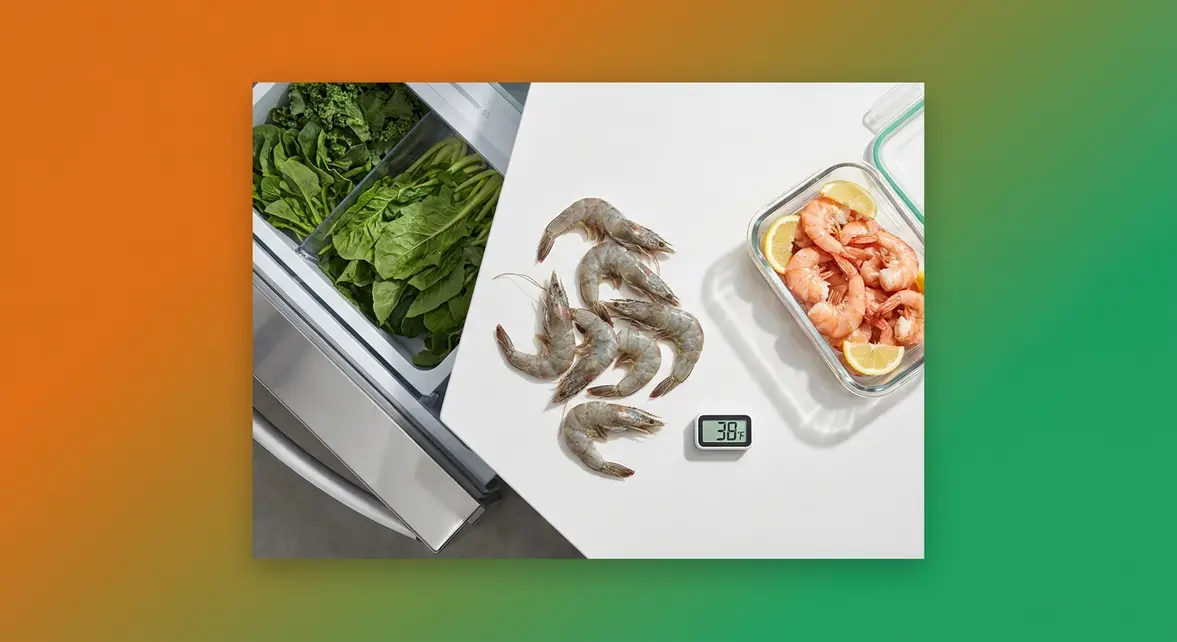
- A refrigerator set to 40°F (4°C) or below — this is the FDA’s defined safe zone for perishable foods. Above 40°F, bacteria multiply rapidly. The FDA refrigerator and freezer storage chart specifies safe temperature and time limits for all perishable foods, including shrimp (2024).
- An airtight container or zip-lock bag — open or loosely covered packaging dramatically shortens shelf life.
- About 5 minutes — that’s all this guide takes.
Estimated Time: 5 minutes to read; immediate application.
You’ll also learn The Shrimp Clock Reset Rule in Step 1 — a simple framework that explains exactly why cooked shrimp and thawed shrimp have completely different storage windows, even though both start as the same protein.
Checkpoint ✓ Before moving to Step 1, confirm your fridge is set to 40°F or below. If you’re not sure, a refrigerator thermometer costs about $10 and is the single best food safety investment in your kitchen.
Step 1: Identify Your Shrimp Type Before Checking Timelines
The shelf life of shrimp depends entirely on whether it’s raw, cooked, or thawed — and that distinction changes everything. Applying the wrong timeline to your shrimp type is the most common food safety mistake home cooks make. Before any number in this guide applies to you, identify which category your shrimp falls into.
Shrimp Storage Master Timeline
| Shrimp Type | Refrigerator (40°F or below) | Freezer (0°F or below) |
|---|---|---|
| Raw (fresh or never frozen) | 1-2 days | 3-6 months |
| Cooked | 3-4 days | 2-3 months |
| Thawed (previously frozen, raw) | 1-2 days | Do not refreeze |
| Thawed (previously frozen, cooked) | 1-2 days | Do not refreeze |
Source: FDA Refrigerator & Freezer Storage Chart (2024)
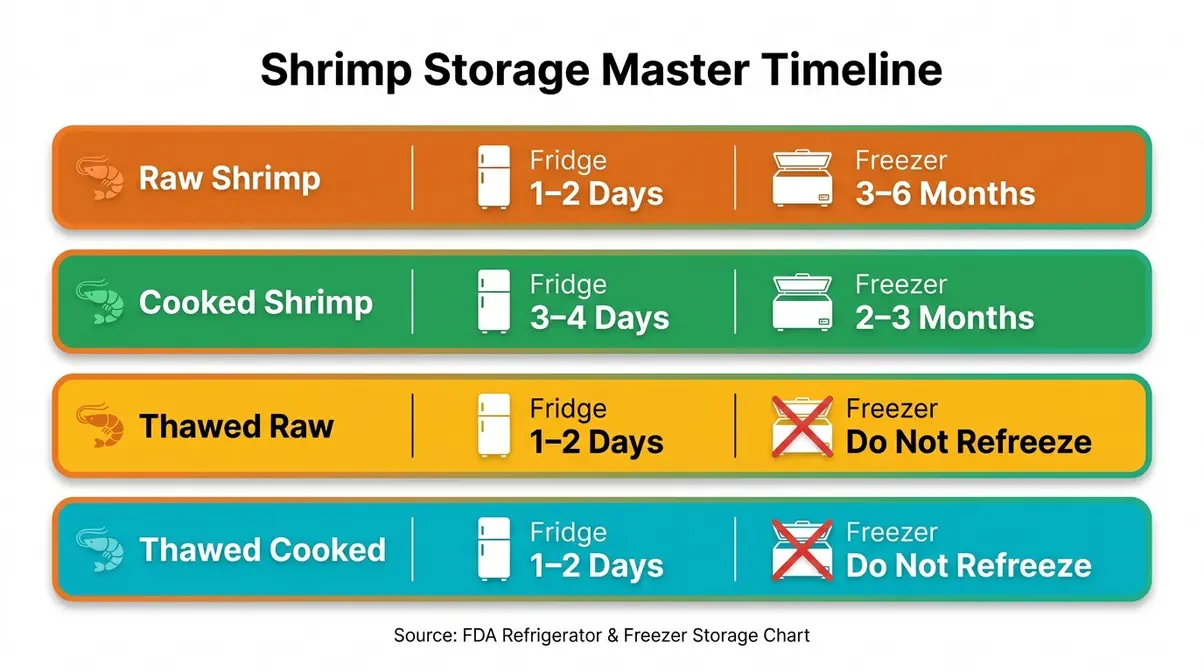
Raw shrimp is safe in the refrigerator for 1-2 days; cooked shrimp for 3-4 days — per the FDA refrigerator and freezer storage chart (2024). Thawed shrimp, whether raw or cooked before freezing, follows the same 1-2 day window as fresh raw.
Here’s the concept that ties all of this together:
The Shrimp Clock Reset Rule: Cooking shrimp resets the spoilage clock to Day 0, giving you a fresh 3-4 day window. Thawing does NOT reset the clock — thawed shrimp is still on its original raw timeline of 1-2 days.
Think about what this means in practice. If you thaw frozen raw shrimp and cook it tonight, you now have a fresh 3-4 day cooked window. However, if you thaw that same shrimp and put it back in the fridge without cooking, you only have 1-2 days — and the clock was already running before it was frozen.
For a deeper dive into the shelf life of cooked shrimp, see our complete freshness guide.
- Have cooked shrimp? → Jump to Step 2.
- Have raw shrimp? → Jump to Step 3.
- Have thawed shrimp? → Jump to Step 4.
Checkpoint ✓ You should now know your shrimp type and its maximum safe storage window. If your shrimp has already been in the fridge longer than the table shows, skip ahead to Step 5 to check for spoilage before making any decision.
Now that you know the timelines at a glance, let’s start with the most forgiving type — cooked shrimp — and explain exactly why the 3-4 day window works the way it does.
Step 2: Check How Long Cooked Shrimp Lasts in the Fridge
Cooked shrimp is safe for 3 to 4 days in the fridge, per FDA guidelines. The clock starts the moment cooking ends — not when you bought the shrimp. This is where The Shrimp Clock Reset Rule works in your favor: if you cooked previously thawed raw shrimp tonight, you now have a fresh 3-4 day window starting today.
The Clock Reset Rule for Cooked Shrimp
When raw shrimp — including shrimp that was previously frozen and thawed — is cooked to an internal temperature of 165°F, the heat kills the bacteria that cause illness and the storage clock resets to Day 0. You get a brand-new 3-4 day window from that moment.
Contrast this with thawing, which does NOT reset the clock (covered in Step 4). This is the most important food safety distinction in the entire guide.
Here’s how it plays out in real life:
- Shrimp Alfredo made on Monday = safe through Thursday (Day 4).
- Raw shrimp bought Monday, thawed Tuesday, cooked Wednesday = safe through Saturday (Day 4 from cooking).
- Raw shrimp bought Monday, thawed Tuesday, NOT cooked = must be cooked or discarded by Wednesday (Day 2 from purchase).
Cooked shrimp is safe in the refrigerator for 3-4 days when stored in an airtight container at 40°F or below — according to FDA safe food handling recommendations (2024). The FDA also mandates refrigerating all perishable foods within 2 hours of cooking, or 1 hour when the outside temperature exceeds 90°F.
How to Store Cooked Shrimp Correctly
Follow these steps to reach the full 3-4 day window safely:
- Cool for no more than 30 minutes before refrigerating. Never leave cooked shrimp at room temperature for more than 2 hours total (1 hour if it’s above 90°F outside). The “Danger Zone” — between 40°F and 140°F — is where bacteria multiply rapidly.
- Transfer to an airtight container or zip-lock bag. Squeeze out excess air before sealing. This slows oxidation and moisture loss.
- Label with today’s date. You’ll thank yourself on Day 3 when you can’t remember when you cooked it.
- Store in the coldest part of the fridge — usually the back of the bottom shelf, never the door.
If cooked shrimp sat out for more than 2 hours before you refrigerated it, discard it — even if it looks and smells perfectly fine. Bacteria can multiply to dangerous levels without producing any detectable odor or color change.
Checkpoint ✓ Cooked shrimp = 3-4 days, starting from when cooking ended. If yours has been in the fridge for more than 4 days, move to Step 5 for a spoilage check.
Raw shrimp has a much shorter window — and the reasons why are worth understanding before you open that package.
Step 3: Follow the 1-2 Day Rule for Raw Shrimp
Raw shrimp lasts only 1 to 2 days in the refrigerator, per FDA guidelines. It is one of the most perishable proteins in your kitchen. The reason: raw shrimp can carry Vibrio — a type of bacteria naturally found in some raw shellfish that can cause severe food poisoning — and Vibrio multiplies quickly even at refrigerator temperatures.
Safety vs. Quality: The 24-Hour vs. 48-Hour Rule
Understanding the difference between peak quality and the safety limit helps you make smarter decisions at every stage:
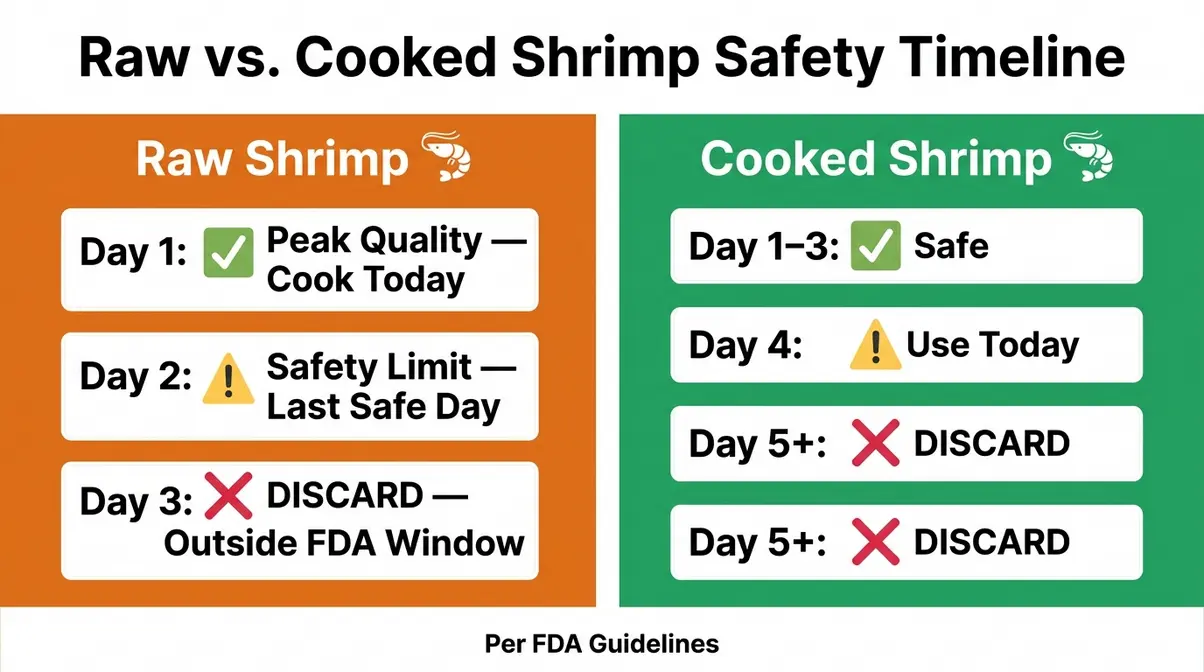
- Day 1 (within 24 hours of purchase): Peak quality. The shrimp has a firm texture, fresh ocean scent, and the best flavor. Cook it today if you can — this is when raw shrimp is at its best.
- Day 2 (24-48 hours): Still within the FDA’s safety window, but quality may begin to decline slightly. This is your last safe day. Cook it today, without exception.
- Day 3 and beyond: Outside the FDA safety window. Do not cook it. Discard it — even if it smells fine. Vibrio and Salmonella cannot always be detected by smell alone.
This last point is critical and one that every competitor misses. Cooking does NOT neutralize all toxins produced by bacteria that have already multiplied to dangerous levels. Once raw shrimp crosses the 48-hour mark, the question isn’t “does it smell bad?” — it’s “has bacterial activity already produced toxins that heat can’t destroy?”
The answer on Day 3 is: possibly yes. Don’t take that risk.
How long can raw shrimp stay in the fridge? Safely, no more than 2 days — full stop. FDA guidelines for storing fresh seafood advise storing fresh seafood at 40°F or below and using it within 2 days of purchase (2024).
Who Should Be Extra Cautious: High-Risk Groups
If you or someone you’re cooking for falls into one of these groups, apply stricter standards:
- Pregnant individuals, elderly adults, young children, and immunocompromised people face a significantly higher risk of severe illness from Vibrio. The CDC recommends these groups avoid raw or undercooked shellfish entirely.
- For these groups, even Day 2 raw shrimp carries elevated risk. Cook raw shrimp within 24 hours of purchase, or freeze it immediately.
According to the CDC, an estimated 80,000 vibriosis illnesses occur each year in the United States, with approximately 52,000 linked to eating contaminated food — primarily raw or undercooked seafood (CDC, 2024). The CDC’s guidance on vibriosis makes clear that raw shellfish is the primary exposure route.
Checkpoint ✓ Raw shrimp = 1-2 days maximum. Day 1 for peak quality, Day 2 as the absolute safety limit. If your raw shrimp has been in the fridge for 3 or more days, do not cook it. Discard it.
What about shrimp you pulled from the freezer? Thawed shrimp has its own set of rules — and they might surprise you.
Step 4: Apply the Clock Reset Rule for Thawed Shrimp
Once thawed, shrimp is safe for 1 to 2 days in the fridge — the same window as fresh raw shrimp. Thawing does NOT reset the clock. Think of freezing as pressing “pause” on the storage timer — thawing hits “play” again from exactly where it left off, not from the beginning.
Thawed shrimp is safe for 1-2 days in the refrigerator — the same window as fresh raw shrimp — because thawing resumes the original storage clock rather than resetting it (FoodSafety.gov safe selection guidelines, 2024).
For the full breakdown of thawed shrimp safety, see our shrimp freshness guide.
How Long to Defrost Shrimp in the Fridge (and Why Method Matters)
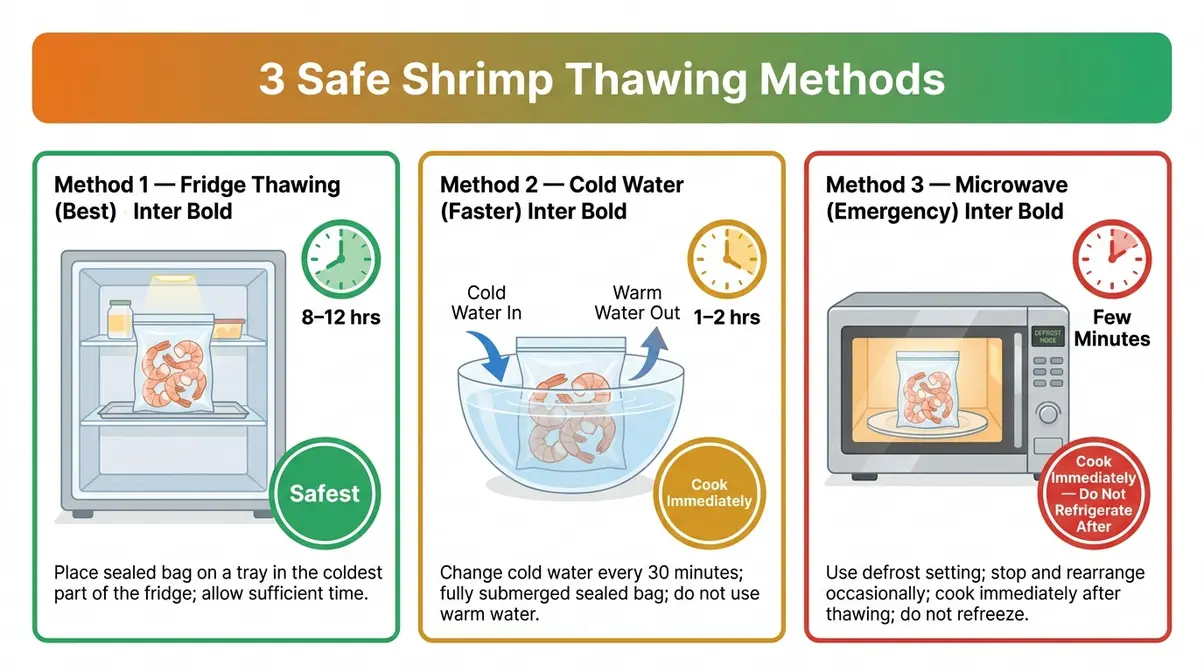
The method you use to thaw shrimp affects both safety and your options afterward. Here are the three safe methods:
Method 1 — Fridge Thawing (Best)
Place frozen shrimp in a sealed bag on the bottom shelf of the fridge. Takes 8-12 hours (overnight). This is the safest method because the shrimp never enters the Danger Zone (40°F-140°F). After thawing, you have 1-2 days to cook it.
Method 2 — Cold Water Thawing (Faster)
Place shrimp in a sealed bag and submerge in cold water. Change the water every 30 minutes. Takes 1-2 hours. Cook immediately after — do not return to the fridge. Once thawed this way, the shrimp must be cooked right away.
Method 3 — Microwave (Emergency Only)
Use the defrost setting and cook immediately. Microwave thawing creates hot spots that can partially begin cooking the shrimp — never store microwave-thawed shrimp in the fridge afterward.
Critical rule: Never refreeze raw shrimp that has been thawed. Texture degrades significantly, and the safety risk increases on the second thaw cycle.
Checkpoint ✓ Thawed shrimp = 1-2 days, same as fresh raw. If you thawed shrimp 3 or more days ago, discard it. If you’re thawing shrimp right now, decide whether you’ll cook it today or tomorrow — those are your only two safe options.
Before you cook or toss that shrimp, there’s one more check worth doing — a quick sensory test that takes less than 60 seconds.
Step 5: Spot Spoilage Using the Sensory Checklist
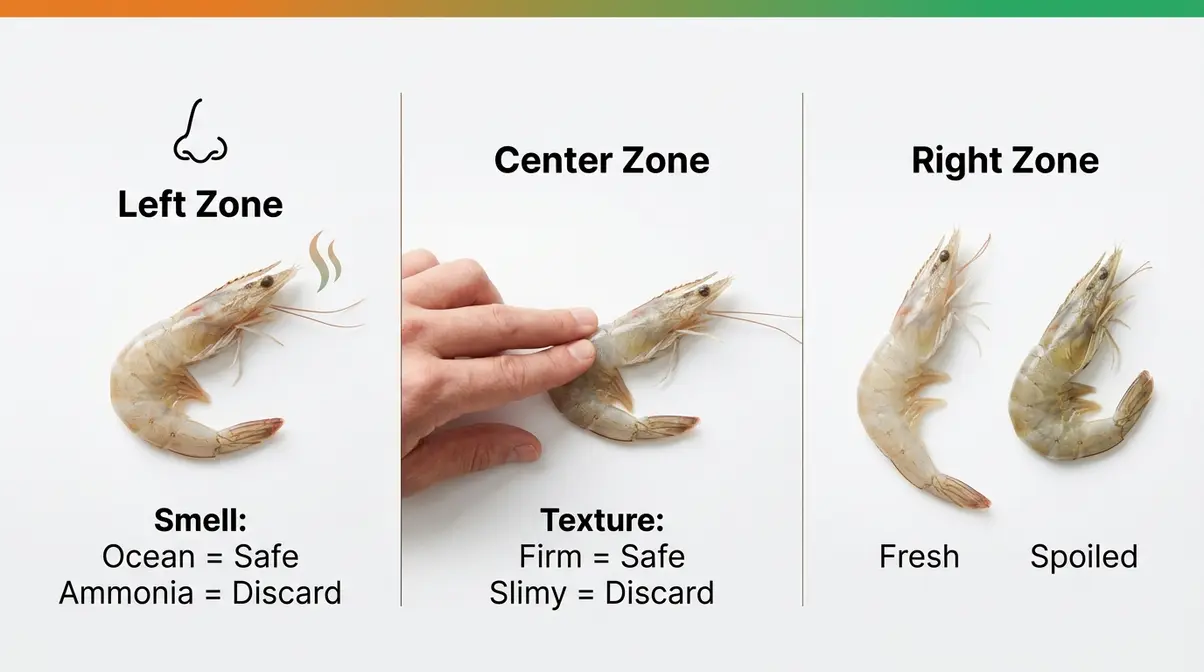
This step is the most important one for anyone who’s unsure. A three-part sensory check — smell, texture, and color — gives you a definitive answer on whether your shrimp is still safe. It directly addresses the most common anxiety: “my shrimp smells a little fishy — is that normal?”
According to the FDA, fresh shrimp flesh should have a clear, pearl-like color and little or no odor. Spoiled seafood can smell sour, rancid, fishy, or of ammonia — and these odors become stronger after cooking (FDA guidelines for selecting and serving fresh and frozen seafood safely, 2024).
Check the Smell First
Smell is your most reliable spoilage signal. Here’s the full spectrum:
- Normal / Safe: A mild, clean, briny scent — like the ocean. Fresh shrimp may have almost no odor at all.
- Early warning: A slightly stronger “fishy” smell that wasn’t there yesterday. Not necessarily unsafe yet, but cook it immediately and do not delay.
- Spoiled: A sour or vinegar-like smell — sharp and unpleasant. Discard immediately.
- Definitely spoiled: An ammonia-like smell — chemical, sharp, almost like bleach or cleaning fluid. This odor is caused by bacteria breaking down proteins and amino acids during decomposition. Even a faint ammonia smell means the shrimp is past the point of safety. Discard it.
A useful way to remember the spectrum: ocean scent = safe; sour = warning; ammonia = gone. There is no middle ground with ammonia — if you smell it, the shrimp is too far gone.
Check the Texture
Pick up a piece of shrimp and feel it before cooking:
- Fresh: Firm, slightly springy, not sticky. Raw shrimp may feel slightly slippery from natural moisture, but it should spring back when pressed.
- Spoiled: A slimy or sticky surface is the clearest texture signal of bacterial growth. Mushy shrimp that falls apart rather than holding its shape is also a discard.
Sliminess and ammonia smell together mean the shrimp has been spoiled for some time. Do not taste-test to confirm — discard immediately.
Check the Color
- Fresh raw shrimp: Clear to translucent flesh with a pearl-like tone. Shells may be gray-green, pink, or white depending on the species — all normal.
- Fresh cooked shrimp: Opaque pink-white color throughout.
- Spoiled: Yellowing flesh, gray or dull discoloration, or dark spots that look like decomposition (not natural shell markings) are all signs to discard. A dull, faded appearance combined with any off-smell confirms spoilage.
Is it safe to eat slightly bad shrimp? No. Food safety guidelines are unambiguous here: when in doubt, throw it out. Vibrio and Salmonella cannot always be detected by smell or appearance alone — a shrimp can look borderline and still carry dangerous bacterial toxin levels.
Checkpoint ✓ If your shrimp passes all three checks — mild or no smell, firm texture, normal color — it is safe to cook and eat. If it fails any single check, discard it.
Step 6: Store Shrimp Correctly to Maximize Shelf Life
Proper storage is what gets you to the full 1-2 or 3-4 day window. Poor storage can cut those timelines in half.
Fridge Setup for Shrimp
- Temperature check first. Your fridge must stay at 40°F (4°C) or below. A fridge running at 45°F can cut your shrimp’s safe window by half.
- Use the coldest zone. Store shrimp in the back of the bottom shelf — not in the door, which experiences the most temperature fluctuation every time it opens.
- Keep it sealed. Raw shrimp should go in an airtight container or a zip-lock bag with excess air squeezed out. Loose plastic wrap is not sufficient — it allows odor transfer and moisture loss.
- Separate raw from cooked. Always store raw shrimp below cooked foods to prevent drip contamination.
- Use a bed of ice for extra freshness. Place the sealed container of raw shrimp in a bowl of ice inside the fridge. This keeps it as close to 32°F as possible without freezing, extending quality closer to the full 2-day window.
The 2-Hour Rule (FDA Safe Food Handling)
The FDA’s 2-hour rule applies to both raw and cooked shrimp: never leave shrimp at room temperature for more than 2 hours total — or 1 hour when ambient temperature exceeds 90°F. This applies to:
- Shrimp left out while prepping other ingredients
- Cooked shrimp on a serving platter at a party
- Groceries sitting in a warm car before being refrigerated
If shrimp has been in the Danger Zone (40°F-140°F) for more than 2 hours, discard it — even if it looks and smells fine. Bacteria can double every 20 minutes in this temperature range.
Checkpoint ✓ Correct storage = airtight container, coldest fridge zone, 40°F or below, within 2 hours of cooking or purchasing. These four conditions are what make the FDA timelines achievable.
Step 7: Freeze Shrimp to Extend Shelf Life
Freezing is the right move when you know you won’t use your shrimp within the safe refrigerator window. The FDA’s storage chart confirms that frozen raw shrimp maintains quality for 3-6 months, while frozen cooked shrimp is best used within 2-3 months.
Freezing Raw Shrimp
- Rinse and pat dry — remove excess moisture before freezing to prevent ice crystal formation that damages texture.
- Peel and devein (optional but recommended) — frozen shrimp is easier to use if it’s already cleaned. Shells can be saved separately for stock.
- Arrange in a single layer on a baking sheet and freeze for 1-2 hours until solid. This prevents shrimp from clumping together.
- Transfer to a zip-lock freezer bag — squeeze out all air before sealing. Label with the date.
- Store at 0°F or below. Quality holds for up to 3-6 months. Texture and flavor begin to decline after that, though the shrimp remains safe if properly frozen.
Freezing Cooked Shrimp
Cooked shrimp freezes well and thaws quickly — ideal for meal prep. Follow the same process as raw shrimp: cool completely, store in an airtight freezer bag with air removed, and label with the date. Use within 2-3 months for best quality.
One critical rule: Never refreeze raw shrimp that has already been thawed. The second freeze-thaw cycle damages cell structure and creates additional bacterial risk. If you thawed more raw shrimp than you need, cook the remainder and then freeze the cooked portion.
Checkpoint ✓ Freezing extends raw shrimp to 3-6 months and cooked shrimp to 2-3 months. Always label with the freeze date, and never refreeze previously thawed raw shrimp.
Step 8: Storage Rules for Leftover Shrimp Dishes
Shrimp prepared as part of a dish follows slightly different storage logic — the other ingredients matter too.
Cocktail Shrimp
Pre-cooked cocktail shrimp follows the standard cooked shrimp rule: 3-4 days in the fridge in an airtight container. Keep it separate from the cocktail sauce, which can introduce additional acidity and moisture that accelerates spoilage. If cocktail shrimp was served at a party and sat out for more than 2 hours, discard it regardless of how it looks.
Shrimp Pasta and Shrimp Scampi
Shrimp pasta dishes — including shrimp scampi and shrimp Alfredo — are safe for 3 days in the fridge when stored in an airtight container. Mixed dishes should be consumed closer to the 3-day mark rather than 4, because pasta absorbs moisture and cream-based or butter-based sauces can shorten the safe window slightly. Reheat thoroughly to 165°F before eating.
Shrimp Ceviche and Fried Shrimp
Shrimp ceviche is a special case. The acid from lime or lemon juice “cooks” the shrimp’s texture, but acid alone does not kill Vibrio or Salmonella the way heat does. Ceviche made with raw shrimp should be consumed within 24 hours and kept tightly covered in the fridge. Ceviche made with pre-cooked shrimp follows the standard 3-4 day cooked rule.
Fried shrimp — whether tempura, breaded, or battered — is safe for 3-4 days in the fridge. The breading will soften and lose crunch, but the shrimp itself follows standard cooked storage guidelines. Reheat in an oven or air fryer to 165°F for best texture and safety.
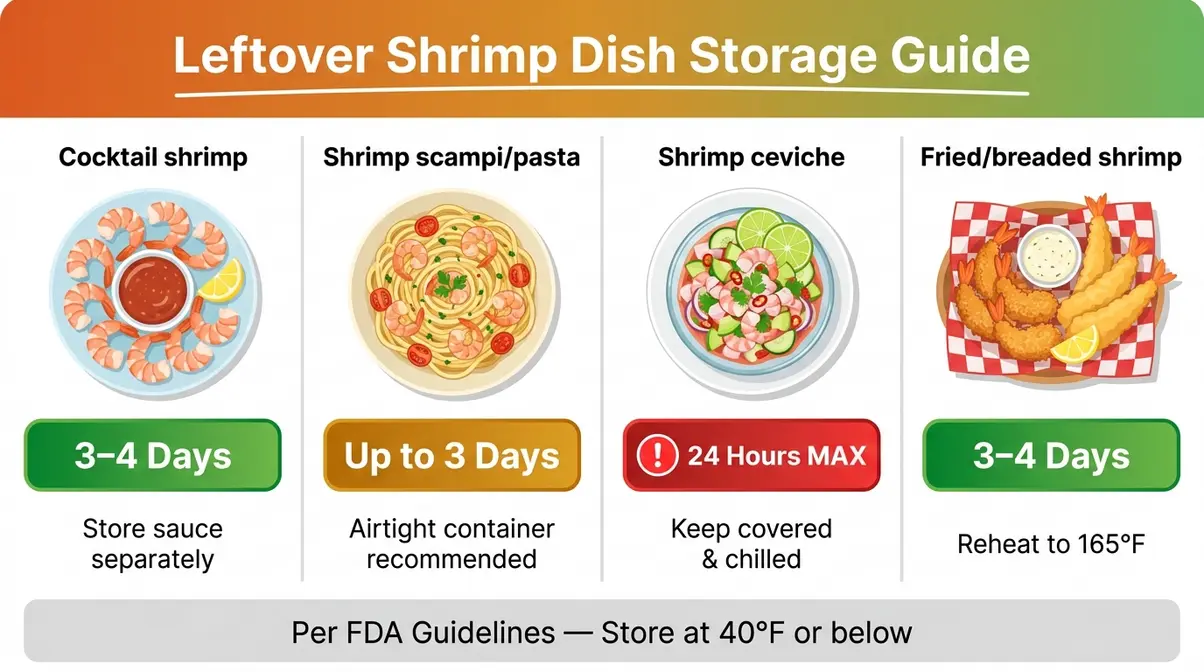
Checkpoint ✓ Leftover shrimp dishes: cocktail shrimp and fried shrimp = 3-4 days; shrimp pasta/scampi = up to 3 days; raw shrimp ceviche = 24 hours maximum. When in doubt, apply the sensory checklist from Step 5 before eating any leftover shrimp dish.
Verify Your Results: The Final Safety Confirmation
Before you cook or serve shrimp, run through this quick final checklist. It takes under 60 seconds.
Shrimp Safety Final Check:
| Question | Safe Answer | Discard If… |
|---|---|---|
| What type is it? | Raw, cooked, or thawed identified | You genuinely can’t tell |
| How many days has it been in the fridge? | Raw/thawed: 1-2 days · Cooked: 3-4 days | Past the limit for its type |
| Does it smell normal? | Mild ocean scent or no odor | Sour, fishy, or ammonia smell |
| What’s the texture? | Firm, slightly springy | Slimy, sticky, or mushy |
| What does it look like? | Translucent/pearl (raw) or opaque pink (cooked) | Yellow, gray, dark spots, dull |
| Did it sit out more than 2 hours? | No | Yes — discard regardless of smell |
If your shrimp passes every row, it’s safe to cook and eat. If it fails even one row, discard it. Foodborne illness from Vibrio or Salmonella is not worth the risk — and it is never worth it to taste-test shrimp you’re unsure about.
- The Shrimp Clock Reset Rule — Final Summary:
- Cooking resets the clock → 3-4 day fresh window from today.
- Thawing does not reset the clock → 1-2 days from original purchase.
- When in doubt, throw it out.
Troubleshooting: Common Shrimp Storage Mistakes
⚠️ Food Safety Reminder: If you suspect your shrimp has spoiled, do not taste it to check. Discard it. Foodborne illness from contaminated shrimp can cause severe symptoms within 4-96 hours of consumption.
Common Pitfalls
Pitfall 1: Counting Days from When You Froze It, Not When You Bought It
Many people assume freezing resets the freshness clock. It doesn’t. If you bought shrimp on Monday, left it in the fridge for 2 days, and then froze it on Wednesday, that shrimp was already at its quality limit before freezing. To avoid this, freeze shrimp on the day of purchase — or at least within Day 1 — not as a last resort on Day 2.
Pitfall 2: Storing Shrimp in the Fridge Door
The door is the warmest part of any refrigerator because it’s exposed to room temperature every time you open it. Shrimp stored in the door may never consistently reach 40°F. Always use the back of the bottom shelf.
Pitfall 3: Assuming “It Smells Fine” Means It’s Safe
Vibrio and Salmonella can reach dangerous levels before producing a detectable odor. This is especially true for shrimp that has been in the fridge for exactly 2 days. The smell test is a useful tool, but it is not a substitute for respecting the FDA’s time limits. If the timeline has passed, discard the shrimp — regardless of smell.
Pitfall 4: Leaving Cooked Shrimp on the Table After a Meal
It’s easy to forget the serving dish at the end of a meal. If cooked shrimp sat at room temperature for more than 2 hours (or 1 hour above 90°F), it is in the Danger Zone and must be discarded. Set a phone timer when you serve shrimp at gatherings.
Pitfall 5: Refreezing Thawed Raw Shrimp
If you thaw raw shrimp and then decide not to cook it, you cannot safely refreeze it as raw. Your options are to cook it now and then freeze the cooked portion, or discard it. Refreezing raw thawed shrimp increases both texture damage and bacterial risk.
When to Choose Alternatives
When your shrimp is past the safe window: Rather than attempting to salvage borderline shrimp, substitute with frozen shrimp thawed safely via the cold-water method (Steps 4 and 7). It takes 1-2 hours and is always safer than eating shrimp you’re uncertain about.
When you cook for high-risk individuals: If you regularly cook for pregnant, elderly, or immunocompromised people, consider switching to pre-cooked frozen shrimp for dishes like shrimp cocktail and salads. This eliminates Vibrio risk from raw shellfish entirely.
When to Seek Medical Help
If you or someone in your household ate shrimp and develops symptoms — nausea, vomiting, diarrhea, stomach cramps, or fever — within 4 to 96 hours, contact a healthcare provider. Vibrio illness can escalate quickly in high-risk individuals. For severe symptoms (bloody diarrhea, high fever, signs of dehydration), seek emergency care immediately.
Advanced Tips: General Seafood Storage Principles
The same core principles that apply to shrimp extend to most other shellfish and finfish. According to the FDA’s storage chart, lean fish (cod, tilapia, sole) and fatty fish (salmon, mackerel) both follow the same 1-2 day raw refrigerator window as shrimp — and cooked fish follows the same 3-4 day cooked window.
A few additional principles worth knowing:
- Oysters, clams, and mussels (live shellfish) follow different rules — they’re stored live and have their own freshness tests. Do not apply shrimp timelines to live shellfish.
- Smoked fish is an exception: it can last up to 14 days refrigerated due to the preservation effect of the smoking process (FDA, 2024).
- The 2-hour room-temperature rule applies universally to all seafood, regardless of type. This is the single most important food safety habit for any seafood cook.
- Canned seafood is shelf-stable for up to a year unopened; once opened, treat it like cooked seafood (3-4 days refrigerated).
The underlying principle across all seafood: cold temperatures slow bacterial growth but do not stop it. Time limits exist because even at 40°F, bacteria continue to multiply — just more slowly. Respecting those limits is the only reliable way to stay safe.
Frequently Asked Questions
Is shrimp still good after 5 days in the fridge?
No — shrimp is not safe to eat after 5 days in the refrigerator, regardless of whether it’s raw or cooked. Raw shrimp must be cooked or frozen within 1-2 days of purchase, per FDA guidelines. Cooked shrimp is safe for 3-4 days maximum. At 5 days, even cooked shrimp is past its safe window. Discard it without tasting — bacteria can be present at dangerous levels without producing obvious odor or color changes. When in doubt, throw it out.
How do you know if shrimp has gone bad?
Spoiled shrimp shows three clear signs: an ammonia-like or sour smell, a slimy texture, and gray or yellow discoloration. Fresh shrimp smells mildly of the ocean or has almost no odor. Any sharp, chemical, or vinegar-like smell is a discard signal. According to the FDA, uncooked spoiled seafood can have sour, rancid, fishy, or ammonia odors — and these smells become even stronger after cooking (FDA, 2024). If shrimp fails any one of these three checks, discard it.
How long is shrimp good for after thawed?
Thawed shrimp is safe for 1-2 days in the refrigerator — the same window as fresh raw shrimp. Thawing does not reset the storage clock; it simply resumes the original timeline from before the shrimp was frozen. This is The Shrimp Clock Reset Rule in action: only cooking resets the clock. If you thawed shrimp more than 2 days ago without cooking it, discard it. For best results, thaw shrimp in the fridge overnight and cook it the following day.
How long will cocktail shrimp last in the fridge?
Pre-cooked cocktail shrimp lasts 3-4 days in the refrigerator when stored in an airtight container at 40°F or below. Store it separately from the cocktail sauce to prevent moisture transfer. If cocktail shrimp was served at a party or gathering and sat out for more than 2 hours at room temperature, discard it regardless of appearance — the FDA’s 2-hour rule applies to pre-cooked shrimp as it does to all perishable foods (FDA, 2024).
Can I cook raw shrimp I had in the fridge for 3 days?
No — do not cook raw shrimp that has been in the fridge for 3 days. The FDA’s safe storage window for raw shrimp is 1-2 days. By Day 3, the shrimp is outside the safe limit. Importantly, cooking does not neutralize all toxins that bacteria may have already produced during the extra day of storage. The shrimp may smell fine and still be unsafe. Discard it and start with fresh or properly frozen shrimp.
Can raw shrimp last 3 days in the fridge?
Raw shrimp cannot safely last 3 days in the refrigerator. The FDA specifies a maximum of 1-2 days for fresh shellfish stored at 40°F or below. Day 1 is the quality peak; Day 2 is the absolute safety limit. On Day 3, raw shrimp has exceeded the safe window and should be discarded. Some sources cite slightly longer windows, but the FDA’s more conservative 1-2 day guideline for fresh shellfish is the standard food safety recommendation — and the safer choice to follow.
Is it safe to eat slightly bad shrimp?
No — it is not safe to eat shrimp that shows any signs of spoilage, no matter how mild. The phrase “slightly bad” describes shrimp that is already on or past the boundary of safety. Vibrio and Salmonella bacteria can be present at illness-causing levels even when shrimp smells only faintly off. The CDC estimates approximately 80,000 vibriosis illnesses occur in the United States annually (CDC, 2024). Foodborne illness is not dose-dependent in a predictable way — even a small amount of contaminated shrimp can cause severe symptoms.
How do I know if shrimp is gone bad?
Shrimp has gone bad if it smells of ammonia or sourness, feels slimy or sticky, or looks faded, gray, or discolored. Fresh raw shrimp has a clear, pearl-like appearance and a mild ocean scent or no smell at all, per FDA guidance. Run the three-part sensory check from Step 5: smell first (ammonia = discard immediately), then texture (slimy = discard), then color (yellowing or dark spots = discard). If your shrimp has been in the fridge longer than its safe window, discard it without running the sensory check — the timeline alone is sufficient reason.
Conclusion
For home cooks and anyone standing at the fridge with a bag of shrimp and a question, the answer is straightforward: raw shrimp lasts 1-2 days in the fridge; cooked shrimp lasts 3-4 days, per the FDA’s official Refrigerator & Freezer Storage Chart. The CDC estimates 80,000 vibriosis illnesses occur in the U.S. annually — the vast majority linked to raw or undercooked seafood. The best protection is understanding and respecting these timelines before you cook, not after.
The Shrimp Clock Reset Rule is the framework that makes all of this click: cooking resets the spoilage clock and gives you a fresh 3-4 day window; thawing does not reset it and leaves you with the original 1-2 day raw timeline. Apply this rule to every shrimp decision you make — it removes the guesswork entirely.
Your next step is simple. Check your shrimp right now using the three-part sensory checklist from Step 5 — it takes 60 seconds. If it’s within the safe window and passes the smell, texture, and color checks, cook it tonight. If it’s past the limit or fails any check, discard it and start fresh. No guessing, no risk, no regrets.

quickdishcook
Recipe developer and writer at Quick Dish Cookbook.